
AI tutor app development is not just adding a chatbot to an education app. A production-ready AI tutor needs approved learning content, learner context, retrieval controls, pedagogical guardrails, human review paths, LMS integration, assessment evidence, and a staged MVP plan. If those parts are missing, the product may feel impressive in a demo but fail when students ask ambiguous questions, teachers need auditability, or institutions ask how learner data is protected.
The safest roadmap is to build the tutor around one narrow learning workflow first: a course-aware question helper, practice generator, feedback assistant, study-plan coach, or assessment support tool. Then expand only after answer quality, student safety, data handling, and teacher oversight are measurable. That keeps the first release useful without pretending the AI can replace curriculum design, instruction, compliance, or academic judgment.
If you are early in scoping, use NextPage's AI Agent Readiness Assessment to pressure-test workflow clarity, data readiness, integration access, and human-review controls. Then use the MVP Scope Builder to separate a safe first release from later AI tutor features.
Quick Answer: What An AI Tutor App Roadmap Includes
An AI tutor app roadmap should cover seven workstreams: learning data, tutor experience, AI architecture, guardrails, LMS and payment integrations, evidence and analytics, and phased delivery. The first release should answer a narrow learning job well, such as helping students practice from approved course material, instead of trying to become a universal tutor on day one.
| Roadmap Layer | What It Decides | MVP Question |
|---|---|---|
| Learning data | Curriculum sources, permissions, chunking, metadata, freshness, and learner context. | What approved content can the tutor use? |
| Tutor experience | Student prompts, hints, practice, feedback, teacher controls, and parent/admin views. | Which one learning workflow creates value first? |
| AI architecture | RAG, model choice, orchestration, memory, cost controls, and evaluation logs. | Where must the tutor cite or refuse? |
| Guardrails | Privacy, age-appropriate interaction, academic integrity, escalation, and human review. | What should the AI never do alone? |
| Integrations | LMS, SSO, SIS, payments, content libraries, assessment tools, and analytics. | Which systems are required for launch? |
What Makes AI Tutor Development Different
Generic education app development usually starts with courses, video, quizzes, dashboards, notifications, and payments. AI tutor development adds a second product: an AI workflow that must understand learning objectives, respect student privacy, explain its limits, recover from wrong answers, and produce evidence that educators can review.
That is why AI tutor scope should not be estimated only by screen count. The expensive parts are often invisible: course ingestion, retrieval quality, evaluation data, role permissions, prompt/version governance, safety testing, LMS grade or activity sync, analytics, and teacher review queues. NextPage's education app development cost guide covers the broader LMS and education app budget drivers; this roadmap focuses specifically on the AI tutor layer.
Current AI education guidance and market discussion are converging on the same point: personalization is useful only when privacy, transparency, age-appropriate controls, teacher oversight, and learning evidence are designed into the product. Treat those as core product requirements, not compliance polish at the end. For teams comparing model choices, retrieval workflows, and product guardrails, NextPage's AI development services explain how to move from prototype AI features to production workflows.
AI Tutor Product Architecture
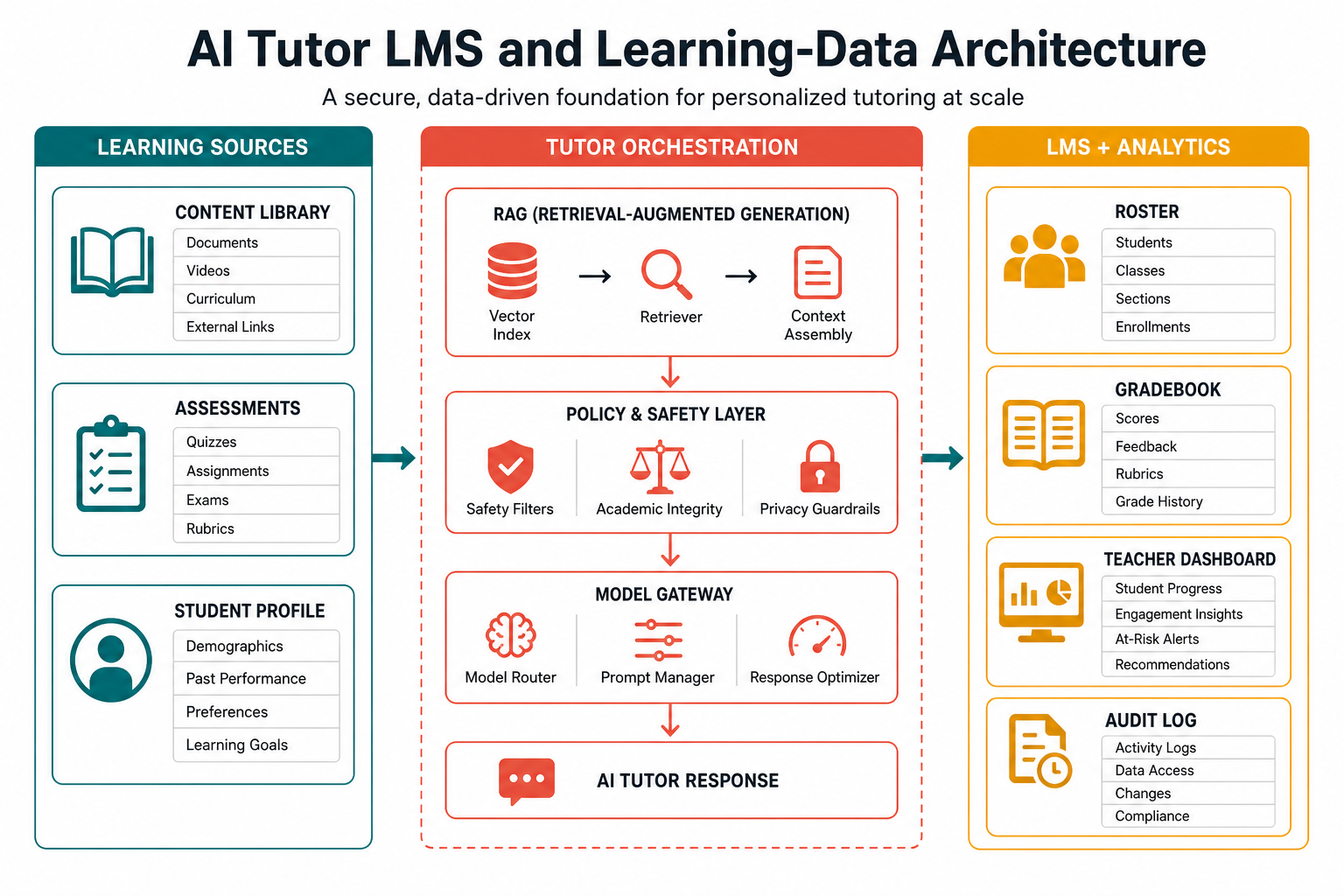
A practical AI tutor architecture starts with approved source material: course modules, lesson objectives, rubrics, textbook excerpts, practice banks, videos, transcripts, policies, and teacher-created examples. That material needs metadata for subject, grade level, lesson, difficulty, source owner, update date, and permission rules. Without that layer, the tutor cannot reliably answer from the right context.
The next layer is retrieval and learner context. For many products, this means a RAG system that retrieves course-specific content and combines it with permitted learner data such as progress, quiz attempts, skill gaps, language preference, accessibility needs, and enrollment context. If the product handles sensitive student records, retrieval must be scoped by role, course, tenant, and consent model. NextPage's enterprise RAG implementation services page explains how private knowledge workflows are designed around access boundaries and evaluation, which is directly relevant to AI tutor products.
The tutor engine then orchestrates prompts, tools, answer style, citations, hinting behavior, feedback rules, and escalation. A strong tutor should not simply provide final answers. In many subjects, it should ask diagnostic questions, give graduated hints, encourage student reasoning, and flag when a teacher or human tutor should intervene.
The architecture should also separate product roles from model permissions. A student session may retrieve only the assigned course and the learner context needed for the current activity. A teacher view may inspect answer history, correction reasons, and cohort-level signals. An admin view may manage source approvals, retention rules, integration settings, and audit exports. That separation keeps AI tutoring useful without giving one chat surface access to every record in the education platform.
Plan Learning Data Before Model Features
Learning data is the foundation of an AI tutor app. Before choosing a model, define what the tutor is allowed to know, what it is allowed to remember, and how content changes get reflected in answers. A high-quality AI tutor normally needs these data decisions:
- Source scope: courses, modules, rubrics, question banks, teacher notes, standards, and institutional policies.
- Content ownership: who can upload, approve, retire, or override learning material.
- Student context: what progress, performance, accommodations, and profile data may be used.
- Data minimization: what the tutor does not need to store, infer, or send to model providers.
- Freshness: how updated lessons, corrections, and policy changes invalidate stale retrieval chunks.
- Auditability: how prompts, retrieved sources, model responses, feedback, and review outcomes are logged.
For a first release, avoid ingesting every possible source. Pick one subject, course, exam path, or training module and design the data pipeline around that. The narrower the content boundary, the easier it is to evaluate answer quality and prove the tutor is helping rather than guessing.
That data plan should include ownership and deletion rules before the first pilot. Decide which source changes require re-indexing, which learner events can be used for personalization, which records must be excluded from model prompts, and how long logs can be retained for review. These decisions matter for privacy, but they also make the product easier to debug when a student, teacher, or institution challenges an answer.
If the product will recommend lessons, predict skill gaps, or personalize practice, a machine learning layer may be needed beyond the language model. NextPage's machine learning development services focus on data readiness, model APIs, monitoring, and production workflows, which are the same disciplines needed for adaptive education products.
Guardrails And Human Review Are Product Features
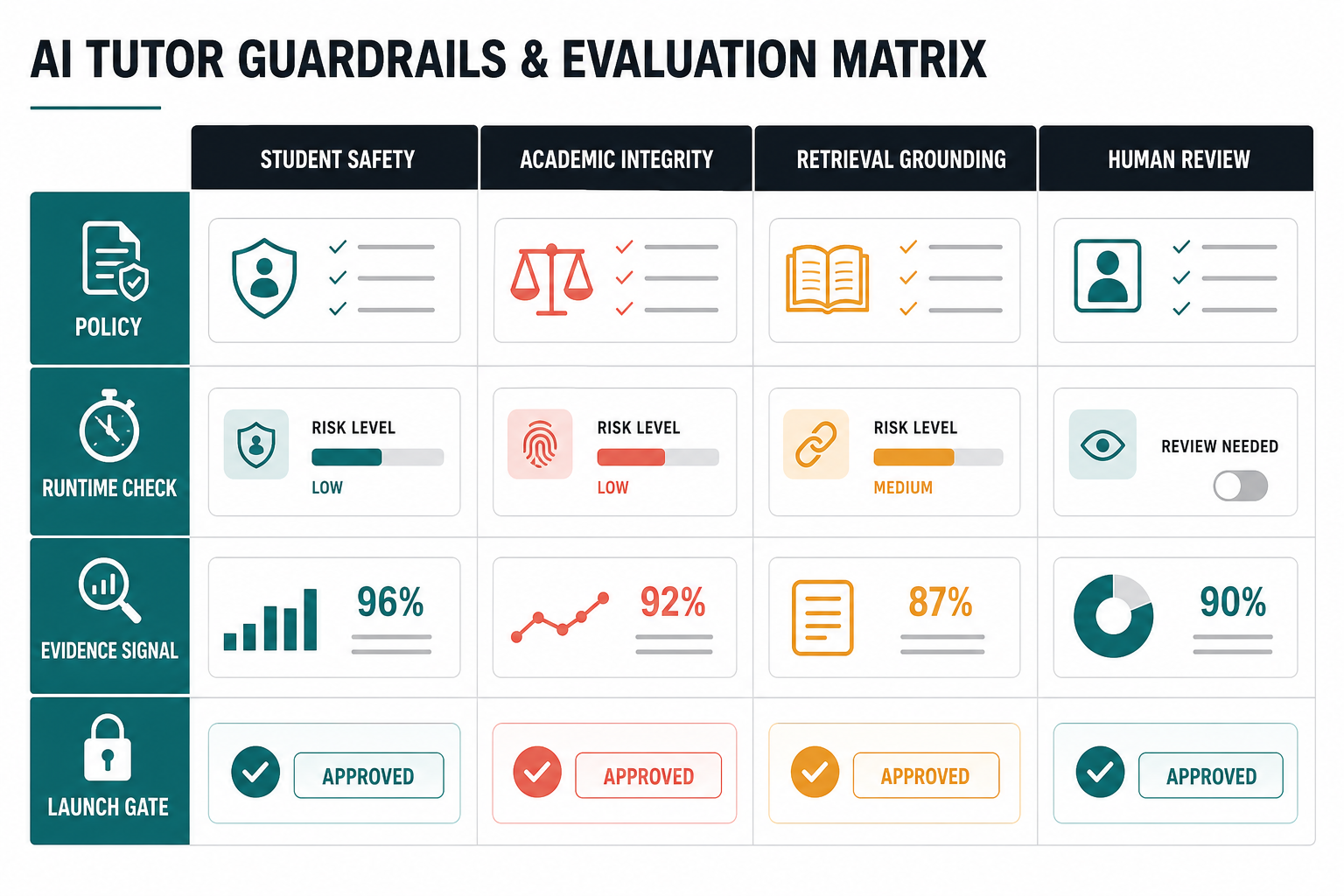
AI tutor guardrails should be designed around learner safety, academic integrity, privacy, and pedagogical quality. A generic refusal filter is not enough. The product needs rules for when to answer, when to guide, when to refuse, when to cite course material, and when to escalate.
| Risk Area | Guardrail | Evidence To Collect |
|---|---|---|
| Incorrect help | Use approved sources, citations, answer confidence, and fallback behavior. | Gold-set evaluations, teacher review samples, source-hit logs. |
| Over-helping or cheating | Prefer hints, worked examples, and Socratic prompts over direct answer dumps. | Prompt tests by assignment type and academic-integrity rules. |
| Unsafe or age-inappropriate interaction | Set age bands, topic filters, escalation paths, and crisis/referral handling. | Safety test cases, moderation logs, human review outcomes. |
| Student privacy | Minimize personal data, separate tenants, scope retrieval, and log access. | Data maps, retention policy, consent/contract records, access audits. |
| Teacher trust | Provide review queues, override controls, citations, and answer history. | Teacher feedback, correction loops, changed-response reports. |
For children, schools, or institutional customers, privacy and safety requirements should be clarified before demo data turns into production data. In the United States, FERPA and COPPA considerations may apply depending on product model, user age, school contracts, parental consent, and the data collected. For global products, local child-safety, data residency, and AI transparency requirements can also change the launch plan. This is not legal advice; it is an engineering scoping warning: the app architecture must be able to enforce whatever rules the business is required to follow.
LMS, Payment, And Analytics Integrations
AI tutor apps usually integrate with at least one learning environment. For institutional products, LTI 1.3 is a common standard for launching external tools inside an LMS with a stronger security model than older LTI flows. In practice, "LTI compliant" does not make the integration automatic. Canvas, Blackboard, Moodle, school portals, SIS tools, grade passback, roster sync, and analytics exports each add platform-specific testing and admin workflows.
For direct-to-consumer or coaching products, the integration map may look different: subscriptions, payments, video sessions, calendar scheduling, parent dashboards, WhatsApp/email nudges, content CMS, and CRM handoff. The tutor still needs role-aware data boundaries because students, parents, tutors, teachers, admins, and content authors should not see the same information.
Mobile and web surface decisions should follow usage context. A mobile-first tutor may need push reminders, offline practice, speech input, and camera-based homework capture. A web-first tutor may need LMS embedding, teacher dashboards, content operations, and admin reporting. NextPage can plan both through mobile app development and web app development, but the right first surface depends on the learning workflow. For generative tutoring workflows that need grounded answers, prompt governance, and evaluation, NextPage's generative AI development work is the closest commercial fit.
MVP Scope For An AI Tutor App
The best AI tutor MVP is narrow, measurable, and reviewable. Avoid launching with open-ended "ask me anything" tutoring across all subjects. A safer first release is one of these:
| MVP Type | Best For | Keep Out Of V1 |
|---|---|---|
| Course-aware Q&A helper | Students asking questions from approved course material. | Ungrounded web answers, cross-course memory, autonomous grading. |
| Practice and hint generator | Skill-building from rubrics, examples, and question banks. | High-stakes scoring and final-answer shortcuts. |
| Teacher feedback assistant | Drafting rubric-aligned feedback for educator review. | Fully automated grading without review evidence. |
| Study-plan coach | Personalized revision paths based on progress and weak areas. | Psychological claims, unsupported learning-style assumptions. |
| Training support bot | Corporate learning, onboarding, and policy training. | HR decisions, compliance sign-off, or unsafe advice. |
For most teams, V1 should include authenticated roles, content ingestion, scoped retrieval, tutor chat, citations or source references, feedback controls, admin analytics, teacher review, safety logs, and a small evaluation set. Later phases can add voice, multimodal homework capture, adaptive sequencing, assessment generation, parent views, multilingual tutoring, marketplace tutors, or deeper LMS grade passback. If the team still needs to turn discovery into a shippable first release, a focused MVP development plan keeps the tutor narrow enough to validate.
Use the Custom Software Cost Estimator only after you define the first tutor workflow. Otherwise, the estimate will hide the largest cost drivers: content preparation, evaluation, integrations, and review operations.
Evaluation Plan Before Launch
An AI tutor should not launch because the demo looks fluent. It should launch because it passes evaluation cases that represent real student behavior. Build a gold set of questions across easy, medium, and edge cases. Include ambiguous prompts, adversarial requests, privacy-sensitive questions, cheating attempts, unsupported topics, multilingual input, accessibility needs, and requests that should escalate.
Track answer accuracy, source grounding, hint quality, refusal quality, escalation quality, response time, cost per session, teacher correction rate, and student helpfulness. For adaptive products, track whether recommendations improve learning outcomes without creating unfair paths or over-personalized assumptions.
Evaluation should continue after launch. Every teacher correction, student thumbs-down, safety flag, and unsupported answer should feed a review loop; NextPage's AI agent observability checklist explains how to instrument traces, evaluations, guardrails, and rollback evidence for these supervised AI workflows. That loop may update prompts, retrieval metadata, source content, model settings, or product policy. This is where many AI tutor products become expensive: not in the first model call, but in the operations required to keep answers useful and safe.
A practical release gate should combine education and software metrics: grounded-answer pass rate, hint quality, inappropriate-answer blocks, cheating-request handling, teacher correction rate, unresolved escalation rate, P95 latency, cost per tutoring session, and audit completeness. Do not reduce that to one model score. The product should show which failure mode improved, which risk remains, and who accepted the launch decision.
Phased Delivery Roadmap
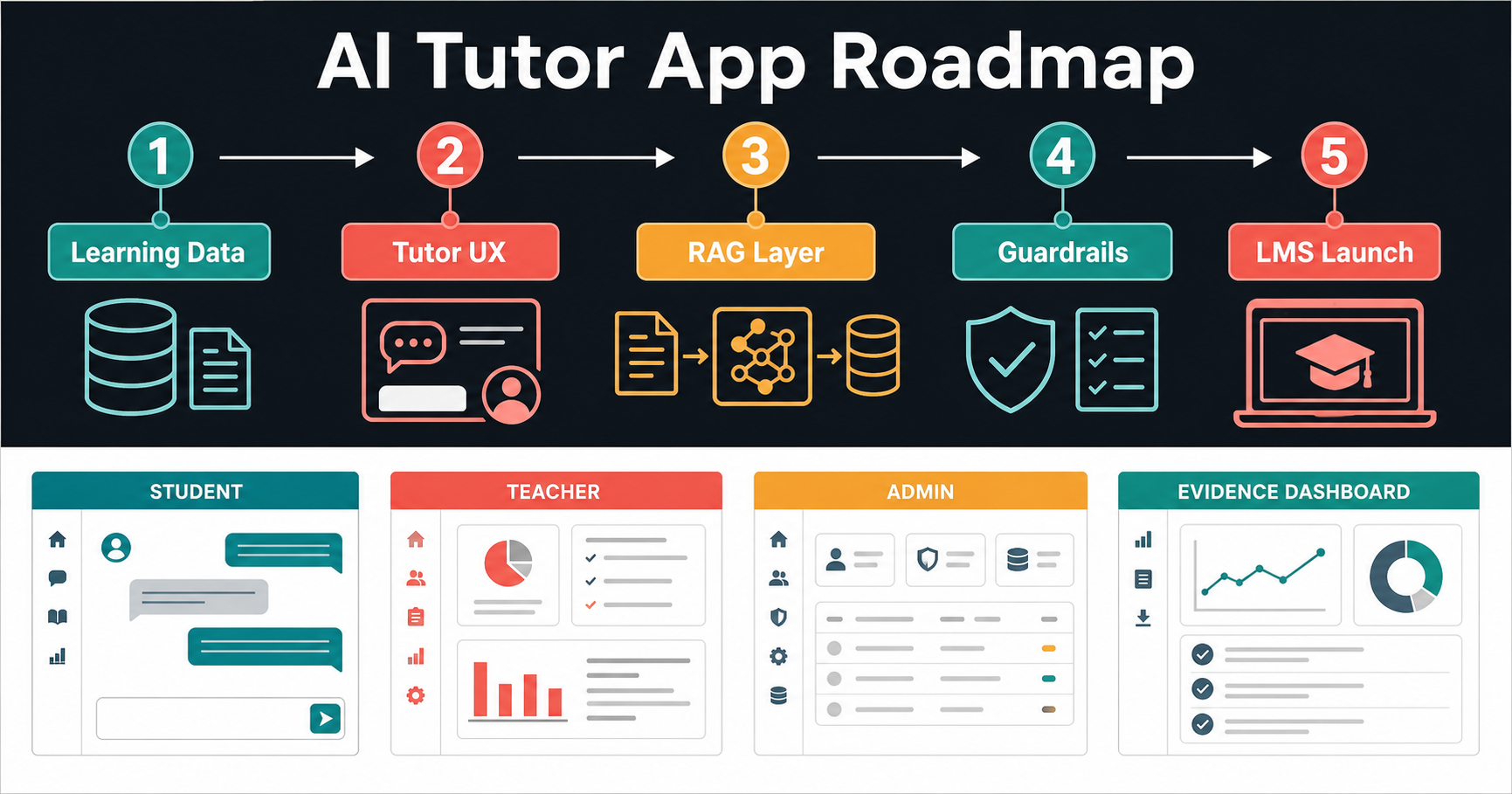
A realistic roadmap usually moves through four phases:
- Discovery and data readiness: define users, learning workflow, content sources, privacy boundaries, success metrics, and integration dependencies.
- Prototype: test retrieval, prompts, answer style, citations, and guardrails against a narrow content set.
- MVP: ship authenticated tutor workflow, admin controls, human review, analytics, safety logs, and one required integration.
- Scale: expand subjects, personalization, multilingual support, mobile features, deeper LMS/SIS integration, and continuous evaluation.
Do not skip discovery because AI makes prototyping feel fast. The prototype proves the interaction; discovery proves whether the data, roles, compliance model, and integration path can support a real product.
How NextPage Can Help
NextPage helps teams plan and build AI-enabled education products across product discovery, data architecture, RAG workflows, AI evaluation, web/mobile apps, integrations, QA, and launch operations. The goal is not to ship a flashy tutor demo; it is to ship a learning product that students can use, teachers can trust, and institutions can review.
If you are planning an AI tutor app, start with a readiness review and a narrow MVP scope. We can map the learning workflow, data pipeline, guardrails, LMS/payment integrations, evaluation plan, and phased build path before you commit to a full platform.