
Quick Answer: Airbnb-Like Marketplace Development Cost
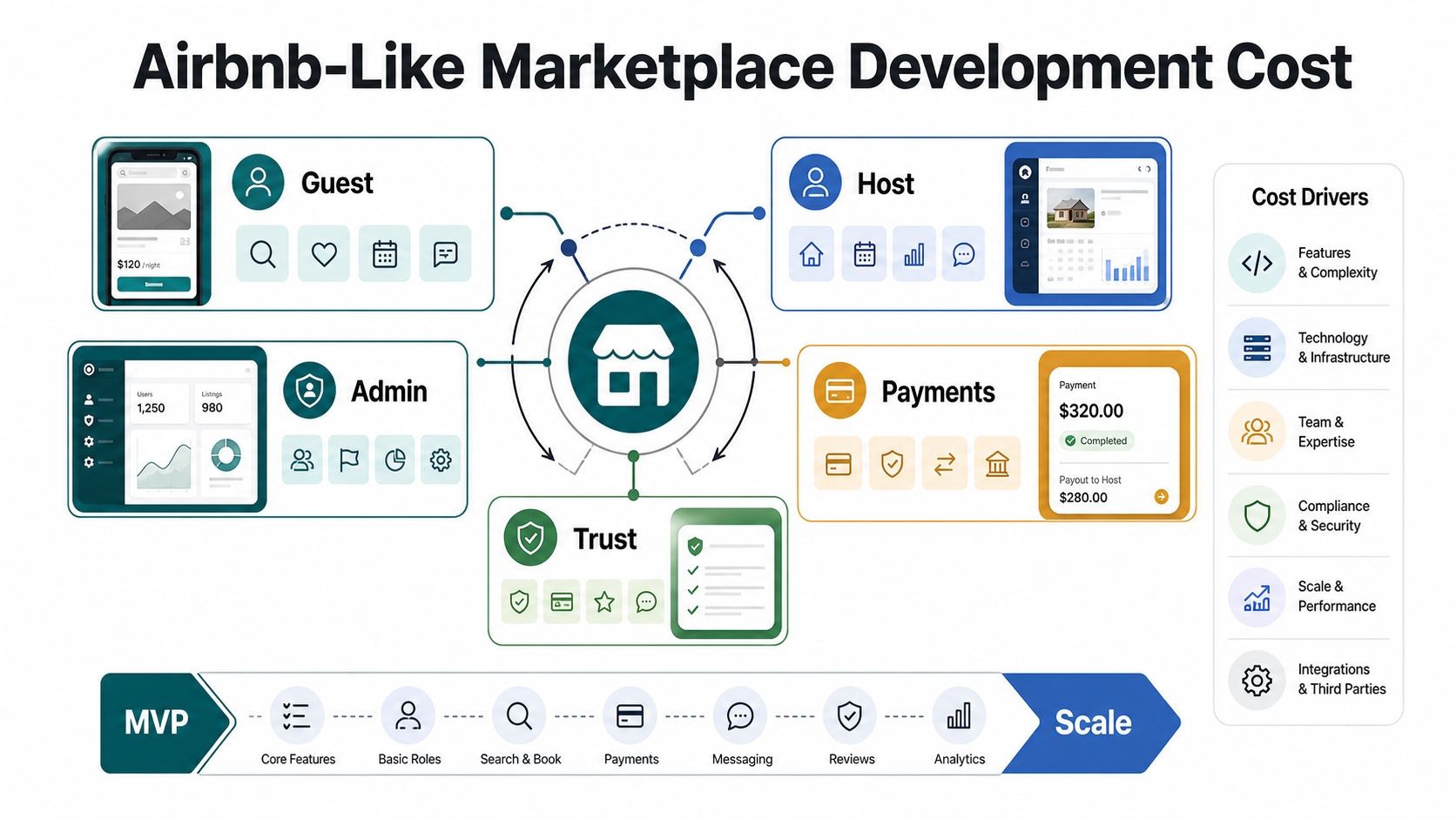
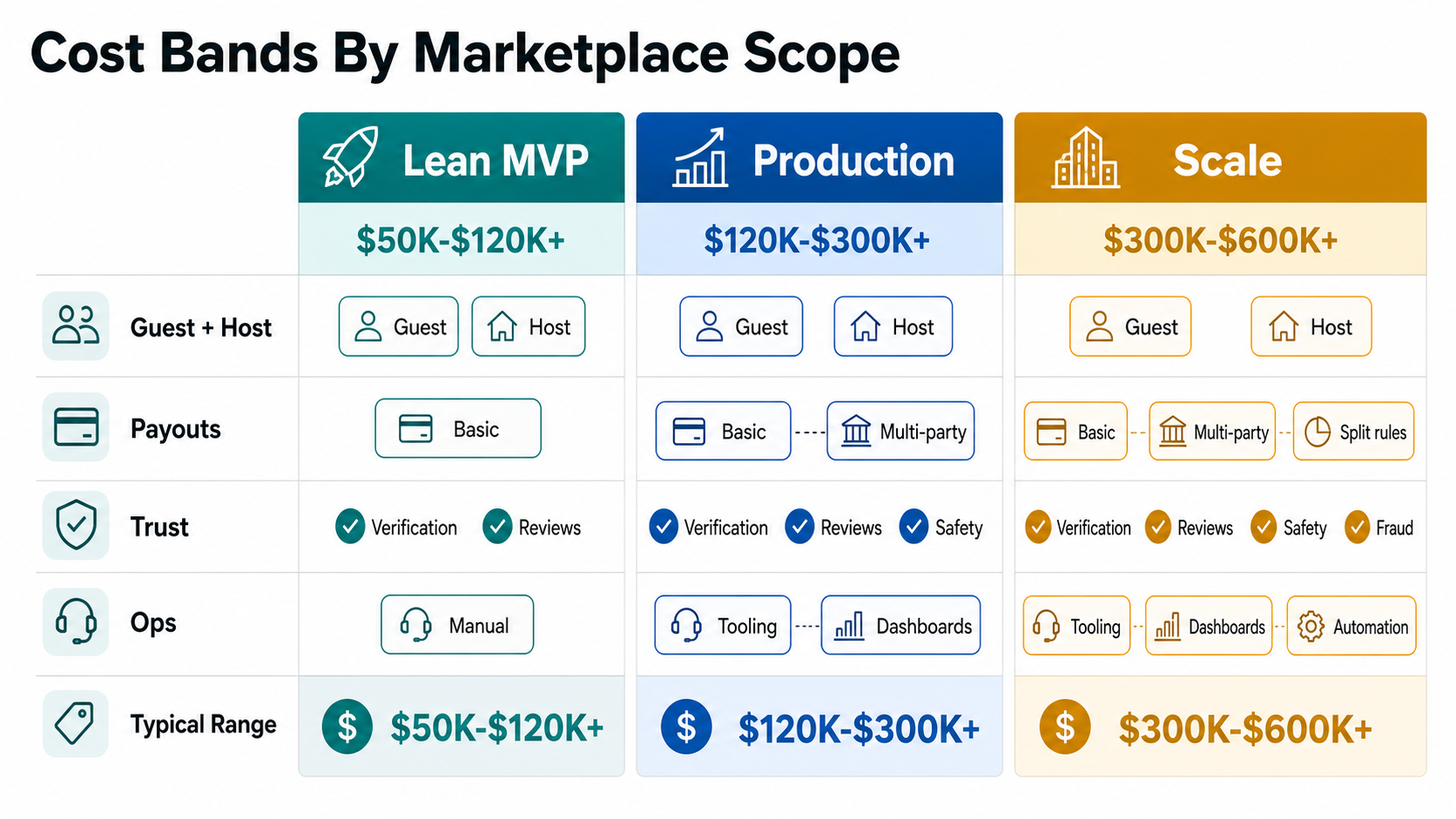
An Airbnb-like marketplace usually costs more than a normal booking website because it is not one product. It combines a guest experience, a host dashboard, a marketplace admin system, calendar and availability logic, search, booking rules, payments, payouts, refunds, messaging, reviews, verification, support tooling, and analytics. A lean custom MVP may start around $50K-$120K+ when the first release is tightly scoped. A production-ready marketplace with stronger trust, payments, host operations, mobile apps, and integrations often moves into $120K-$300K+. A scaled platform with advanced search, risk controls, multi-region operations, loyalty, AI recommendations, and enterprise-grade reliability can exceed $300K-$600K+.
The useful question is not “how much does an Airbnb clone cost?” The better question is what first transaction you need to make reliable. If guests can search, request or confirm a booking, pay safely, message a host, complete the stay, review the experience, and trigger the right payout and support workflow, you have the core marketplace loop. Everything else should earn its place in the roadmap. Use NextPage's Custom Software Cost Estimator for an initial budget range, then use the MVP Scope Builder to decide what belongs in release one.
Why Airbnb-Like Marketplaces Cost More Than Normal Web Apps
A standard marketing site or single-vendor booking app usually has one owner controlling inventory, pricing, support, and fulfillment. A rental marketplace has at least three operating surfaces: guests, hosts, and admins. Each surface creates its own permissions, workflows, notifications, edge cases, and support states.
Availability is a good example. A basic booking calendar only needs to show open slots. A marketplace calendar must prevent double bookings, support host-controlled blackout dates, handle time zones, manage cleaning or preparation buffers, coordinate cancellation rules, and update search results quickly enough that guests do not book stale inventory. That is engineering, QA, and operational design, not just a calendar component.
Payments add another layer. Marketplace payment products such as Stripe Connect exist because platforms need to orchestrate money movement between multiple parties, including onboarding, verification, platform fees, destination charges, transfers, payouts, refunds, and disputes. This is why a rental marketplace estimate should always include payment architecture and risk states, not just checkout.
That also explains why broad marketplace ranges can be misleading. NextPage's broader marketplace app development cost guide is useful for general buyer/seller marketplaces, but rental and booking marketplaces need extra attention to calendar integrity, host trust, cancellation rules, and post-booking operations.
Cost Bands By Marketplace Scope
These ranges are planning bands, not fixed quotes. Final cost depends on discovery depth, team location, app surfaces, integrations, security needs, QA coverage, and how much product uncertainty must be resolved during the build.
| Scope | What It Usually Includes | Typical Cost Drivers | Planning Range |
|---|---|---|---|
| Lean Rental Marketplace MVP | Responsive web app, guest search, listing pages, host onboarding, booking request or instant booking, basic calendar, checkout, manual admin support, reviews | Two user roles, listing workflow, booking state machine, basic payments, admin moderation, QA around first transaction | $50K-$120K+ |
| Production Marketplace Platform | MVP plus stronger host dashboard, messaging, cancellation/refund rules, automated payouts, identity checks, maps, saved searches, notifications, analytics, operational admin tools | Payments and payouts, trust/safety, search relevance, data model, support workflows, mobile UX, observability | $120K-$300K+ |
| Scaled Multi-Market Platform | Production scope plus mobile apps, multi-region pricing/tax rules, advanced verification, dynamic pricing, AI recommendations, partner integrations, fraud controls, high availability | Compliance, localization, performance, automated risk decisions, operational dashboards, experimentation, infrastructure scale | $300K-$600K+ |
A no-code marketplace builder or marketplace SaaS can be much cheaper for validation. That can be the right first move when the business model is not proven. Custom software development makes more sense when your marketplace has unique supply rules, workflow IP, payment logic, trust controls, data model, integrations, or customer experience that off-the-shelf software cannot support.
Feature Cost Drivers By Marketplace Layer
The biggest budget drivers are not always visible to users. Search filters, listing photos, or profile screens are easy to imagine. The expensive work sits in state transitions, exceptions, permissions, and operational reliability.
| Marketplace Layer | Core MVP Scope | Advanced Scope That Raises Cost |
|---|---|---|
| Guest Experience | Search, filters, listing detail, booking request, checkout, trip page, review | Personalized recommendations, map search, saved trips, loyalty, multi-currency, mobile apps |
| Host Operations | Host profile, listing creation, availability, pricing, booking approval, payout view | Calendar sync, dynamic pricing, revenue analytics, team roles, bulk listing tools, channel manager integrations |
| Admin And Support | User/listing moderation, booking lookup, refund support, content controls, basic reports | Risk queues, dispute workflows, SLA dashboards, automated policy decisions, audit logs, role-based support permissions |
| Payments | Checkout, platform fee, payout trigger, refund handling, payment webhooks | Split payments, escrow-like timing, destination charges, tax reporting, payout delays, disputes, multi-region compliance |
| Trust And Safety | Reviews, report listing/user, basic identity checks, admin moderation | Document verification, fraud scoring, content moderation, safety incidents, insurance workflows, host/guest risk rules |
| Data And Search | Listings, location, availability, basic ranking, admin search | Geo search, event-driven indexing, recommendations, pricing intelligence, analytics warehouse |
Every advanced item should be tied to a business risk or conversion goal. For example, instant booking may improve conversion but raises the cost of calendar accuracy and cancellation handling. Host analytics may improve supply retention but can wait until you have enough host activity to make the dashboard useful.
What To Build In The MVP
A strong rental marketplace MVP should prove one supply category, one geography or operating niche, and one complete transaction loop. It should not try to become Airbnb on day one. Most teams overspend when they combine unproven demand with a large feature list.
- Guest path: browse/search, filters, listing detail, booking request or instant booking, payment, confirmation, messaging, review.
- Host path: onboarding, profile, listing setup, photo/content management, availability, pricing, booking response, payout status.
- Admin path: user and listing review, booking oversight, support notes, refund actions, content moderation, basic metrics.
- Marketplace rules: cancellation policy, fee model, payout timing, refund logic, notification events, review rules.
- Operational foundation: audit trails for payment events, booking state changes, admin actions, and user support history.
Defer mobile apps unless mobile-native behavior is essential for the first transaction. A responsive web app can validate many rental marketplace models faster. If mobile apps are required, decide whether they are guest-only, host-only, or both. That choice changes cost, QA, release operations, and support.
Use the MVP Scope Builder to separate release-one features from later-phase features. The first release should make one transaction reliable, not satisfy every future stakeholder.
Payments, Payouts, Trust, And Safety
Payments are where many marketplace estimates are too optimistic. A single-vendor checkout can often be scoped around payment authorization, order status, and refunds. A marketplace needs to define who is paid, when they are paid, what fee the platform keeps, what happens after cancellation, how disputes are handled, and what evidence support teams need.
For many Airbnb-like products, payment scope includes host onboarding, identity or business verification, guest checkout, platform commission, payment webhooks, payout timing, refunds, cancellation fees, chargebacks, receipts, and reconciliation reports. Stripe Connect and similar marketplace payment tools reduce the amount of custom payment infrastructure you need, but they do not remove product decisions. You still need to model money movement and support states correctly.
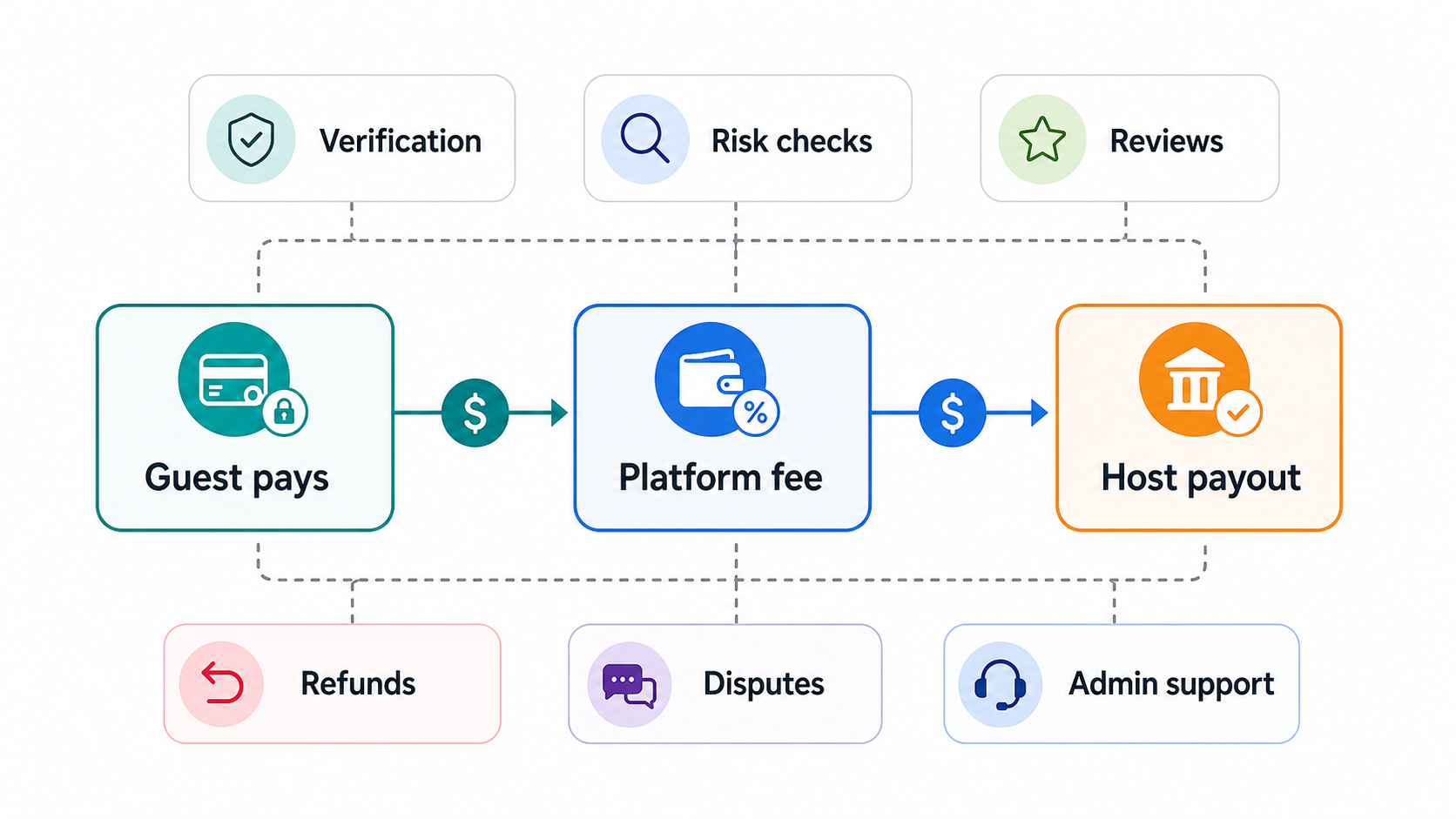
Trust and safety should be part of the MVP plan, not a later cleanup project. Rental marketplaces often handle profile data, addresses, user-generated content, messages, payments, reviews, and offline interactions. At minimum, plan reporting tools, review moderation, listing approval, secure messaging rules, and admin visibility into risky events. For travel-like or location-based flows, NextPage's guide to secure payment gateway integration is a useful companion for payment lifecycle thinking.
Team, Timeline, And Architecture Choices
A realistic MVP team usually needs product discovery, UX/UI design, frontend development, backend/API development, QA, project management, and DevOps or cloud support. A lean build may combine roles, but it should not skip product architecture. Marketplace mistakes are expensive to unwind once booking states, payment events, host permissions, and admin workflows are in production.
| Phase | Typical Work | Timeline Signal |
|---|---|---|
| Discovery And Scope | User roles, transaction model, payment flow, cancellation/refund policy, MVP backlog, technical architecture | 2-4 weeks |
| UX And Product Design | Guest search, listing pages, host onboarding, booking flow, admin workflows, design system | 3-6 weeks |
| MVP Build | Core web app, APIs, database, payments, admin, notifications, QA, deployment | 10-18 weeks |
| Pilot And Hardening | Real host onboarding, payment tests, support workflows, analytics, bug fixes, performance | 4-8 weeks |
Architecture should support the marketplace loop without overbuilding. Most MVPs can start with a modular monolith, relational database, managed search or search-index layer, object storage, payment webhooks, transactional email/SMS, and observability. Microservices rarely help before the team has real traffic and clear domain boundaries. For general architecture and budget context, compare this article with NextPage's web app development cost guide.
Build From Scratch, Use Marketplace Software, Or Start Hybrid?
There are three practical paths. No-code or marketplace SaaS is fastest for validating the idea, especially when your model fits standard listing, booking, and payment rules. A custom build gives you control over experience, workflow, integrations, and data, but it requires a larger initial investment. A hybrid path starts with a focused custom layer around a validated workflow while using managed tools for payments, messaging, search, analytics, and infrastructure.
Choose no-code when the main risk is demand. Choose custom when the main risk is execution of a differentiated operating model. Choose hybrid when you need custom marketplace logic but do not want to spend on commodity infrastructure. The wrong choice is usually visible in the backlog: if the team spends most of its time fighting platform limitations, custom may be justified; if the team is still guessing who the supply and demand sides are, custom is premature.
Budget Risks To Catch Before Development
Marketplace budgets drift when teams postpone hard decisions. Before signing off on an estimate, resolve these questions:
- Booking model: request-to-book, instant booking, inquiry-first, or managed approval?
- Inventory model: one listing per property/service, multiple units, recurring slots, or custom availability rules?
- Payment model: collect now, authorize now and capture later, hold funds until check-in, or pay host after completion?
- Fee model: guest fee, host fee, subscription, commission, promoted listings, or mixed monetization?
- Trust model: basic reviews, identity checks, listing approval, document verification, incident reporting, or fraud scoring?
- Support model: manual admin actions, automated refund rules, dispute queues, or SLA-backed support operations?
These are not just business choices. They shape the data model, API contracts, admin screens, QA cases, and payment integration. A low quote that ignores them is not cheaper; it is incomplete.
Cost Controls That Keep The Build From Drifting
The safest way to control Airbnb-like marketplace development cost is to separate product risk from platform scale. Treat the MVP as a controlled operating test: one supply type, one booking model, one fee model, one payment path, one admin workflow, and one launch geography. This keeps discovery focused on the decisions that change engineering scope instead of letting every future marketplace idea enter release one.
| Decision | Lower-Cost Starting Point | When To Upgrade |
|---|---|---|
| Booking Model | Request-to-book with admin visibility | Instant booking when calendar accuracy, cancellation policy, and host readiness are proven |
| Payments | Standard checkout, platform fee, clear refund rules | Multi-party payouts, wallet credits, tax logic, and region-specific settlement |
| Trust | Manual listing review, reviews, report flows, support notes | Automated verification, risk scoring, incident workflows, and policy automation |
| Search | Location, dates, price, category, and availability filters | Personalization, dynamic ranking, map clustering, recommendations, and demand signals |
| Operations | Admin dashboard for users, listings, bookings, refunds, and support | Workflow queues, analytics, audit logs, CRM exports, and finance reconciliation |
For integration-heavy commerce and booking products, use portfolio examples such as Venuecart as a reminder that the visible app is only part of the system. The operational layer behind catalog, checkout, fulfillment, support, and reporting is where estimates become more realistic.
Next Step: Scope The First Transaction Before Estimating The Full Platform
If you are planning an Airbnb-like marketplace, start by defining the smallest reliable transaction. Who lists supply? Who books it? What must be true before money moves? What happens if either side cancels? What does support need to see? Which trust checks are mandatory before launch?
Once those answers are clear, estimate the MVP around the guest, host, admin, payment, trust, and analytics layers. Use NextPage's Custom Software Cost Estimator to get a first budget range, then discuss the result with a web app development team that can pressure-test the marketplace workflow before engineering starts.