
Quick Answer: API Modernization For AI Agents
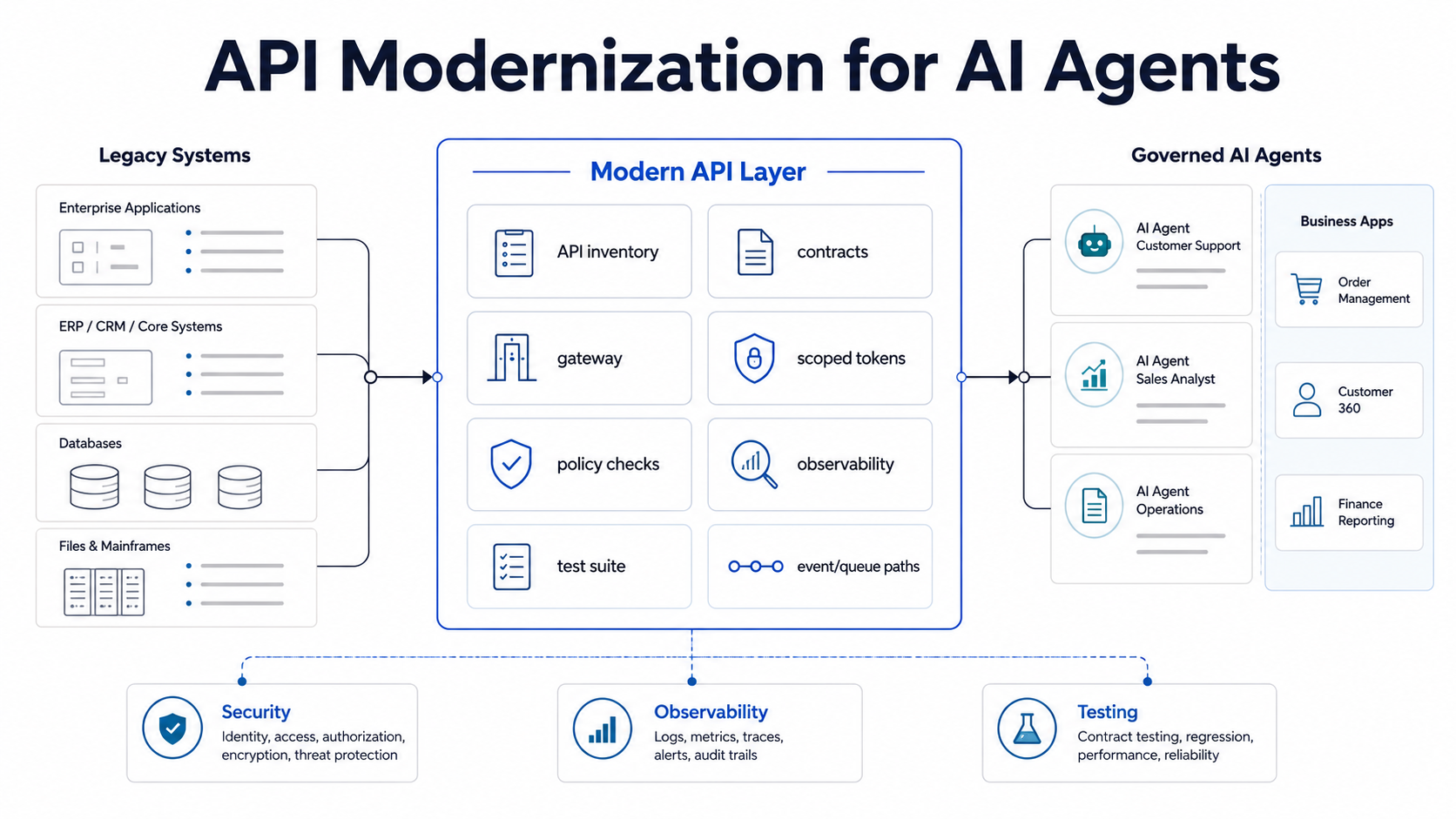
API modernization for AI agents means rebuilding, wrapping, and governing enterprise APIs so agents can retrieve context, call approved tools, and support workflows without bypassing security, auditability, data ownership, or human review. It is not enough to expose an old endpoint to an agent. The API needs a clear contract, scoped identity, authorization policy, rate limits, monitoring, test coverage, rollback paths, and an operating model for exceptions.
The practical starting point is an inventory: which APIs exist, which workflows they support, which systems of record they touch, which data is sensitive, and which actions are safe for AI-assisted use. From there, modernize in phases. Stabilize the legacy interfaces first, add canonical objects and contract tests, put a gateway or policy layer in front of risky actions, introduce agent-specific scopes, and require human approval for high-impact writes until the workflow has enough evidence to automate.
If your team is unsure where the risk sits, use the Legacy Software Modernization Scorecard before funding a broad rewrite. For production agent work, pair that with the AI Agent Readiness Assessment so workflow clarity, data readiness, integration access, and human-review controls are evaluated together.
Why AI Agents Change API Modernization
APIs already connect products, portals, dashboards, SaaS tools, CRMs, ERPs, data platforms, payment systems, and internal workflows. AI agents change the pressure on those APIs because the caller may no longer be a human developer or a predictable application screen. The caller may be a non-human identity that reads context, plans a task, calls tools, and repeats actions at machine speed.
Postman's 2025 State of the API report describes AI agents as new API consumers and reports that only a minority of developers design APIs specifically for agents, while unauthorized agent access is a leading concern. Salt Security's 1H 2026 State of AI and API Security findings frame APIs as the action layer for agents and highlight visibility gaps in machine-to-machine traffic. The exact numbers will evolve, but the direction is clear: agent access turns API design, identity, monitoring, and security into one modernization decision.
This is why API modernization should sit inside a broader enterprise software integration services roadmap. The question is not only whether an endpoint works. The question is whether the workflow can be trusted when an agent uses it repeatedly, under policy, with evidence, and with a human fallback when confidence is low.
What Makes an API Agent-Ready?
An agent-ready API is boring in the best way. It has explicit resources, stable contracts, predictable errors, bounded permissions, clear ownership, test fixtures, telemetry, and documented action limits. It is designed for systems that may automate work, not just for humans clicking through a UI.
| Capability | What Good Looks Like | Why Agents Need It |
|---|---|---|
| API inventory | Known owners, consumers, data classes, auth method, traffic, and business workflow mapping | Prevents unknown endpoints from becoming invisible agent tools |
| Stable contracts | Versioned schemas, required fields, examples, error model, and change policy | Lets agents and orchestration code reason about inputs and failures |
| Scoped access | Separate agent identities, least-privilege scopes, short-lived credentials, and approval thresholds | Limits blast radius when an agent or prompt path behaves incorrectly |
| Policy layer | Gateway rules, rate limits, allowlists, deny rules, data filters, and kill switch | Separates allowed tool use from broad backend access |
| Observability | Correlation IDs, audit logs, traces, cost, latency, error queues, and anomaly detection | Explains what the agent saw, decided, called, and changed |
| Testing | Contract tests, integration smoke tests, security checks, replay fixtures, and regression suites | Stops API changes from silently breaking automated workflows |
Google's API design guidance is useful here because resource naming, consistent methods, and predictable behavior still matter when AI is involved. Agentic workflows do not remove classic API design discipline. They punish teams that skipped it.
Start With API and Workflow Inventory
The first modernization mistake is starting with a gateway purchase or a rewrite backlog before the team knows which workflows matter. An agent-ready API program should begin with a combined API and workflow inventory.
List every API, batch export, webhook, database read, file transfer, RPA script, and manual workaround that supports the target workflow. For each one, capture owner, system of record, data sensitivity, current consumers, authentication, write actions, error rate, latency, rate limits, logging, and business impact. Then mark which paths are read-only, low-risk write, high-risk write, or never-agent-accessible.
This inventory often reveals that the real modernization need is not one API. It is a cluster of brittle dependencies around a workflow: an old ERP export, a CRM update endpoint, a support portal action, a finance approval rule, and a manual spreadsheet reconciliation. In those cases, NextPage's ERP integration and modernization services model is a useful pattern: stabilize the workflow boundary, clarify data ownership, and modernize risky modules in controlled phases.
Legacy Integration Patterns For Agent Workflows
Not every legacy system should be rewritten before agents can help. The right integration pattern depends on API availability, business risk, data quality, and how much authority the agent needs.
| Pattern | Best Fit | Agent Risk | Modernization Note |
|---|---|---|---|
| Read-only API wrapper | Legacy data lookup, status checks, reporting, eligibility context | Low to medium | Good first step when the agent only needs context |
| Command API with approvals | CRM notes, ticket routing, draft updates, low-risk workflow changes | Medium | Add human approval, audit log, and rollback before autonomy |
| Event or queue bridge | Long-running syncs, back-office jobs, asynchronous enrichment | Medium | Useful when the legacy system cannot handle real-time agent calls |
| UI automation or RPA bridge | No API, fragile vendor system, temporary migration path | Medium to high | Use as a bridge with monitoring, not as a permanent hidden integration |
| Module rebuild | Critical workflow with bad data, poor uptime, or unsafe actions | High | Modernize the domain service before giving agents tool access |
The best pattern is often hybrid. Use APIs for stable business objects, events for asynchronous work, and a workflow engine for approvals. Keep AI behind the workflow boundary rather than burying model logic inside every connector. NextPage's AI integration platform development guide covers that platform layer in more detail.
Security Controls For Agent API Access
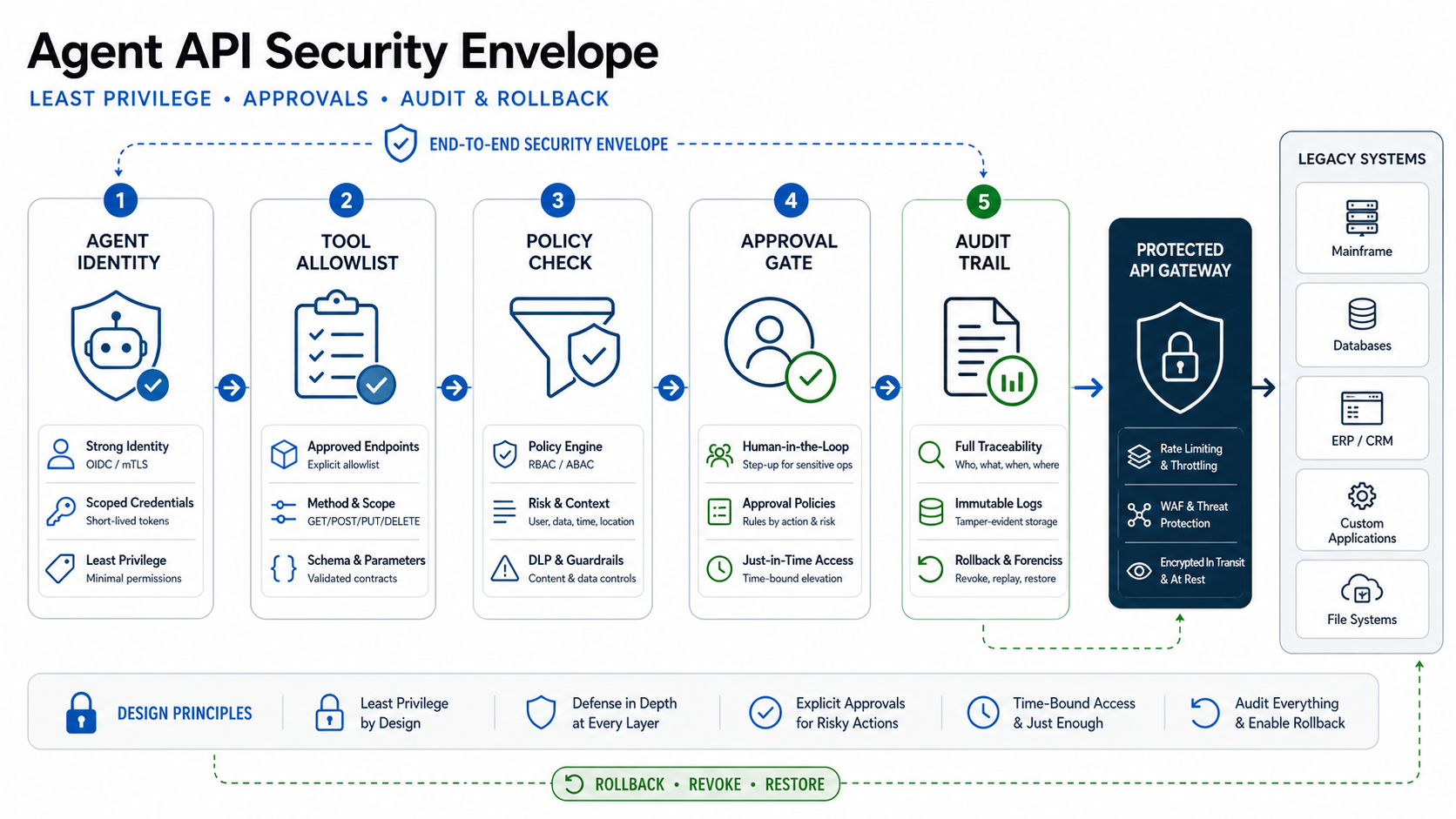
Agent API access should be treated as a new identity and authorization class, not as a shared service account. A human user, a backend service, a scheduled integration, and an AI agent do not carry the same risk. Their credentials, scopes, logs, and approval rules should be different.
Start with least privilege. Create agent-specific identities, short-lived tokens, explicit tool allowlists, tenant boundaries, field-level restrictions, and policy checks before writes. Separate read tools from write tools. Require confirmation or human approval for money movement, customer-impacting changes, irreversible operations, privileged data, legal/compliance workflows, and production configuration changes. For a broader agent-control checklist, pair this API work with NextPage's secure AI agent development checklist.
For governance depth, connect API modernization to the controls in NextPage's AI agent identity governance checklist. Agent access should have an owner, purpose, expiration, audit trail, incident response path, and revocation mechanism. A kill switch is not dramatic. It is basic operations hygiene when a non-human actor can call business systems at scale.
Observability and Audit Trails
Traditional API monitoring asks whether requests are fast, healthy, and successful. Agent API monitoring has to answer more questions: which user or workflow authorized the agent, what context did it retrieve, which tools did it call, what data did it change, what policy checks ran, what confidence or rationale was recorded, and who approved or rejected the action?
Use correlation IDs across the full path: user request, agent run, retrieved records, prompt/tool call, API request, downstream event, human approval, final write, and rollback. Log request payload shape without leaking sensitive data. Capture response categories, not just status codes. Track anomalous volume, new endpoint access, repeated failed permissions, tool loops, retry storms, and expensive workflows.
Good observability also improves product trust. Business users are more likely to accept agent assistance when they can see the source data, action rationale, approval status, and audit history. Engineers are more likely to support agent workflows when failures land in a queue with enough evidence to reproduce them. NextPage's AI agent observability checklist goes deeper on traces, evaluations, guardrails, and rollback evidence for tool-using systems.
Contract Testing and DevSecOps
AI agents make API regressions more expensive because automated workflows may fail faster than a human user can notice. Contract testing should become part of the modernization backlog.
At minimum, maintain OpenAPI or equivalent schemas, request and response examples, negative test cases, auth tests, permission tests, rate-limit tests, and replay fixtures for common workflows. Add integration smoke tests for the exact agent tool calls: read customer context, fetch order status, draft update, submit for approval, write approved change, and recover from failure. NextPage's QA automation testing services cover the same API and integration automation discipline needed here: contracts, payloads, auth, third-party handoffs, webhooks, and backend workflows should be validated before they reach users.
Security testing should include OWASP API risks, broken object-level authorization, excessive data exposure, prompt-injection paths that influence tool calls, insecure direct object references, token handling, and logging leaks. Shift-left testing matters, but production traffic still needs monitoring because agents can create usage patterns that pre-production tests did not anticipate.
Cost Drivers For API Modernization
API modernization cost depends less on the number of endpoints and more on the number of workflows, systems of record, security boundaries, data-quality issues, and operating requirements. A read-only wrapper for one legacy system is a different project from an agent-ready integration layer across ERP, CRM, billing, support, warehouse, and analytics systems.
| Cost Driver | Why It Adds Effort | How To Control Scope |
|---|---|---|
| Legacy complexity | Old schemas, unclear ownership, stored procedures, brittle exports, and undocumented side effects | Start with a workflow slice instead of rewriting the whole system |
| Write actions | Writes need authorization, validation, rollback, approval, and audit design | Separate read-only agent use from supervised write use |
| Security requirements | Identity, scopes, token lifetime, tenant isolation, data masking, and incident response add design work | Define risk tiers and apply controls based on impact |
| Testing depth | Contracts, fixtures, integration tests, security tests, and replay tools take setup time | Prioritize tests around agent tool paths and critical workflows |
| Observability | Logs, traces, metrics, dashboards, alerts, and exception queues need instrumentation | Use one correlation model across APIs, agents, and workflow systems |
Most teams should budget the first release around one valuable workflow and the APIs required to operate it safely. The payoff is not simply faster integration. It is reduced rework, fewer hidden failures, safer agent experimentation, and a platform that can absorb more workflows later.
A Practical Rollout Plan
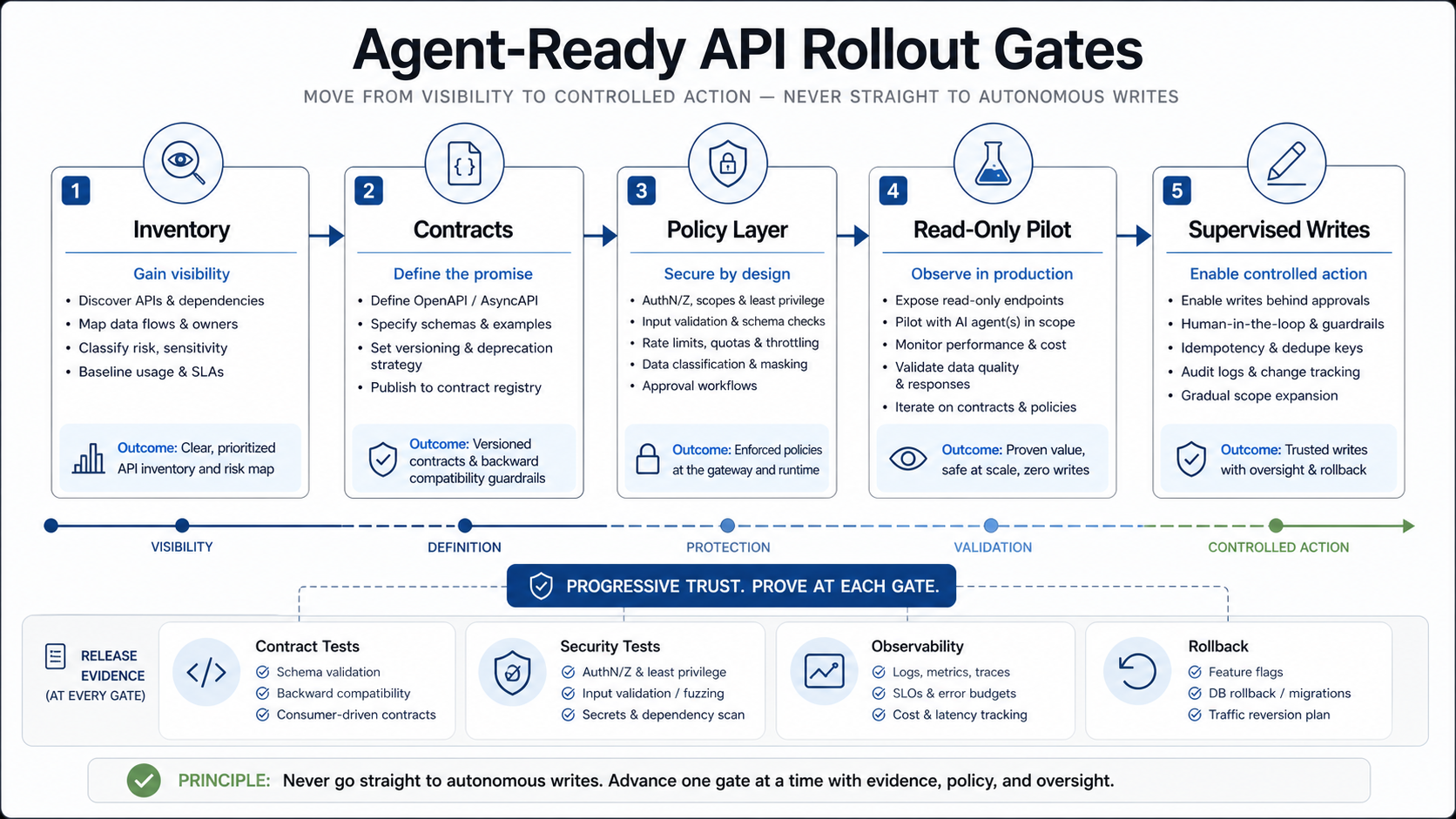
A safe rollout moves from visibility to controlled action. Do not start with autonomous write access. Build evidence first.
- Inventory and risk tiering: map APIs, workflows, data sensitivity, write actions, and current consumers.
- Stabilize the first workflow: choose one high-value workflow and fix the riskiest legacy dependency.
- Define contracts: document schemas, examples, errors, versions, ownership, and approval rules.
- Add the policy layer: introduce gateway controls, scoped identities, rate limits, tool allowlists, and audit logging.
- Test agent tool paths: run contract, integration, security, and regression tests around the exact actions agents will perform.
- Launch read-only assistance: let agents retrieve, summarize, classify, and recommend using source-linked evidence.
- Add supervised writes: allow low-risk writes only after human approval, rollback, and monitoring are proven.
- Expand gradually: add more workflows after telemetry shows quality, safety, adoption, and supportability.
If the agent itself is still undefined, use agentic AI development services to design the operating loop, tool access, approvals, monitoring, and fallback behavior before widening API access.
API Modernization Readiness Checklist
- Do we know which APIs and legacy paths support the target agent workflow?
- Is there a named owner for every system of record and API contract?
- Are agent identities separate from human users and backend services?
- Can the agent access only the fields and actions needed for the workflow?
- Are high-impact writes blocked, supervised, or approval-gated?
- Do contracts include examples, error semantics, versioning, and deprecation rules?
- Can we trace an agent action from user request to API call to final system change?
- Do we have contract tests and integration smoke tests for the agent tool paths?
- Can security teams see machine-to-machine and agent-driven traffic separately?
- Is there a kill switch, revocation process, rollback path, and incident owner?
If several answers are weak, the first project should be an API modernization readiness sprint, not a large autonomous agent rollout.
How NextPage Helps
NextPage helps teams modernize APIs, legacy integrations, and workflow systems so AI agents can support real operations safely. We start with the business workflow, then map APIs and systems of record, identify risky legacy dependencies, design contracts, build integration layers, add security controls, automate API tests, and define observability and approval paths.
If you are preparing AI agents for customer support, operations, finance, field teams, or internal knowledge work, start with an API and agent readiness review. The output should be a phased roadmap: what to wrap, what to rebuild, what to block, what to monitor, and what can safely move from read-only assistance to supervised action.