
Quick Answer: Astrology App Development Cost In 2026
Astrology app development cost in 2026 depends less on the word "astrology" and more on the product model you are building. A lightweight horoscope or content MVP can be a focused mobile/web build. A live consultation marketplace with astrologer onboarding, chat, calls, wallet credits, commissions, moderation, subscriptions, and analytics is a much larger software product. An advanced Astrotalk-style platform with video, multilingual content, AI-assisted personalization, reports, puja or spiritual commerce, and high-traffic operations needs phased product investment.
For planning, founders should separate three scopes: an MVP that proves demand, a growth platform that handles real marketplace operations, and an advanced platform that adds automation, deeper personalization, and scale. NextPage's astrology app development services help teams define that boundary before design and engineering begin.
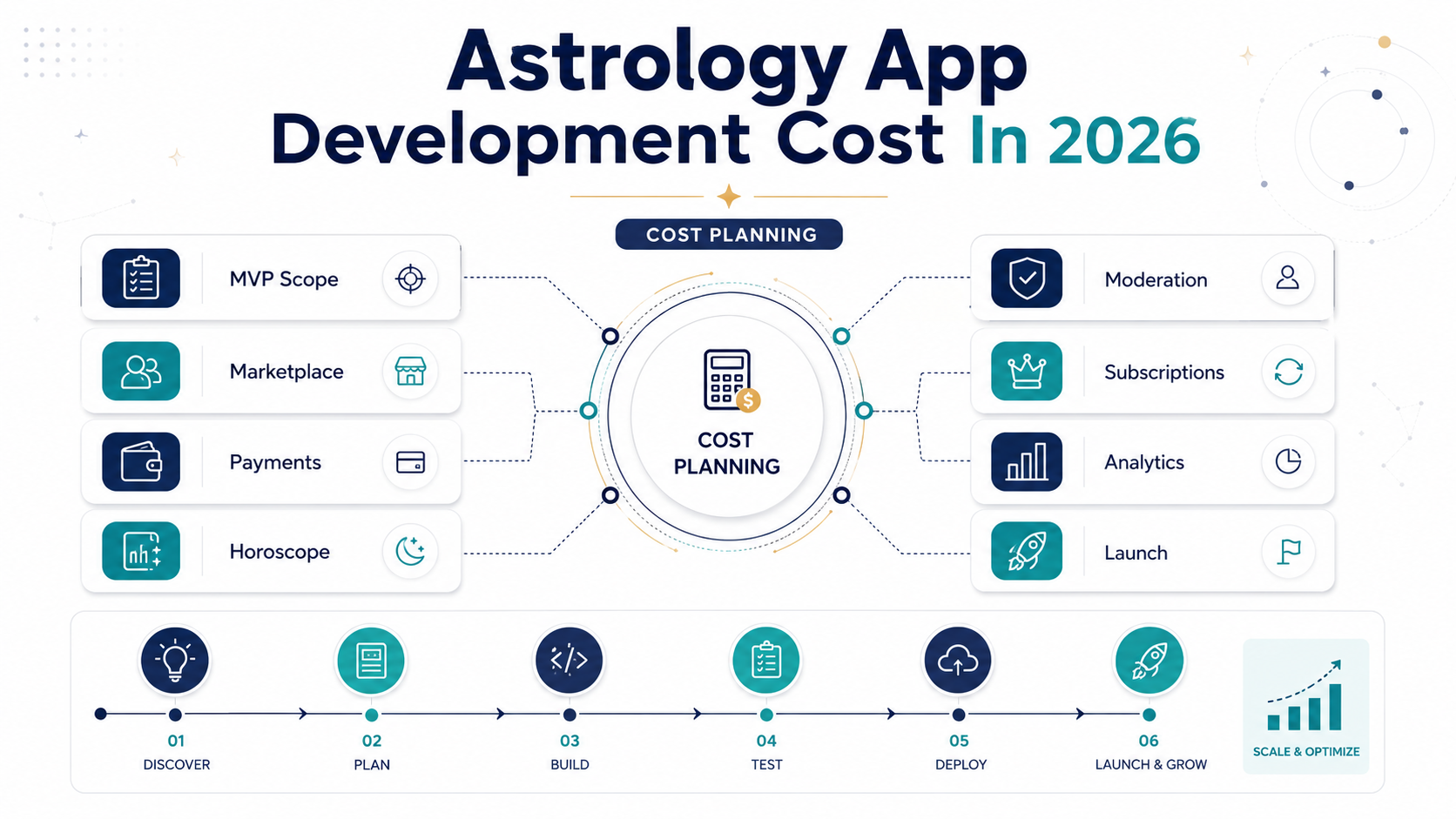
The biggest cost drivers are live consultation workflows, wallet/payment logic, astrologer availability and payouts, horoscope or kundli engines, admin moderation, app-store payment compliance, data privacy, multilingual content, and launch QA. Use the Custom Software Cost Estimator once you know which of those features belong in release one.
Why Astrology App Costs Vary So Much
Two astrology apps can look similar in a pitch deck but be completely different to build. A daily horoscope app mostly needs content workflows, profiles, notifications, and subscription logic. A consultation platform needs user discovery, astrologer onboarding, live chat or calls, session timing, wallet deductions, refunds, earnings, disputes, ratings, and admin controls. A spiritual commerce platform may also include report purchases, puja bookings, live events, marketplace catalogs, and creator tools.
This is why competitor cost ranges are often broad. Current 2026 cost guides commonly describe basic apps, mid-level consultation apps, and advanced platforms as separate tiers. That tiered framing is useful, but it still needs a product-specific breakdown. A founder building only horoscope subscriptions should not pay for marketplace complexity. A founder building live consultations should not underestimate wallet, availability, communication, moderation, and payout logic.
The safest way to estimate is to define user roles first: customer, astrologer, admin, support agent, content editor, finance operator, and sometimes partner or vendor. Every new role adds screens, permissions, states, notifications, reports, and support workflows. That is where budget changes.
Cost Tiers For An Astrology App
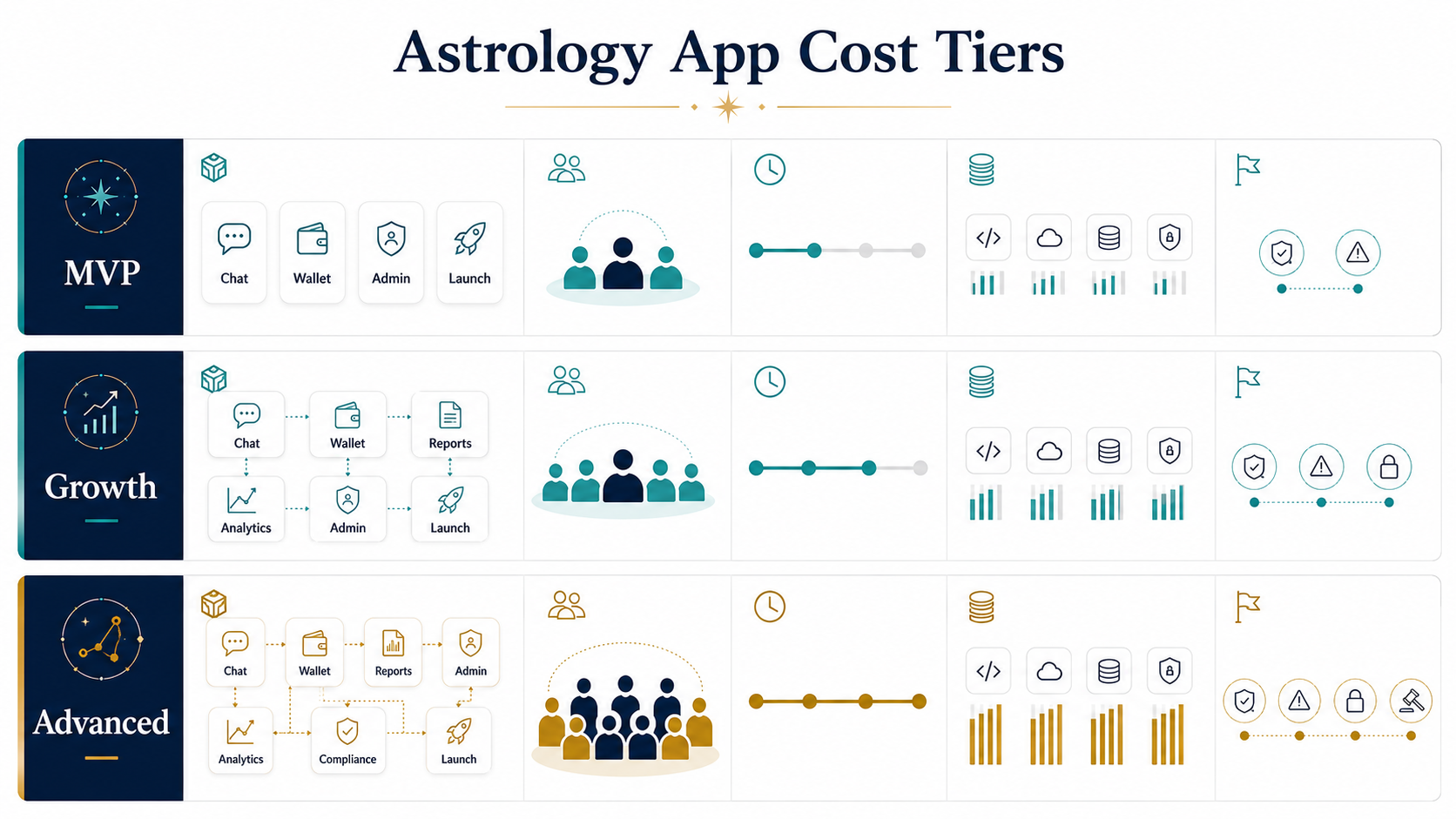
Use these tiers as planning bands, not guaranteed quotes. Final cost depends on platform choice, engineering location, design quality, integrations, data model, compliance work, and QA coverage.
| Scope | Best For | Typical Feature Set | Budget Pattern |
|---|---|---|---|
| MVP Horoscope Or Consultation Starter | Validating demand with a focused audience. | User profiles, birth details, horoscope content, basic booking or chat request, payment link or compliant purchase flow, admin panel, notifications. | Lowest cost tier because the product has fewer roles, simpler workflows, and limited automation. |
| Growth Consultation Platform | Building a real astrologer marketplace with paid sessions. | Astrologer onboarding, availability, live chat/call, wallet credits, commissions, refunds, ratings, reports, content library, moderation, analytics. | Mid to high tier because payments, real-time communication, trust, and operations drive complexity. |
| Advanced Spiritual Commerce Platform | Scaling multiple revenue lines and high-traffic operations. | Video, AI-assisted recommendations, multilingual content, subscriptions, personalized reports, puja/e-commerce workflows, advanced matching, CRM, BI dashboards. | Highest tier because it combines marketplace, content, commerce, data, and infrastructure concerns. |
If your first estimate includes every advanced feature, run the scope through the MVP Scope Builder. It is usually better to launch a narrow consultation or report workflow cleanly than to delay release while building a full platform that has not proven demand.
Features That Drive The Budget
The feature list below explains where engineering time usually goes. The goal is not to add everything. It is to understand which pieces are core to the first business model.
| Feature Area | Why It Affects Cost | MVP Advice |
|---|---|---|
| Birth profile and horoscope engine | Requires accurate birth data capture, location/time handling, content rules, API decisions, and report templates. | Start with one reliable calculation/report flow instead of many traditions and formats. |
| Live chat, audio, or video consultation | Adds real-time sessions, timers, notifications, availability, missed-call states, recording/privacy choices, and support tools. | Pick one primary communication mode first. Chat is usually easier than audio/video. |
| Wallet credits and payments | Needs balance tracking, deductions, refunds, invoices, reconciliation, and app-store payment decisions. | Design ledger rules early. Do not treat wallet credits as a UI-only feature. |
| Astrologer onboarding | Requires profile review, expertise tags, rates, availability, KYC/document workflows when needed, and quality controls. | Begin with a managed astrologer panel and manual review before automating every step. |
| Ratings, reviews, and trust | Impacts ranking, dispute handling, abuse prevention, and customer confidence. | Use simple post-session feedback and admin review first. |
| Subscriptions and reports | Needs recurring billing, entitlement checks, content delivery, renewal states, and customer support workflows. | Launch one subscription or report package before creating complex bundles. |
| Admin moderation and support | Controls refunds, complaints, content edits, astrologer issues, session history, and fraud signals. | Budget for admin screens. They are not optional for marketplace operations. |
| Analytics and revenue dashboards | Requires event tracking, funnel metrics, session economics, astrologer performance, and cohort reporting. | Track acquisition, conversion, session completion, repeat purchase, and refund rate from day one. |
Wallet, Payments, And App-Store Policy Planning
Payment architecture is one of the easiest places to under-scope an astrology app. A pay-per-minute consultation flow sounds simple until the product needs top-ups, session timers, low-balance warnings, partial refunds, failed payments, astrologer commissions, settlement reports, promo credits, support adjustments, and audit trails.
If the product stores value, deducts credits, or manages marketplace earnings, borrow the discipline of fintech ledger design. NextPage's eWallet app development services page explains the kind of stored-value, transaction, and reconciliation thinking that also applies to astrology wallet workflows.
App-store rules must be checked for the exact purchase flow. Google Play's payments policy generally requires Google Play billing for payments that unlock in-app features, content, or digital services unless a policy exception applies. Apple's guidelines include a person-to-person services exception for real-time services between two individuals, but subscriptions, digital content, and app functionality still need careful StoreKit/payment design. Treat this as product architecture, not a launch-week compliance chore.
Cost Breakdown By Workstream
A useful astrology app estimate should show where the money goes. Screen count alone is not enough because the expensive parts are often invisible to users: data rules, payment states, admin operations, integration monitoring, and QA coverage. Break the quote into workstreams so tradeoffs are easier to discuss.
| Workstream | What It Includes | Why It Matters |
|---|---|---|
| Product discovery | User roles, revenue model, policy assumptions, launch metrics, feature priority, and first-release boundary. | Prevents the app from becoming an unfocused clone before demand is proven. |
| UX/UI design | Onboarding, birth details, astrologer discovery, booking, wallet states, report delivery, support, and admin flows. | Trust depends on clear purchase states, session expectations, and easy recovery when something goes wrong. |
| Mobile/web app | Customer-facing app or PWA, profile, notifications, content, consultation flow, purchase flow, and account settings. | This is the visible product experience and usually the first place founders notice scope creep. |
| Backend and APIs | Authentication, roles, session logic, wallet ledger, content/report delivery, notifications, integrations, and audit logs. | Backend quality determines whether the product can support paid users and real operations. |
| Admin and operations | Astrologer review, rate management, refunds, disputes, reports, content edits, moderation, and support dashboards. | Without admin tooling, the business pays for manual work after launch. |
| QA and release | Device testing, payment-state testing, session timing, refunds, permissions, analytics, app-store checks, and regression coverage. | Paid consultation apps need more QA than simple content apps because failed states affect money and trust. |
This workstream view also helps compare vendors. A low quote may simply omit admin tooling, app-store payment planning, analytics, privacy work, or post-launch support. Those omissions do not remove the work; they push it into launch risk.
Build-Vs-Buy Decisions For Astrology App Features
Not every feature should be built from scratch. Many astrology products should integrate existing services for payments, notifications, analytics, authentication, communication, or chart calculations. The custom work should focus on the experience and workflow that differentiates the product: how users discover astrologers, how trust is built, how sessions are priced, how reports are delivered, and how operators manage quality.
The build-vs-buy decision is especially important for horoscope calculations and communication infrastructure. Buying an API can reduce launch time, but it may limit formats, localization, pricing, data control, or report customization. Building everything internally may create more control, but it can delay validation and increase maintenance. The right answer depends on whether the feature is a commodity enabler or a core product advantage.
For founders, the practical question is: would users choose your app because of this feature, or does it just need to work reliably? If it just needs to work, integrate a proven service. If it defines your product experience, design it deliberately and budget for ownership.
Team And Timeline For Building An Astrology App
A serious astrology app usually needs more than one developer. A lean MVP team may include a product strategist, UX/UI designer, mobile or full-stack engineer, backend engineer, QA engineer, and project lead. A growth platform may add DevOps, data/analytics, security review, content operations, and specialist support for real-time communication or payment architecture.
Timeline depends on how many workflows must be production-ready at launch. A focused MVP can be planned, designed, built, tested, and launched in phases. A marketplace with wallets, live sessions, astrologer operations, and admin tooling needs more discovery and QA because more things can go wrong after users pay.
- Discovery and scope: define user roles, monetization, app-store flow, data model, and first-release feature boundary.
- UX and prototype: design onboarding, birth profile capture, consultation booking, wallet/payment states, and admin workflows.
- Engineering: build mobile/web app, backend, admin, integrations, payment logic, content/report workflows, and notifications.
- QA and launch: test devices, payment states, session timing, refunds, role permissions, analytics, and app-store submissions.
For cost estimation, the most important timeline question is not "How many months?" It is "Which workflows must be safe enough for paid users on day one?" Paid consultation and wallet logic need stricter testing than a static horoscope content feed.
Revenue Models To Plan Before Development
The revenue model changes the architecture. A free horoscope app with ads has different data, consent, and retention needs than a premium consultation marketplace. A subscription product has different entitlement and renewal logic than one-off report purchases. A wallet-credit product needs balance and refund rules. A marketplace needs commission and payout reporting.
| Revenue Model | Product Implication | Common Risk |
|---|---|---|
| Pay-per-minute consultation | Session timers, balance checks, wallet deductions, astrologer earnings, refunds, and dispute handling. | Underbuilt ledger and support tools. |
| Paid reports | Report templates, personalization inputs, delivery states, order history, and customer support. | Low trust if reports feel generic or delivery fails. |
| Subscriptions | Entitlements, renewals, cancellation, content freshness, and app-store billing integration. | Confusing plan rules and weak retention metrics. |
| Marketplace commission | Astrologer rates, commission splits, settlement reports, ranking rules, and quality monitoring. | Finance reconciliation becomes manual. |
| Spiritual commerce add-ons | Catalog, order states, vendor workflows, logistics, live events, or puja booking operations. | Commerce complexity distracts from the core app before demand is proven. |
Plan the revenue model before design. Otherwise the team may build pleasant screens that cannot support the actual money flow.
Privacy, Trust, And Ethical Product Design
Astrology apps collect sensitive personal context: birth date, birth time, location of birth, contact details, chat history, payment information, preferences, and sometimes audio/video interaction data. Google Play's user data policy treats financial/payment data, authentication data, location, microphone/camera data, and other categories as personal or sensitive. Even when astrology is not a regulated medical or financial category, users still expect privacy and respectful handling.
Trust also means product language should avoid guaranteed outcomes. The app can provide spiritual, entertainment, wellness, or consultation experiences, but the software should not promise factual certainty about health, finance, relationships, or future events. This matters for user trust, support risk, and brand credibility.
Build consent, deletion requests, privacy policy coverage, support escalation, content moderation, and abuse prevention into the first architecture. These are cheaper to plan early than to retrofit after app-store review or customer complaints.
MVP Scope For Founders
A practical astrology MVP should prove one business model, not every possible astrology feature. For many founders, the strongest first release is one of these: a horoscope/report app with paid personalization, a managed live-chat consultation MVP, or a subscription content product with expert-led upsells.
Use the existing astrology app MVP roadmap to decide which features are must-have, which can wait, and which only make sense after demand is proven. The roadmap should include what you will measure: account creation, profile completion, first purchase, session completion, repeat usage, astrologer utilization, refund rate, and support load.
Do not let an MVP become a clone of a mature marketplace. Mature platforms have years of operational learning, brand trust, astrologer supply, and support infrastructure. Your first release should test whether the audience wants your specific experience and whether the economics work.
How NextPage Estimates Astrology App Development Cost
NextPage starts with product discovery rather than a generic feature checklist. We map the audience, revenue model, user roles, consultation flow, payment/wallet model, content or horoscope engine, admin operations, app-store constraints, privacy needs, and launch metrics. Then we separate the first release from the growth roadmap.
That process gives founders a more useful estimate because it exposes the real cost drivers: role complexity, real-time communication, payment rules, ledger design, third-party APIs, QA coverage, and operational tooling. It also helps avoid building expensive features before the market has validated them.
If you are deciding whether to build an astrology app, start with the cost estimator and a short scope session. The goal is not to produce the biggest possible roadmap. The goal is to define a launchable product that can earn trust, process payments safely, support astrologers, and give you enough data to decide the next phase.