
Quick Answer: Which Astrology App Features Belong In The MVP?
An astrology app MVP should include the smallest set of features that lets a user find the right astrologer, book or join a consultation, pay safely, receive useful content, and trust the product enough to come back. For most teams, that means user onboarding, birth details, astrologer profiles, availability, booking, chat or call sessions, wallet credits or payments, notifications, a basic horoscope/content CMS, admin moderation, support, and analytics.
Growth features such as AI-assisted personalization, advanced horoscope engines, community feeds, livestreams, loyalty programs, marketplace ranking, and deep multilingual automation can wait until the first workflow is stable. If your scope is still fuzzy, start with NextPage's MVP Scope Builder and reduce the first release to one clear consultation journey plus one content loop.
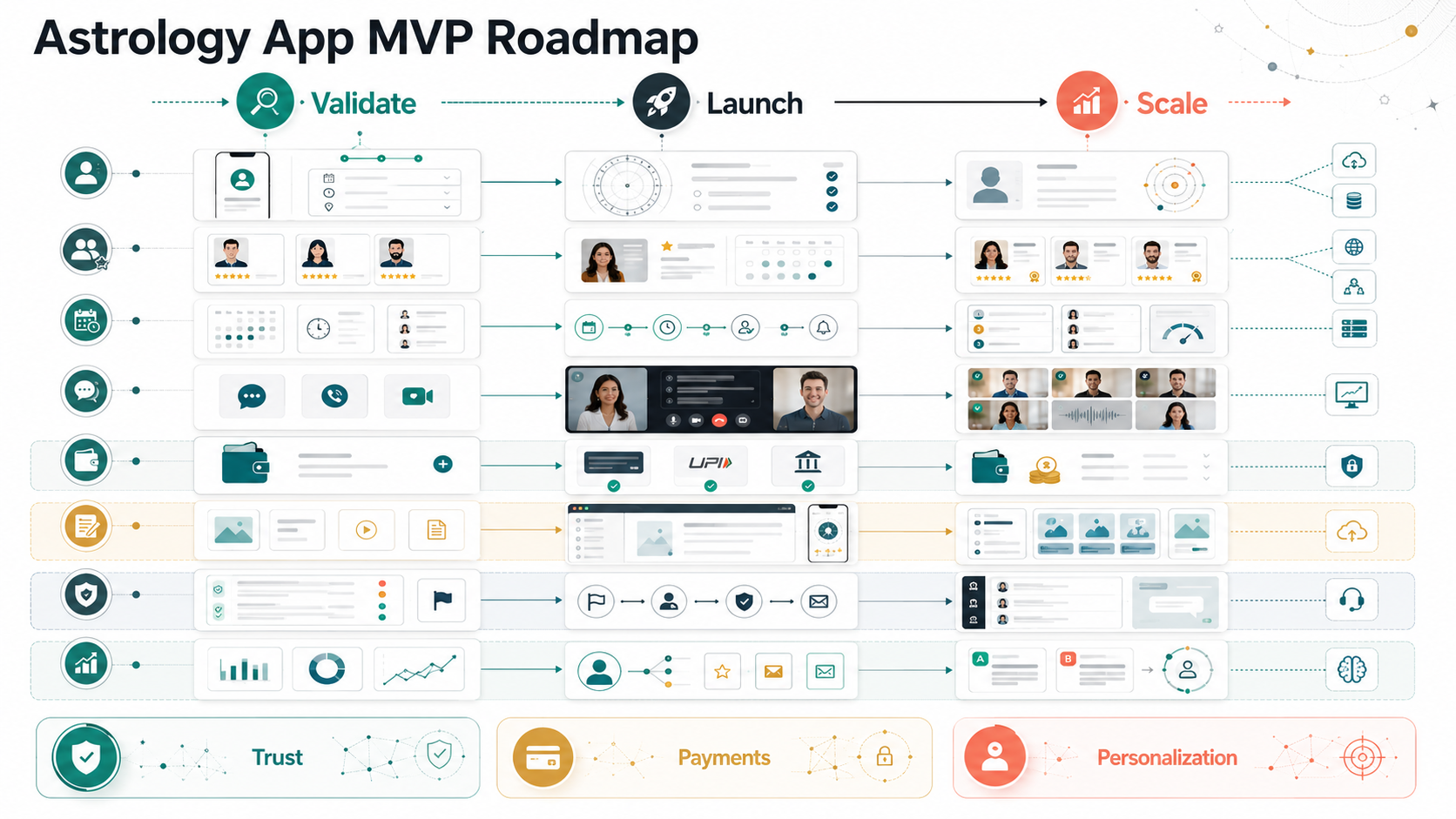
Why Astrology Apps Need A Roadmap Instead Of A Feature Dump
Astrology app features can quickly sprawl. A founder may want daily horoscopes, live chat, kundli matching, video calls, paid reports, wallet credits, subscriptions, astrologer onboarding, recommendations, admin dashboards, support tickets, referral campaigns, and multilingual content. All of those can be valid, but not all of them belong in version one.
The practical question is not "How many features can we list?" It is "Which features prove the business model without creating avoidable operational risk?" Advice-heavy apps handle sensitive questions, payment disputes, session quality, trust signals, privacy expectations, and content review. That makes the MVP more like a managed service marketplace than a simple content app.
NextPage's Astrology App Development Services page covers the broader platform options. This guide focuses on the roadmap: what to build first, what to postpone, and how to protect the first release from becoming too heavy to launch.
The Four Principles Behind A Strong Astrology App MVP
A strong astrology app MVP follows four principles. First, every feature should support one core journey: discovery, booking, consultation, payment, or retention. Second, trust and privacy are product requirements, not polish. Third, admin and support workflows should launch with the marketplace, because session disputes and refunds will not wait for phase two. Fourth, personalization should start with transparent preferences and behavior signals before advanced prediction or AI features.
These principles keep the product focused. A horoscope content app can launch with a simpler stack than a live-consultation marketplace. A consultation marketplace needs scheduling, payments, role-based dashboards, and moderation. A spiritual commerce platform needs product catalog, order flows, wallet or subscriptions, and customer support. Choose one primary model first.
User Onboarding, Birth Details, And Consent
User onboarding should collect only the data needed for the first useful experience. For astrology products, that often includes name, birth date, birth time, birth place, preferred language, consultation interest, and notification preferences. Some teams also ask relationship status, career interest, or wellness intent, but these fields should be optional unless they directly affect the first release.
Because birth details, location, chat history, and payment information can feel personal, privacy copy should be clear. Explain why the app asks for each data point, what the user can edit, and how support or astrologers can access session information. Google Play's user-data policy treats personal and sensitive user data seriously, and Apple also expects clear privacy details for collected data. The software choice is simple: collect less, explain more, and keep consent revocable.
A good MVP onboarding flow should include account creation, basic profile, birth details, language, consent, and a first suggested action. Do not add a long questionnaire just because personalization is on the roadmap. Long onboarding creates drop-off before users see value.
Astrologer Profiles, Search, And Discovery
Astrologer profiles are the storefront of a consultation app. The MVP profile should include display name, areas of expertise, languages, consultation modes, experience summary, pricing, rating or review signals, availability, response expectations, and verification status. If the product works in a region where certifications or identity checks matter, the admin workflow must record those checks without exposing private documents to users.
Search and filters should start practical: language, expertise, price, availability, consultation mode, and rating. Advanced matching can wait. If you launch ranking too early, you may create trust and fairness problems before you have enough booking data to rank responsibly.
For products that share some marketplace logic with matchmaking or advice-heavy platforms, NextPage's Matrimonial App Development Company page is useful context because profile quality, verification, privacy, reporting, and trust controls are similar operating concerns.
Booking And Availability Workflow
Booking is the center of the MVP. Users need to see when an astrologer is available, choose a slot or instant queue, confirm the consultation mode, pay or reserve credits, receive reminders, and join the session without confusion. Astrologers need a schedule, booking rules, cancellation controls, session status, and a way to mark completion.
There are two common models. Scheduled booking works well for premium consultations, specific experts, and longer sessions. Instant queue works well for quick chat or short calls. Many teams want both, but the MVP should start with the model that best matches the first revenue path. Supporting both doubles edge cases around availability, refunds, no-shows, and support.
If your product also needs maps, push, chat, video, or third-party calendars, use the Mobile App Integrations Checklist before estimating development. Integrations usually drive more delivery risk than the visible screens suggest.
Chat, Audio, And Video Consultation Modes
Consultation mode is a business decision as much as a technical one. Text chat is easier to moderate and audit, but users may expect real-time response. Audio feels personal and lower bandwidth than video, but it needs call reliability and clear billing. Video creates a premium experience, but it adds device permissions, bandwidth issues, recording policy questions, and more QA scenarios.
For an MVP, pick one default consultation mode and make it reliable. If chat is the first mode, build session start/end, message status, typing state, payment timer, support escalation, and transcript retention rules. If audio or video is first, define reconnection behavior, failed-call refunds, device permission copy, call quality expectations, and session completion rules.
Do not hide operational rules in admin training. They belong in product flows: what happens when the astrologer is late, when a user disconnects, when payment fails, or when the session needs support review.
Wallet Credits, Payments, And Subscriptions
Astrology apps often use wallet credits because consultation billing may depend on session length, astrologer rate, promotional credits, or prepaid packages. A simple MVP can support prepaid credits, direct checkout, or a fixed-price booking. Choose the model that makes disputes easiest to handle.
Wallets and stored value require careful ledger design. Track credit purchase, hold, debit, refund, bonus credit, expiry, and adjustment separately. Do not treat a wallet as a single mutable balance without an audit trail. If the roadmap includes wallet-heavy flows, NextPage's eWallet App Development Services page gives useful scope context around transaction products, ledgers, and security.
Subscriptions are better as a growth feature unless the MVP is content-first. A subscription can work for daily horoscopes, premium reports, or member discounts, but it complicates renewals, cancellation, app-store rules, support, and revenue recognition. For a consultation marketplace, prove booking demand first.
Content CMS And Horoscope Workflows
Astrology apps need content even when live consultations are the monetization engine. Daily horoscopes, weekly forecasts, compatibility notes, festival content, educational explainers, and promotional landing pages can create repeat usage between paid sessions. The MVP CMS should let admins publish content by zodiac sign, topic, language, date, and audience segment.
Personalized reports and generated interpretations should start constrained. Templates, expert-reviewed content, and clear disclaimers are safer than fully open-ended outputs. If AI-assisted content is on the roadmap, define review rules, confidence boundaries, blocked topics, and escalation paths before launch. The product should never present sensitive advice as guaranteed outcomes.
This is where growth-stage personalization can become powerful. Preferences, reading history, booking behavior, language, and content engagement can inform recommendations without pretending the system knows more than it does.
Astrology App Feature Priority Matrix
The best way to control scope is to sort features by release value and operating risk. MVP features should prove the core transaction and trust model. Should-have features improve conversion and retention. Later-phase features need more data, governance, or support maturity.
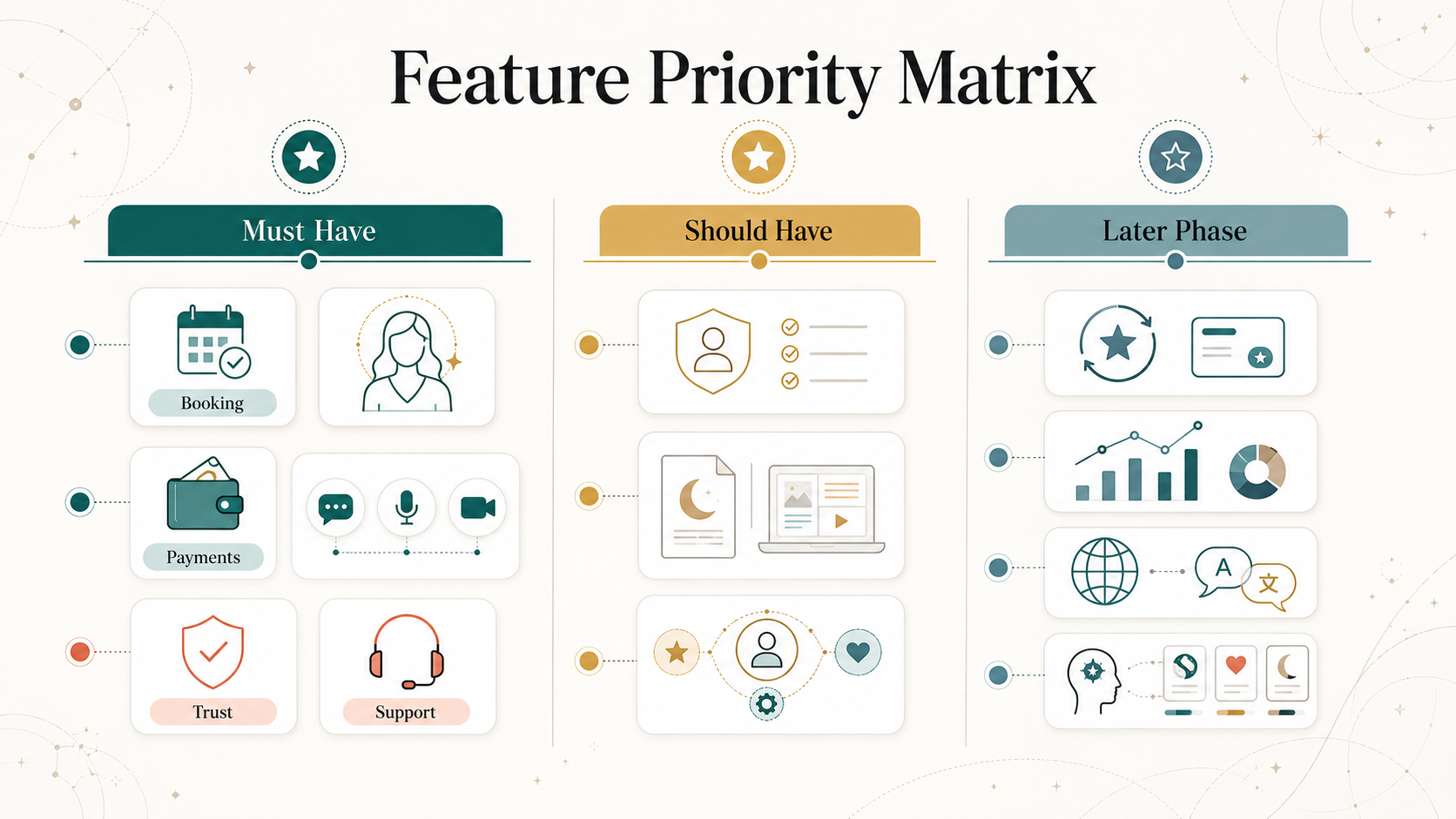
| Feature Area | MVP Version | Growth Version | Why It Matters |
|---|---|---|---|
| Onboarding | Account, birth details, language, consent | Preference quiz and guided recommendations | Creates the first useful profile without slowing signup |
| Astrologer Discovery | Profiles, expertise, language, price, availability | Ranking, matching, promoted experts | Helps users choose with confidence |
| Booking | Scheduled slot or instant queue | Hybrid booking, packages, recurring sessions | Turns interest into paid usage |
| Payments | Checkout or wallet credits with audit trail | Subscriptions, coupons, loyalty, bundles | Protects revenue and reduces disputes |
| Moderation | Reports, support queue, content review | Risk scoring and automated routing | Protects users, experts, and platform trust |
| Personalization | Language, topic, and history-based suggestions | AI-assisted recommendations and report generation | Improves retention after the core flow works |
Admin Dashboard, Moderation, And Support
The admin dashboard is not optional for an astrology marketplace. Admins need to manage astrologers, expertise categories, pricing, availability, user reports, payments, refunds, content, promotions, and support cases. Without admin tooling, every edge case becomes a developer ticket or manual database edit.
Moderation should cover chat abuse, sensitive questions, misleading claims, refund disputes, astrologer no-shows, poor session quality, and content corrections. The goal is not to police every interaction manually. The goal is to make serious issues visible, trackable, and resolvable.
Support tools should show the session timeline, payment state, refund eligibility, user complaint, astrologer response, and admin decision history. Audit history matters because payment and trust disputes are easier to resolve when the system records what happened.
Analytics And Personalization Roadmap
Analytics should start with product operations: signup completion, profile completion, search usage, booking conversion, session completion, cancellation, refund rate, repeat booking, content engagement, and support case reasons. These metrics reveal where the MVP is working and where personalization might help.
Personalization can begin simply. Recommend astrologers by language, topic, availability, past sessions, and content interest. Recommend content by zodiac sign, preferred topics, and reading history. Save advanced AI, predictive scoring, and automated advice generation until the platform has enough data and governance to use it responsibly.
If AI is part of the future roadmap, use NextPage's AI Agent Readiness Assessment before turning user chats, birth details, or payment behavior into automated workflows. Advice-heavy products need tighter guardrails than ordinary recommendation engines.
Multilingual And Regional Rollout
Astrology products often serve users across languages, regions, traditions, and consultation styles. That does not mean every language belongs in the first release. Start with the language and market that best matches the first astrologer network, content pipeline, and support team.
The MVP should support a multilingual-ready structure even if it launches in one or two languages. Store content keys, astrologer language availability, translation status, user language preferences, and support categories cleanly. Retrofitting localization after launch is expensive when content, notifications, FAQs, reports, and admin workflows are all hard-coded.
For release planning, pair the multilingual roadmap with app-store readiness. NextPage's App Store Optimization guide is a useful reminder that app descriptions, screenshots, keywords, and trust claims should match the market you are launching into.
Security, Privacy, And Store Readiness
An astrology app may not be regulated like a clinical product, but it can still touch sensitive user intent. Users may ask about relationships, career, finances, health worries, family matters, or personal crises. Store only what the product needs, protect payment and chat data, make account deletion clear, and separate internal analytics from private consultation content.
Security basics include encrypted transport, secure token storage, least-privilege admin access, audit logs, payment-webhook validation, rate limiting, abuse reporting, and role-based dashboard permissions. If the product includes live chat, audio, or video, also define recording policy, transcript retention, and support access rules.
Before launch, run mobile QA across devices, notifications, payment states, permissions, offline behavior, and app-store flows. The Mobile App Testing Checklist helps turn that into release evidence instead of a last-minute smoke test.
Team, Timeline, And Cost Drivers
The timeline depends on platform choice, consultation mode, payment model, admin depth, content complexity, and integration count. A narrow MVP with one mobile platform, one consultation mode, basic wallet or checkout, and a focused admin dashboard is very different from a multi-language marketplace with chat, audio, video, subscriptions, AI personalization, and complex astrologer operations.
Most builds need product strategy, UX, mobile engineering, backend engineering, QA, DevOps, and a project lead. Video calling, wallet ledgers, AI features, or advanced analytics may add specialist work. For budget planning, use NextPage's Custom Software Cost Estimator and compare the output with the Mobile App Development Cost 2026 guide.
The best estimate is not a universal astrology-app average. It is a scoped release plan that shows which user roles, workflows, integrations, content operations, payment rules, and support controls are included in version one.
Astrology App MVP Launch Checklist
- Define the core model: content app, consultation marketplace, spiritual commerce, or hybrid platform.
- Pick one first consultation flow: scheduled booking or instant queue, not both unless the budget supports it.
- Map payment rules: checkout, wallet credits, refunds, holds, bonuses, expiry, and disputes.
- Design trust controls: verification, ratings, support, reports, disclaimers, and moderation queues.
- Limit personalization: start with preferences and behavior before advanced AI or predictive features.
- Prepare admin operations: astrologers, pricing, availability, content, payments, support, and audit history.
- Validate release evidence: payment tests, device tests, permission states, failed sessions, and support scenarios.
How NextPage Helps Scope Astrology App Development
NextPage helps founders and product teams turn astrology app ideas into buildable MVP roadmaps. That can include feature prioritization, UX flows, mobile app architecture, booking and consultation workflows, wallet or payment design, admin dashboards, content operations, moderation, QA, and production launch support.
The strongest first engagement is usually a focused MVP scoping session: what user journey proves demand, which trust controls must launch from day one, which integrations create the biggest risk, and which features should wait for real usage data. That keeps the first release useful, easier to test, and more honest about the work required to scale.