
An automotive parts eCommerce platform is not a normal online store with a bigger catalog. It has to answer one hard question thousands of times a day: will this exact part fit this exact vehicle, at the right price, from the right warehouse, with enough confidence for a buyer to place the order? The platform architecture has to connect fitment data, SKU normalization, inventory sync, B2B pricing, search, returns, payments, and ERP or PIM systems into one operating model.
For distributors, aftermarket sellers, and B2B commerce teams, the practical roadmap starts with data before design. A polished storefront cannot fix weak interchange data, stale stock, unclear dealer pricing, or manual order handoffs. The safest path is to build the first release around a complete transaction loop: vehicle lookup, compatible product discovery, account-specific pricing, inventory promise, checkout, ERP order creation, and exception handling.
If you need a directional scope before vendor calls, use NextPage's Custom Software Cost Estimator. It helps turn catalog size, user roles, integrations, workflow complexity, and support expectations into a more realistic planning range.
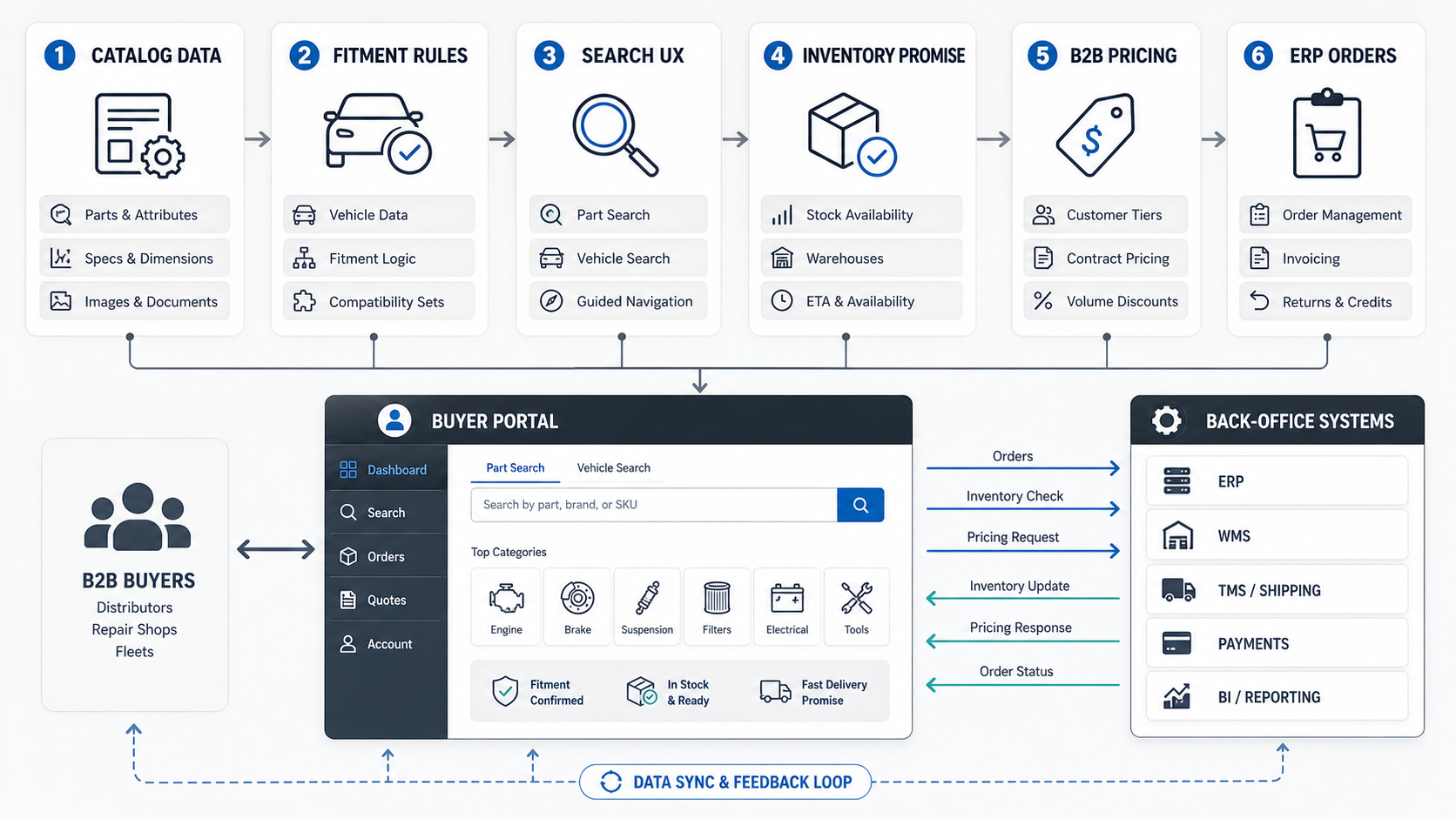
Quick Answer: Automotive Parts eCommerce Platform Development
Automotive parts eCommerce platform development should begin with the catalog and fitment model, not the visual storefront. A strong roadmap defines how products, vehicles, compatibility rules, substitutions, inventory, pricing, accounts, and orders move between the commerce layer and operational systems.
| Roadmap Layer | What It Solves | What To Prove Before Scaling |
|---|---|---|
| Catalog and fitment foundation | SKU structure, product attributes, ACES/PIES-style data, year-make-model logic, interchange, and vehicle selectors. | Real product data imports cleanly and buyers can find compatible parts without keyword guessing. |
| Search and discovery | Part number lookup, faceted filters, synonym handling, category navigation, and compatibility warnings. | Common buyer paths return the right part family, not just broadly related products. |
| Inventory and pricing | Warehouse availability, backorders, dealer pricing, contract pricing, volume breaks, and quote workflows. | The cart reflects price and stock rules buyers actually see in the ERP or distributor system. |
| Transaction loop | Checkout, tax, shipping, payment, purchase orders, ERP order creation, and order status updates. | Orders can flow end to end without staff retyping line items. |
| Scale and automation | PIM governance, analytics, returns, fraud controls, AI recommendations, and self-service account tools. | The platform reduces support tickets, wrong-part returns, and manual sales ops workload. |
This is why automotive commerce often needs custom engineering even when the storefront starts on Shopify, BigCommerce, Magento, WooCommerce, OroCommerce, or a specialist parts platform. The commodity storefront is only one part of the system. The differentiator is the data and integration layer behind it.
Why Generic Commerce Platforms Break In Auto Parts
Generic commerce platforms are optimized for products that can be described by a small set of attributes: name, image, price, variants, stock, and shipping. Auto parts catalogs are denser. One brake pad, sensor, filter, headlamp, battery, or suspension component may need fitment rules, OEM cross references, aftermarket interchange numbers, position notes, trim exclusions, engine variants, supplier feeds, dimensions, warranty rules, hazardous shipping flags, and different pricing for retail, installer, fleet, dealer, and marketplace channels.
The issue is not whether a storefront can display many SKUs. The issue is whether the platform can keep data structured enough for search, filtering, recommendations, sales reps, and integrations to trust it. If fitment gets stuffed into product descriptions, customers cannot filter reliably. If inventory is batch-updated once a day, fast-moving SKUs oversell. If dealer pricing sits in spreadsheets, sales reps become the real checkout engine.
NextPage sees the same pattern in broader custom software development cost planning: the budget follows workflow risk, integration depth, data quality, and support requirements more than screen count. Auto parts commerce simply makes those risks visible earlier.
Build The Catalog And Fitment Data Model First
The first architectural decision is where product truth lives. Smaller sellers may manage products directly in the commerce platform with fitment apps. Larger distributors usually need a PIM, ERP, supplier-feed pipeline, or custom catalog service that normalizes product records before publishing them to the storefront.
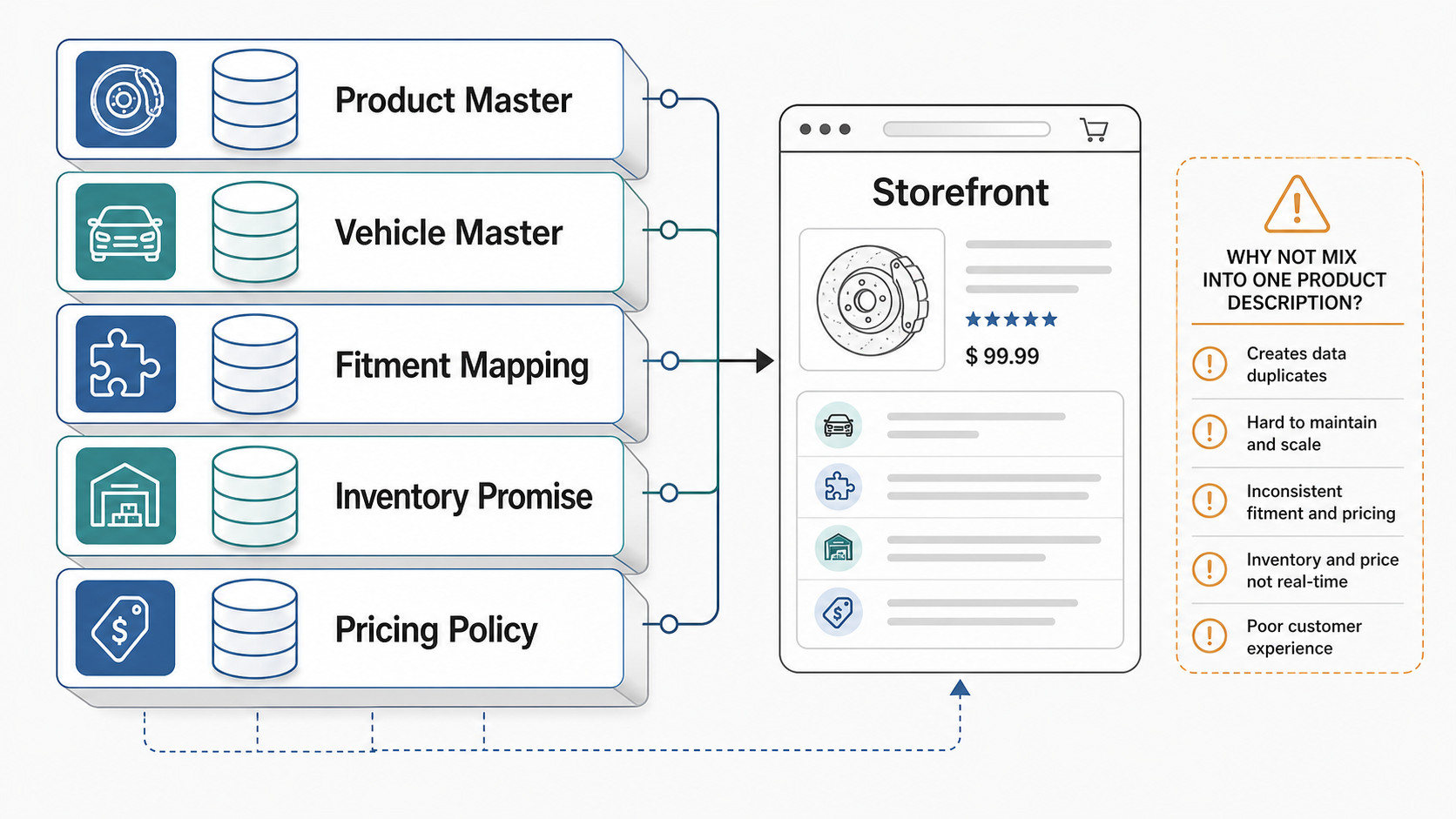
A useful catalog model separates product identity from fitment compatibility. Product identity includes SKU, brand, part number, category, attributes, media, descriptions, warranty, dimensions, and supplier. Fitment compatibility maps products to vehicles, trims, engines, positions, notes, and exclusions. Inventory and price should remain separate again, because they change more frequently than product attributes.
| Data Object | Example Fields | Common Failure Mode |
|---|---|---|
| Product master | SKU, brand, part number, category, attributes, image set, warranty, dimensions. | Duplicate SKUs, inconsistent attributes, poor category mapping, and missing media. |
| Vehicle master | Year, make, model, trim, engine, drivetrain, region, body style. | Fitment works for broad models but fails on trim, engine, or position-specific cases. |
| Fitment mapping | Product-to-vehicle relation, notes, exclusions, position, interchange, confidence. | Incorrect compatibility recommendations and higher wrong-part returns. |
| Inventory promise | Warehouse stock, lead time, dropship status, backorder rules, reservation logic. | Products show as available even when they cannot ship on time. |
| Pricing policy | Retail, account, dealer, contract, tier, promo, margin, approval rules. | B2B customers call sales because online pricing does not match negotiated terms. |
The MVP should include a real import from actual catalog data, not a hand-cleaned sample. Importing 5,000 messy SKUs teaches more than designing 50 perfect records. The test should measure import time, validation errors, missing attributes, fitment coverage, search relevance, and storefront performance. If product records are being moved from an older store or supplier feed, the same mapping discipline used in product data migration to WooCommerce applies: preserve external keys, normalize attributes, and reconcile product counts against usable storefront behavior.
Catalog Governance Rules To Set Before Launch
Before engineering starts, name an owner for every major data object. Product managers may own category and attribute rules, operations may own inventory promises, finance may own price rules, and sales may own customer-specific terms. The platform should make those boundaries visible through import validation, approval states, change logs, and exception reports.
For automotive teams using ACES and PIES-style data, treat standards as an exchange format, not as a substitute for governance. ACES helps structure application and fitment data, while PIES supports product information such as descriptions, attributes, dimensions, and digital assets. The business still needs rules for missing values, substitutions, regional exceptions, superseded part numbers, and supplier feed conflicts.
Design Fitment Search As A Product Workflow
Year-make-model search is often treated as a widget. It should be treated as a product workflow. A buyer may search by vehicle, part number, VIN, category, brand, symptom, or prior order. A professional buyer may want to paste a list of SKUs, reorder from history, or search by interchange. A consumer may need guardrails that explain why a part is compatible or why a similar-looking part is not.
The platform should support multiple discovery paths: vehicle selector, part number search, category browse, saved garage, account-specific favorites, and sales-rep assisted lookup. Search should handle typos, synonyms, brand aliases, OEM and aftermarket part numbers, and no-result recovery. Filters should not expose irrelevant options once the vehicle context is selected. For larger catalogs, search quality should be tested as an operating workflow, similar to the integration and search-risk planning in NextPage's eCommerce app development cost guide.
For the first release, pick the highest-value buyer path and make it complete. For example, a distributor selling to repair shops may prioritize account login, vehicle lookup, part number search, live stock, purchase orders, and fast reorder. A DTC aftermarket seller may prioritize SEO category pages, guided fitment, rich product pages, checkout, and returns instructions.
Connect Inventory, Pricing, And ERP Before Adding More Features
Inventory and pricing decide whether the platform can replace phone and email workflows. Auto parts buyers often care about which warehouse has stock, when it can ship, whether substitutions are allowed, and whether their negotiated price is honored. These rules usually live in ERP, WMS, dealer management, pricing engines, or legacy systems.
For B2B portals, the commerce layer needs account hierarchy, buyer roles, credit limits, purchase-order checkout, quote workflows, approval routing, contract pricing, tax rules, order history, invoice access, and sales-rep visibility. NextPage's B2B eCommerce portal development roadmap is relevant here because automotive buyers rarely operate like anonymous retail shoppers.
ERP integration should be designed around events, not just nightly sync. Product and price updates may tolerate scheduled jobs. Stock, order creation, payment status, shipment updates, and cancellations often need near-real-time handling, retries, audit logs, and exception queues. When the ERP is the system of record, the storefront should show operational truth rather than optimistic marketing copy. If the ERP, warehouse, or distribution environment is heavily customized, compare the integration work with the module and ownership patterns in the manufacturing ERP implementation guide.
If inventory, purchasing, fulfillment, or finance workflows need custom modules, NextPage's custom ERP development services page maps the service-side approach: focused modules, integrations, dashboards, and role-specific workflows around operations data.
A Practical MVP Roadmap
Phase 1: data discovery and platform decision. Inventory the catalog sources, fitment data, supplier feeds, ERP/WMS systems, pricing rules, customer account model, sales channels, and returns process. Decide whether the first release can use a commerce platform with apps or needs a custom catalog service.
Phase 2: catalog and fitment foundation. Normalize SKUs, product categories, attributes, media, vehicle data, fitment rules, and validation checks. Build import jobs, admin review screens, and error reports before polishing the storefront.
Phase 3: first transaction loop. Launch one complete buyer journey: vehicle or part lookup, compatible product page, account pricing, inventory promise, cart, checkout, order creation, confirmation, and order status. This loop is more valuable than ten partial features.
Phase 4: B2B and operational depth. Add quote flows, purchase orders, contract pricing, user roles, saved lists, account dashboards, sales-rep tools, returns, invoices, and customer-specific catalogs.
Phase 5: scale, analytics, and automation. Add PIM governance, marketplace feeds, advanced recommendations, margin analytics, warehouse routing, fraud controls, and AI-assisted search only after the core data and transaction loop are trustworthy.
If the product is primarily a custom web platform, NextPage's custom eCommerce web app development services page is the closest service fit. If the roadmap includes mobile buyer apps or field-sales workflows, compare the scope against the broader eCommerce app development guide.
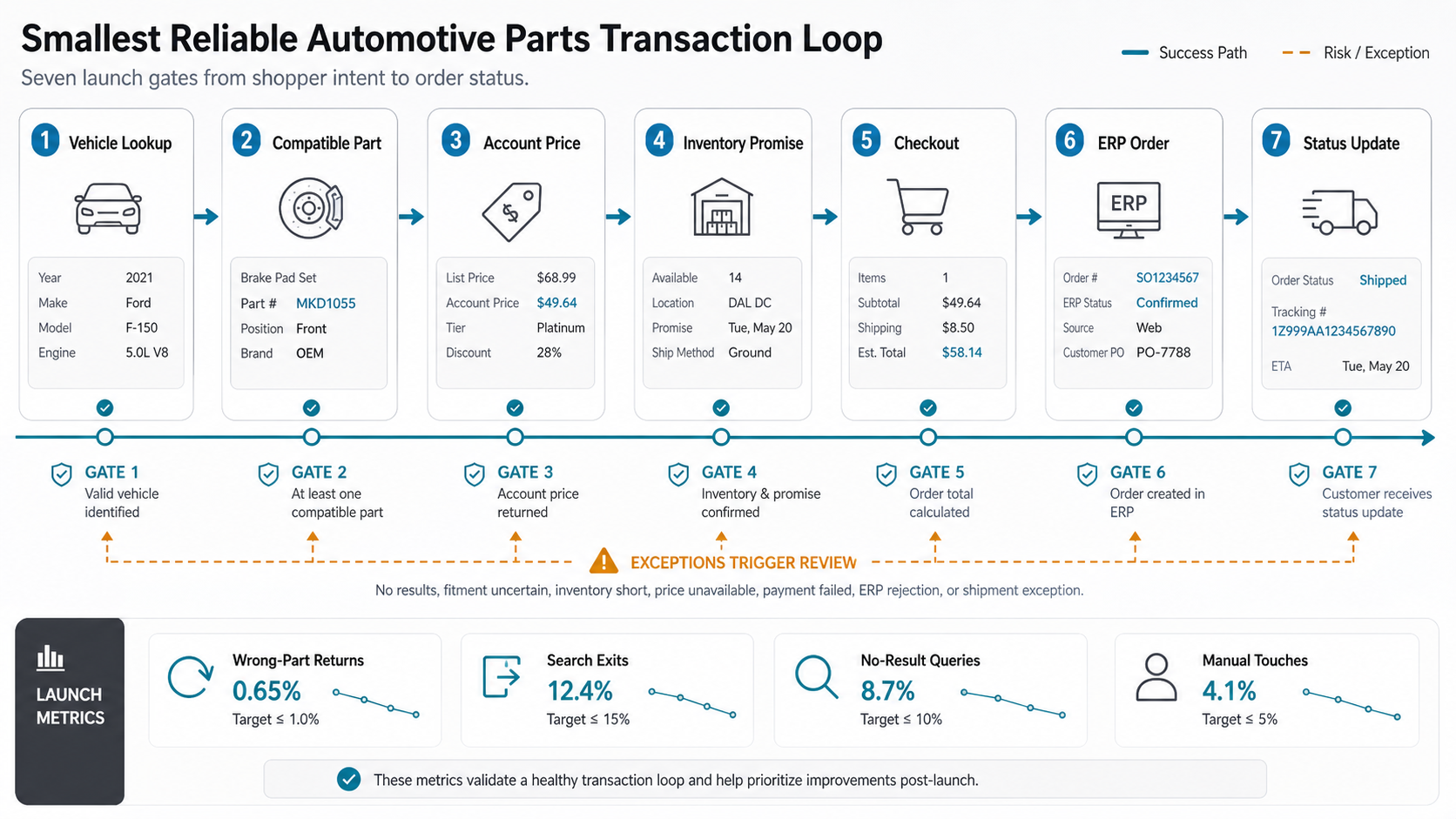
Launch Metrics That Prove The Loop Works
Post-launch analytics should connect buyer behavior to operational outcomes. Track no-result searches, fitment uncertainty, wrong-part returns, inventory promise misses, quote turnaround, manual order touches, ERP rejection reasons, and support tickets by product category. These metrics show whether the platform is reducing operational work or only moving manual work into a new interface.
For teams still deciding how much to build in version one, NextPage's MVP Scope Builder can help separate the first transaction loop from later marketplace, mobile, AI, and analytics features.
Build Vs Buy: When Custom Development Makes Sense
Buy or configure when the business has a manageable catalog, common fitment needs, standard retail pricing, limited integrations, and a team that can live inside the chosen platform's constraints. Many early-stage sellers can start with a hosted storefront, fitment app, supplier-feed connector, and careful data governance.
Build or heavily customize when the operating model is more complex: multiple warehouses, dealer or fleet accounts, negotiated pricing, custom quote rules, high-volume SKU imports, vehicle compatibility edge cases, ERP-driven stock, marketplace syndication, sales-rep workflows, or unique product recommendations. At that point, the commerce platform becomes one interface in a larger system.
Custom does not have to mean rebuilding every commodity feature. The pragmatic approach is to use mature services for payments, tax, email, shipping labels, search infrastructure, and analytics where they fit, then build the parts-specific data and workflow layer that generic tools cannot model cleanly. When leaders are unsure whether to configure, buy, or build, NextPage's Build Vs Buy Decision Tool is a useful way to pressure-test fitment, account pricing, integration, and workflow risk before committing to a platform path.
Automotive Parts eCommerce Cost Drivers
Cost depends on catalog complexity, fitment depth, number of integrations, B2B account rules, storefront customization, migration needs, and support expectations. A focused MVP may stay lean if it proves one buyer journey with a constrained catalog and one ERP integration. A distributor-grade platform with PIM, complex fitment, live warehouse inventory, dealer pricing, quotes, purchase orders, account portals, returns, and analytics requires a larger implementation budget.
| Cost Driver | Why It Matters | Budget Control Move |
|---|---|---|
| Catalog size and quality | Messy product data increases import, validation, search, and support work. | Run a sample import with real SKUs and fix data rules before full migration. |
| Fitment complexity | Trim, engine, position, interchange, and exclusion rules affect search and returns. | Launch with the highest-volume categories first and measure wrong-part risk. |
| ERP/WMS integration | Stock, price, order, shipment, and invoice data often sit outside the storefront. | Define event ownership, retry behavior, and exception queues before coding. |
| B2B pricing and accounts | Contract pricing, PO workflows, roles, and credit rules change checkout logic. | Start with the most common account type and add advanced approval flows later. |
| Performance and search | Large catalogs can slow filtering, imports, and product pages. | Benchmark real search and category pages before expanding SKU volume. |
For budget planning, compare the automotive roadmap with NextPage's custom ERP development cost guide and use the Custom Software Cost Estimator to model catalog size, roles, integrations, workflow complexity, and platform choices. The same principle applies: estimate by workflows, integrations, data risk, and support responsibility.
Implementation Checklist For Auto Parts Teams
- Define the source of truth for products, fitment, price, stock, customers, and orders.
- Run a real catalog import before choosing final architecture.
- Map the top buyer paths: vehicle lookup, part number search, reorder, quote, and sales-rep assisted order.
- Decide which pricing rules must be online on day one and which can remain assisted.
- Document ERP/WMS APIs, rate limits, authentication, sandbox access, data fields, and write-back rules.
- Plan for no-result search, substitute parts, backorders, and fitment uncertainty.
- Measure wrong-part returns, search exits, no-result queries, quote turnaround, and manual order touches after launch.
The best first release is not the largest storefront. It is the smallest reliable operating loop that proves buyers can find the right compatible part, trust the price and inventory, place the order, and receive status without staff rebuilding the order manually behind the scenes.
How NextPage Can Help
NextPage helps commerce and distribution teams scope, design, and build custom eCommerce platforms around operational complexity: catalog data, fitment workflows, ERP and inventory integrations, B2B portals, account pricing, dashboards, and scalable web applications.
A practical engagement starts with product discovery, data and integration audit, MVP scope, architecture plan, and budget model. From there, the team can build the data foundation, buyer experience, admin workflows, and integration layer in phases rather than trying to launch every channel and feature at once. For proof of similar operational software thinking, review the ScanPilot portfolio case study, where field data capture and back-office visibility had to work as one operating loop.