
A strong custom ERP development company should prove how it will understand your operating model, protect data migration, own integrations, test real business exceptions, and support the system after go-live. Do not choose only from a portfolio screenshot, hourly rate, or a generic ERP module list. ERP software becomes part of finance, inventory, procurement, production, HR, reporting, and approvals, so the partner has to show evidence for delivery discipline as well as engineering capacity.
The best shortlisting process starts with requirements discovery, then evaluates ERP-specific risks: master data quality, legacy system dependencies, role permissions, audit trails, integration ownership, rollout sequencing, QA evidence, and post-launch support. If the vendor cannot explain those areas before a proposal, the proposal will usually hide risk in change requests.
If you are early in planning, use the Custom Software Cost Estimator to frame the first budget band. If your project involves legacy modules, data migration, or connected workflows, review custom ERP development services and ERP integration and modernization before you compare vendors.
Quick Answer: How To Choose A Custom ERP Development Company
Choose a custom ERP development company by scoring it on discovery quality, ERP domain fit, integration capability, data migration controls, security and audit design, QA process, delivery model, and support ownership. The right partner should ask about workflows, exceptions, approvals, data ownership, reports, integrations, and rollout risk before estimating the build.
A useful evaluation sequence is:
- Define the operating problem. Clarify which workflows, departments, and records the ERP must control first.
- Ask for discovery artifacts. Look for process maps, role matrices, data inventories, integration diagrams, and release assumptions.
- Pressure-test migration and integration. ERP failures often come from weak source data and unclear system ownership, not weak screens.
- Compare delivery models honestly. Fixed price, time and material, dedicated team, and hybrid milestones each fit different uncertainty levels.
- Verify support and governance. ERP needs launch support, monitoring, change control, and reporting improvements after go-live.
Custom ERP Development Company Scorecard
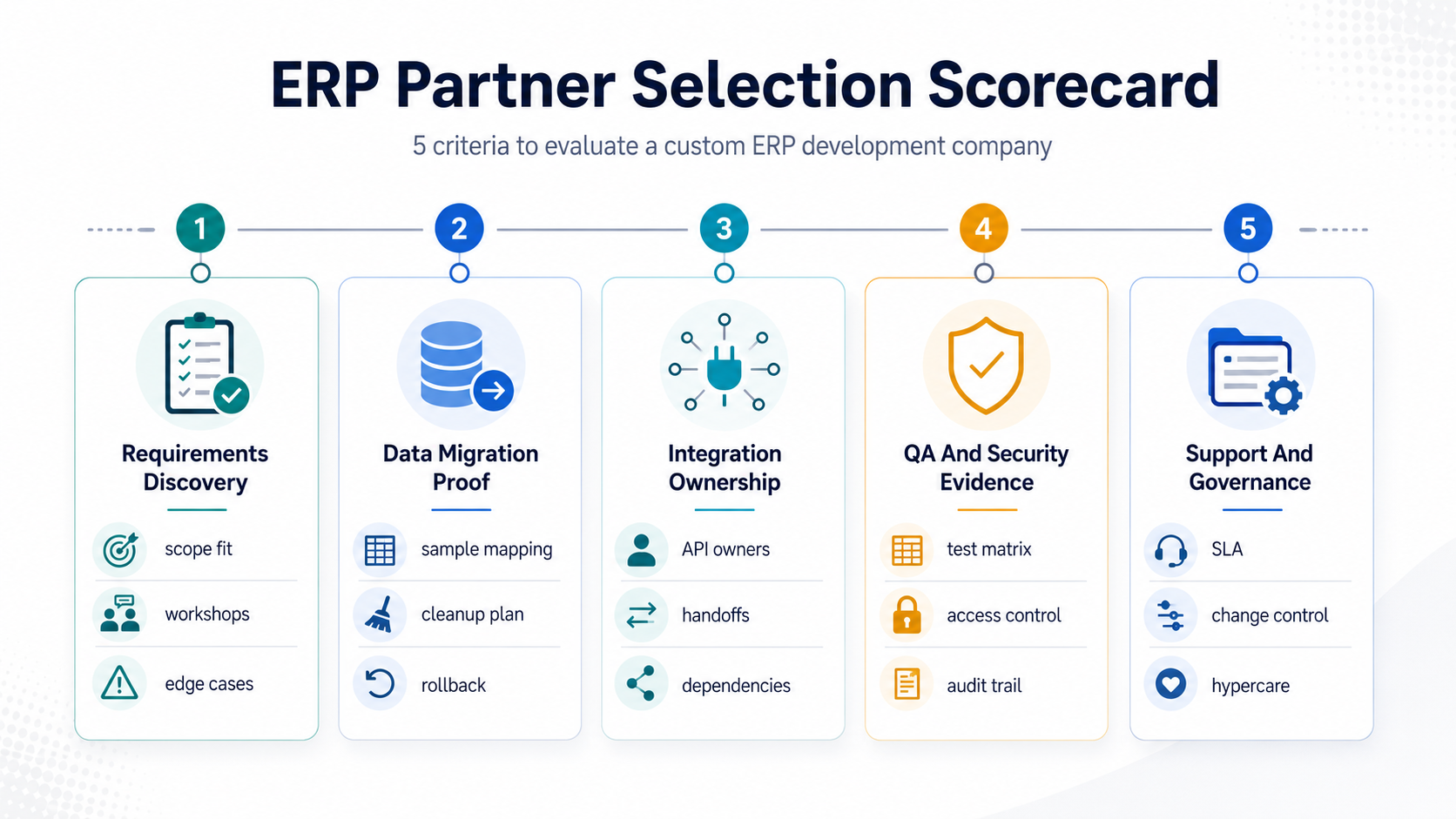
| Evaluation Area | What A Strong Vendor Shows | Red Flag |
|---|---|---|
| Requirements discovery | Workflow maps, user roles, exception paths, reports, compliance needs, and release-one boundaries. | Starts with a feature list before understanding how operations actually run. |
| ERP domain fit | Examples for inventory, procurement, production, finance handoffs, approvals, reporting, or your specific operating model. | Only shows generic dashboards or unrelated SaaS apps. |
| Data migration | Source inventory, field mapping, validation reports, reconciliation plan, rollback approach, and cutover support. | Treats migration as a one-time import near launch. |
| Integrations | Ownership rules, API/webhook/batch patterns, retry handling, sync logs, reconciliation, and failure alerts. | Says “we can integrate anything” without naming data owners or failure paths. |
| Security and permissions | Role-based access, audit logs, approval controls, backups, environment separation, and sensitive data boundaries. | Leaves permissions and audit evidence for the end of the project. |
| QA and rollout | UAT plan, test scenarios for exceptions, parallel runs, training, cutover checklist, and hypercare model. | Tests only happy-path screens and asks users to “try it once” before launch. |
| Support model | Response expectations, monitoring, enhancement process, integration ownership, and release governance. | Offers only ad hoc developer availability after go-live. |
Start With ERP Requirements, Not Vendor Demos
ERP demos can create false confidence because every demo looks clean when it avoids messy exceptions. Real ERP work is about the purchase order that changes after partial receipt, the inventory adjustment that needs approval, the customer record duplicated across systems, the invoice that must reconcile with accounting, and the manager who needs a restricted report without exposing payroll or margin data.
Before vendor calls, document the release-one workflow in plain operational terms. Which department owns the first release? Which existing system remains the source of truth? Which records must migrate? Which reports are required for weekly decisions? Which approval paths are legally, financially, or operationally mandatory?
This is where a focused custom software development company checklist helps, but ERP selection needs a deeper operating lens. You are not just buying software delivery. You are choosing who will translate business controls into a system people rely on daily.
Ask Hard Questions About Migration And Integrations
Many ERP projects get into trouble because the vendor estimates screens while underestimating data and system dependencies. Master data can be inconsistent, product codes may not match across departments, old exports may be manual, and finance may need reconciliation evidence before it trusts the new system.
Ask each vendor to explain the migration workflow before asking for a final price. A credible answer should include data source inventory, mapping rules, cleansing responsibilities, test imports, validation reports, rollback plan, cutover timeline, and post-cutover support. If the vendor cannot name who validates inventory, customers, vendors, chart-of-account mappings, or open transactions, the risk is still with you.
Integrations need the same discipline. ERP systems often connect accounting, CRM, ecommerce, warehouse tools, payroll, supplier portals, BI dashboards, and legacy databases. Ask who owns each record type and what happens when a sync fails. The right vendor should describe retry logic, error queues, sync logs, and reconciliation reports, not just the API endpoint.
For integration-heavy programs, use NextPage's ERP integration and modernization approach as a reference point: stabilize old workflows, define system contracts, modernize the highest-risk modules in phases, and avoid big-bang replacements when a staged rollout is safer.
Choose The Delivery Model That Matches ERP Uncertainty
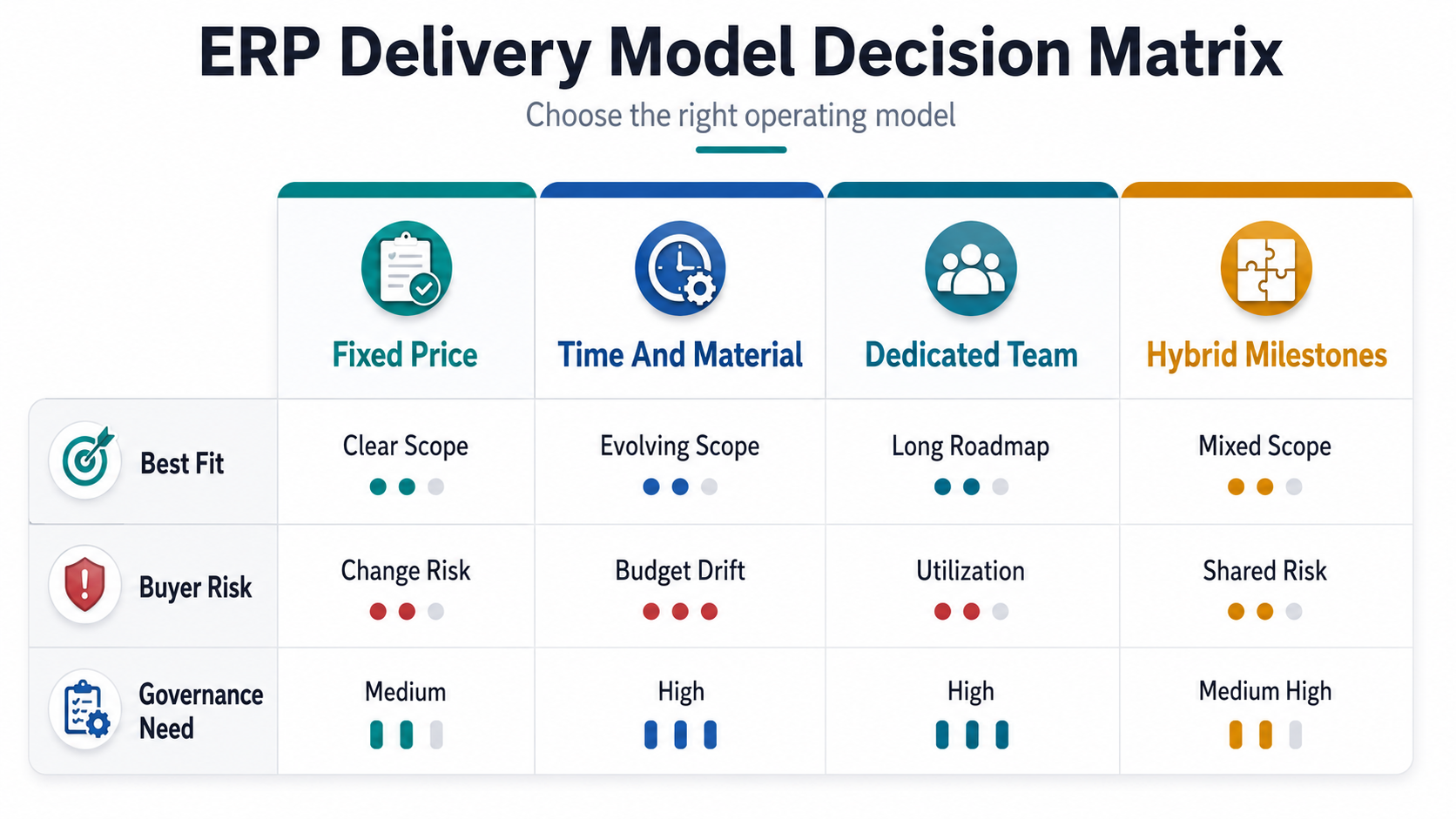
Custom ERP buyers often ask for fixed price because the project feels risky. Fixed price can work for a narrow module with stable workflows, limited integrations, clean data, and clear acceptance criteria. It is dangerous when the project still has unknown data quality, multiple departments, old systems, changing approvals, or unclear reporting requirements.
| Model | Best Fit | Buyer Risk | What To Ask |
|---|---|---|---|
| Fixed price | Narrow, stable module with known workflows and limited integration. | Change requests if discovery was thin. | What assumptions, exclusions, and acceptance criteria are priced? |
| Time and material | Complex discovery, evolving workflows, uncertain migration or integration scope. | Budget drift without governance. | How will sprint scope, burn rate, and decisions be reported? |
| Dedicated ERP team | Phased roadmap, modernization, multiple modules, ongoing support and iteration. | Needs active product ownership. | Which roles are included and who owns architecture, QA, and delivery management? |
| Hybrid milestones | Discovery fixed, pilot capped, later phases estimated from evidence. | Requires honest checkpoints. | What evidence unlocks the next phase? |
If you are comparing India-based delivery models, the Dedicated India Team Cost Calculator can help model team shape and monthly range. The broader guide to software development outsourcing to India is useful when you need to compare managed delivery, staff augmentation, and vendor accountability.
Questions To Ask Before Shortlisting An ERP Vendor
Use these questions in the first two vendor conversations. Strong ERP companies answer with process and evidence. Weak vendors answer with vague confidence.
| Question | What You Want To Hear |
|---|---|
| How do you convert our workflows into ERP requirements? | Discovery workshops, process maps, role matrix, exception catalog, reporting inventory, and release boundary. |
| How do you handle messy source data? | Profiling, cleansing rules, ownership assignment, test imports, validation reports, reconciliation, and rollback. |
| Who owns integration failures after launch? | Clear ownership, monitoring, retry/error handling, logging, support SLA, and escalation path. |
| How do you test ERP permissions and approvals? | Role-based test cases, negative tests, approval-path tests, audit trail checks, and UAT evidence. |
| How do you decide fixed price vs T&M vs dedicated team? | A model based on scope certainty, change frequency, data quality, integration risk, and buyer governance. |
| What happens in the first 90 days after go-live? | Hypercare, issue triage, monitoring, training support, report adjustments, and release governance. |
Red Flags When Comparing Custom ERP Companies
- The estimate arrives before discovery. ERP scope depends on workflows, data, roles, reports, and integrations. A fast number is usually full of assumptions.
- The vendor talks only about modules. Modules matter, but integration ownership, permissions, migration, and support decide whether the system works.
- Migration is described as import/export. ERP migration needs validation and reconciliation, not only file movement.
- QA is limited to screen testing. ERP QA should test approvals, failed syncs, duplicate records, returns, partial orders, permissions, reports, and cutover scenarios.
- Support is undefined. Mission-critical ERP needs response expectations and integration ownership after launch.
- Everything is promised as fixed price. Fixed price without clear assumptions usually means padded scope or painful change control.
How Budget Should Influence Vendor Selection
Budget matters, but the cheapest ERP proposal is rarely the lowest-risk one. Compare vendors by what is included in discovery, data migration, integrations, QA, environments, support, and documentation. A quote that excludes migration validation or post-launch support is not comparable to one that includes those costs.
Use custom ERP development cost planning to separate a focused module from a full operating platform. A vendor may be right for a procurement workflow but wrong for a multi-entity ERP transformation. Another vendor may be strong at integrations but too heavy for a narrow internal tool. Match vendor shape to program risk.
A good proposal should show release-one scope, phase-two exclusions, assumptions, acceptance criteria, data and integration responsibilities, security controls, rollout plan, support model, and team roles. If those pieces are missing, the total price is not yet a decision-quality estimate.
How NextPage Helps With Custom ERP Vendor Decisions
NextPage approaches ERP selection from the operating model first. We map the workflow, users, records, approval paths, reports, source systems, integration dependencies, migration risk, QA scenarios, and support expectations before turning the idea into a build plan. That makes it easier to decide whether you need a fixed-scope module, a dedicated ERP team, or a phased modernization program.
If you are comparing vendors, start with a short discovery review. We can help pressure-test the release-one workflow, identify hidden integration and migration risk, and convert the ERP idea into a vendor-ready scorecard. From there, the next step can be a cost estimate, a custom ERP development plan, or an integration modernization roadmap.