
Quick Answer: Community Spaces In Pet Care Apps
Community spaces in pet care apps help owners move from isolated task management to a trusted network of advice, local services, events, and peer support. The best pet care products still handle core jobs such as profiles, vaccination records, reminders, bookings, and health notes, but the community layer makes the app worth reopening between appointments.
For founders, the practical goal is not to bolt a social feed onto a pet profile app. It is to design a safe operating system for pet owners: verified profiles, species-aware groups, question-and-answer threads, local recommendations, playdates, lost-pet alerts, vet and groomer discovery, moderation, and clear monetization. If you are planning the build, NextPage's mobile app development team can help turn that scope into a staged MVP rather than an overloaded first release.
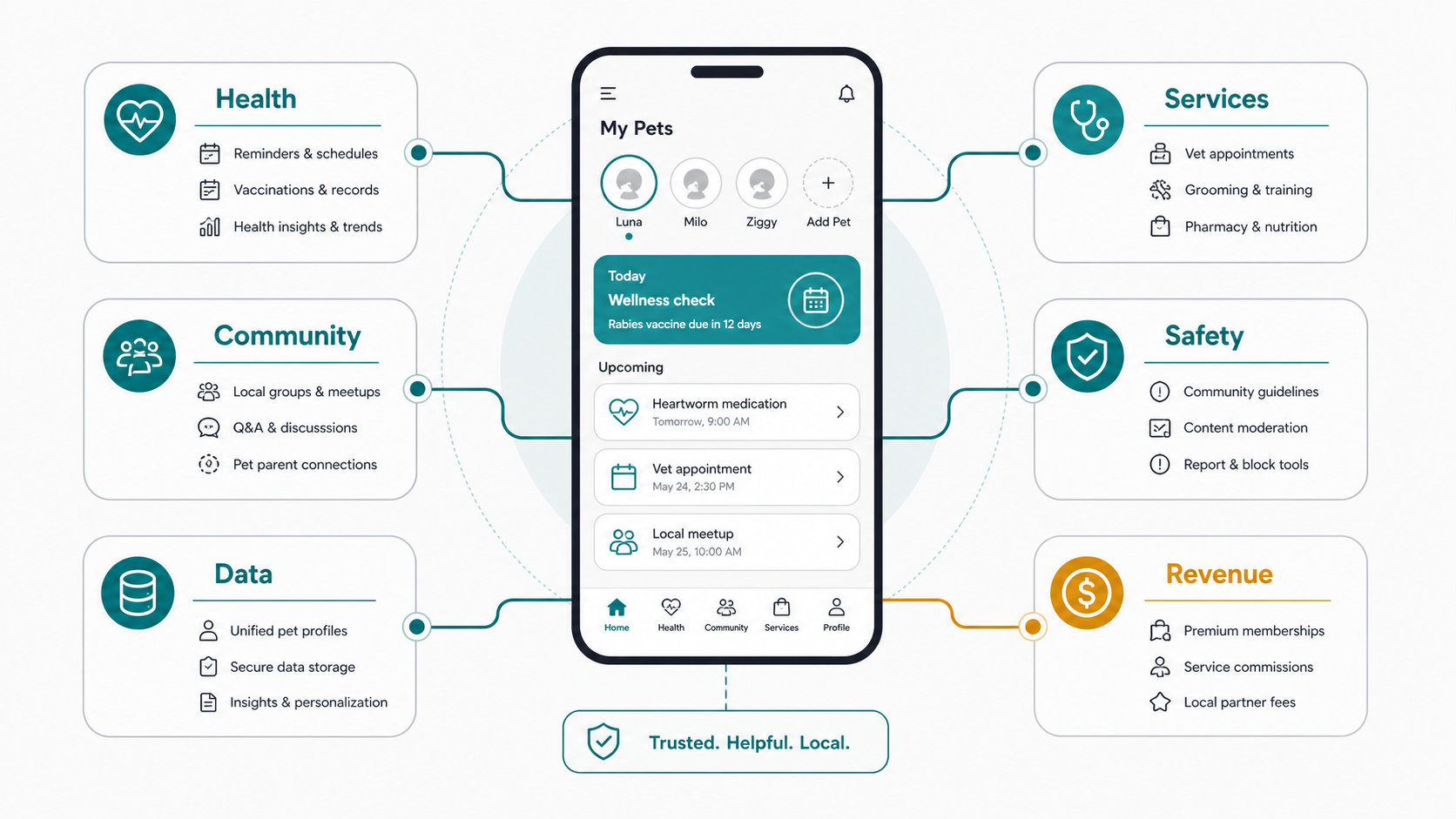
Why Community Matters In A Pet Care App
Pet owners need more than reminders. They look for trusted advice when a symptom feels unusual, local suggestions when choosing a groomer, practical tips for behavior issues, and reassurance from people who understand the same breed, age, or care routine. A community space gives the product a reason to exist between transactional moments.
That engagement matters commercially. Appointment scheduling, medication reminders, vaccination history, and food logs are useful, but many users only open them when something is due. Forums, Q&A, local events, rescue updates, product recommendations, and peer stories create repeat visits. The app becomes a habit, not just a database.
The article's previous version treated community as one feature in a list. A better product strategy treats community as the engagement layer that supports health management, service discovery, retention, and monetization.
Core Product Foundation Before Social Features
Before adding groups or feeds, the app needs reliable core care workflows. Build pet profiles with species, breed, age, weight, medical notes, vaccination records, allergies, dietary needs, insurance information, and emergency contacts. Add reminders for medication, grooming, checkups, meals, and recurring supplies. Connect those reminders to useful context instead of sending generic push notifications.
For example, a rabies vaccination reminder can include the last vaccine date, vet contact, appointment booking link, and local regulation note. A medication reminder can include dosage, timing, refill date, and a caregiver handoff note. Similar patterns appear in healthcare products; this guide on scheduling and reminders in doctor appointment booking apps is useful when translating appointment logic into pet care workflows.
The community layer should sit on top of this foundation. A user who asks a health question should be able to share relevant context safely. A user joining a local group should be matched by location, pet type, preferences, and safety rules. A user booking a service should see reviews and community signals without exposing private health data.
Community Features That Create Real Utility
Useful community features solve specific owner problems. Broad social feeds tend to get noisy quickly. Instead, design spaces around jobs to be done:
| Community need | Feature pattern | Product value |
|---|---|---|
| Advice from similar owners | Breed, age, location, and condition-specific groups | Higher relevance and stronger repeat visits |
| Trusted answers | Q&A threads with expert tags and moderation | Better information quality and reduced misinformation |
| Local discovery | Vet, groomer, trainer, walker, and boarding recommendations | Commercial partner opportunities |
| Offline connection | Playdates, walks, adoption events, and meetups | Community depth beyond the app |
| Safety incidents | Lost-pet alerts, hazard reports, and emergency broadcasts | High-trust utility during urgent moments |
Feature selection should come from real user segments, not assumptions. If you have not mapped owner types yet, review why user personas matter in app development. A first-time puppy owner, senior-dog caregiver, exotic-pet owner, breeder, shelter volunteer, and multi-pet household will not use the community in the same way.
Trust, Safety, And Moderation Are Product Features
Pet care communities touch emotional, medical, location, and marketplace data. That makes trust and safety central to the product, not a policy page added later. Users should understand what advice is peer experience, what comes from a verified professional, and what requires a veterinarian. The app should prevent dangerous medical claims, abusive behavior, spam, scams, and unsafe meetups.
Start with verified profiles, reporting tools, content categories, blocked terms, expert labels, private messaging controls, and clear escalation routes. For local events or playdates, add location privacy, RSVP controls, age and size matching, and optional host verification. For service recommendations, separate organic reviews from paid placements.
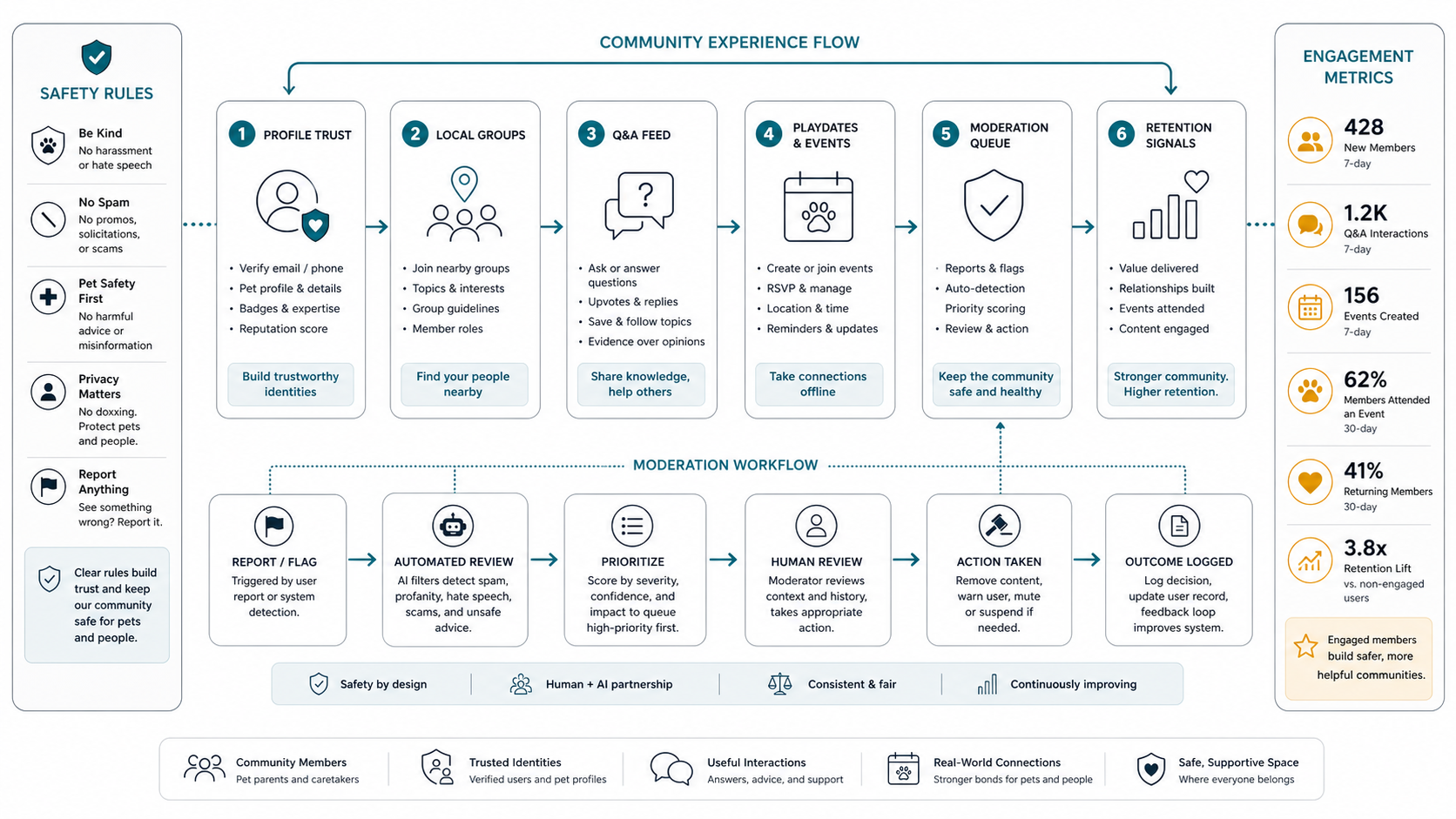
This is also where custom engineering matters. Off-the-shelf social modules rarely understand pet health context, local service workflows, or risk routing. A custom build through custom software development can define the right data boundaries, moderation queues, admin tools, and analytics from the start.
Technology Stack For Modern Pet Care Communities
A pet care community app usually needs a mobile frontend, secure backend, user and pet profile model, notification system, media handling, search, moderation tools, analytics, payments, and integrations. Depending on scope, it may also include GPS features, teleconsultation, wearable or smart feeder integrations, AI-assisted triage, and local marketplace workflows.
Do not add every technology in version one. Prioritize the stack around the product promise. If the core promise is health organization, invest first in records, reminders, caregiver sharing, and vet workflows. If the core promise is local community, invest first in groups, Q&A, location-safe matching, moderation, and events. If the core promise is services, invest first in provider profiles, booking, payments, reviews, and support.
AI can help with symptom intake, content classification, duplicate question detection, spam filtering, and personalized recommendations, but it should not replace veterinary judgment. Keep high-risk guidance routed to professionals and make uncertainty visible.
Monetization Models For Pet Care Community Apps
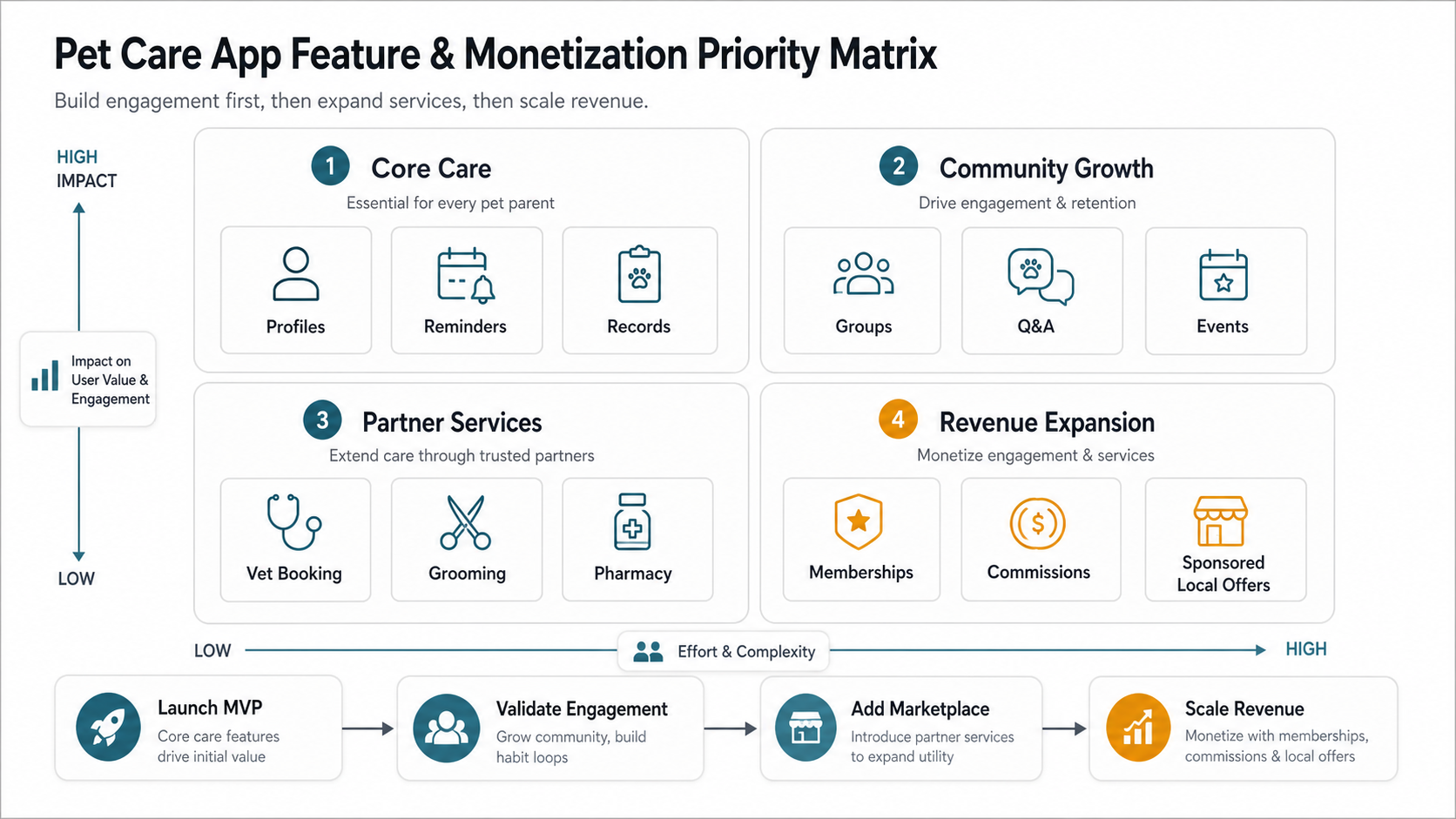
Monetization should follow trust. If the app pushes paid services too early, owners may treat the community as advertising. If the app creates useful care records and real local value first, monetization can feel natural.
| Revenue model | Best fit | Risk to manage |
|---|---|---|
| Freemium subscription | Advanced reminders, family sharing, premium records, and deeper insights | Do not lock essential safety features behind a paywall |
| Marketplace commission | Vet, grooming, walking, boarding, training, and pet supply bookings | Disclose sponsored placements and protect review quality |
| Provider SaaS | Admin tools for clinics, groomers, trainers, shelters, or pet communities | Avoid building a second product before consumer demand is proven |
| Sponsored local offers | Relevant promotions from trusted pet businesses | Keep offers contextual and limited |
If your roadmap includes provider listings, service bookings, commissions, trust workflows, and disputes, compare the scope against NextPage's marketplace app development cost guide. Marketplace logic can quickly become the most complex part of the product.
Development Roadmap From MVP To Scaled Community
A practical MVP should prove one engagement loop and one care utility. For many teams, that means pet profiles, reminders, local Q&A groups, moderation, and a simple provider directory. Avoid launching with every pet type, every city, every service category, and a full social graph at once.
- Discovery: Interview target owner segments, vets, groomers, trainers, and shelters. Define the first community niche.
- MVP: Build profiles, reminders, local groups, Q&A, reporting, admin moderation, and basic analytics.
- Pilot: Launch in one location or owner segment and measure activation, repeat use, useful answers, event participation, and moderation load.
- Service layer: Add provider profiles, booking requests, reviews, and support workflows only after local demand is visible.
- Revenue expansion: Add subscriptions, partner offers, and commissions where they improve the owner experience.
Use a cost model before locking scope. The Custom Software Cost Estimator can help compare a focused MVP against a broader marketplace or community platform build.
Metrics That Show The Community Is Working
Downloads are not enough. A pet care community app should be measured by owner trust and repeated utility. Track profile completion, reminder setup, weekly active owners, answered questions, time to useful answer, repeat group visits, event RSVPs, reported content, moderation response time, provider inquiries, booking conversion, subscription upgrades, and churn.
Community quality matters as much as volume. If a small group consistently solves real owner problems, the app may be healthier than a larger feed full of low-quality posts. Social mechanics from other verticals can help, but they must be adapted carefully. This guide to social media integration in app experiences shows how sharing loops can drive discovery, while pet care requires stricter privacy and safety controls.
Common Mistakes To Avoid
The biggest mistake is building a generic social network and hoping pet owners will supply the value. Strong pet communities are structured around care, locality, trust, and action. Other common mistakes include weak moderation, no expert boundaries, shallow pet profiles, too many features in the MVP, unclear provider incentives, and monetization that feels like advertising.
Another mistake is ignoring operational tooling. Moderators, provider partners, support teams, and content managers need dashboards and workflows. Without them, the app may look polished while the business struggles to keep the community safe and useful.
How NextPage Can Help
NextPage helps founders and product teams design and build pet care apps that connect real care workflows with community engagement. That can include product discovery, UX flows, mobile app development, backend architecture, reminders, service booking, marketplace logic, moderation tooling, analytics, and rollout planning.
If you are deciding whether your pet care product should start as a simple care companion, a local community, or a service marketplace, start by scoping the smallest version that can prove repeat owner value. From there, NextPage can help build the mobile and backend system that supports trust, retention, and revenue without overwhelming the first release.