
Quick Answer: Food Recommendations In Travel Apps
Food recommendations in travel apps should do more than show nearby restaurants. A useful travel product helps people discover local dishes, compare trusted places, match meals to dietary needs, fit dining into an itinerary, and book or save the next stop without leaving the trip flow.
For founders and product teams, the opportunity is not just a restaurant directory. The stronger product is a food discovery layer that combines location, cuisine, trip context, budget, opening hours, accessibility, social proof, and traveler preferences. If you are planning mobile app development for travel, hospitality, food commerce, or destination experiences, food recommendations should be treated as a core journey, not an add-on screen.
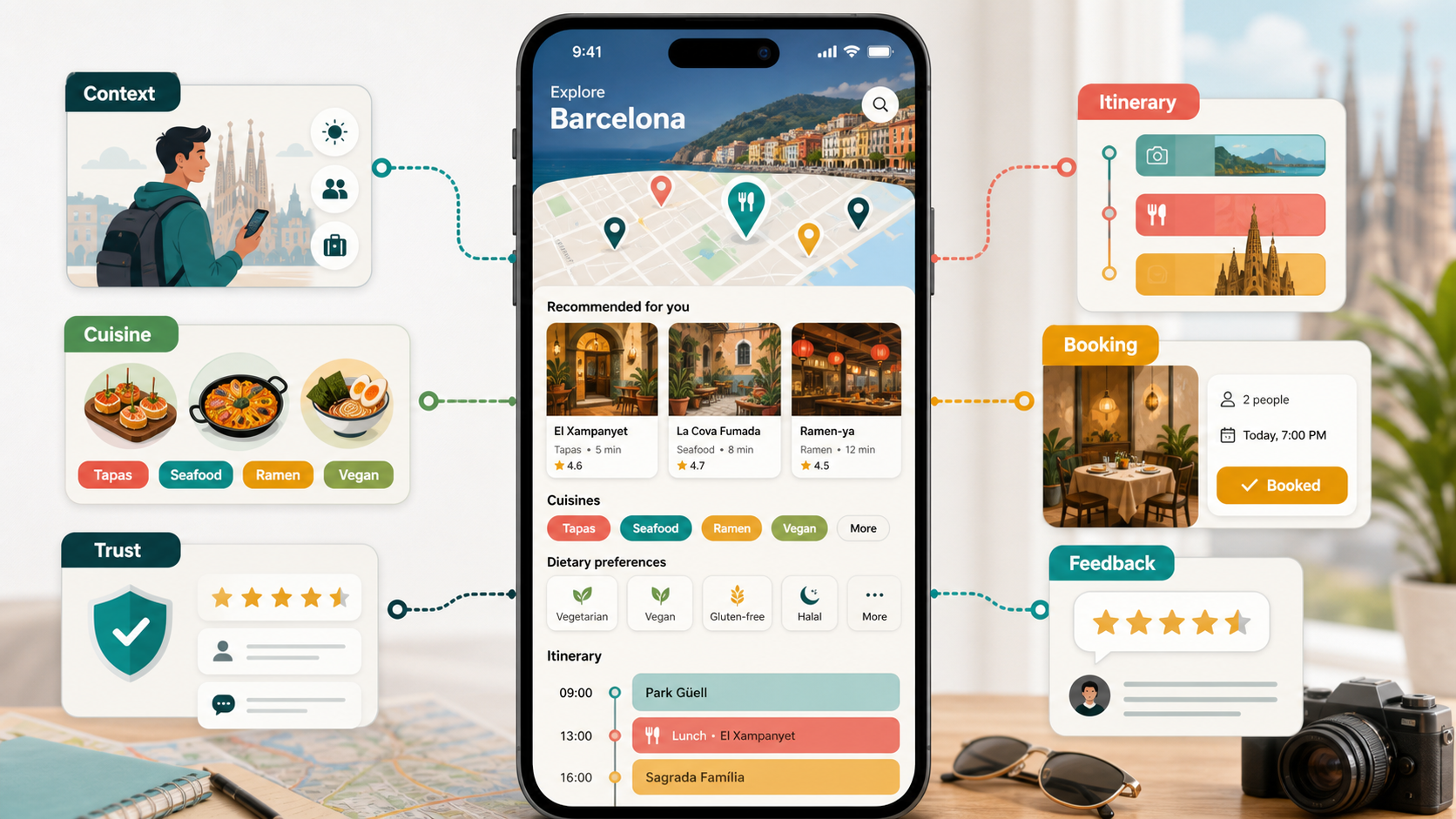
Why Food Discovery Belongs Inside The Trip Flow
Food is one of the most repeated decisions in a trip. Travelers may decide where to eat three or four times a day, often while moving between attractions, checking transport times, managing group preferences, or staying inside a budget. A separate food search can work, but it creates friction when the traveler has to compare maps, menus, reviews, timings, dietary needs, and itinerary distance manually.
A travel app can solve that by making food discovery contextual. Instead of asking only "what is nearby?", the app can ask: what cuisine is locally meaningful, what is open when the user will arrive, which places match a vegetarian or allergy constraint, which venue fits the remaining day plan, and whether a booking or pickup option is available.
This is also where food features become commercially useful. Recommendation surfaces can support restaurant partnerships, paid experiences, guided food walks, reservation commissions, loyalty offers, sponsored but labeled placements, and premium itinerary planning. The product still has to protect trust; users will leave if recommendations feel random, biased, stale, or unsafe.
What A Great Food Recommendation Feature Needs
A strong food recommendation experience usually combines content, data, UX, and operations. The table below separates the feature areas that matter most during product planning.
| Feature Area | What It Should Support | Why It Matters |
|---|---|---|
| Traveler context | Location, trip dates, time of day, group size, budget, preferred cuisines, dietary needs, mobility needs, and saved places. | Recommendations become relevant to the actual trip, not only the current map location. |
| Local cuisine knowledge | Signature dishes, neighborhood specialties, market routes, seasonal foods, food festivals, and cultural notes. | The app can guide culinary exploration instead of returning generic restaurant lists. |
| Trust signals | Verified hours, recent reviews, photo freshness, menu confidence, safety notes, cancellation rules, and source transparency. | Travelers need confidence when they are in an unfamiliar city and may not speak the local language. |
| Itinerary fit | Distance from planned stops, travel time, opening windows, reservation availability, route sequencing, and offline access. | Food choices become part of the day plan instead of a separate interruption. |
| Booking and action | Save, share, reserve, call, navigate, order, join a tour, add to itinerary, or send to a group vote. | Recommendations convert into decisions and revenue opportunities. |
| Feedback loop | Ratings, skipped reasons, favorites, photo uploads, repeat preferences, and post-visit prompts. | The system improves over time and avoids repeating irrelevant suggestions. |
Recommendation Architecture For Food And Travel
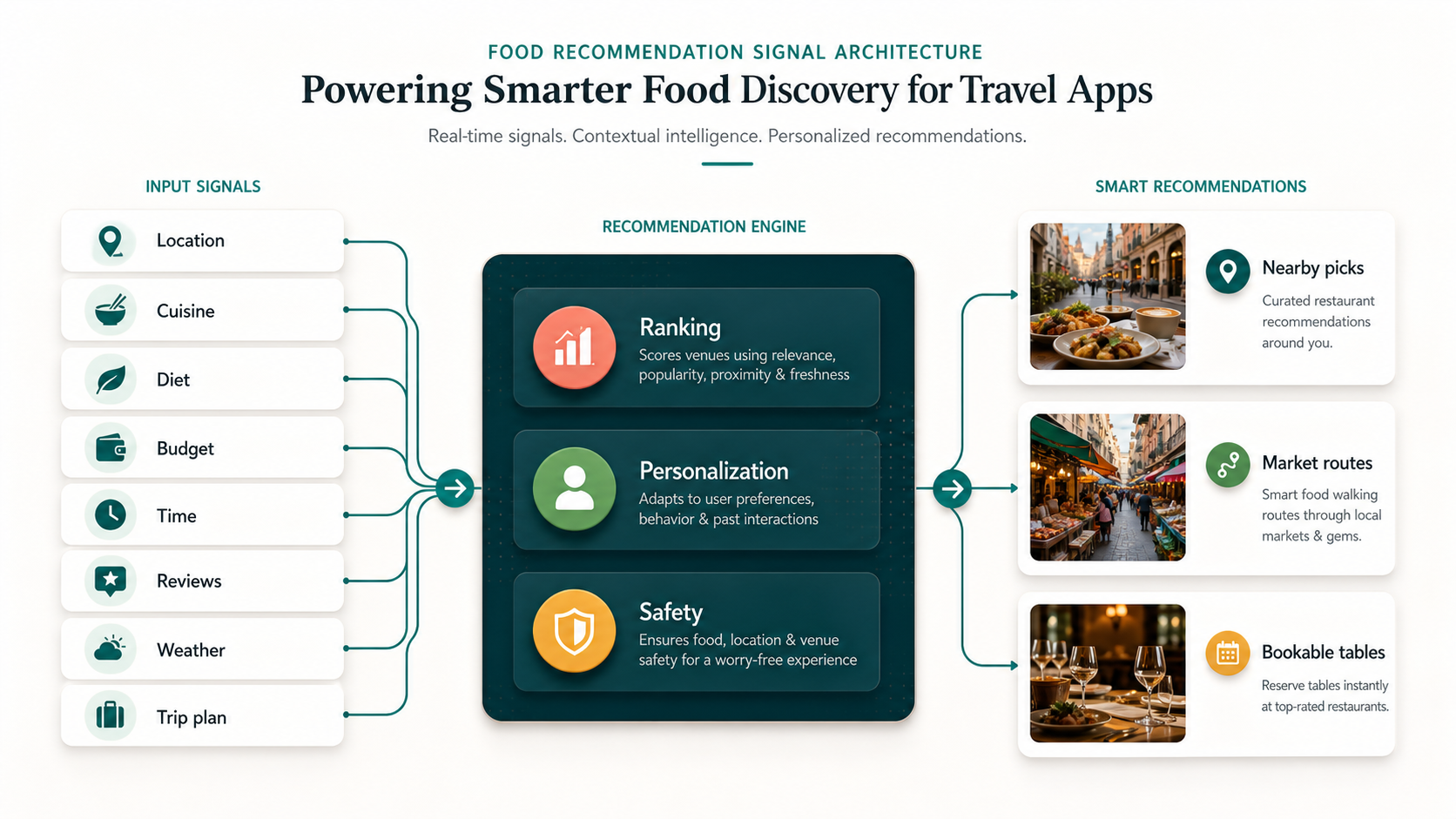
The recommendation layer should start with reliable data rather than a flashy interface. Basic restaurant records need names, addresses, coordinates, opening hours, cuisine tags, price range, photos, menu links, reservation links, and source timestamps. Advanced records may include dietary tags, queue patterns, crowd levels, dish popularity, delivery or pickup options, accessibility notes, and language support.
Personalization can then rank options against traveler intent. A solo traveler may prefer quick local markets near transit. A family may need allergy-safe venues with predictable menus. A couple may want reservations near an evening activity. A food tourist may want regional dishes even if they require a detour. This kind of ranking often benefits from machine learning development, but the first version can still use transparent rules and editorial curation.
Do not let personalization hide the reasoning. Travelers trust recommendations more when they can see why a place is suggested: "popular for local breakfast", "open after your museum visit", "vegetarian-friendly near your hotel", or "fits your saved street food route". Explanation text also improves accessibility and helps users make decisions faster.
How To Balance Street Food, Fine Dining, And Local Markets
The original article treated street food and fine dining as a choice. In a travel app, they should be modeled as different use cases. Street food is often about proximity, authenticity, confidence, and timing. Fine dining is about booking, occasion, budget, dress code, cancellation policy, and availability. Markets sit somewhere else again: they are route-based, exploratory, and often better as a half-day itinerary than a single listing.
Design separate recommendation cards for these patterns. A street food card may highlight the dish, stall hours, cash requirements, safety notes, and nearby landmarks. A fine dining card may show reservation availability, tasting menu details, dress code, deposit policy, and transport time. A market route may show a sequence of stops, recommended arrival time, top dishes, rest breaks, and offline map support.
This is where travel and food systems overlap with broader food commerce. Teams planning marketplace, ordering, or restaurant features can also review food delivery app development benefits to understand how discovery, menus, ordering, operations, and customer retention connect.
Offline And On-Trip Reliability
Food discovery often happens when connectivity is weak: airport arrivals, remote towns, underground transit, old city centers, or roaming-heavy international trips. The app should cache saved places, maps, restaurant addresses, booking references, dietary notes, and itinerary steps before the user needs them.
Offline behavior should be explicit. If hours or table availability are not fresh, say so. If a saved route was last synced yesterday, show a timestamp. If the user is in a low-connectivity area, keep the core plan readable and queue feedback or favorites until the device reconnects. For a deeper technical companion, see the guide to offline functionality for remote travel destinations.
Trust, Safety, And Recommendation Quality
Food recommendations carry real-world risk. Bad data can send travelers to closed restaurants, unsafe neighborhoods, allergen-heavy menus, tourist traps, or venues that do not match cultural expectations. The product should combine automation with review workflows, especially for dietary labels, sponsored placements, and high-traffic destination pages.
Make trust visible in the interface. Show when hours were last verified, whether reviews are recent, whether a place is partner-sponsored, and why a venue appears in a route. Avoid burying sponsored results inside organic recommendations. Travelers can accept ads; they are less forgiving when the app makes commercial placement look like neutral local advice.
Portfolio experience matters here because the problem is not only design. It touches location, restaurant records, profile preferences, notifications, moderation, subscriptions, and admin operations. The NextPage FeastFlow portfolio case study shows a related social dining product with native apps, restaurant discovery, chat, check-ins, trust workflows, and an operations console.
MVP Roadmap For Food Recommendations In A Travel App
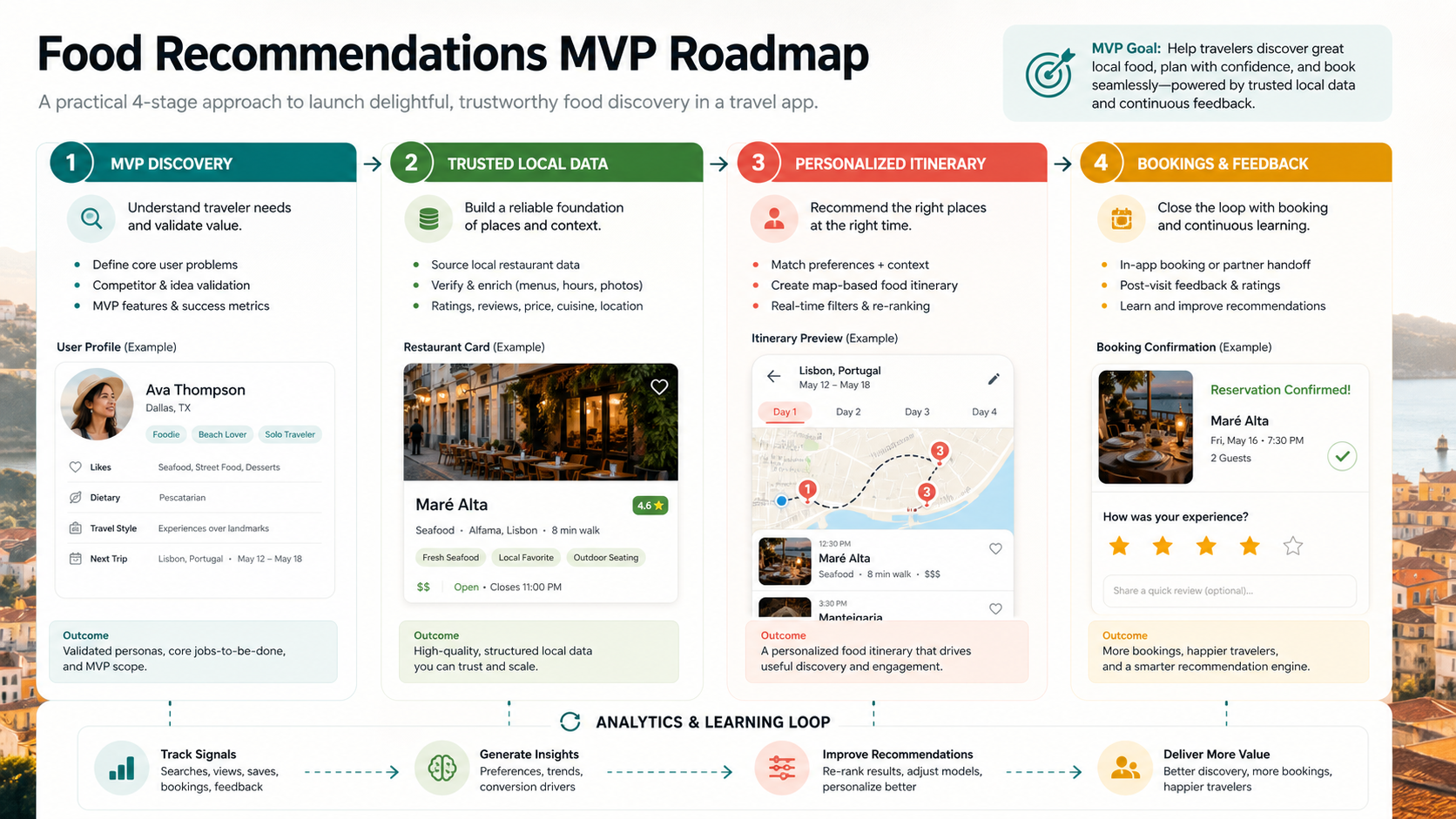
- MVP discovery: choose one destination type, one traveler segment, and a small set of food journeys such as street food, family dining, vegetarian meals, or date-night reservations.
- Trusted local data: build restaurant and dish records with source timestamps, cuisine tags, price range, hours, location, and review confidence.
- Personalized itinerary: rank options by trip timing, distance, budget, group needs, dietary constraints, and saved interests.
- Bookings and feedback: add save, share, reserve, navigate, review, skip reason, and post-visit feedback loops.
If the product is still early, the MVP Scope Builder can help separate launch-critical food discovery workflows from later recommendation, booking, and monetization layers. For budget framing, pair that with the Custom Software Cost Estimator.
Monetization Models That Do Not Break Trust
Food recommendations can support several revenue models: restaurant booking commissions, food tour referrals, sponsored placements, premium itinerary planning, destination partnerships, subscription-only curated guides, affiliate experiences, or local ordering flows. The key is to separate relevance from monetization. The app should explain sponsored results, avoid overloading users with offers, and keep organic recommendations useful.
A food business product can also become its own landing or commerce layer. NextPage's NextBite food ordering platform is a useful example of mobile-first food commerce built around simple menus, WhatsApp ordering, and low-friction sales workflows. Travel apps can borrow that same lesson: make the next action obvious and easy.
Cost And Scope Considerations
The cost of food recommendation features depends on scope. A curated guide with static lists is far simpler than a real-time marketplace with reservations, payments, supplier dashboards, multilingual content, personalization, and offline sync. The highest-cost areas are usually data quality, integrations, admin tooling, maps, personalization, booking logic, and trust operations.
For a travel-specific cost breakdown, review travel app development cost. Use it to decide whether the first release should be a curated food guide, an itinerary add-on, a restaurant discovery marketplace, or a full travel platform with AI personalization and supplier workflows.
Final Recommendation
Food recommendations can become one of the most valuable parts of a travel app when they are designed around the trip, not just the map. Start with trusted local data and a narrow traveler use case. Add itinerary fit, dietary preferences, booking actions, offline reliability, and transparent trust signals. Then expand into personalization and monetization only when the recommendation loop is useful without paid placement.