
Custom real estate software development cost is best estimated by workflow, data source, integration risk, and rollout phase, not by screen count. A focused CRM or listing MVP can stay in the low-to-mid six figures. A brokerage platform, property-management portal, AI search product, or transaction workflow that connects MLS/IDX data, CRM, maps, payments, documents, mobile apps, analytics, and role-based portals needs a larger budget and a phased delivery plan.
For 2026 planning, treat the budget as a scope model. A discovery prototype may cost tens of thousands of dollars. A useful MVP for CRM, listing management, and admin workflows often lands around $60,000-$150,000. A full platform with MLS/IDX or RESO Web API work, buyer and agent portals, payments, documents, AI search, mobile apps, analytics, security, QA, and support can reach $200,000-$700,000+ depending on markets and complexity.
If you need a directional range before a vendor call, start with NextPage's Custom Software Cost Estimator. It weighs product type, feature complexity, user roles, integrations, AI features, and support expectations so the budget conversation starts with assumptions instead of guesswork.
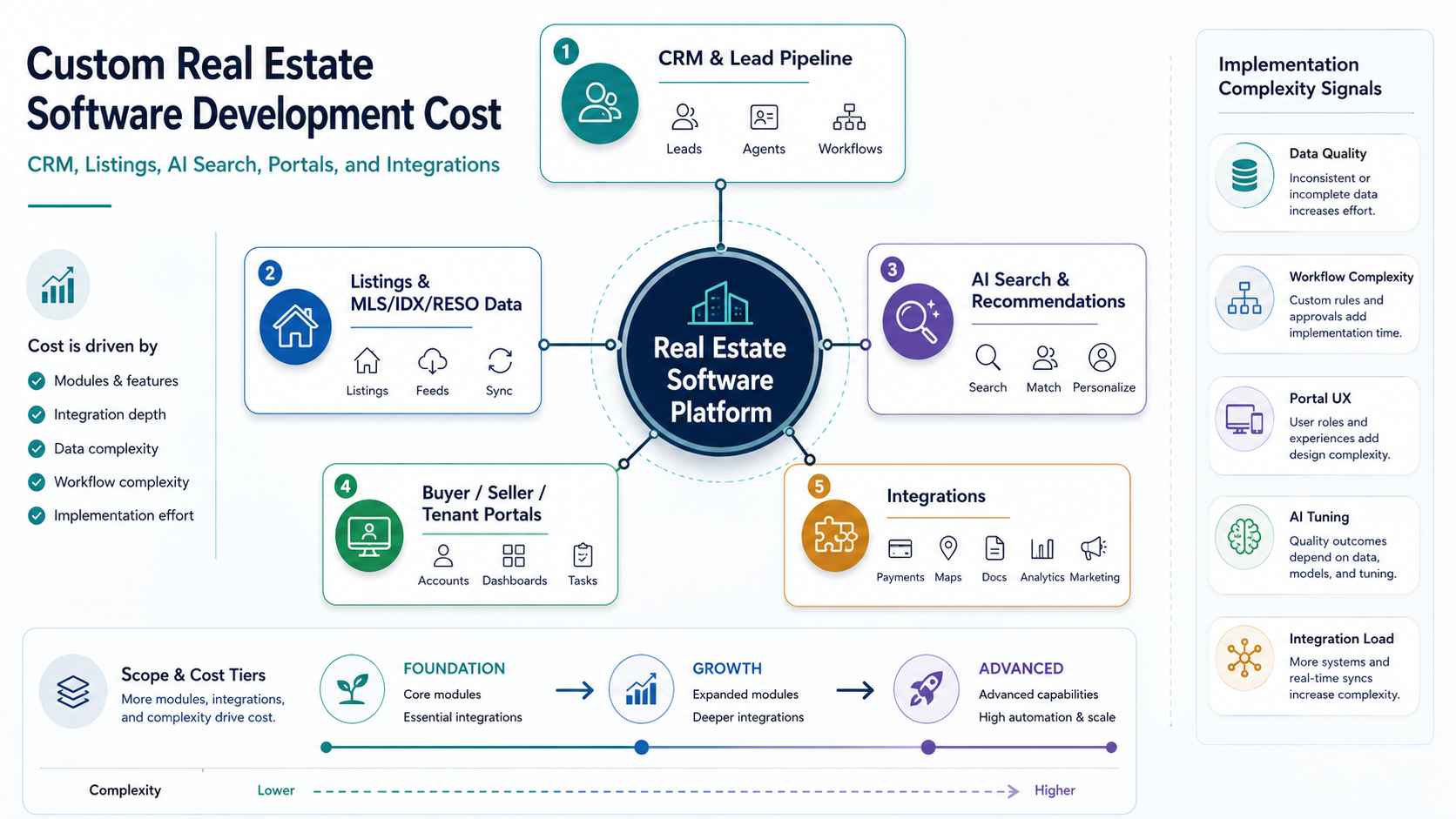
Quick Answer: Custom Real Estate Software Development Cost
Custom real estate software development cost depends on platform type, listing data strategy, number of user roles, integration depth, compliance needs, AI scope, and rollout model. A narrow internal CRM is very different from a multi-market brokerage operating system that connects agents, buyers, sellers, tenants, property managers, payment providers, document tools, marketing automation, and analytics.
| Build Type | Typical Budget Band | What It Usually Includes |
|---|---|---|
| Discovery prototype | $15,000-$40,000 | Product strategy, workflows, clickable prototype, technical plan, integration inventory, and cost model. |
| Focused CRM or listing MVP | $60,000-$150,000 | Core user roles, lead pipeline, listing management, admin dashboard, basic search, and a few integrations. |
| Brokerage or portal platform | $150,000-$350,000 | CRM, property search, listing feeds, agent workflows, buyer/seller portal, analytics, content workflows, and permissions. |
| Property management platform | $200,000-$500,000+ | Tenant/owner portals, leases, maintenance, payments, inspections, documents, reporting, and accounting integrations. |
| AI-enabled PropTech platform | $250,000-$700,000+ | AI search, recommendations, valuation signals, lead scoring, document automation, data pipelines, evaluation, monitoring, and support. |
These are planning bands, not fixed prices. A disciplined MVP can cost less than a bloated "simple app" if the team avoids speculative features. A small portal can cost more than expected if it needs multiple MLS markets, legacy CRM migration, payment reconciliation, granular permissions, and mobile apps at launch.
Why Real Estate Software Cost Varies So Much
Real estate software is rarely just a set of screens. The expensive part is the operating model underneath the interface. A brokerage CRM needs lead routing, agent assignment, contact history, listing context, activity tracking, email or SMS automation, and reporting. A property portal needs listings, saved searches, inquiries, showing requests, documents, media, permissions, and notifications. A property-management system needs leases, maintenance tickets, rent payments, owner reporting, inspections, and accounting handoffs.
Cost rises when those workflows need to share data. If the CRM knows which listing a buyer viewed, search knows the buyer's preferences, the portal knows document status, and analytics knows conversion by source, the product becomes more valuable and more complex. Data models, permissions, event tracking, audit trails, and integration error handling matter more than visual polish.
This is why a real estate budget should be estimated by workflow and risk, not page count. The same pattern appears in NextPage's custom software development cost guide: product cost follows the business process, integration complexity, user-role count, security requirements, and support model.
Module Cost Breakdown For CRM, Listings, Search, And Portals
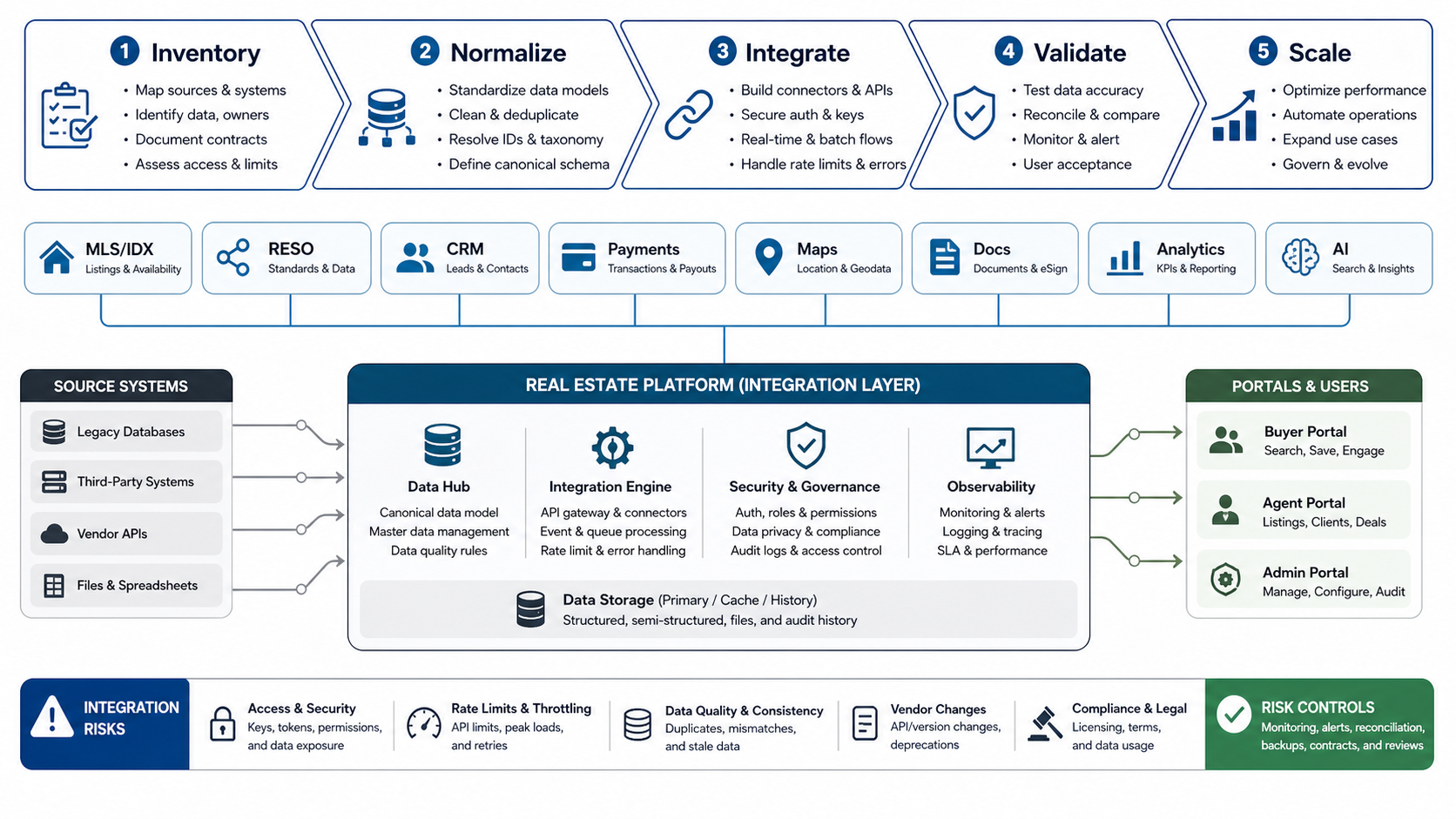
Use module budgeting to decide what belongs in release one and what can wait. The numbers below are directional bands for planning; actual estimates depend on design depth, data quality, integration availability, testing coverage, and support expectations.
| Module | Planning Range | Main Cost Drivers |
|---|---|---|
| Real estate CRM | $40,000-$180,000 | Lead sources, assignment rules, pipeline stages, agent teams, automation, call/SMS/email integrations, activity history, reporting, and migration. |
| Listing management | $35,000-$160,000 | MLS/IDX/RESO feed strategy, media handling, map search, saved searches, syndication rules, listing approvals, and data freshness. |
| Buyer, seller, tenant, or owner portal | $50,000-$220,000 | User roles, documents, requests, notifications, payments, appointment flows, permissions, and mobile responsiveness. |
| Property management workflows | $80,000-$300,000+ | Leases, rent, maintenance, inspections, owner statements, compliance, vendor workflows, and accounting handoffs. |
| AI search and recommendations | $50,000-$250,000+ | Property embeddings, preference learning, lead scoring, valuation signals, prompt workflows, guardrails, evaluation, monitoring, and data pipelines. |
| Analytics dashboards | $25,000-$120,000 | KPIs, event tracking, attribution, agent performance, listing performance, forecast views, and executive reporting. |
For mobile-heavy products, compare the platform budget with NextPage's real estate app development cost guide. Native mobile apps can be justified for agent field work, tenant maintenance uploads, push notifications, offline media capture, or consumer property search. A responsive web portal or PWA may be enough for the first release if the workflow is mostly form, search, and dashboard driven.
Integration Risks: MLS, IDX, RESO, CRM, Payments, Maps, And Documents
Integrations are where many real estate budgets move. MLS data is not a single universal database. IDX rules, local market coverage, data display restrictions, refresh expectations, brokerage permissions, feed vendors, and compliance obligations can change the implementation plan. RESO describes the Web API as the modern transport standard for real estate data, while older RETS patterns still appear in legacy environments. The technical question is not simply "can we integrate MLS?" It is which markets, which fields, which data rights, which refresh cadence, and which fallback process apply.
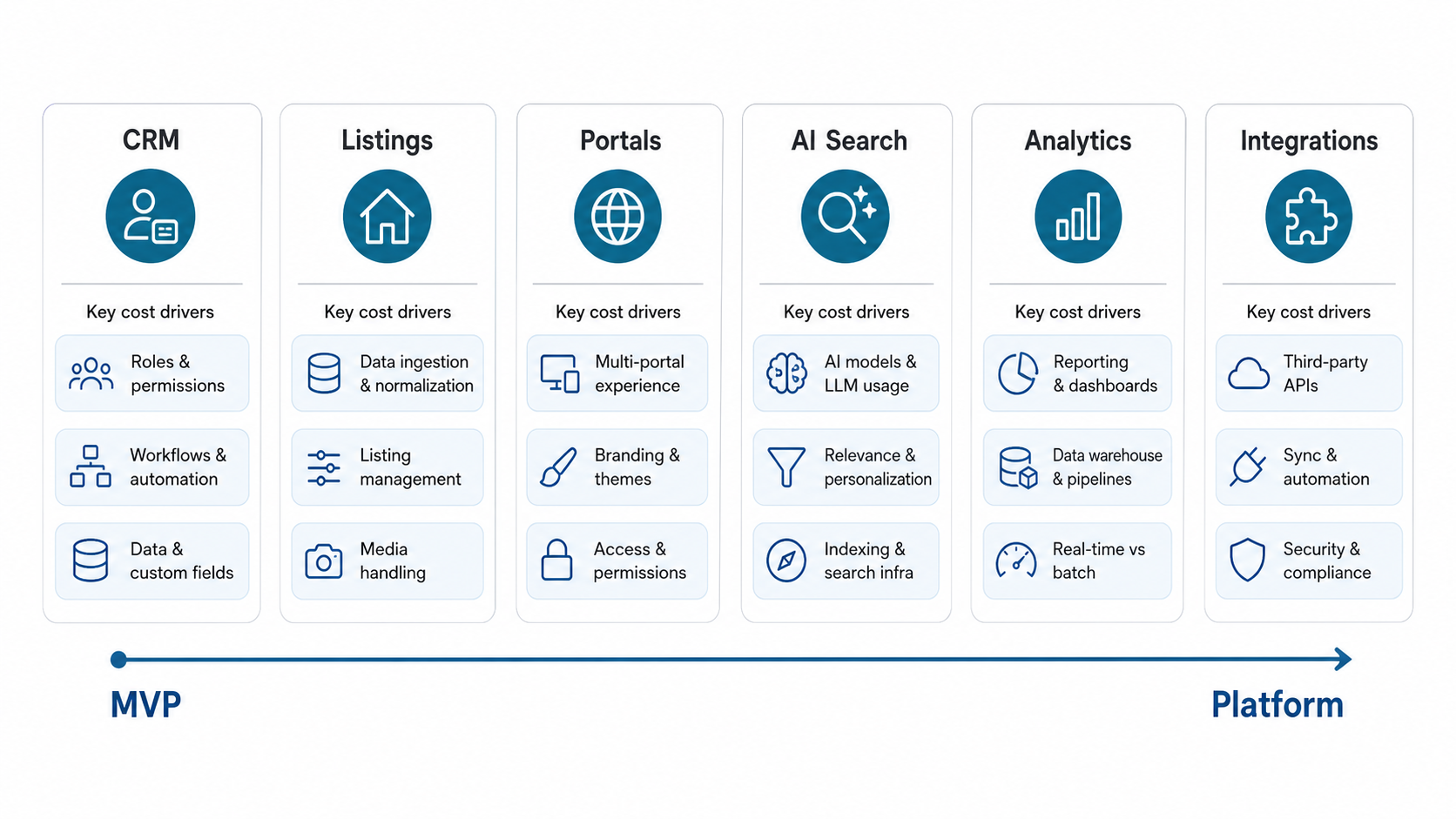
Other integrations can be just as important. CRM migration may require contact deduplication, custom fields, campaign history, notes, ownership rules, and consent records. Payments require reconciliation, failed-payment handling, refunds, webhooks, security review, and accounting exports. Map and geocoding APIs add usage pricing, search tuning, boundary handling, school or neighborhood data, and performance concerns. Document workflows may touch e-signature, storage, access control, audit trails, and retention.
A useful discovery phase should produce an integration inventory. For each system, capture owner, API availability, authentication, rate limits, data fields, update frequency, error handling, write-back needs, sandbox access, cost, launch-critical workflows, and support owner. Without this inventory, a vendor quote can look cheaper while hiding the work that will appear mid-project.
How AI Features Change The Budget
AI features can improve real estate software when they solve a clear decision: better property discovery, faster lead response, stronger valuation context, smarter agent follow-up, automated listing summaries, document extraction, or churn and conversion prediction. They also add data, evaluation, privacy, and operations work that a standard CRUD application does not need.
Start with bounded AI. A search assistant that explains why listings match a buyer's preferences is easier to validate than an open-ended "AI agent" that promises to run the whole brokerage. Lead scoring should show source signals, confidence, and recommended next action. Valuation features should distinguish internal planning signals from formal appraisals. Document automation should preserve human review for contracts, disclosures, and sensitive decisions.
NextPage's AI real estate app features guide goes deeper on search, valuation, tours, and CRM automation. For cost planning, budget AI as a product capability: data preparation, model or API selection, prompt and workflow design, evaluation datasets, monitoring, user feedback, fallback behavior, and compliance review. If the AI layer will drive sales follow-up or lead routing, compare the workflow against AI agents for sales before giving it write access to CRM records.
Build, Buy, Or Customize?
Buying is usually better when the business model fits standard tools: a single brokerage website, conventional IDX search, common lead forms, basic email automation, and straightforward reporting. Configuring an existing CRM, IDX website builder, or property-management platform can be cheaper and faster than custom software.
Build or customize when your process is the differentiator. Examples include proprietary lead-routing logic, multi-branch brokerage operations, nonstandard property data, complex commission or referral workflows, tenant and owner experiences that off-the-shelf tools cannot support, unique investor dashboards, AI-assisted search products, or integrations across legacy systems that cannot be replaced quickly.
A good middle path is phased. Use SaaS where it is strong, then build the layer that makes your operating model unique. Keep a mature email provider, payment processor, or e-signature tool, but build a custom workflow layer that connects listings, leads, documents, tasks, and analytics around your process. If CRM is the center of the decision, compare scope against NextPage's custom CRM development cost guide.
A Practical MVP Roadmap
Phase 1: discovery and budget model. Define user roles, workflows, data sources, integration risks, compliance constraints, and KPI targets. Decide what the first release must prove: lead conversion, listing operations, tenant service, owner reporting, agent productivity, or buyer search quality.
Phase 2: prototype and data model. Design the main flows, admin model, permissions, listing schema, contact schema, activity events, documents, and analytics events. A clickable prototype plus technical architecture prevents expensive ambiguity.
Phase 3: MVP build. Build the smallest complete operating loop. For a brokerage CRM, that might be lead capture, listing context, assignment, follow-up tasks, agent dashboard, and reporting. For a portal, that might be listings, saved searches, inquiries, documents, notifications, and admin controls.
Phase 4: integrations and hardening. Add MLS/feed work, CRM migration, payments, map search, email/SMS, analytics, security, audit logs, and operational monitoring. Test with real data, not just sample records.
Phase 5: AI and scale. Add AI search, recommendations, lead scoring, automated summaries, or predictive analytics only after event data and workflows are stable. Use measurable evaluation criteria before rollout.
If the platform is primarily web-based, NextPage's web app development cost article can help teams compare role count, workflow depth, integrations, and reporting complexity before adding mobile or AI scope. If the first release is still too broad, use the MVP Scope Builder to separate launch-critical workflows from phase-two ideas.
How To Control Cost Without Weakening The Product
Cost control is not the same as cutting quality. The strongest budget lever is sequencing. Build one complete workflow instead of five partial workflows. Launch one market before all markets. Start with one listing data strategy before adding every feed variant. Use one portal role before adding buyer, seller, tenant, owner, vendor, and admin experiences at once.
Keep the first release opinionated. Require a scope table that separates launch-critical, phase-two, and "not yet" features. Require an integration inventory before fixed pricing. Require sample data early. Require acceptance criteria for search, lead routing, document access, payment status, and reporting. Require support and maintenance assumptions because real estate data freshness, feed changes, and third-party API updates are ongoing responsibilities.
NextPage's real estate software development company page explains the service-side view: property search, listing data, broker CRM, property management, portals, admin workflows, and integrations need to be designed as one product system.
How NextPage Can Help
NextPage helps real estate teams estimate, scope, design, and build custom software around the workflows that actually drive value: listing operations, CRM, lead response, search quality, portals, documents, payments, AI features, dashboards, and integrations. A practical engagement starts with a discovery sprint, integration inventory, MVP scope, and budget model.
The right first question is not "how much does a real estate app cost?" It is "which workflow should become faster, more reliable, or more valuable after release one?" Once that is clear, the cost model becomes a set of tradeoffs you can manage instead of a surprise.