
Quick Answer: Ecommerce App Development
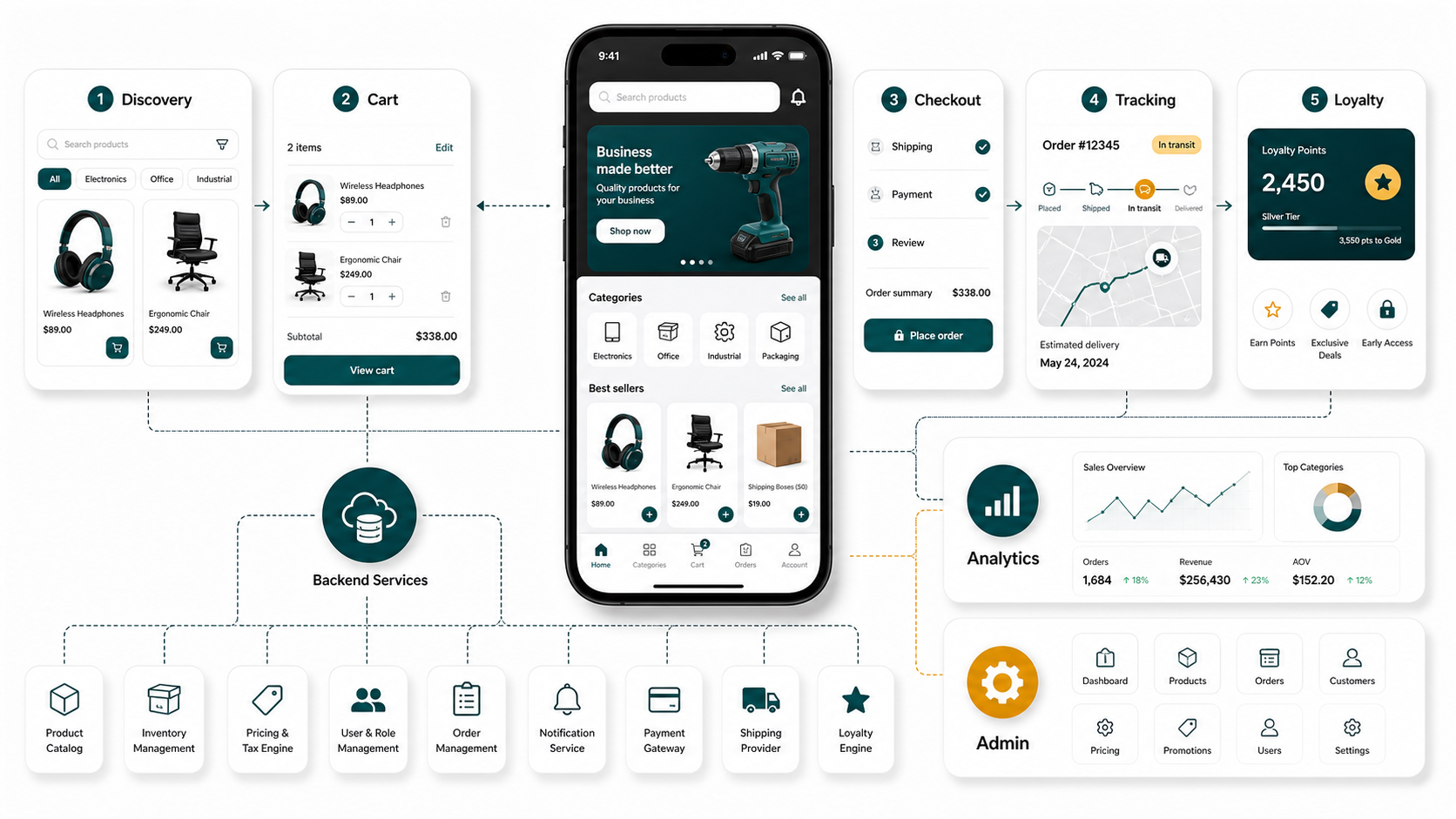
Ecommerce app development is the process of building a mobile or web shopping product that helps customers discover products, compare options, buy securely, track orders, get support, and return for repeat purchases. A successful ecommerce app is not just a catalog with a payment button. It is a connected commerce system that includes customer experience, product data, cart, checkout, payment gateway, fulfillment, notifications, analytics, and admin operations.
The right first release depends on your business model. A direct-to-consumer store, multi-vendor marketplace, grocery app, fashion app, B2B ordering portal, and subscription commerce product all need different workflows. Start with the core transaction and the operational rules behind it, then plan features around conversion, retention, and maintainability. If mobile is a primary channel, involve a team experienced in mobile app development early so UX, backend integrations, performance, and analytics are designed together.
When Should A Business Build An Ecommerce App?
Build an ecommerce app when the mobile buying journey is important enough to justify a dedicated product. Good signals include high mobile traffic, repeat purchases, loyalty programs, complex catalog discovery, personalized offers, app-only engagement, or a need for faster repeat checkout than a website can provide.
Do not build an app only because competitors have one. If the existing website has slow checkout, poor product data, weak fulfillment, or no clear retention plan, fix those foundations first. An app amplifies the commerce system behind it; it cannot compensate for unclear pricing, unreliable inventory, confusing delivery rules, or weak support processes.
Ecommerce App Feature Priority Matrix
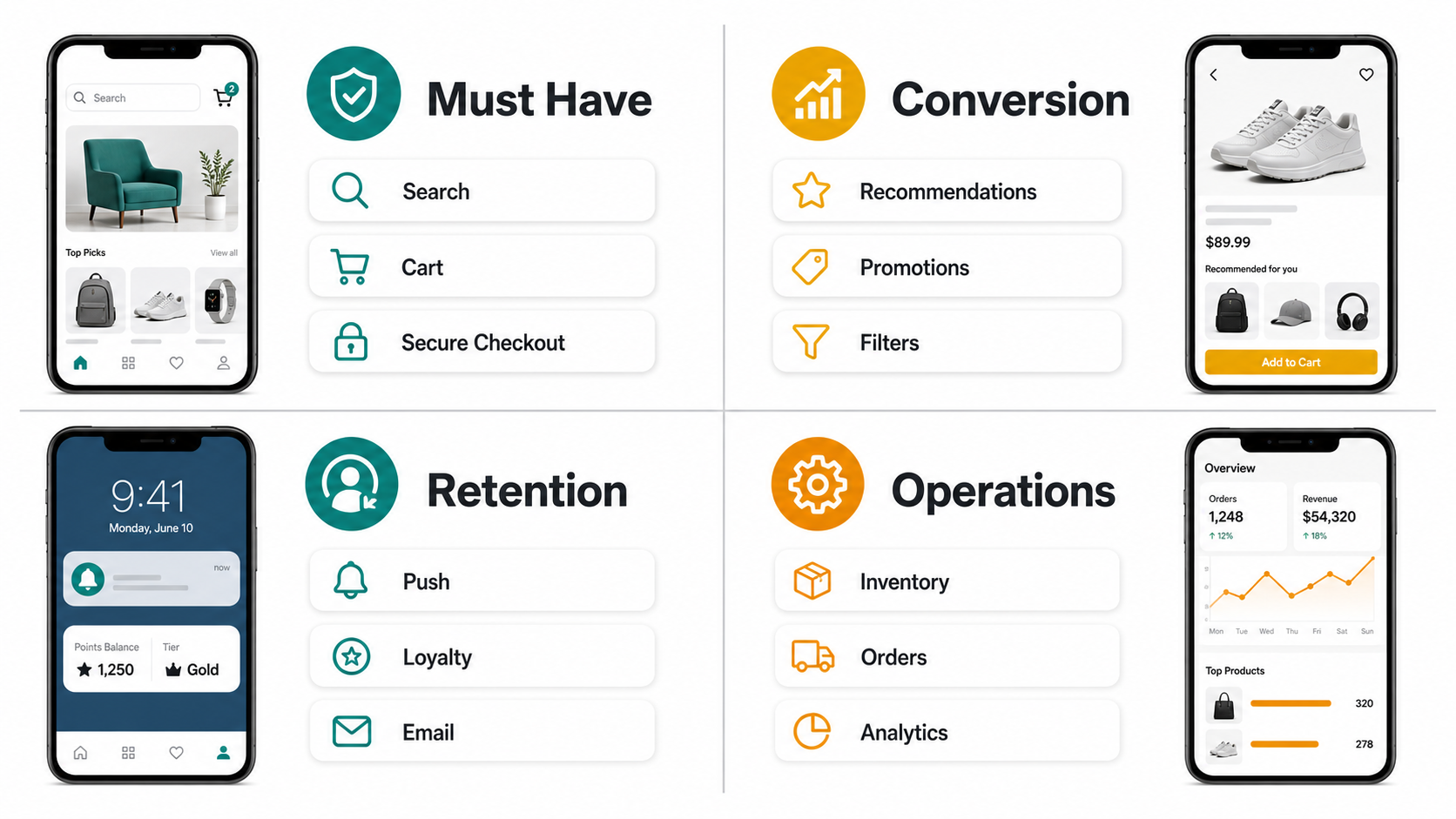
Feature planning should separate launch essentials from growth-stage additions. The MVP must support a complete purchase and the operational work behind that purchase. Advanced personalization, AR previews, social commerce, and AI recommendations are valuable later only when catalog quality, order data, and analytics are reliable.
| Feature Area | What To Include | Launch Priority |
|---|---|---|
| Account and profile | Signup, login, saved addresses, order history, preferences, wishlist, and privacy controls. | Must have |
| Catalog and discovery | Categories, search, filters, product detail pages, variants, product media, availability, and recommendations. | Must have |
| Cart and checkout | Cart, coupon logic, taxes, delivery options, payment gateway, order confirmation, refunds, and failed payment recovery. | Must have |
| Fulfillment and support | Inventory sync, delivery status, shipment tracking, returns, support tickets, live chat, and notifications. | Must have |
| Retention | Push notifications, loyalty, referrals, subscriptions, personalized offers, saved carts, and reorder prompts. | Growth stage |
| Admin and analytics | Product controls, order management, campaign tools, dashboards, permissions, audit logs, and conversion analytics. | Must have |
Core Features Of Ecommerce App Development
A useful ecommerce app starts with a clear product discovery flow. Customers should be able to search, filter, compare, inspect product details, read reviews, understand delivery options, and move to checkout without confusion. Product pages need strong images, price clarity, variant choices, inventory status, shipping estimate, returns policy, and social proof.
The cart and wishlist should make buying flexible. Customers often compare products across sessions, so saved carts, wishlists, recently viewed items, and reorder paths can improve conversion. For multi-vendor or marketplace apps, the cart also needs vendor rules, shipping splits, seller policies, commissions, and payout workflows. Use the marketplace app development cost guide when your ecommerce idea includes seller onboarding, payouts, dispute handling, or buyer-seller trust controls.
Customer support features should be planned before launch, not patched in later. Include order status, cancellation rules, returns, refund requests, FAQs, live chat or ticketing, and escalation workflows. The support model should connect to admin users so the business can resolve order issues without manual database work.
How To Build An Ecommerce App
Start with product discovery, not screen design. Define customer segments, product structure, business rules, order lifecycle, payment needs, fulfillment model, return policy, integrations, compliance needs, and launch metrics. Then design the customer journey from first product view to repeat purchase and map every operational step behind it.
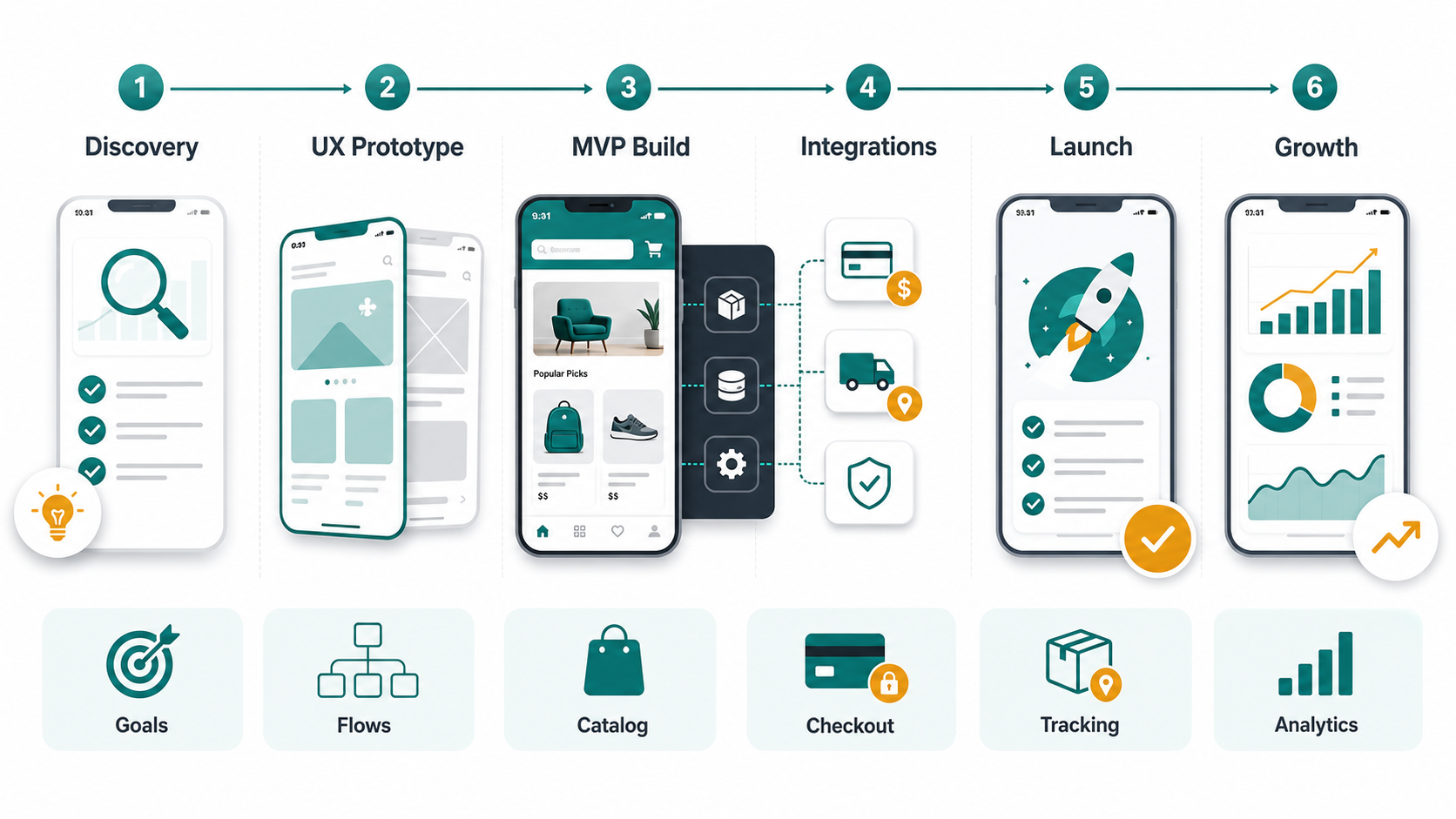
- Discovery: define goals, buyer segments, product data, business rules, integrations, risks, and success metrics.
- UX prototype: design product discovery, product detail pages, cart, checkout, account, order tracking, returns, and support flows.
- MVP build: implement authentication, catalog, cart, checkout, payments, orders, admin controls, analytics, and core notifications.
- Integrations: connect commerce backend, inventory, payment gateway, shipping, tax, CRM, email, analytics, and support systems.
- Testing: test checkout edge cases, payment failures, refunds, inventory changes, device behavior, performance, and security.
- Launch and growth: release the app, monitor conversion and defects, then add loyalty, personalization, subscriptions, recommendations, A/B testing, and deeper analytics.
For a comparable transaction-heavy product, review the development sequence in How To Develop A Pizza Delivery App Like Domino's. The domain is different, but the workflow shows the same need to connect mobile UX, payment, order tracking, notifications, fulfillment, and operations.
Ecommerce App Development Cost Drivers
Ecommerce app development cost depends on scope, integrations, and operational complexity more than the number of visible screens. A simple storefront connected to an existing commerce backend is much smaller than a marketplace with vendor onboarding, commissions, payouts, returns, promotions, loyalty, subscriptions, and custom analytics.
Major cost drivers include native versus cross-platform development, design depth, catalog complexity, search and filtering, payment gateway work, shipping and tax logic, inventory sync, admin panels, analytics, QA, performance tuning, security, and post-launch support. For deeper budget planning, use NextPage's eCommerce app development cost guide and the Custom Software Cost Estimator before freezing the MVP scope.
| Scope | Typical Build Contents | Cost Risk |
|---|---|---|
| Starter storefront | Catalog, product pages, cart, checkout, payment, order history, and basic admin connection. | Low to medium if backend already exists. |
| Custom ecommerce app | Custom UX, catalog rules, promotions, loyalty, analytics, support, and deeper backend integration. | Medium to high depending on integrations. |
| Marketplace or multi-vendor app | Buyer app, seller workflows, vendor onboarding, commissions, payouts, disputes, and trust controls. | High because operations and payments are more complex. |
| AI-enabled commerce app | Recommendations, search assistance, segmentation, personalized offers, and demand insights. | High if data quality and evaluation are weak. |
Checkout, Payments, And Security
Checkout is where ecommerce app strategy becomes measurable. Keep forms short, show the total cost early, support saved addresses, make delivery choices clear, handle coupons without breaking payment, and provide obvious recovery when a transaction fails. A slow checkout, surprise shipping cost, forced signup, or unreliable payment flow can erase the benefit of the app.
Payment gateway work should cover cards, wallets, local payment methods, refunds, failed payment recovery, webhook reconciliation, fraud checks, and secure tokenized payment behavior. Security should also include authentication, session handling, role-based admin access, data encryption, audit logs, secure integration patterns, and careful handling of personally identifiable information.
Current Ecommerce App Development Trends
Current ecommerce app planning should account for faster checkout expectations, wallet adoption, AI-assisted product discovery, personalized recommendations, social commerce, short-form product video, conversational support, sustainability filters, and better post-purchase tracking. These trends are useful only when they support a clear customer need and measurable business outcome.
AR product previews, voice shopping, AI styling, social shopping, and advanced recommendation systems need clean product data, content operations, event tracking, and reliable analytics. Launch the foundation first, then add experiments that can be measured against conversion, retention, average order value, and support load. For supporting mobile commerce context, see E-Commerce Mobile Apps - Shopping Made Easy.
Testing, Quality Assurance, And Launch
Ecommerce QA must test more than happy-path browsing. Cover product variants, out-of-stock behavior, coupons, taxes, delivery rules, payment failures, refunds, cancellations, order confirmation, push notifications, email receipts, returns, admin permissions, analytics events, and app performance under load.
Before launch, prepare app store assets, screenshots, release notes, monitoring, support workflows, rollback plans, and conversion dashboards. App store visibility also matters; pair product launch with App Store Optimization so users can understand the app quickly from the listing.
Launch And Growth Metrics
The best ecommerce app metrics connect product usage with revenue and operations. Track activation, search success, product detail views, add-to-cart rate, checkout completion, payment failure rate, cart abandonment, average order value, repeat purchase rate, return rate, notification opt-in, delivery issues, support tickets, and app performance.
Use those metrics to prioritize the roadmap. If checkout completion is weak, fix payment and form friction before adding advanced trends. If repeat purchases are low, improve loyalty, personalized offers, reorder paths, and lifecycle notifications. If support tickets are high, improve order status visibility, returns, and admin tooling.
Final Recommendation
Build an ecommerce app when it gives customers a faster, more personal, and more reliable shopping journey than your existing channels. Start with the complete transaction: discovery, product detail, cart, checkout, payment, order tracking, support, and admin operations. Then use analytics to decide where personalization, loyalty, automation, and advanced commerce features deserve investment.
The strongest apps make shopping easy for customers and manageable for the business. If the roadmap includes custom workflows, complex integrations, or marketplace operations, treat the app as a commerce platform rather than a simple storefront.