
Quick Answer: What Should You Ask An eCommerce Development Company?
Before hiring an eCommerce development company, ask how they will choose the platform, map integrations, protect checkout reliability, improve conversion, structure product data, support AI-assisted discovery, measure performance, and operate the store after launch. A strong partner should be able to explain tradeoffs, not just show screenshots of previous stores.
The best checklist starts with the business model. A single-brand DTC store, a B2B ordering portal, a marketplace, a subscription commerce product, and a social commerce storefront need different architecture. Your shortlisting process should test whether the agency understands catalog complexity, account rules, pricing, payments, tax, inventory, promotions, fulfillment, analytics, and post-launch iteration. If the project needs custom buyer workflows, admin tooling, or commerce-specific integrations, compare the proposal against NextPage's eCommerce web app development services so the vendor conversation covers both storefront experience and operational software.
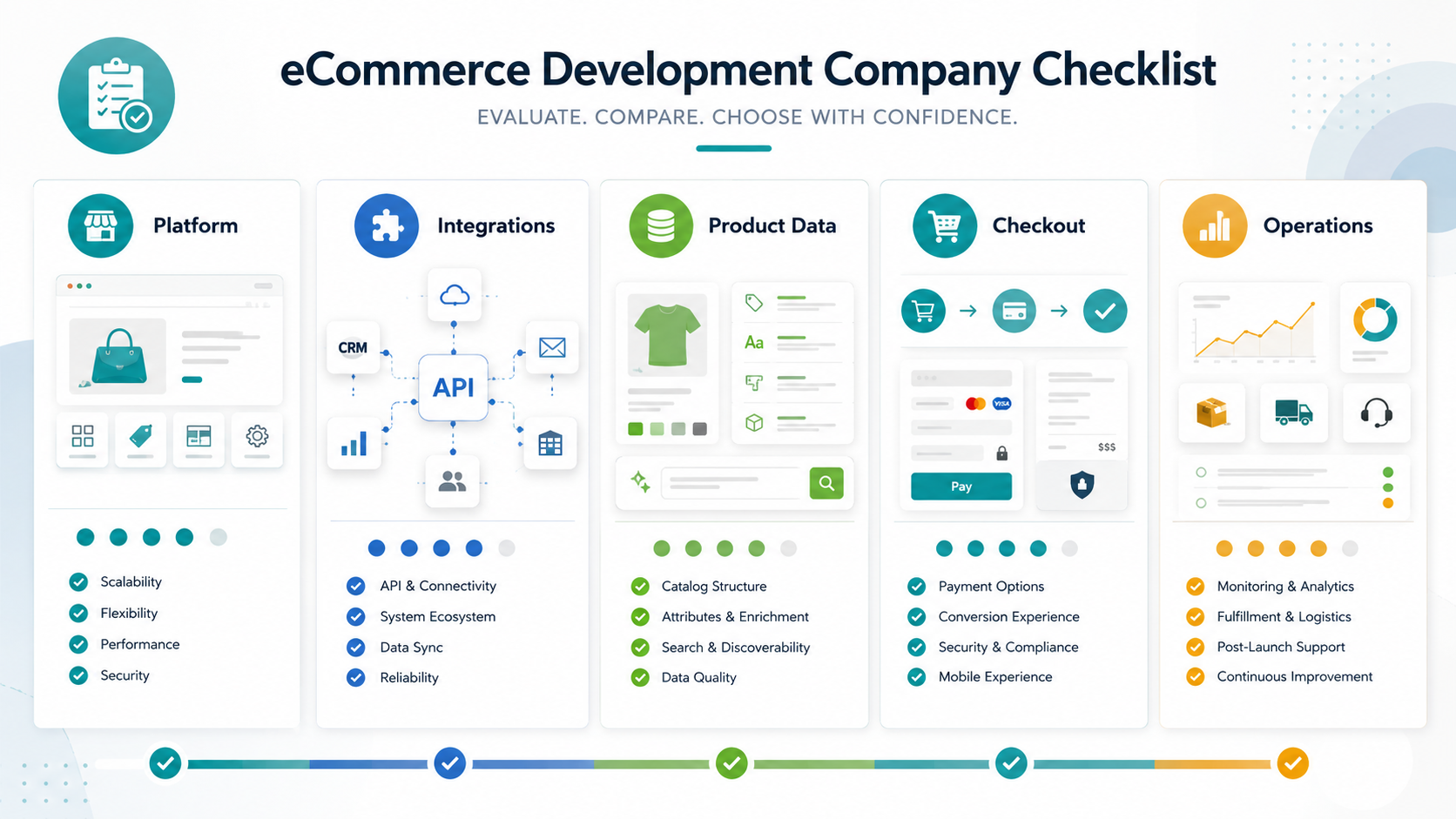
If you need a directional build range before vendor conversations, NextPage's eCommerce app development cost guide can help you frame feature scope, integrations, and MVP decisions before you ask for proposals.
Why A Checklist Matters More Than A Vendor Ranking
Many eCommerce company lists focus on agency size, hourly rate, location, case studies, and platform badges. Those signals are useful, but they do not answer the harder question: can this team build the commerce system your business actually needs? A glossy storefront can still fail if inventory is stale, search is weak, checkout is slow, tax rules are wrong, or no one owns post-launch experimentation.
The reference market is also changing. AI shopping assistants, richer product feeds, instant checkout experiments, and agentic commerce are making product data quality and operational accuracy more important. Commerce buyers increasingly need partners who understand storefront UX and the backend promises behind it: availability, delivery dates, returns, pricing, compatibility, and customer-specific terms.
In 2026, the practical takeaway is not to chase every AI-shopping announcement. It is to make the store machine-readable, observable, and accurate enough for customers, support teams, search experiences, and future shopping agents to trust it. That means stronger product attributes, feed governance, payment authorization controls, inventory freshness, and exception handling before any AI layer is allowed to influence checkout.
A useful checklist turns vague claims into evidence. Instead of asking, "Have you built eCommerce sites?", ask for the platform decision memo, integration diagram, checkout test plan, catalog governance approach, analytics event map, and post-launch optimization backlog from a similar engagement.
Platform Fit: Ask What Should Stay Standard And What Needs Custom Code
Start by asking which platform the company recommends and why. Shopify, Shopify Plus, Adobe Commerce, WooCommerce, BigCommerce, headless commerce, custom web apps, and marketplace architectures all solve different problems. The answer should depend on catalog size, SKU variants, B2B account logic, merchandising needs, checkout rules, content workflow, internationalization, integration count, and internal team maturity.
| Question | Why It Matters | Good Evidence |
|---|---|---|
| Which parts should be native platform features? | Prevents custom code where standard features are safer. | Feature-by-feature build vs configure matrix. |
| Where will custom logic live? | Keeps pricing, account, and integration rules maintainable. | Architecture diagram and ownership notes. |
| How will the platform scale? | Prevents launch success from becoming performance failure. | Traffic, catalog, order, and admin-volume assumptions. |
| What happens if we migrate later? | Protects data portability and future replatforming. | Data model, export, API, and content ownership plan. |
If your commerce workflow is closer to a custom ordering system than a standard store, compare the plan against broader web app development cost drivers such as user roles, workflows, data models, permissions, integrations, and admin operations.
Integration Readiness: ERP, CRM, Payments, PIM, And Fulfillment
Integrations are where many eCommerce builds become expensive. Ask the company to map every system that needs to exchange data with the store: ERP, CRM, payment gateway, tax service, shipping carrier, warehouse, PIM, CMS, email platform, loyalty, reviews, analytics, customer support, fraud tools, and accounting. Then ask which system owns each object.
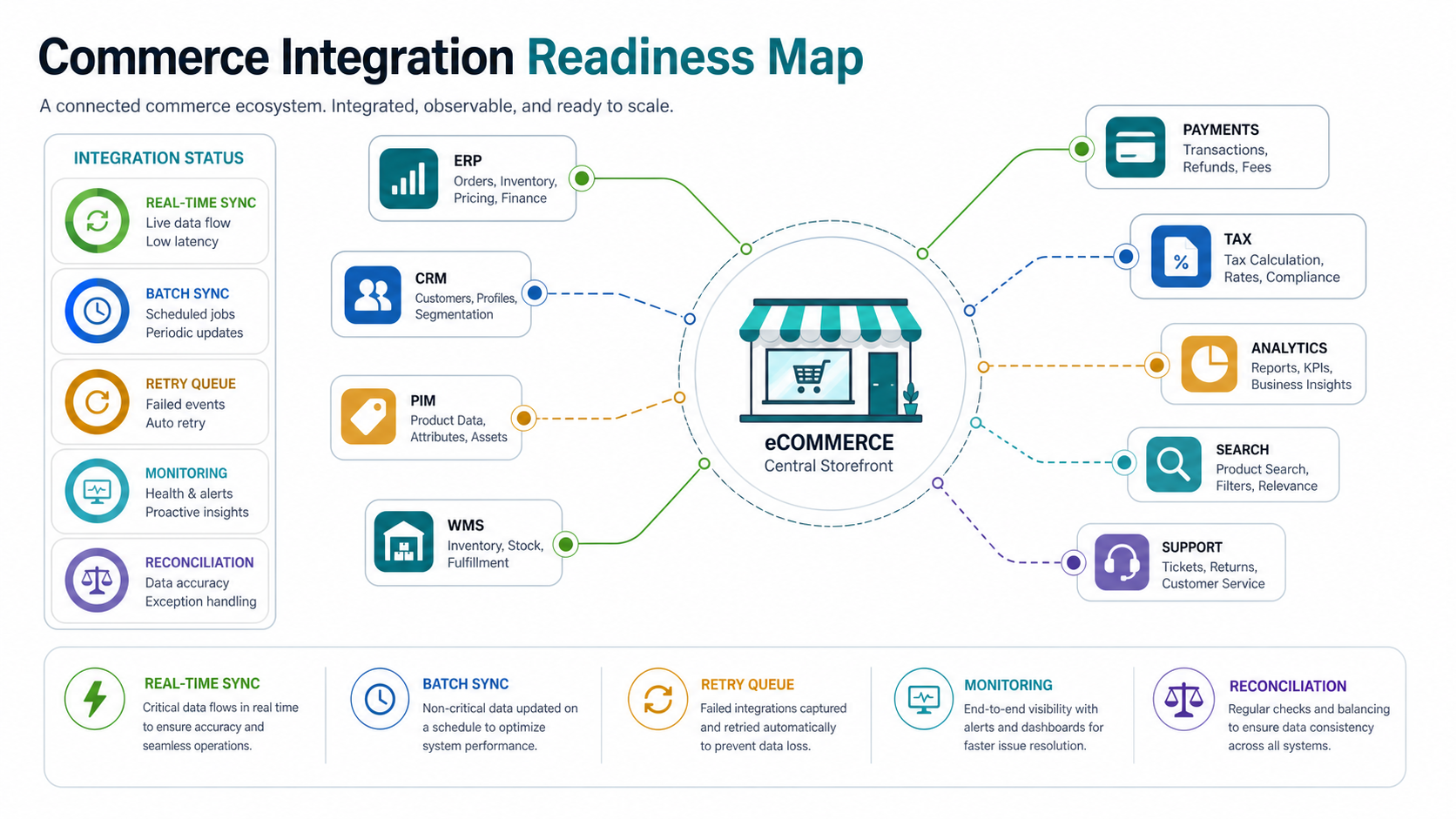
A capable partner will discuss sync frequency, failure recovery, duplicate handling, API limits, retry logic, audit logs, alerting, and reconciliation. They should be explicit about what is real-time, what can be batch, and what requires human approval. For social-led commerce or campaign-driven launches, NextPage's social commerce app development services page shows how the commerce surface, campaign storefront, mobile web experience, and backend operations need to connect.
| Data Object | Common Owner | Checklist Question |
|---|---|---|
| Product catalog | PIM, ERP, or commerce platform | Who controls SKU status, variants, attributes, and media? |
| Inventory | ERP, WMS, or commerce platform | How fresh must stock be before checkout makes a promise? |
| Pricing | ERP, commerce, or pricing engine | How are promos, customer tiers, taxes, and currencies handled? |
| Orders | Commerce, ERP, or OMS | What confirms payment, fulfillment, cancellation, and refund state? |
| Customers | CRM, commerce, or identity platform | How are accounts, consent, support history, and B2B roles synced? |
B2B And Marketplace Edge Cases To Test Early
Standard storefront proposals often understate B2B and marketplace complexity. If buyers need contract pricing, approval workflows, quote requests, account hierarchies, tax exemption, partial fulfillment, seller onboarding, catalog permissions, or negotiated payment terms, ask the vendor to model those rules before design starts.
A B2B portal or marketplace should have a clear account model, permission matrix, pricing source, order approval path, seller or buyer onboarding flow, and exception queue. Use NextPage's B2B eCommerce portal development roadmap as a planning reference when the project extends beyond a simple DTC checkout.
| Edge Case | Question To Ask | Evidence To Request |
|---|---|---|
| Contract pricing | Where are customer-specific prices stored and audited? | Pricing source-of-truth map and test cases. |
| Account hierarchy | Who can browse, quote, approve, and reorder? | Role matrix and sample buyer journey. |
| Marketplace sellers | How are products, payouts, disputes, and SLAs governed? | Seller onboarding and operations workflow. |
| Partial fulfillment | How are split shipments, backorders, and substitutions handled? | Order state diagram and notification rules. |
Product Data And AI Search Readiness
eCommerce development is no longer only about category pages and checkout screens. Product data now feeds onsite search, recommendations, ads, marketplaces, AI answers, shopping assistants, and customer support automation. Ask how the partner will structure product titles, attributes, variants, compatibility fields, FAQs, reviews, availability, shipping promises, and schema markup.
AI-assisted shopping raises the bar for accuracy. If an assistant compares products, checks stock, or summarizes buying criteria, weak product data can send the buyer to a competitor with clearer information. A development partner should understand structured product feeds, search relevance, semantic filters, merchandising rules, and content that answers buyer questions directly. For broader visibility planning, review NextPage's AI search optimization playbook and adapt the same principle to product and category content.
Ask for examples of product-data governance: required fields by category, approval workflow, bulk import process, enrichment rules, media standards, canonical IDs, duplicate handling, and how content changes are tested before they affect search or feeds.
Conversion, Checkout, Mobile UX, And Performance
A commerce build is not finished when the store launches. Ask how the company will reduce friction from product discovery to payment. That includes mobile speed, faceted search, product page clarity, cart behavior, guest checkout, address validation, payment options, coupon handling, shipping estimates, return clarity, trust signals, and post-purchase messaging.
The partner should define analytics events before launch, not after conversion problems appear. At minimum, track product views, search queries, filter usage, add-to-cart, checkout starts, payment failures, coupon errors, shipping estimate interactions, account creation, and order completion. NextPage's eCommerce conversion optimization services focus on exactly this layer: checkout UX, speed, analytics, experiments, and buyer-path clarity.
- Ask how they test checkout across mobile devices, browsers, payment methods, tax rules, and shipping scenarios.
- Ask what performance budget they use for product listing pages and product detail pages.
- Ask whether analytics events are named, documented, and validated before launch.
- Ask how post-launch experiments will be prioritized by revenue impact and effort.
For a more tactical review, pair the vendor proposal with an eCommerce checkout optimization checklist. The best development companies can explain how they will test cart clarity, guest checkout, address validation, payment failures, shipping estimates, coupon errors, order confirmation, and analytics before launch.
Security, Analytics, And Operational Ownership
Security and operations should be part of the proposal. Ask about PCI scope, payment tokenization, account permissions, admin access, fraud controls, rate limiting, logging, backups, release approvals, monitoring, incident response, and dependency updates. If the company treats these as optional maintenance tasks, the store may launch with unclear ownership.
Analytics ownership is just as important. A good partner should separate engineering metrics from business metrics: uptime, Core Web Vitals, API errors, failed jobs, abandoned checkout, conversion rate, average order value, repeat purchase, revenue by channel, search exit rate, and return rate. The dashboards should help product, marketing, operations, and finance teams make decisions.
For planning a first release, use a tool such as NextPage's MVP Scope Builder to separate launch-critical workflows from later optimization. For budget shape, the custom software cost estimator helps align integration count, roles, and complexity before a full proposal.
eCommerce Development Company Scorecard
Score each shortlisted vendor against the same evidence-based matrix. A strong eCommerce partner should be able to show concrete artifacts for platform fit, integration depth, product data readiness, checkout conversion, and operational ownership.
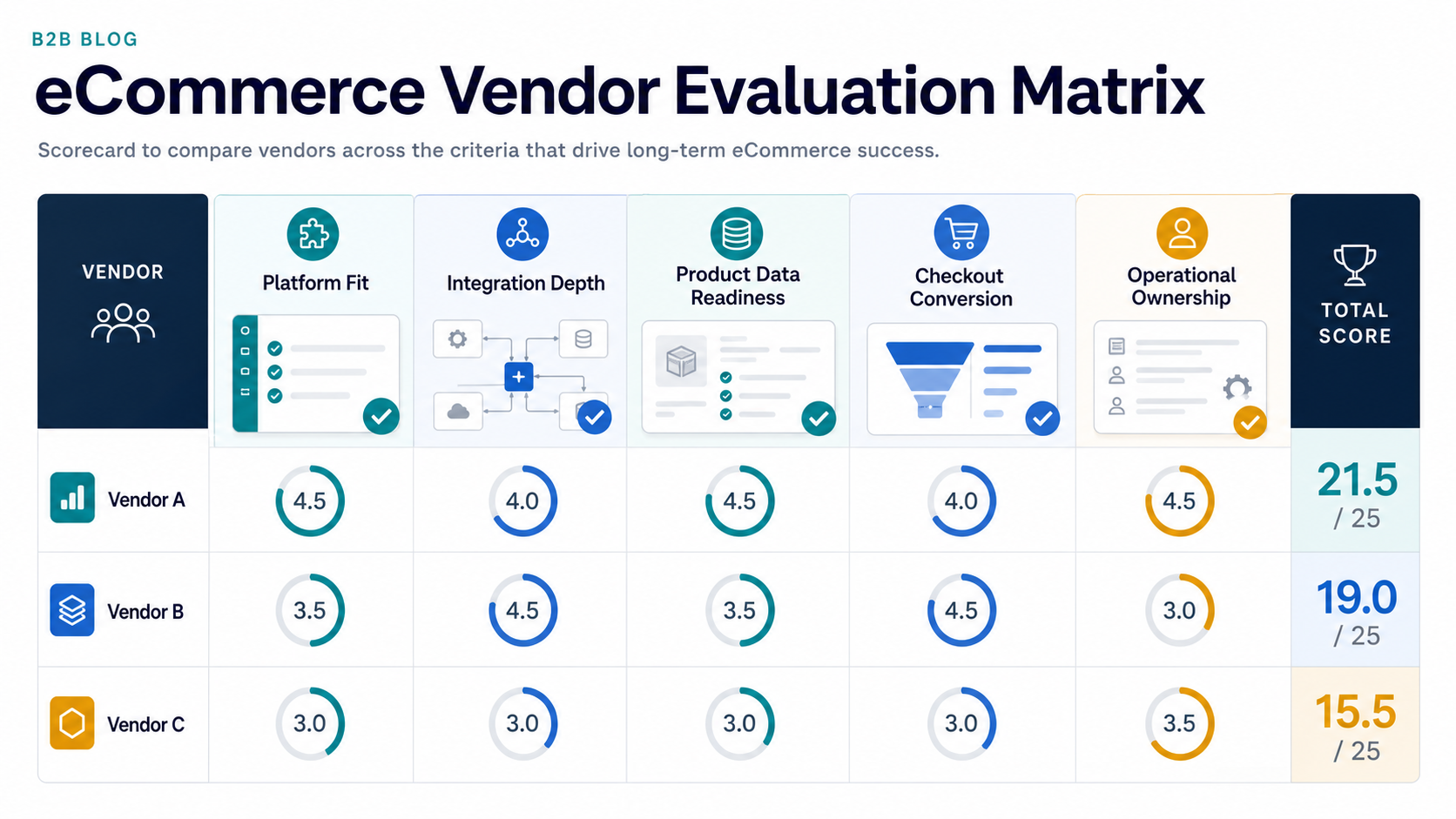
| Area | Score 1 | Score 3 | Score 5 |
|---|---|---|---|
| Platform strategy | Names a platform quickly | Compares platforms at a high level | Maps platform choice to business model, operations, and future migration |
| Integrations | Lists tools | Mentions APIs and connectors | Defines owners, sync patterns, retries, monitoring, and reconciliation |
| Product data | Imports basic fields | Supports categories and filters | Plans attributes, feeds, schema, AI search, governance, and enrichment |
| Conversion | Builds checkout screens | Uses common UX patterns | Tracks friction, tests mobile flows, and owns experiment backlog |
| Operations | Offers support hours | Provides maintenance package | Defines monitoring, release process, incident response, and optimization cadence |
Use this scorecard during vendor calls. Ask each company to show artifacts, not just explain their process. A team that can produce a clear integration diagram, event map, field mapping sheet, test plan, and launch checklist is usually safer than a team that only shows visual design work.
Vendor Evidence To Request Before You Sign
Ask each finalist for project artifacts from a comparable engagement. You do not need private client data, but you should see the shape of their thinking: a platform decision memo, integration diagram, data object ownership map, checkout test plan, analytics event taxonomy, performance budget, release checklist, and post-launch optimization backlog.
Also ask how they staff the work after launch. A one-time build team may be enough for a simple migration, but growth stores often need a dedicated eCommerce development team that can handle releases, experiments, dependency updates, integration changes, and operational fixes without restarting discovery every month.
Red Flags Before You Sign
- The proposal prices screens but ignores integrations, data cleanup, admin operations, and analytics.
- The company recommends a platform before understanding catalog, pricing, fulfillment, and account rules.
- They cannot explain checkout failure handling, payment edge cases, or tax/shipping complexity.
- They treat product data as content entry instead of a search, feed, and merchandising system.
- They have no plan for performance budgets, monitoring, backups, and dependency updates.
- They promise AI personalization without explaining data sources, governance, model boundaries, and measurement.
- They do not define post-launch ownership for conversion experiments and operational fixes.
How NextPage Helps Commerce Teams Plan The Build
NextPage helps commerce teams turn vague store ideas into a buildable roadmap. We map the business model, platform fit, catalog structure, buyer journeys, integrations, checkout requirements, analytics, operational workflows, and launch phases before development starts. That gives founders, retail leaders, and operations teams a clearer scope and a stronger basis for comparing proposals. To review adjacent software and AI work, use the software and AI portfolio as a reference for how complex workflows are framed beyond the storefront.
For teams planning a new commerce product, replatforming effort, marketplace, B2B portal, or conversion upgrade, we can help define the MVP, integration architecture, data model, and delivery plan. Start with the web app development team when the store requires custom workflows, admin tooling, or system integrations beyond a standard storefront.
Book an eCommerce platform and integration planning call with NextPage.