
Quick Answer: Employee Performance Management Software Cost
Employee performance management software cost depends on the workflow you need to run, not just the number of screens. A simple appraisal workflow with employee records, review forms, goals, manager feedback, and basic reports is a very different project from a custom HR platform with 360 feedback, calibration, compensation inputs, payroll handoff, analytics, audit trails, and role-based permissions.
If your company can use a standard HRMS performance module with light configuration, buying SaaS is usually faster. If your review cycles, approval chains, data model, reporting, or integrations keep moving into spreadsheets and manual workarounds, custom employee performance management software becomes worth estimating.
For a directional range, start with the Custom Software Cost Estimator. For the build-versus-buy decision, read NextPage's guide on when custom employee management software makes sense.
What Drives Performance Management Software Cost?
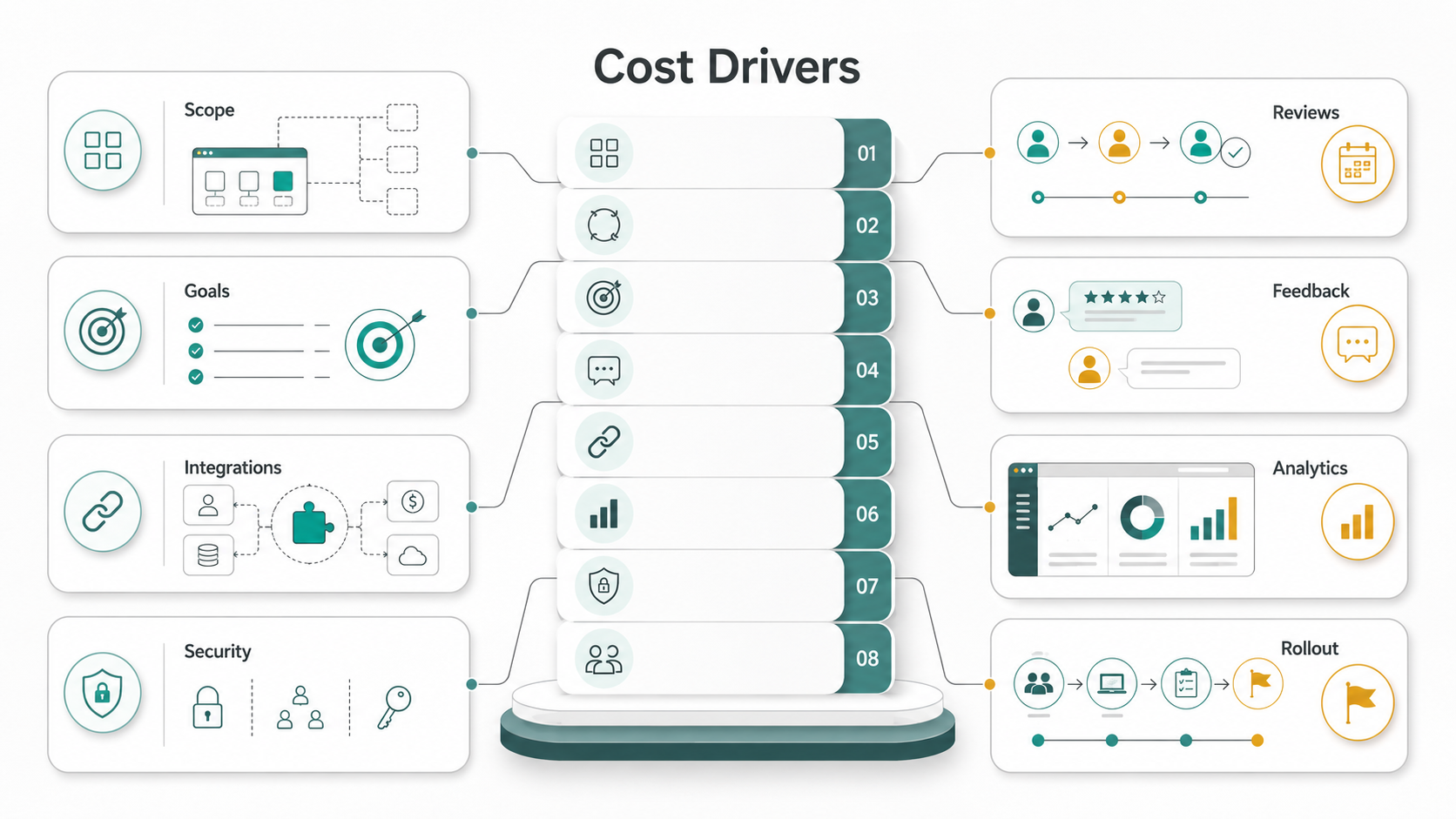
The biggest cost drivers are review workflow complexity, user roles, integrations, reporting depth, employee data controls, and rollout requirements. A useful estimate should separate standard features from the workflows that make your organization different.
| Cost driver | Lower scope | Higher scope |
|---|---|---|
| Review cycles | Annual or quarterly manager reviews | Probation, project feedback, calibration, 360 reviews, promotion evidence |
| Goals and feedback | Simple goals and comments | OKRs, competencies, skill matrices, continuous feedback, weighted scoring |
| User roles | Employees, managers, HR admins | Executives, finance, regional HR, auditors, external reviewers |
| Integrations | HRMS import or CSV | Payroll, identity, attendance, learning, documents, BI, notifications |
| Reporting | Completion status and rating summaries | Trend analysis, calibration views, manager dashboards, compensation inputs |
| Security | Basic role access | Field-level permissions, audit logs, retention, sensitive notes, regional policies |
NextPage's employee performance management software development service starts by mapping review cycles, goals, feedback, employee records, dashboards, approvals, and integrations before estimating the build.
Typical Scope Tiers
Most teams should estimate by scope tier rather than asking for one universal price. The tiers below are planning models, not fixed packages.
| Tier | Included scope | Best for |
|---|---|---|
| Performance review MVP | Employee profiles, review forms, manager feedback, goals, reminders, status dashboard, admin setup | Teams replacing spreadsheets or a lightweight manual review process |
| Custom performance platform | Multiple review cycles, role-based workflows, 360 feedback, competencies, dashboards, exports, HRMS integration | Growing companies that need structured reviews and better reporting |
| Employee performance operations system | Performance, payroll inputs, compensation review, calibration, learning links, analytics, audit logs, integrations, change management | Companies where performance data affects pay, promotions, workforce planning, and leadership reporting |
A narrow MVP can launch faster because it avoids solving every HR process at once. A larger platform needs stronger product discovery, security design, integration planning, and rollout support.
Features That Change The Estimate
Some features look small in a list but carry meaningful product and data complexity. Custom review forms are easy if every team uses the same questions. They are harder when questions change by role, level, department, location, or employment type. Goal tracking is simple when goals are plain text; it becomes deeper when goals connect to OKRs, KPIs, manager approvals, weighted scores, and analytics.
- 360 feedback: Adds reviewer selection, anonymity rules, deadline logic, visibility controls, and summary reporting.
- Calibration: Adds cross-manager comparison, rating distribution, leadership review, audit history, and sensitive access rules.
- Compensation inputs: Adds payroll or finance handoff, stricter permissions, approval records, and compliance sensitivity.
- Analytics: Adds data definitions, dashboards, trend reports, cohort views, and export needs.
- Employee self-service: Adds UX polish, notifications, status visibility, help text, and adoption support.
When these features are central to the business, the project is closer to custom software development than simple HRMS configuration.
Implementation Timeline
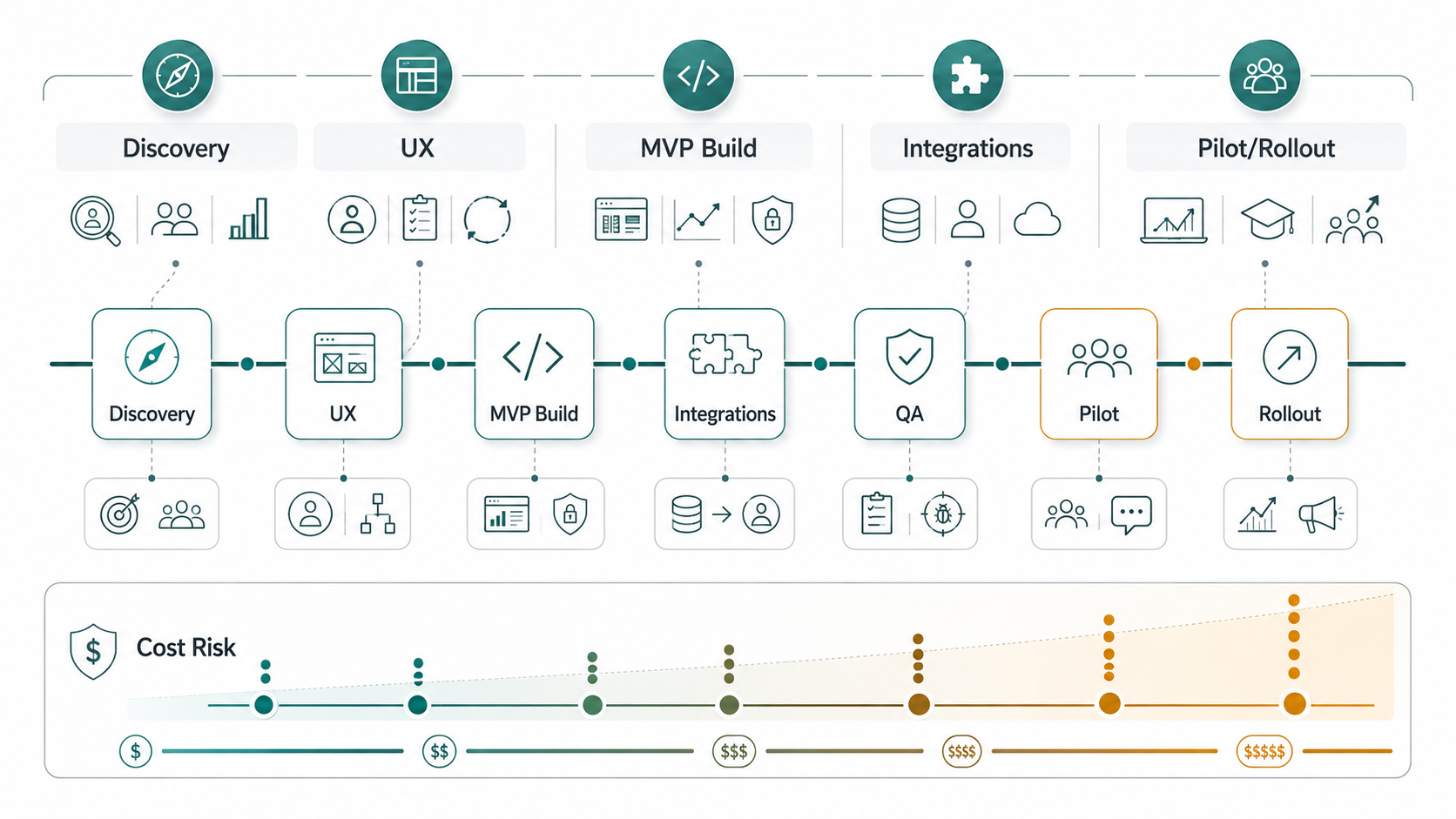
A practical implementation timeline usually moves through discovery, UX/data model, MVP build, integrations and QA, then pilot rollout. Skipping discovery is tempting, but it usually creates rework because performance management touches managers, employees, HR, finance, leadership, and sometimes legal or compliance.
- Discovery: Map current review workflows, data sources, roles, reports, exceptions, and policy constraints.
- UX and data model: Define employee records, review cycles, competencies, goals, permissions, and reporting entities.
- MVP build: Build the first review workflow, admin tools, notifications, dashboards, and employee/manager experience.
- Integrations and QA: Connect HRMS, identity, payroll handoff, documents, or BI tools and test sensitive access paths.
- Pilot and rollout: Launch with a controlled group, measure completion rates, fix confusion, train admins, and expand.
If the first release includes heavy integration, treat QA and rollout as a budget line, not an afterthought. HR software failures damage trust quickly because employees experience the workflow directly.
Integration Costs To Plan For
Performance management software often needs employee master data, manager hierarchy, department, location, role, compensation eligibility, attendance or project data, and payroll or HRMS identifiers. Each integration needs authentication, mapping, sync frequency, retry logic, error handling, and ownership rules.
Payroll-related integrations deserve extra care. In many cases, the custom platform should not calculate payroll. It should collect approved performance or compensation inputs and hand them to a system designed for payroll operations. If your scope includes payroll workflows, review NextPage's HR and payroll software development service boundary before estimating.
Build Vs Buy: Cost Is Not The Only Question
Buying a performance module can be the right move if your process is standard and your reporting needs are modest. Custom software becomes stronger when review logic is specific, sensitive data needs careful visibility, integrations are strategic, or the company needs a workflow that existing tools cannot represent cleanly.
Use the Build vs Buy Decision Tool when stakeholders are split. It helps compare buying, configuring, integrating, and building based on workflow uniqueness, integration depth, strategic advantage, and compliance needs.
How To Control Budget
The best way to control budget is to keep the first release narrow. Build the review workflow that removes the most manual work. Avoid launching every appraisal model, analytics view, and compensation workflow at once. Decide what version one must prove, then move later-phase ideas into a roadmap.
For broader planning, compare this post with NextPage's custom software development cost guide and web app development cost guide. Performance management software is usually a web application with sensitive data, workflow logic, reporting, and integration complexity.
Final Cost Planning Checklist
- Which review workflows must launch in version one?
- How many user roles need different permissions?
- Which HRMS, payroll, identity, document, or analytics systems must connect?
- What employee data is sensitive enough for field-level controls or audit logs?
- Which reports drive decisions, and who owns the definitions?
- How will managers and employees be trained?
- What can be deferred until after pilot feedback?
Once you can answer those questions, the estimate becomes much more useful. If the scope is still fuzzy, use a discovery sprint or estimator before asking for a fixed build number.