
Enterprise RAG implementation cost usually starts around $35,000-$75,000 for a controlled pilot, $80,000-$180,000 for a production knowledge assistant, and $180,000-$500,000+ when the system must support regulated data, document-level permissions, source-system sync, evaluation datasets, audit logs, and managed operations. The expensive part is rarely the chatbot screen. The budget is shaped by whether the retrieval layer can safely find the right document, respect the user's permissions, cite the source, refuse uncertain answers, and keep working as content changes.
Retrieval-augmented generation is useful because it grounds an LLM in company knowledge instead of asking the model to answer from memory. In enterprise settings, that usually means connecting SharePoint, Google Drive, Confluence, CRM exports, PDFs, policies, tickets, product docs, SOPs, or data warehouse records. Each source adds ingestion, parsing, metadata, access-control, evaluation, and support scope.
If you need a first-pass budget before vendor calls, start with NextPage's Custom Software Cost Estimator. Then use the roadmap below to decide whether you are funding a prototype, a governed production RAG system, or a regulated enterprise search layer with ongoing evaluation and support.
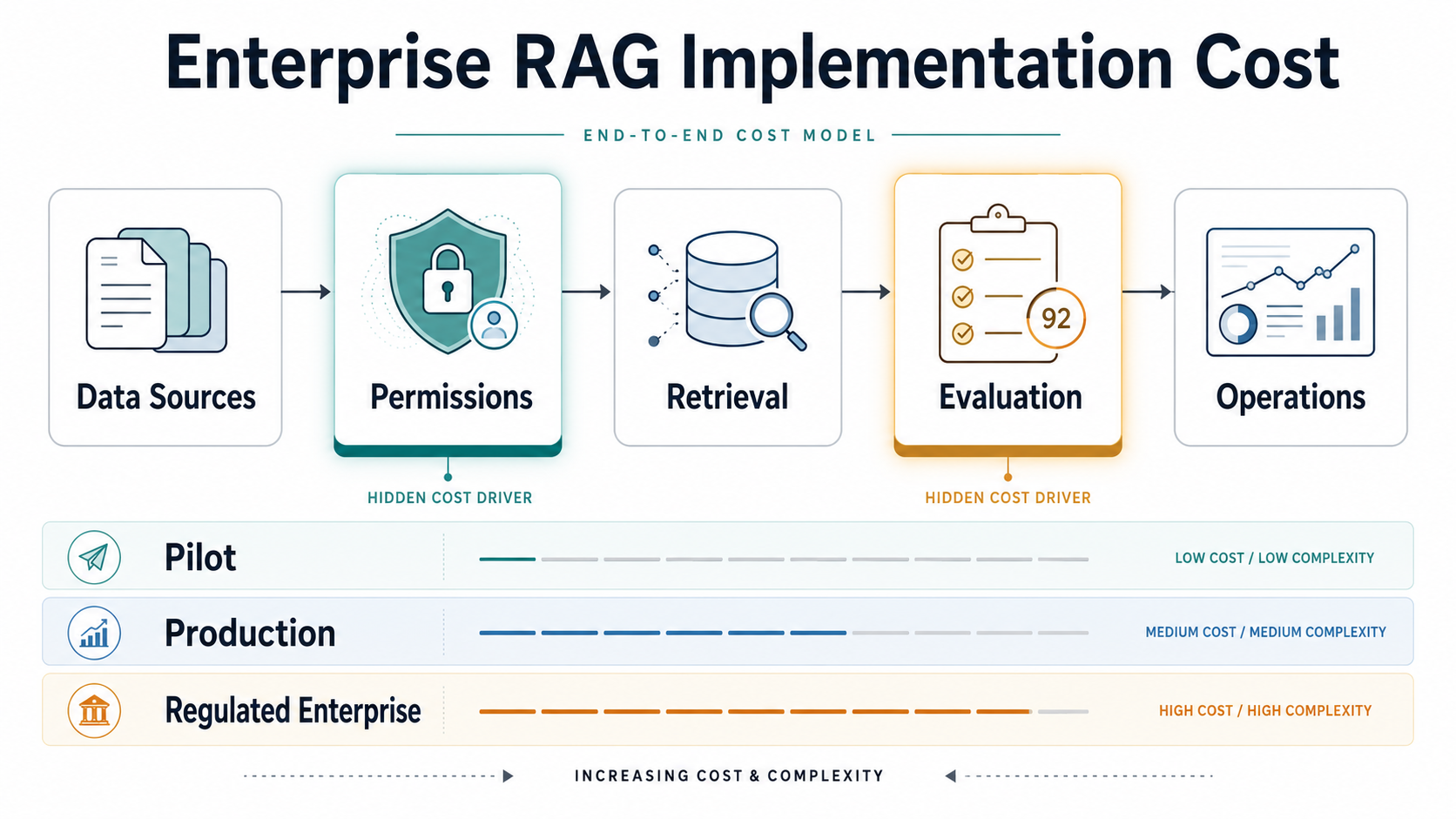
Quick Answer: Enterprise RAG Implementation Cost
RAG implementation cost depends on the operating promise. A demo can answer from a small folder. A production assistant has to ingest changing documents, filter results by user, expose citations, measure retrieval quality, track failures, and support real users. A regulated RAG system adds stronger privacy, audit, retention, residency, review, and security evidence requirements.
| Scope | Typical Build Range | Best Fit | Main Risk |
|---|---|---|---|
| RAG prototype | $15,000-$35,000 | One or two document sets, limited users, manual uploads, basic vector search, simple chat UI, and no complex permission model. | Looks impressive but does not prove production security, quality, or support needs. |
| Controlled pilot | $35,000-$75,000 | One workflow, selected source connectors, role-based access, citations, feedback capture, and a small evaluation set. | Teams under-scope source cleanup and retrieval testing. |
| Production knowledge assistant | $80,000-$180,000 | Multiple sources, scheduled ingestion, metadata filters, permission sync, evaluation dashboards, admin tools, and monitoring. | Permissions, stale content, and weak observability become support problems. |
| Regulated enterprise RAG | $180,000-$500,000+ | Granular RBAC, PII controls, audit logs, data residency, SIEM integration, human review, and formal release gates. | Security and compliance scope can exceed the visible app build. |
These are planning bands, not fixed quotes. RAG cost follows data quality, security requirements, integration depth, answer-risk tolerance, and support responsibility. The broader pattern is similar to custom software development cost: the workflow and risk model matter more than screen count.
Why RAG Prototypes Are Cheaper Than Production RAG
A prototype often uses a small document set, one embedding model, a vector database, and a simple retrieval prompt. That is enough to test whether users like conversational access to internal knowledge. It is not enough to prove the system is safe for customer support, legal, healthcare, finance, HR, engineering, or compliance teams.
Production RAG needs a defined operating contract. Which sources are allowed? Who owns each source? How often does it sync? Which documents are restricted? Which answer types require citations? What should the assistant do when retrieval confidence is low? Who reviews failed answers? What happens when a policy changes?
This is why NextPage recommends scoring the workflow before choosing the stack. The AI Agent Readiness Assessment is useful even for RAG because it forces teams to examine workflow clarity, data readiness, integrations, governance, and human-review controls before giving an AI system production reach.
Data Readiness Is The First Cost Driver
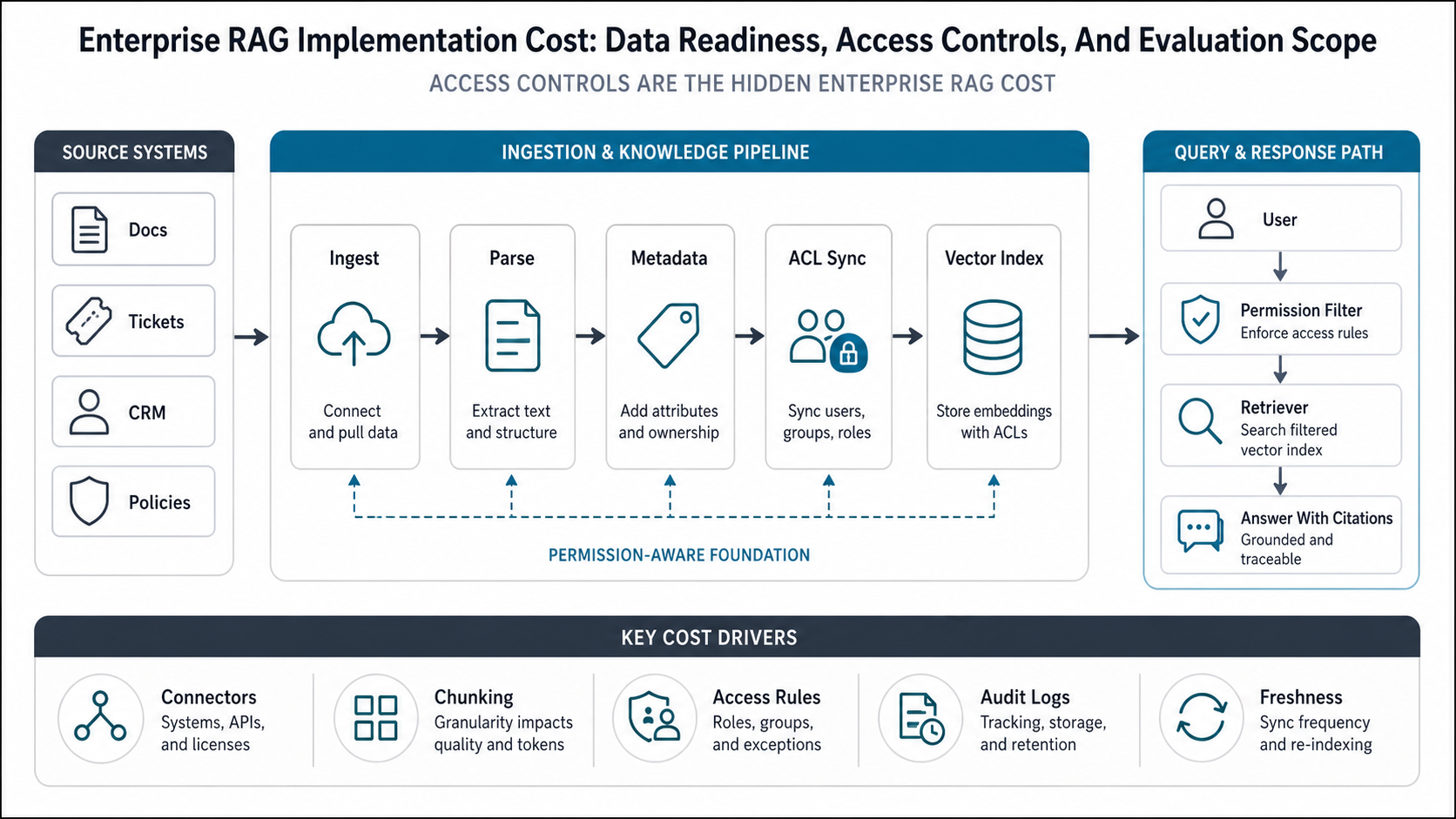
Enterprise RAG quality starts with the source material. Well-structured help docs, SOPs, and product pages are easier to index. Scanned PDFs, duplicated policies, stale folders, inconsistent naming, private notes, and mixed-language files are harder. The assistant can only retrieve what the ingestion pipeline can parse, chunk, classify, and keep current.
Discovery should inventory source systems, document formats, update frequency, owner, sensitivity, access model, duplicate risk, and content quality. A team that skips this step often pays later through poor answers, hidden data leaks, or manual re-indexing work. The companion AI Data Readiness Checklist is useful when teams need a stricter evidence pack before funding a RAG build.
| Data Readiness Item | Why It Adds Scope | How To Control Cost |
|---|---|---|
| Source connectors | SharePoint, Confluence, Drive, S3, CRM, ticketing, and custom databases all need different auth, sync, and failure handling. | Start with the source that owns the highest-value workflow. |
| Document parsing | PDFs, tables, scanned files, images, and slide decks need stronger parsing and quality checks. | Separate high-value complex documents from low-value archives. |
| Chunking and metadata | Retrieval quality depends on section boundaries, titles, dates, owners, tags, and document type. | Define a minimum metadata contract before indexing everything, using RAG knowledge representation patterns when source structure is inconsistent. |
| Content cleanup | Duplicates, old versions, and conflicting policies create answer conflicts. | Create an owner-led cleanup queue for the top sources only. |
| Freshness | Scheduled sync, deletion handling, and stale-index detection become operational work. | Match sync frequency to business risk instead of defaulting to real time. |
Access Controls Are The Hidden Enterprise RAG Cost
The fastest way to fail a security review is to index restricted documents into one shared knowledge base and filter only after the answer is generated. Enterprise RAG must enforce access before retrieval results are used in the response. That usually means permission metadata at ingestion, query-time filtering by user or role, and continuous sync when source permissions change.
Permission scope varies widely. A small pilot may only need three roles. A regulated enterprise may need document-level ACLs, group membership sync, row-level filters, tenant isolation, PII classification, data retention, and audit trails. Managed RAG platforms can reduce engineering work when their connector and ACL model matches the organization. Custom work is still common when the source systems or compliance model are unusual.
For teams planning broader production AI work, NextPage's Enterprise AI Readiness Checklist gives a useful companion view of data, workflow, security, and governance readiness before the RAG system is exposed to users.
Retrieval Quality And Evaluation Are Not Optional
RAG teams often test by asking a few familiar questions in a demo. That is not an evaluation strategy. Production RAG needs a test set of real questions, expected source documents, answer criteria, failure examples, and thresholds for release. The system should measure whether retrieval found the right documents, whether the answer stayed faithful to those documents, and whether citations are useful.
Useful evaluation metrics include precision, recall, F1, MRR, NDCG, faithfulness, citation accuracy, refusal quality, and escalation accuracy. The exact mix depends on the workflow. A policy assistant may prioritize citation accuracy and refusal behavior. A support copilot may prioritize top-answer relevance and coverage. A compliance assistant may prioritize recall and audit evidence because missing the relevant source is more expensive than showing one extra document.
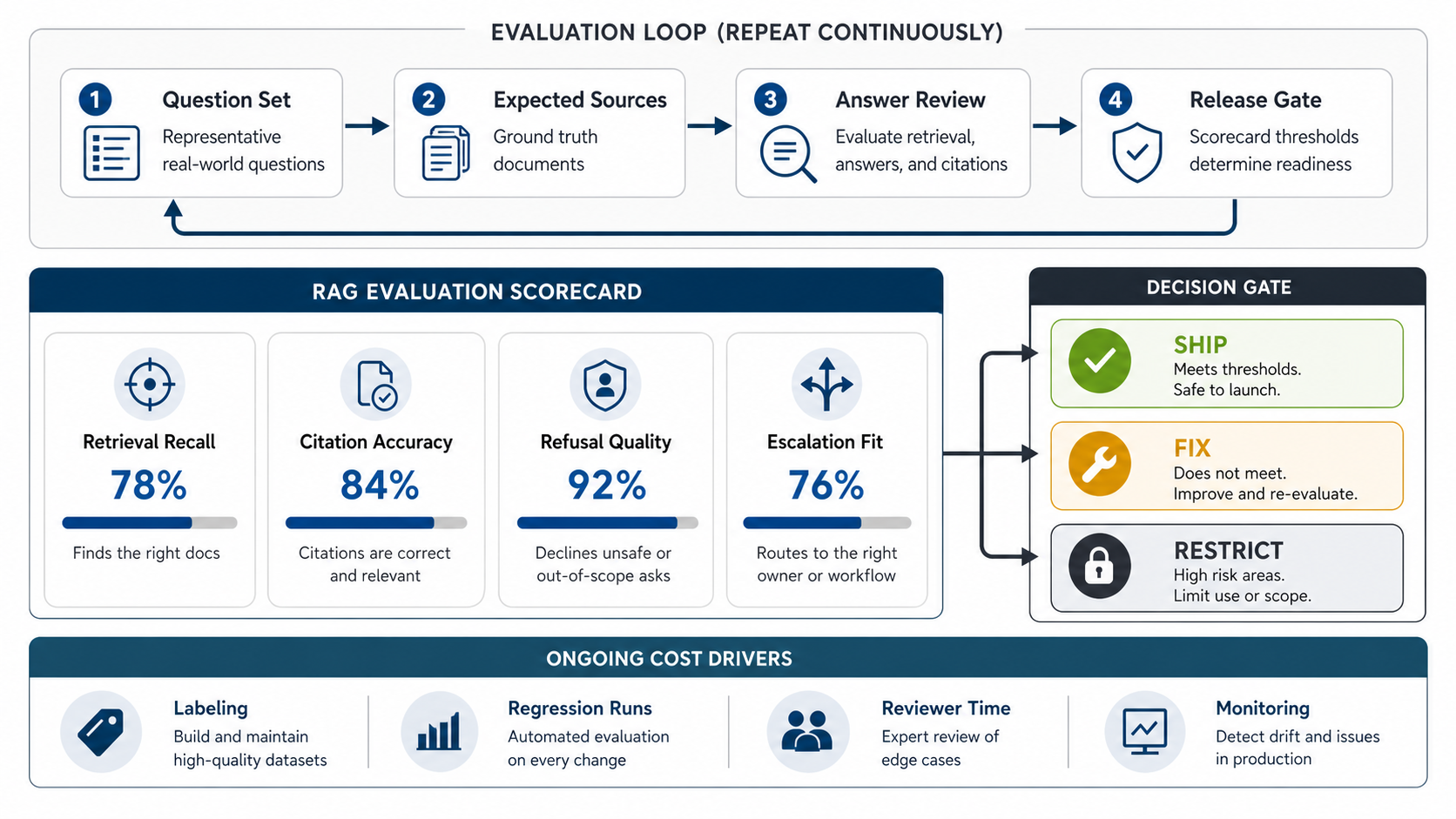
This evaluation layer often adds data labeling, test harnesses, regression runs, dashboards, and review workflows. It belongs in the first implementation budget. NextPage's machine learning development services work usually treats evaluation data, monitoring, and model-quality gates as part of production AI delivery rather than a late QA afterthought.
Build Vs Buy: Managed RAG, Assembled Stack, Or Custom Enterprise Layer
There are three practical ways to build enterprise RAG. A managed platform can handle connectors, vector storage, retrieval defaults, permissions, and observability faster when your sources fit the platform. An assembled stack gives more control over orchestration, vector database, embeddings, reranking, evaluation, and deployment. A custom enterprise layer is often needed when business rules, permission models, audit controls, or product UX are specific to the organization.
| Approach | Good Fit | Cost Tradeoff |
|---|---|---|
| Managed RAG platform | Common enterprise sources, standard permissions, faster internal assistant launch. | Lower build effort, recurring platform cost, and potential limits around customization. |
| Assembled RAG stack | Engineering teams that need control over retrieval, evaluation, vector storage, and model routing. | More implementation effort, better architectural control, higher operations responsibility. |
| Custom enterprise layer | Regulated workflows, unusual sources, customer-facing products, or proprietary decision logic. | Higher initial cost, stronger fit for differentiated workflows and governance. |
For many teams, the right answer is hybrid. Use managed services for commodity ingestion or retrieval infrastructure, then build custom workflow, permissions, admin, evaluation, and product layers around the parts that create business value. NextPage's AI development services page is the closer service path when RAG is part of a larger AI product or business application.
A Practical RAG Implementation Roadmap
Phase 1: discovery and source audit. Pick one use case, name the business owner, list the source systems, identify restricted data, and define what a correct answer must include.
Phase 2: data and permission model. Design document metadata, chunking strategy, source-owner fields, retention rules, role filters, and deletion handling. Decide whether permission checks happen through source ACL sync, application roles, or both.
Phase 3: pilot build. Implement ingestion, embeddings, retrieval, citations, chat or assistant UI, feedback capture, and a first evaluation set. Keep the pilot narrow enough to learn quickly.
Phase 4: evaluation and hardening. Add regression tests, retrieval metrics, refusal cases, monitoring, admin review, prompt/version control, error handling, and security review evidence.
Phase 5: production rollout. Add scheduled sync, observability, support runbooks, onboarding, access audits, cost monitoring, and a roadmap for additional sources or workflows.
If the RAG system is meant to trigger actions instead of only answer questions, connect it to workflow planning. NextPage's AI Automation Services are more relevant when retrieval feeds CRM, ERP, ticketing, finance, or operations workflows.
Team Shape And Timeline
A narrow RAG pilot can often be built by a small team: product/solution lead, AI engineer, backend engineer, frontend engineer, and part-time security or DevOps support. Production systems need more support from data engineering, identity/access management, QA, security, and business owners who can label answers and resolve source conflicts.
Typical timelines are four to eight weeks for a focused pilot, eight to sixteen weeks for a production assistant with multiple sources, and three to six months or more for regulated enterprise rollout. Timeline expands when source owners are unclear, permissions are undocumented, compliance review is heavy, or the team discovers that important documents are stale or contradictory.
Ongoing Costs After Launch
RAG has recurring costs beyond the initial build. Infrastructure includes vector storage, embedding jobs, LLM inference, reranking, logs, and monitoring. Operations include connector maintenance, failed sync handling, content review, evaluation refreshes, support tickets, and access audits. Governance includes security reviews, policy updates, vendor reviews, and incident response evidence.
The ROI model should compare support hours saved, faster onboarding, reduced escalation time, fewer repeated questions, improved compliance evidence, and lower search friction against these recurring costs. NextPage's AI Automation ROI Calculator can help frame savings, but the model should include evaluation and support work because RAG quality degrades when nobody owns the knowledge base.
Enterprise RAG Readiness Checklist
- One high-value use case is selected with a named business owner.
- Source systems, owners, sensitivity, update frequency, and access rules are documented.
- The first release has a defined permission model and query-time retrieval filtering.
- Documents have enough metadata for retrieval, citations, filtering, and freshness checks.
- A test set exists for real user questions, expected sources, failure cases, and release thresholds.
- The system can refuse or escalate when evidence is missing, conflicting, restricted, or stale.
- Admins can see failed syncs, poor answers, user feedback, cost, latency, and retrieval traces.
- Security has evidence for identity, logging, retention, source permissions, and audit requirements.
- The team has a support owner for content cleanup, evaluation refreshes, and access reviews.
How NextPage Can Help
NextPage helps teams scope, design, and build RAG systems that are useful beyond a demo. That can include source discovery, data readiness scoring, architecture, secure retrieval, permission-aware workflows, evaluation datasets, admin tooling, AI product UX, and production monitoring.
The practical first step is not choosing a vector database. It is deciding which workflow deserves an AI knowledge layer, which sources are trustworthy, which users are allowed to see which evidence, and how answer quality will be measured. From there, a controlled pilot can become a production RAG system without surprising the security, compliance, or support teams.