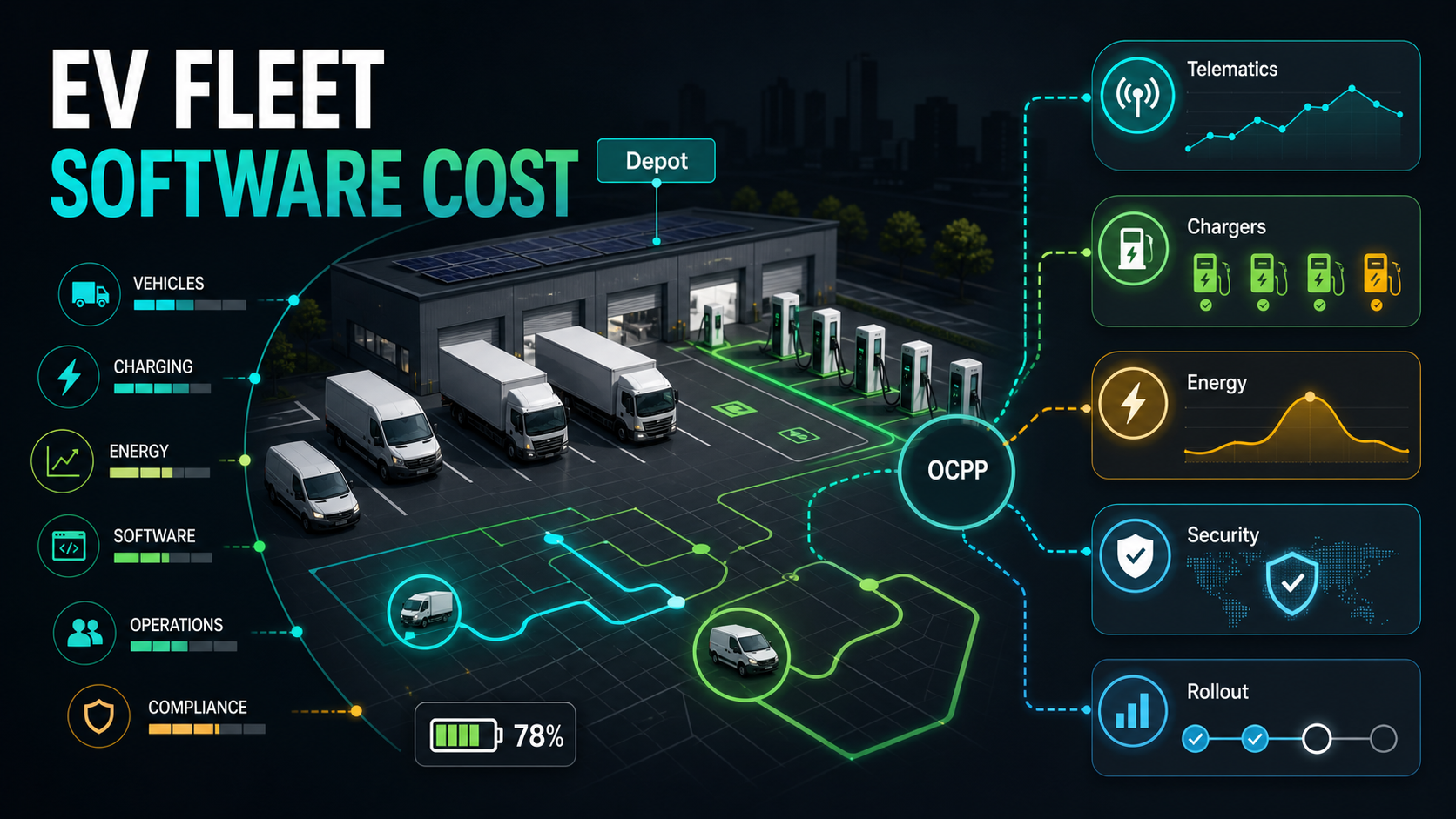

Quick Answer: EV Fleet and Charging Software Cost
EV fleet and charging software usually costs more when it has to coordinate real operations, not when it simply shows chargers on a map. A basic MVP can manage vehicles, depots, charging sessions, users, and dashboards. A better 2026 estimate also separates visibility, control, optimization, and partner-network scope before a team prices engineering effort. A serious fleet platform adds telematics, route planning, charger status, energy-price logic, battery state of charge, maintenance alerts, billing rules, and security controls across operators, drivers, depots, and charging partners.
For most operators, the right first release is not a giant all-in-one EV platform. It is a controlled workflow around one measurable problem: depot charging conflicts, driver range anxiety, unmanaged charging cost, charger downtime, route readiness, or reporting. Start by estimating the core workflow with the Custom Software Cost Estimator, then decide which integrations must be in release one and which can wait.
The biggest cost drivers are charger protocol support, telematics data quality, route and energy optimization, billing complexity, mobile driver workflows, admin permissions, cybersecurity, and how much existing fleet software must be replaced or connected. A phased build can keep the first release useful while avoiding a fragile system that tries to control vehicles, chargers, depots, and utility signals before the operating rules are proven.
2026 planning note: treat standards, uptime evidence, and security operations as estimateable work. DOE and AFDC guidance still ties reliable charging to networked charger operations, data transparency, and managed charging discipline. OCA now has active 2026 OCPP 2.0.1 certification activity and a 2026 security operations guide for OCPP 2.0.1 and 2.1, while federal charging programs keep uptime and data submission visible. Those signals do not mean every MVP needs every protocol feature. They mean the estimate should name which vendor claims are proven, which telemetry is available, which security controls are owned, and which support runbooks must exist before fleet rollout.
What EV Fleet and Charging Software Must Do
EV fleet software sits between vehicles, chargers, drivers, dispatchers, energy teams, maintenance teams, and finance. That makes it different from a consumer charging app. A fleet operator cares about whether tomorrow's routes are covered, whether each vehicle has enough range, which chargers are available, whether a depot peak will raise demand charges, and which exceptions need human action.
A useful platform usually includes four surfaces. The operations dashboard shows vehicle readiness, charger availability, route risk, energy usage, and exceptions. For fleet teams comparing vendors or a custom build, that dashboard should connect naturally to automotive software development services, custom software development, and custom dashboard development services rather than living as an isolated reporting layer. The driver app gives assignment, charging instructions, range guidance, inspection notes, and support flows. The admin portal manages depots, chargers, vehicles, roles, pricing rules, alerts, and reporting. The integration layer connects telematics, charging stations, fleet management systems, billing, ERP, maps, and analytics.
NextPage already covers the operational side in EV fleet energy management software. This cost guide goes one layer deeper into the build decisions that shape budget: which workflows are custom, which protocols are needed, which data sources can be trusted, and which rollout phase should carry each feature.
EV Fleet Software Cost Tiers by Scope
Cost should be estimated by workflow complexity. A simple app with static vehicle records and charger locations is a very different product from a depot optimization platform that reads live telematics, charger sessions, tariffs, maintenance holds, and dispatch requirements. Use these tiers as planning bands, not fixed quotes.
| Scope Tier | Typical Features | Best Fit | Cost Pressure |
|---|---|---|---|
| MVP command center | Vehicle registry, charger registry, depot map, basic session tracking, alerts, admin roles, simple reporting | Early EV fleet pilot with one or two depots | Moderate, mostly product and dashboard work |
| Integrated operations platform | Telematics, charger protocol integration, route readiness, driver app, maintenance alerts, SLA dashboards, exports | Growing fleet with dispatch and maintenance teams | High, driven by integrations and data quality |
| Energy and charging optimization | Managed charging, tariff windows, demand-charge avoidance, load constraints, battery-health rules, scenario planning | Depot-heavy fleets with high charging cost exposure | High to very high, driven by optimization logic and validation |
| Network and partner platform | Multi-tenant accounts, partner chargers, roaming, billing rules, uptime SLAs, API products, audit trails | Charging networks, mobility platforms, or multi-client operators | Very high, driven by permissions, billing, security, and support operations |
If you are unsure where to start, use the MVP Scope Builder to separate the first operational workflow from later optimization ideas. EV software projects often become expensive when every stakeholder asks for a different dashboard before the shared data model is stable.
Feature Cost Drivers That Matter Most
The feature list alone does not explain cost. Two teams can both ask for charger management, but one only needs charger inventory while the other needs OCPP session data, remote start-stop, fault codes, firmware coordination, uptime SLAs, and billing reconciliation. The second system is not just a bigger UI. It is a deeper operational integration.
High-impact cost drivers include live charger status, charger control commands, battery state-of-charge estimates, route energy prediction, driver mobile workflows, maintenance workflows, exception queues, reporting by depot or business unit, and role-based access for operators, finance, partners, and vendors. The broader custom software development cost model applies here: workflow depth, integration risk, permission design, QA, and change management shape the budget more than screen count.
- Vehicle and charger registry: lower cost when records are simple, higher cost when assets have lifecycle, warranty, compliance, and maintenance states.
- Charging sessions: lower cost for manual logs, higher cost for live charger telemetry and control.
- Route readiness: higher cost when the platform predicts range using payload, weather, route, driver behavior, traffic, and charger availability.
- Energy cost rules: higher cost when tariffs, demand charges, depot load limits, and charging windows influence scheduling.
- Driver app: higher cost when offline mode, inspections, navigation handoff, support, documents, and alerts are required.
- Security and audit: higher cost when charger commands, partner access, billing, and operational safety need strong controls.
EV Fleet Cost Driver Matrix
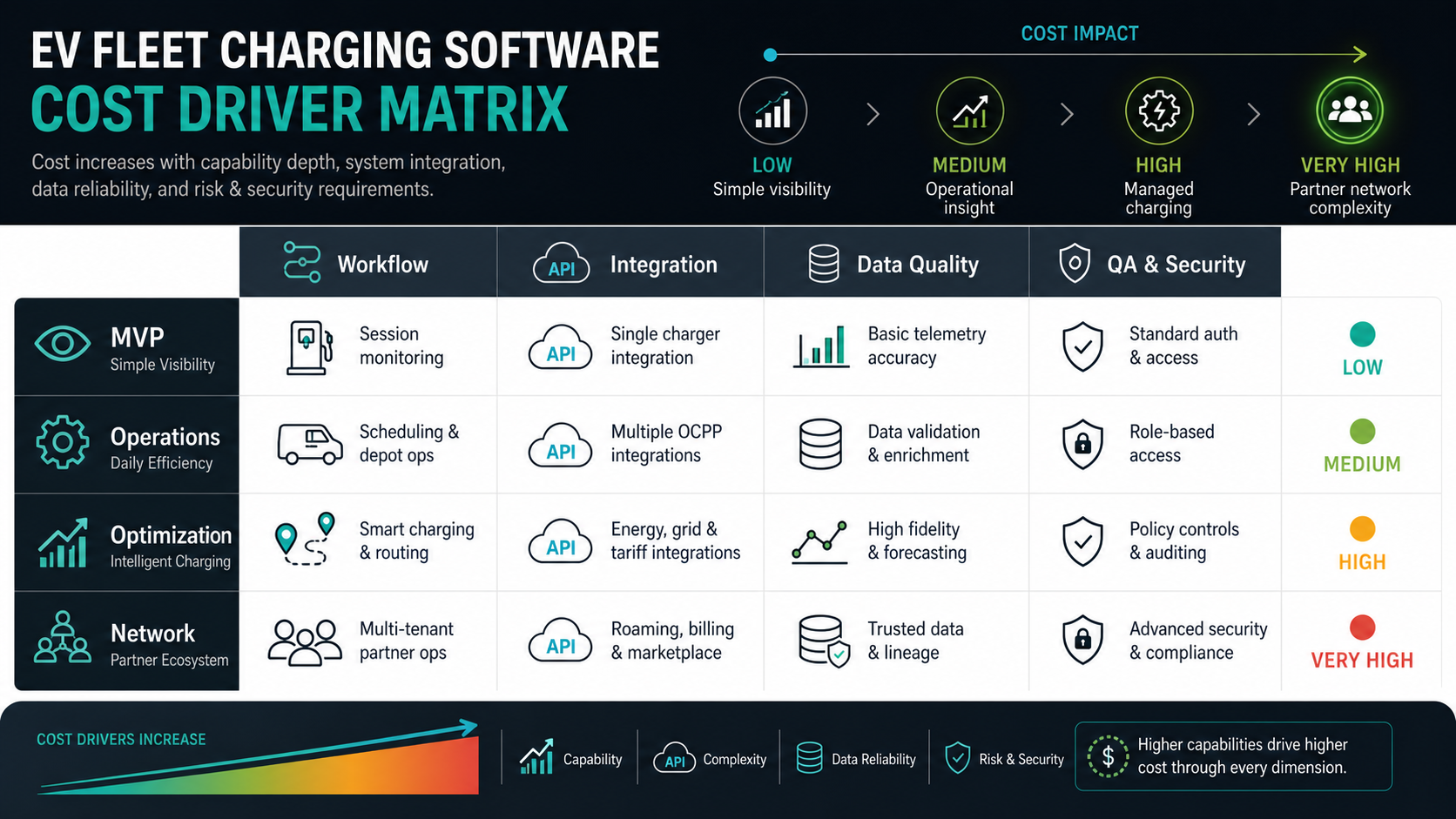
Use the cost tiers as a starting point, then price the work by operational depth. The same feature label can mean very different engineering effort depending on whether the software only displays information, recommends action, controls devices, or coordinates multiple companies.
| Cost Driver | Lower-Cost Version | Budget-Raising Version | Estimate Question |
|---|---|---|---|
| Workflow control | Dashboards, manual updates, basic alerts | Approval queues, exception ownership, dispatch write-back, human-in-the-loop automation | Who acts when a vehicle, charger, route, or depot constraint changes? |
| Integration depth | Scheduled imports or read-only vendor APIs | OCPP events, remote commands, telematics normalization, ERP or billing reconciliation | Which systems are read-only, and which must the platform control or update? |
| Data quality | Single depot, limited vehicle fields, manual overrides | Freshness checks, confidence scoring, delayed-event handling, vendor variance, audit trails | Can operators trust the data enough to change tomorrow's routes? |
| QA and security | Standard web and mobile QA with basic roles | Protocol testing, command authorization, partner roles, incident runbooks, security review | What happens if charger state, billing, or remote control fails? |
This is where the estimate should connect commercial scope to engineering reality. A route-readiness dashboard may fit an MVP, while managed charging with tariff windows, depot load limits, partner chargers, and remote commands should be treated as a later operating platform unless those controls are the first business case.
OCPP, Telematics, Maps, Billing, and Depot Integrations
Integrations are where EV fleet software becomes real. Charger integrations often involve OCPP, vendor APIs, charger status, session logs, remote commands, firmware data, and fault events. Vehicle integrations can involve telematics, GPS, odometer, state of charge, diagnostics, driver behavior, maintenance codes, and trip history. Maps and routing add geocoding, traffic, distance, route constraints, charging stops, and estimated arrival energy.
OCPP support matters because operators do not want every charger vendor to become a separate one-off integration. ISO 15118 and plug-and-charge concepts can matter for authentication and future charging experiences, but they should be scoped based on the fleet's charger ecosystem rather than added as a buzzword. Billing and finance integrations add another layer: internal cost allocation, depot energy reporting, reimbursement, partner settlement, tax handling, and invoice reconciliation.
This is why an EV fleet project often needs the same discipline as IoT app development services. The platform has to handle device signals, event streams, API failures, delayed data, monitoring, and support processes. It also overlaps with automotive software delivery when the work includes telematics, vehicle data, fleet workflows, and EV charging operations. If the driver experience is part of release one, connect the estimate to the mobile app development scope as well as backend and device-integration work.
| Integration | Questions to Ask | Why It Changes Cost |
|---|---|---|
| Charging stations | Which vendors, OCPP versions, commands, and uptime events are required? | Protocol depth, vendor variance, and test environments affect engineering and QA. |
| Telematics | Which vehicles, devices, data fields, and refresh intervals are available? | Dirty or delayed data can force normalization, confidence scoring, and fallback rules. |
| Fleet/dispatch tools | Which system owns routes, assignments, drivers, and job status? | Ownership rules determine whether the EV platform recommends, writes, or only reports. |
| Energy and billing | Do you need tariffs, demand charges, cost centers, invoices, or partner settlement? | Financial workflows add audit, reconciliation, permissions, and reporting complexity. |
2026 Charging Standards That Change Scope
August 18, 2026 source status: The current planning evidence still supports keeping protocol testing, uptime reporting, connector roadmap, and security operations as explicit estimate lines. Open Charge Alliance material continues to frame OCPP 2.1 as the forward-looking protocol surface while OCTT public testing pages still emphasize conformance tooling for OCPP 1.6 and 2.0.1; eCFR 23 CFR 680.116 still anchors covered public charging uptime above 97%; EV-ChART remains the Joint Office submission hub for charging-session, uptime, outage, and maintenance-cost data; and SAE J3400/J3400-2 keeps North American connector/inlet transition work relevant for mixed-fleet rollout plans.
EV fleet estimates should now separate charger visibility from standards-aware control. The Open Charge Alliance lists OCPP 2.1 as the latest protocol release after OCPP 2.0.1 became IEC 63584 in 2024, so teams should ask whether the product only needs OCPP 1.6/2.0.1 compatibility or whether it must prepare for newer bidirectional, DER, and smart-charging workflows. That choice affects charger test rigs, command authorization, certificate handling, event replay, and support runbooks.
| Standards Area | Why It Affects Cost | Planning Decision |
|---|---|---|
| OCPP 2.1 and OCPP 2.0.1 | Newer charger-management capabilities add richer device data, security profiles, remote commands, and more protocol-specific QA. | Decide which charger vendors and OCPP versions are required for release one versus later depots. |
| SAE J3400 / NACS transition | North American fleets may run mixed connector eras during 2025-2026, which changes charger inventory, adapter policy, route planning, and driver support. | Model connector type, charger compatibility, and fallback rules instead of treating every station as interchangeable. |
| ISO 15118 / Plug & Charge | Automated authentication and billing can simplify the driver experience but adds certificate, payment, roaming, and exception-handling scope. | Keep Plug & Charge out of the MVP unless the business case depends on seamless public or partner charging. |
| V2G and bidirectional charging | Vehicle-to-grid workflows need utility, tariff, asset-health, warranty, and controls logic beyond normal session tracking. | Treat V2G as a separate optimization phase after fleet data and charger operations are stable. |
The practical budgeting rule is simple: if software recommends charging, the estimate is mostly data, workflow, and UX. If software controls charging, invoices partners, or changes dispatch commitments, the estimate must include protocol testing, security review, incident response, operations support, and dashboard evidence that makes reliability claims auditable.
For 2026 planning, keep the standards decision explicit: OCPP 2.0.1 remains a practical certification target for many charger-management products, OCPP 2.1 expands the forward-looking protocol surface, SAE J3400/J3400-2 affects North American connector and inlet planning, ISO 15118-20 affects Plug & Charge and bidirectional assumptions, and OCPP security operations now need operational ownership rather than a one-time checklist. Those standards should flow into the vendor evidence checklist below instead of sitting as disconnected feature names.
Vendor Evidence Checklist For 2026 Scope
2026 evidence refresh: Ask for proof that maps to the actual release. OCA's 2026 certification and security-operations material makes OCPP evidence more concrete, DOT/FHWA and Joint Office charging programs keep uptime and data submission in the operating model, and AFDC guidance keeps managed charging tied to networked charging systems. A vendor slide is not enough for estimation. Request logs, simulator flows, certificate/security responsibilities, charger-model matrices, fault examples, uptime definitions, and support runbooks.
Before locking the estimate, ask every charger, telematics, roaming, payment, and energy-management vendor for evidence that can be tested. OCPP 2.0.1 certification status, OCPP 2.1 roadmap maturity, SAE J3400/J3400-2 connector planning, ISO 15118 assumptions, and uptime/data-reporting commitments do not mean every release-one fleet platform needs full protocol depth. They mean the estimate should name which claims are proven, which are roadmap items, and which require custom integration, QA, monitoring, or support work.
OCPP 2.1 test-case maturity note: Treat OCPP 2.1 as a forward-looking scope item unless the vendor can show which functions are supported, tested, and operationally owned today. Open Charge Alliance material identifies OCPP 2.1 as the latest protocol and notes added support for ISO 15118-20, bidirectional charging, DER control, battery swapping, and new authorization options; its 2026 OCTT update also says OCPP 2.1 test cases were still progressing through testing. For an estimate, that means release one should separate certified OCPP 2.0.1 flows from OCPP 2.1 roadmap claims, then price simulator coverage, charger lab access, exception handling, certificate operations, and acceptance tests as explicit work.
| Evidence To Request | What It Proves | Estimate Impact |
|---|---|---|
| OCPP 1.6, 2.0.1, and 2.1 support matrix by charger model | Which commands, security profiles, diagnostics, meter values, local cost calculation, authorization options, and DER or bidirectional capabilities are actually available. | Separates normal charger visibility from protocol adapter work, simulator setup, command authorization, and version-specific QA. |
| Certification, simulator, and test-case evidence | Whether the vendor can expose conformance evidence, replayable flows, fault logs, and edge-case responses for the features the release will depend on. | Moves test environments, mocks, charger labs, and acceptance criteria into scope before rollout risk appears in the depot. |
| SAE J3400 / J3400-2 connector and inlet roadmap | How mixed connector eras, adapters, depot hardware, driver instructions, and public-network charging will behave during transition. | Clarifies whether release one needs connector-aware routing, inventory, support scripts, and exception handling. |
| ISO 15118-20 assumptions and conformance evidence | Whether Plug & Charge, bidirectional charging, certificate handling, EVCC/SECC behavior, and security test cases are mature enough for the fleet workflow. | Prevents underestimating certificate operations, payment/roaming exceptions, test artifacts, and charger/vehicle compatibility work. |
| OCPP security operations responsibility map | Who owns TLS posture, certificate rotation, credential lifecycle, remote-command approvals, logging, incident response, and vendor access across chargers and CSMS workflows. | Makes security operations part of the budget instead of a late review after integrations are built. |
| Uptime, data submission, and fault accountability | Which telemetry proves charger availability, failed sessions, outage exclusions, remediation ownership, and data reporting for public or internal reliability dashboards. | Turns uptime claims into data model, dashboard, escalation, and support-runbook scope. |
If a vendor cannot provide that evidence, treat the missing artifact as scope. It may become a simulator, contract term, integration spike, QA environment, fallback workflow, manual operating procedure, or support escalation path. That is often cheaper than discovering the gap after chargers, vehicles, drivers, and depot schedules are already committed.
Uptime Evidence And Telemetry Ownership
When uptime reporting is part of the software promise, estimate the evidence trail before estimating the dashboard. The eCFR text for 23 CFR 680.116 requires covered public charging programs to keep each charging port above 97% average annual uptime and to calculate port uptime from outage minutes, excluded outage minutes, and a rolling prior-year window. Even private depot programs can use the same discipline: define exactly when hardware and software are considered available, which outage reasons are excluded, which vendor owns remediation, and which data proves the decision.
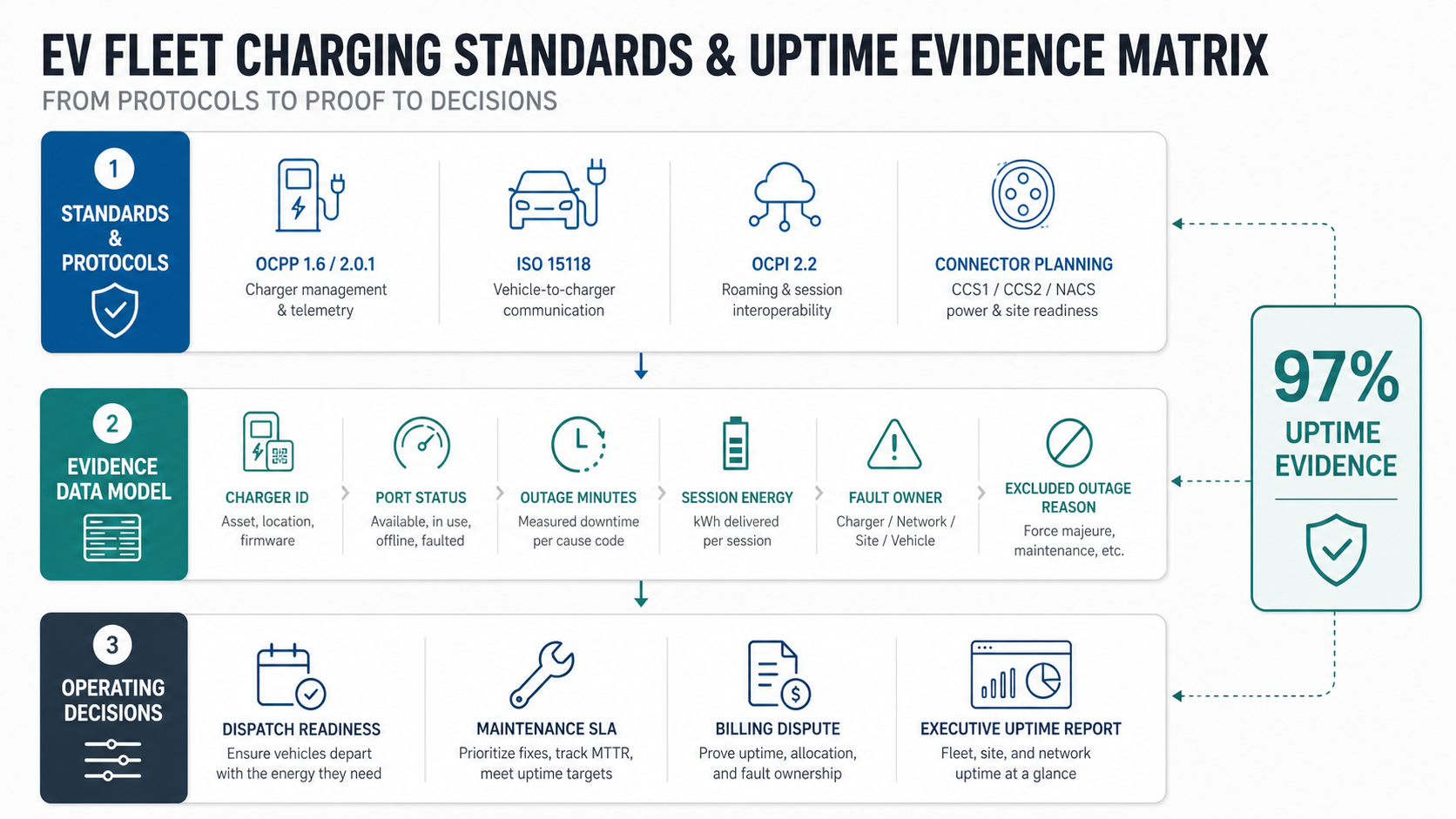
The Joint Office EV-ChART workflow also keeps data submission visible for charging infrastructure programs, so teams should avoid vague reliability metrics. A practical data model should preserve station ID, port ID, connector type, network provider, real-time status, session start and end time, energy dispensed, peak power, fault code, outage duration, exclusion reason, maintenance owner, and customer-support path. Those fields make route readiness, billing disputes, maintenance SLA reviews, and executive uptime reporting auditable from the same source of truth.
Security and Reliability for Charging Operations
Reliability scope refresh: Public charging programs continue to make uptime, data transparency, and support ownership software-estimation issues, not only operations KPIs. Covered public deployments have uptime requirements, and the same discipline is useful for private fleets: define which telemetry proves a port is online, which failed sessions count against route readiness, which vendor owns remediation, and how exceptions feed dispatch, maintenance, billing, and executive reporting. OCPP security operations should also be sized as ongoing work: TLS posture, certificate lifecycle, credential rotation, access review, command approvals, incident response, and log retention all need owners.
When reporting or uptime evidence is in scope, budget for the data model behind the dashboard, not only the visual layer. The platform should preserve charger ID, network provider, port ID, session timestamps, energy delivered, peak power, payment method, fault or outage minutes, excluded outage rationale, and remediation owner so operations teams can reconcile uptime, invoice disputes, maintenance SLAs, and route-readiness decisions from the same evidence trail.
EV charging software touches infrastructure, billing, driver identity, asset data, location data, and sometimes remote charger control. Security cannot be bolted on after the MVP. At minimum, plan role-based access, strong authentication, least-privilege API keys, audit logs, secure command handling, encrypted secrets, data retention rules, vendor access controls, and incident-response workflows.
Reliability also matters because charger downtime affects routes. The software should distinguish between missing data, charger fault, vehicle issue, driver delay, and depot load constraint. Each exception needs an owner and escalation path. A dashboard that only turns a tile red is not enough. Operators need the reason, impact, suggested action, and confidence level.
For higher-risk fleets, add environment separation, change approvals for remote commands, API rate-limit handling, anomaly alerts, recovery runbooks, and independent logs for charger actions. Security requirements should be part of scope estimation from day one, especially when partners, vendors, depots, and finance teams share the platform.
Security scope should also reflect the charging protocol and vendor model. OCPP 2.0.1 introduced stronger security profiles and richer device-management capabilities than older charging integrations, but a fleet still has to decide which charger vendors, commands, certificates, logs, and support procedures are actually in scope. Treat protocol support as a product and QA decision, not just a checkbox.
Connected vehicle work can borrow patterns from the connected vehicle platform architecture roadmap and the OTA updates and remote diagnostics implementation guide: separate telemetry ingestion, command authorization, release governance, monitoring, support ownership, and rollback paths before the pilot goes live.
A Practical Rollout Plan
The safest rollout is phased around operating confidence. Start with visibility, then coordination, then controlled optimization. Jumping straight to autonomous charging decisions is risky if telematics is incomplete, charger status is unreliable, or depot teams still override schedules manually.
- Discovery and data audit: map vehicles, chargers, depots, routes, software systems, data owners, and operational pain points.
- MVP visibility: build the asset model, depot dashboard, charger/session visibility, simple alerts, and manual exception tracking.
- Operational workflow: add driver app, dispatch context, route readiness, maintenance holds, escalation queues, and reporting.
- Managed charging: introduce tariff windows, depot load constraints, charging recommendations, and human approval for high-impact decisions.
- Optimization and scale: add scenario planning, predictive maintenance inputs, partner access, advanced analytics, and controlled automation.
A good pilot should have measurable KPIs: charge-readiness rate, missed-route incidents, charger downtime, manual coordination hours, average energy cost per mile, demand-charge exposure, driver support tickets, and exception resolution time. Those metrics make it easier to decide whether the next phase should add more automation, more integrations, or better field workflow support.
Set the KPI baseline before release one goes live. If the team does not know the current missed-route rate, manual scheduling hours, demand-charge exposure, or charger fault recovery time, the managed-charging roadmap will look precise but remain hard to defend. A useful estimate should include the instrumentation and reporting work needed to prove those improvements, not only the screens that display them.
Rollout Control Board for Cost and Risk
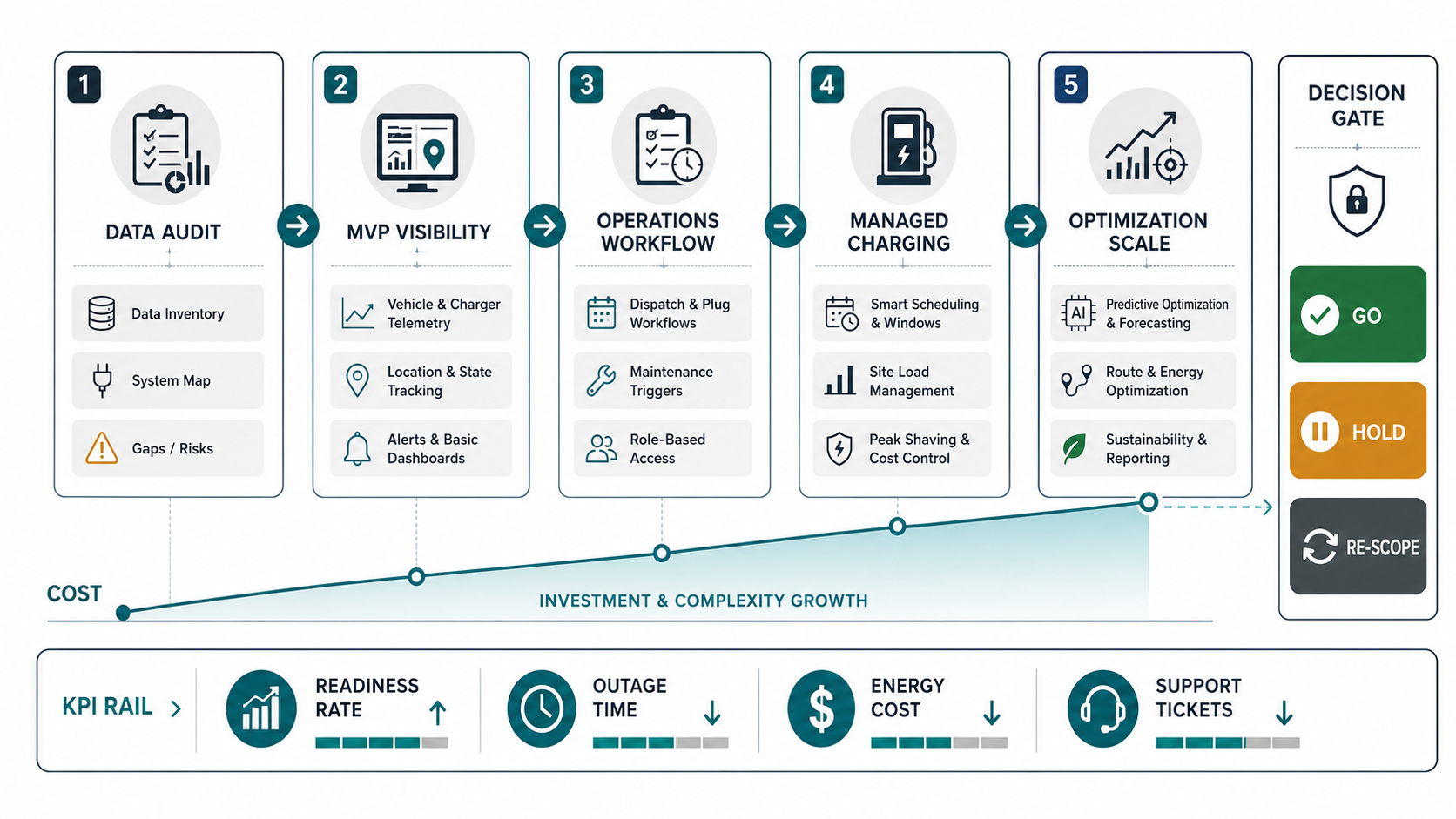
A practical rollout should use metrics that tell the team whether the next phase is ready. Data trust comes before automation. Route readiness comes before managed charging. Charger uptime and exception ownership come before partner billing or network-level commitments.
| Phase | Control Metric | Decision Gate |
|---|---|---|
| Data audit | Vehicle, charger, route, depot, and session records have owners and freshness rules | Do operators trust the data enough to retire spreadsheets? |
| MVP visibility | Route readiness and charger status are visible before dispatch decisions | Does the dashboard prevent avoidable missed routes? |
| Operations workflow | Exceptions have owners, actions, timestamps, and resolution reasons | Can teams close issues without developer or vendor escalation? |
| Managed charging | Energy-cost recommendations include load, tariff, queue, and route constraints | Are recommendations accurate enough for human approval? |
| Scale | Partner access, billing, uptime, audit, and support SLAs are measurable | Can the platform support more depots, vendors, and business units? |
Teams that need forecasting, route-risk scoring, or demand-charge recommendations can extend the roadmap with predictive analytics services. Fleets planning AI-assisted dispatch or support triage should also map these controls against AI agents for automotive and logistics operations so automated recommendations stay reviewable. Start with supervised recommendations and clear confidence bands before letting software automatically move charging sessions or dispatch assignments.
Build, Buy, or Extend Existing Fleet Software?
Not every fleet needs custom EV software. If an existing charging management platform already covers your charger vendors, pricing rules, uptime needs, and reporting, buying may be faster. Custom development makes more sense when the fleet workflow is operationally specific: mixed vehicle types, depot constraints, proprietary dispatch logic, local energy tariffs, unusual partner rules, or custom reporting for finance and operations.
A hybrid approach is common. The connected vehicle platform architecture decision is similar: use managed infrastructure where it reduces risk, then build custom workflow software where the fleet has proprietary dispatch, charger, partner, billing, or support rules. Keep an existing charger platform or telematics product, then build a custom operations layer that connects the data and workflows your team actually needs. This can reduce risk while still giving dispatchers, energy managers, and executives a single view of readiness, cost, and exceptions.
If your fleet also needs mobile workflows, review what already exists in fleet management app features and broader transportation app development patterns. Driver adoption, inspection flows, notifications, offline behavior, dispatch context, and support paths often decide whether the platform improves operations or becomes another dashboard nobody trusts.
For procurement, price the total operating surface instead of only the custom build. Charger-vendor lock-in, roaming or payment rules, OCPP version support, tariff updates, depot-network access, support SLAs, cybersecurity evidence, and data-export rights can all change the real cost of ownership. A useful estimate should show which capabilities stay with the charging platform, which sit in a custom operations layer, and which need contract terms before engineering starts.
How NextPage Estimates EV Fleet Software
NextPage estimates EV fleet and charging software by mapping the actual operating model first. We identify the depots, vehicles, chargers, users, data sources, decisions, exceptions, and reporting needs before recommending a stack. Then we separate release-one workflows from later optimization so the first build solves a visible business problem.
A practical engagement can include discovery workshops, data and integration audit, MVP scope, architecture, UI/UX, backend APIs, charger or telematics integrations, dashboard development, driver app workflows, QA, security review, production rollout, and ongoing support. The point is not to ship a generic EV app. The point is to make charging, routing, energy cost, and fleet readiness easier to operate.
If you are planning EV fleet or charging software, start with the workflow that is most expensive today: charging coordination, range risk, energy cost, downtime, or reporting. NextPage can help turn that workflow into a scoped MVP and a rollout plan that grows into a reliable fleet platform. Use the MVP Scope Builder outputs to pressure-test the first release, compare build options before vendor selection, and review the RouteLedger fleet operations API portfolio case study for a related example of telemetry, inspections, maintenance, GPS, and fleet-domain API architecture.