
Taking a taxi booking app into new countries is not only a translation project. A ride-hailing product has to understand local languages, address formats, currencies, payment habits, map accuracy, driver rules, rider support expectations, tax handling, app store behavior, and market-specific operations.
The safest approach is to internationalize the product first, then localize each launch market with clear operational rules. If the app still hard-codes one language, one currency, one date format, one payment provider, or one dispatch model, every new country will create expensive rework.
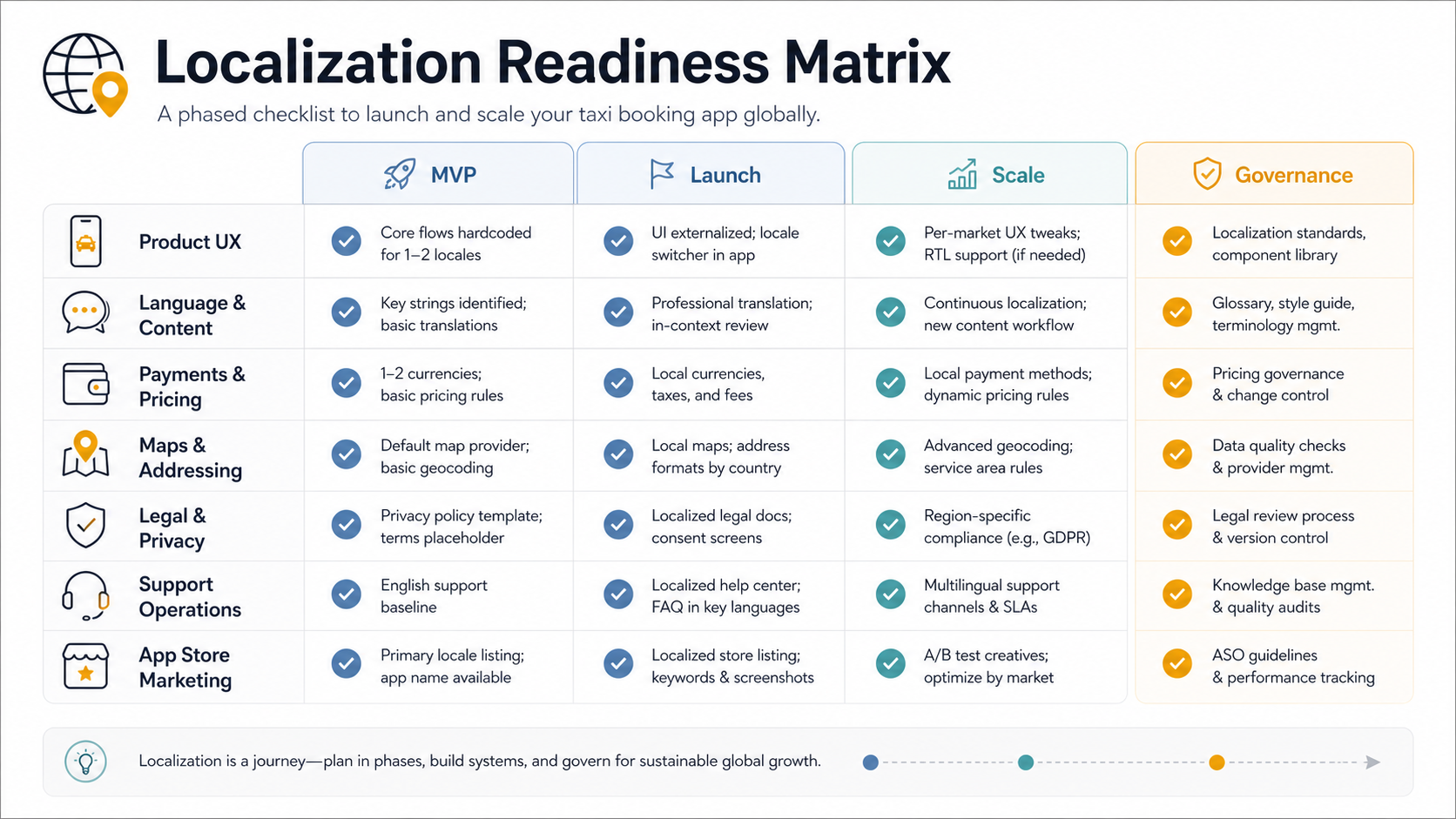
Quick Answer: How Do You Globalize A Taxi App?
Globalizing a taxi app means separating market-specific rules from the core product. The booking, driver, dispatch, payment, support, notification, and admin workflows should stay consistent, while language, currency, taxes, service zones, address formats, payment methods, legal copy, app store assets, and support operations can change by country or city.
For most teams, the rollout should happen in phases: prepare the app for internationalization, select one or two priority markets, localize product and operations for those markets, test with real riders and drivers, then scale only after service quality metrics are stable. This is especially important for taxi products because local trust, pickup accuracy, payments, and support speed directly affect adoption.
Internationalization Vs Localization For Taxi Apps
Internationalization is the engineering work that makes the app adaptable. It includes translation keys, locale-aware formatting, right-to-left layout support where needed, configurable pricing, country-specific settings, time zones, units, payment routing, and admin controls. Without this foundation, localization becomes repeated custom development.
Localization is the market work that makes the app feel native to riders, drivers, and operators. It includes translated copy, local pickup instructions, city-specific service zones, payment options, support scripts, app store listings, compliance messaging, driver onboarding content, and culturally appropriate visuals. The two disciplines have to work together: internationalization creates the flexible system; localization fills it with market-specific decisions.
Choose Markets Before Translating The App
Do not localize for every possible market at once. Start with a shortlist based on demand, competitive intensity, driver supply, payment maturity, map reliability, regulatory complexity, customer acquisition cost, support coverage, and expected unit economics. A market with a large rider base can still be a poor first launch if payment, licensing, or driver onboarding rules are too complex for the current team.
For the product roadmap, compare the new market against your current taxi booking app features. If a country requires cash payments, airport queue rules, driver document checks, language-specific support, or different cancellation policies, those requirements should be planned before translation starts.
Localization Readiness Matrix
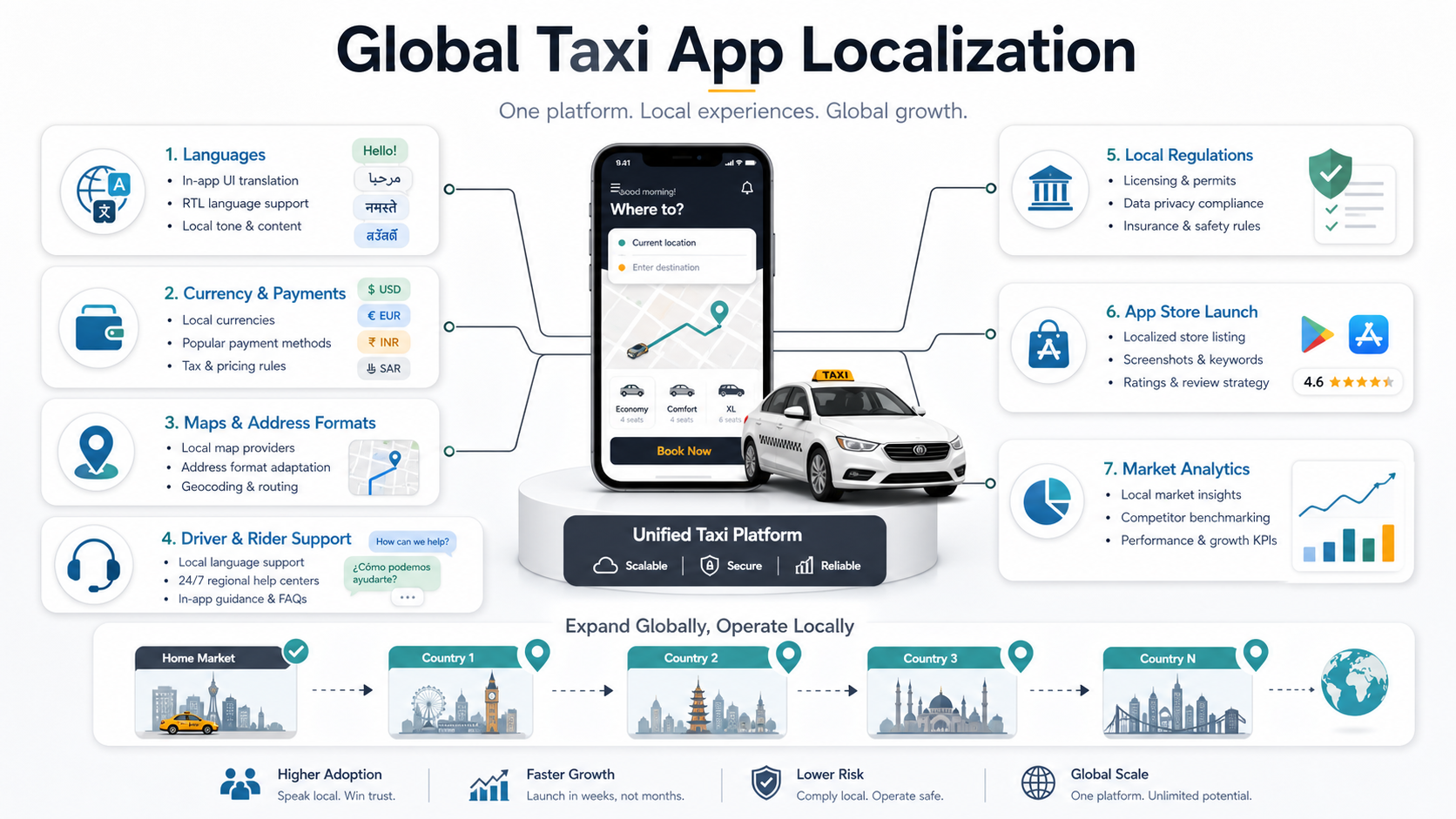
| Area | What Must Be Localized | Why It Matters |
|---|---|---|
| Product UX | Language, layout expansion, right-to-left support, units, date formats, and local instructions. | Riders and drivers need the app to feel familiar and trustworthy. |
| Payments | Currency, taxes, receipts, refunds, cash rules, wallets, cards, bank transfers, and provider routing. | Payment failure is one of the fastest ways to lose a new market. |
| Maps and addresses | Address formats, pickup landmarks, geocoding quality, zones, tolls, airports, and route rules. | Taxi apps depend on precise pickup and drop-off context. |
| Operations | Driver onboarding, support language, escalation rules, service hours, and local SLA targets. | Localization fails when support and operations stay single-market. |
| Compliance | Terms, privacy, driver documents, data retention, taxes, insurance, and local transport rules. | Country-specific legal gaps can block launch or create avoidable risk. |
| Marketing | App store copy, screenshots, keywords, social proof, referral offers, and launch campaigns. | Localized acquisition improves conversion and lowers wasted spend. |
Build A Country-Aware Product Architecture
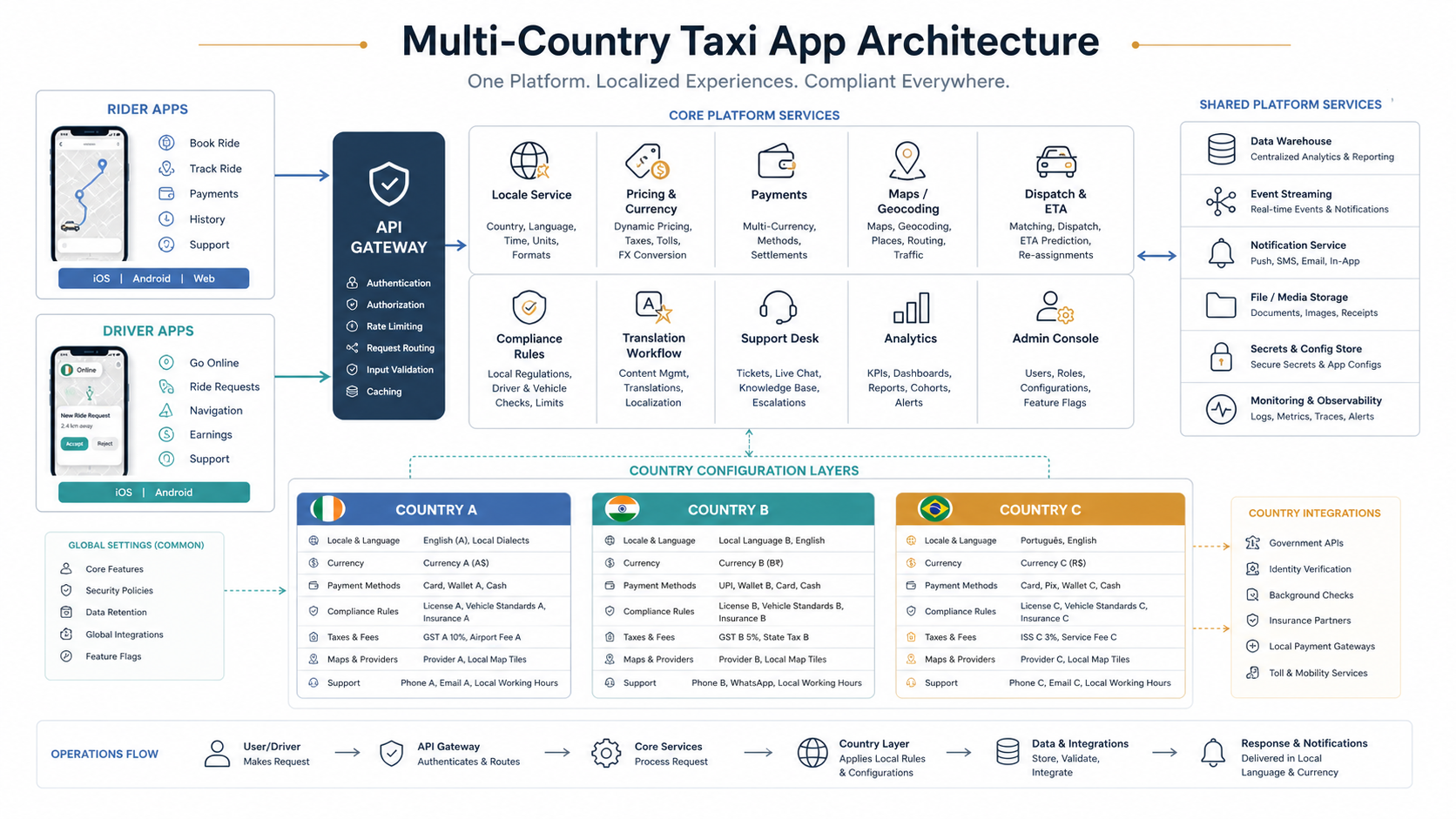
The core taxi app should not branch into separate products for every country. A better pattern is a shared platform with market configuration. Keep rider apps, driver apps, booking, dispatch, trip state, payments, notifications, support, analytics, and admin controls connected through a consistent backend. Then expose country-level configuration for language, currency, service zones, pricing rules, payment providers, document requirements, tax labels, and legal copy.
This is where taxi localization overlaps with mobile app development and backend platform design. The app has to handle mobile UX, real-time trip flows, admin operations, QA, analytics, and post-launch updates as one product system.
For fleet-heavy products, the RouteLedger fleet operations API case study is a useful reference because it shows how operational APIs, GPS telemetry, asset history, notifications, and deployment architecture can support complex transportation workflows.
Localize Payments, Pricing, And Currency
Payment localization affects the rider experience, driver payouts, reconciliation, taxes, fraud monitoring, and support. Each market may need different payment methods: cards, wallets, UPI-style bank transfers, cash, corporate billing, prepaid balances, or local gateways. The app should also support local currency display, rounding rules, receipt formats, refund policies, tax labels, and settlement workflows.
Pricing rules also change by city and country. Taxi products often need base fare, distance, time, minimum fare, surge rules, airport fees, toll handling, cancellation fees, promo codes, and driver incentives. If you are estimating the build effort for these variations, the Custom Software Cost Estimator can help frame budget and timeline assumptions before the implementation plan is locked.
Adapt Maps, Addresses, And Dispatch Rules
Map localization is more than changing labels. Some countries rely on street addresses, some on landmarks, some on building names, and some on neighborhood references. Airports, malls, business districts, gated communities, and public transport hubs may need special pickup rules. A global taxi app should allow city-specific pickup guidance and service-zone configuration.
Real-time trip quality depends on the same foundation. Local map coverage, GPS noise, route matching, toll roads, traffic patterns, and airport queue rules can change ETA accuracy. Use the guide on real-time GPS tracking for taxi booking apps when planning how location, ETA, dispatch, and safety alerts should behave in each market.
Peak-hour behavior also differs by city. The post on high demand and peak hours in taxi booking app development is relevant when localization includes supply balancing, surge rules, driver incentives, and dispatch operations.
Prepare Language, Content, And Translation Workflows
Every visible string should live outside the codebase in a translation-ready system: app labels, onboarding screens, notifications, emails, SMS templates, support macros, error states, empty states, legal notices, and app store copy. Design for text expansion because translated strings can be much longer than English. Also test truncation, push notification previews, receipt layouts, and right-to-left layouts where required.
Translation quality matters most in high-stress moments: failed payments, missed pickups, driver cancellations, refund explanations, safety alerts, and support escalation. These messages should be reviewed by native speakers and local operators, not only machine translated.
Localize Compliance, Privacy, And Driver Operations
Taxi platforms handle sensitive data: identity, phone numbers, live location, trip history, payment records, support messages, ratings, and sometimes driver documents. Each country can have different rules for consent, data retention, document storage, tax invoices, driver eligibility, insurance, safety reporting, and consumer protection.
Driver operations need equal attention. Localized onboarding should cover document uploads, vehicle requirements, payout timing, service conduct, cancellation rules, airport pickups, and local support channels. For broader fleet and field operations patterns, OpsLink shows how mobile field execution and admin operations can share one platform model.
Localize App Store And Growth Campaigns
Each launch market needs localized app store titles, subtitles, descriptions, keywords, screenshots, preview videos, review prompts, and support links. A translated listing is not enough. The strongest listings show local use cases, trusted payment methods, city context, benefit-led screenshots, and proof that the app supports the market.
After the product is stable, use the principles in App Store Optimization to improve discovery and conversion in each country. Also decide whether the mobile stack supports your market roadmap. The tradeoffs in native versus cross-platform mobile app development matter when the product depends heavily on background location, maps, payments, and device-specific behavior.
Test Localization Before Country Launch
Localization QA should cover more than translated screens. Test booking, cancellation, payments, refunds, driver acceptance, location permissions, push notifications, support flows, receipts, app store assets, admin reports, and analytics events in each locale. Run tests on real devices, local networks, and real map conditions wherever possible.
Use staged launches. Start with internal users, then a driver pilot, then a limited rider rollout, then a wider launch after support volume, payment success, pickup accuracy, cancellation rate, driver acceptance rate, and ETA reliability are acceptable.
Common Global Taxi App Mistakes
- Translating too early: translation without configurable pricing, payments, service zones, and support workflows creates launch friction.
- Hard-coding market rules: country-specific logic inside the app slows every future launch.
- Ignoring payment habits: riders may expect local wallets, cash, bank transfers, invoices, or refund flows that differ from the home market.
- Underestimating map differences: pickup accuracy, landmarks, tolls, traffic, and airport rules can change the entire trip experience.
- Keeping support centralized in one language: urgent ride, payment, and safety issues need local-language support scripts and escalation paths.
- Launching without local metrics: each market needs its own conversion, cancellation, ETA, payment, support, and driver supply dashboards.
How NextPage Can Help
NextPage can help plan and build global taxi app platforms with mobile apps, backend APIs, country-aware configuration, payment integrations, map and dispatch logic, admin consoles, analytics, QA, and launch support. The strongest first step is a localization readiness review that turns target markets into product requirements, technical architecture, rollout phases, and operational checklists.
If your taxi, fleet, logistics, or transportation app is ready to move beyond one market, treat globalization as a product architecture decision. Build a flexible core platform, localize only what each market needs, and use launch data to decide when the next country is ready.