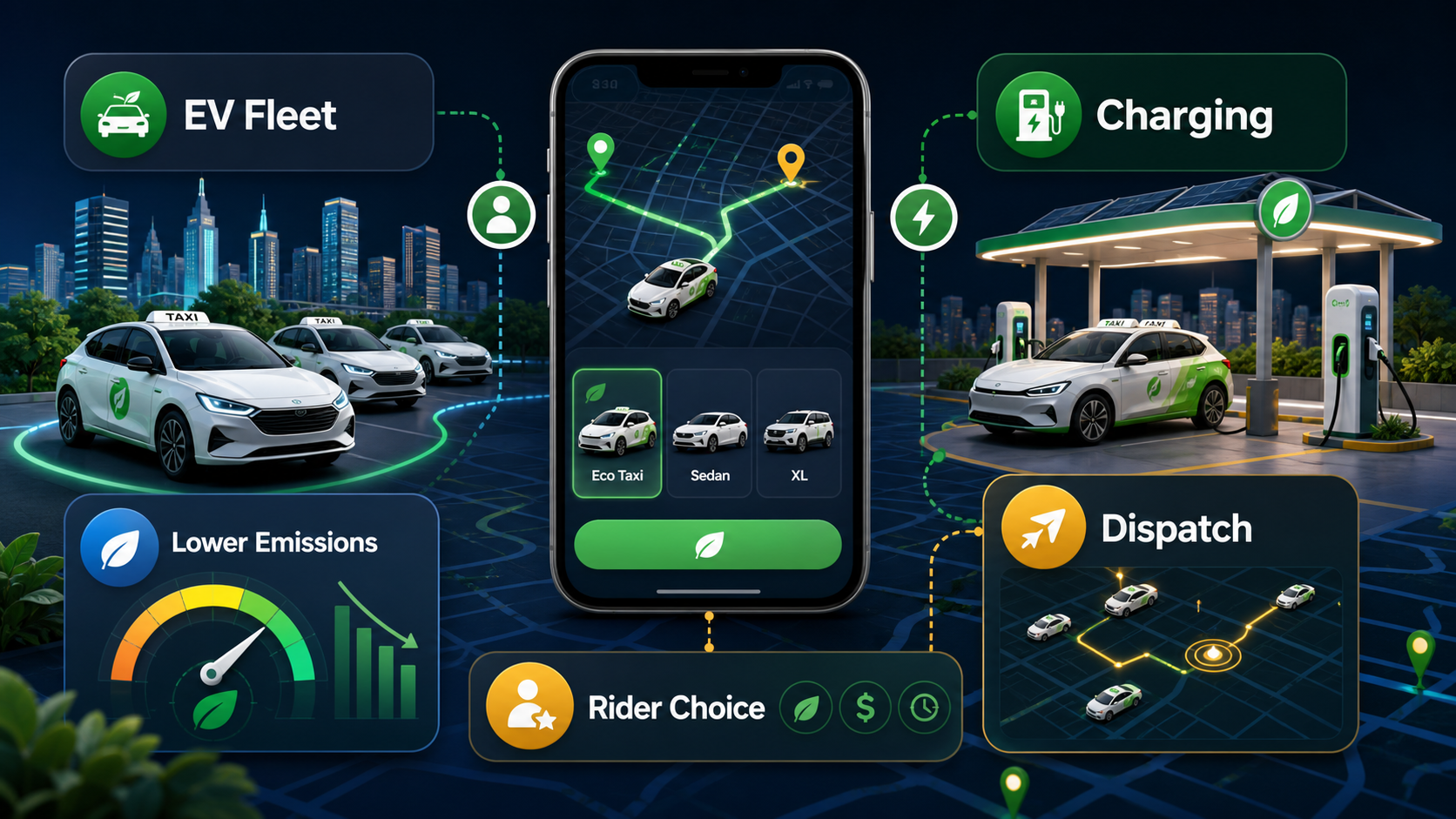

Quick Answer: Eco-Friendly Taxi Booking Apps
Eco-friendly taxi booking apps help riders choose lower-emission trips while giving operators the controls needed to run electric, hybrid, and efficient mixed fleets. The app is not only a booking screen. It becomes the system that connects vehicle availability, charging status, route length, driver incentives, rider preferences, fleet economics, and sustainability reporting.
For a transport business, the practical goal is simple: make greener rides easy to book without making dispatch unreliable or margins worse. That usually means adding EV and hybrid fleet filters, charging-aware driver assignment, range and route logic, transparent rider messaging, incentive rules, and dashboards that show cost, utilization, emissions, and service quality together.
If you are planning mobile app development for a taxi or ride-hailing platform, treat sustainability as a product and operations requirement from the beginning. A green fleet strategy works best when the booking app, driver app, admin panel, dispatch engine, and analytics layer are designed around the same operating model.
Why Green Transportation Now Matters For Taxi Apps
Electric mobility is no longer a niche experiment. The International Energy Agency's Global EV Outlook 2025 shows that electric car adoption continues to expand across major and emerging markets, while public and private charging networks keep growing. For taxi operators, that shift changes customer expectations, fleet planning, infrastructure partnerships, and long-term operating costs.
Taxi and ride-hailing vehicles are especially important because they drive more miles than many privately owned cars. When high-mileage vehicles become cleaner and more efficient, the effect is felt across fuel spend, maintenance planning, city air quality, rider perception, and brand trust. A booking app can make that transition visible by showing greener ride options and by helping operators allocate the right vehicle to the right trip.
The opportunity is not limited to large urban fleets. Regional operators, airport transfer services, corporate mobility providers, and local taxi brands can all start with a mixed fleet and scale the greener share over time. The app should support that staged rollout instead of assuming every vehicle becomes electric on day one.
What Makes A Taxi App Eco-Friendly?
An eco-friendly taxi app is built around decisions that reduce wasted miles, fuel use, idle time, and unnecessary emissions. EV support matters, but it is only one part of the product. Dispatch quality, route optimization, pooling logic, driver behavior, charging access, and customer education all contribute to the environmental outcome.
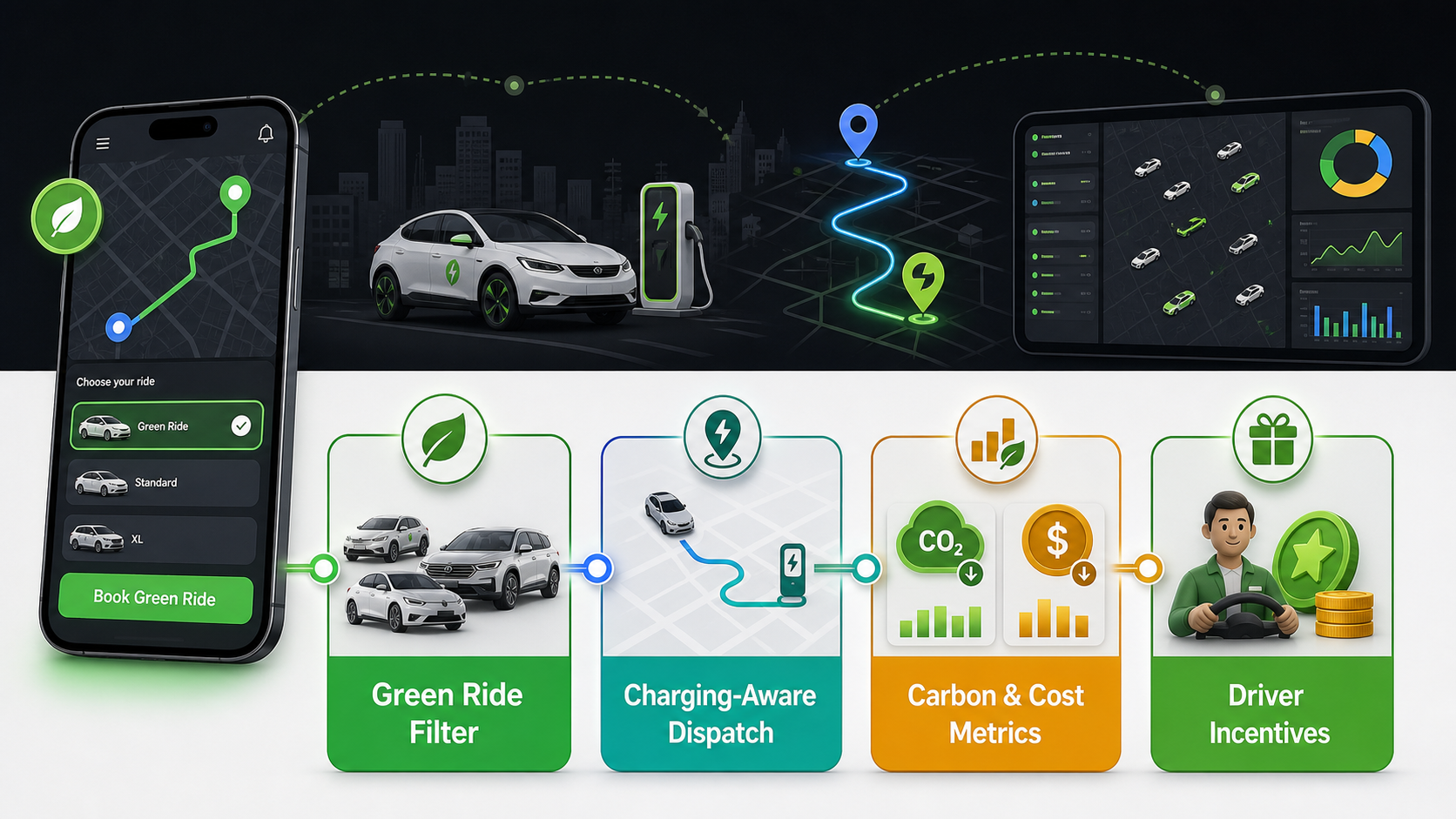
The foundation still includes core taxi booking app features: rider registration, pickup and drop-off selection, fare estimates, driver matching, GPS tracking, payments, ratings, support, and admin control. The green layer adds new rules and data points on top of those basics.
| Eco-friendly capability | What the app needs | Why it matters |
|---|---|---|
| Green ride filter | Rider-facing EV, hybrid, shared ride, or lower-emission preference | Turns sustainability into a visible choice at booking time |
| Fleet energy profile | Vehicle type, range, battery or fuel state, efficiency, and maintenance status | Prevents poor dispatch decisions and range-related service failures |
| Charging-aware dispatch | Charging station locations, dwell time, driver schedule, and route length | Keeps EV utilization high without stranding vehicles |
| Smart route planning | Traffic, distance, pickup clustering, idle reduction, and rerouting logic | Reduces wasted miles and improves arrival reliability |
| Sustainability reporting | Trip-level and fleet-level metrics for emissions, energy, savings, and utilization | Helps operators prove progress and improve operations |
Fleet Operations For Electric And Hybrid Vehicles
Adding electric and hybrid vehicles changes the operating model behind the app. A petrol or diesel taxi can usually refuel quickly and return to the queue. An EV needs the system to understand battery level, charging availability, trip length, local traffic, weather impact, and driver shift timing. These details should influence dispatch before the rider ever notices a constraint.
The admin panel should let operators tag vehicles by fuel type, range, charging connector, depot, driver assignment, maintenance status, insurance status, and eligible service zone. Dispatch rules can then prioritize EVs for suitable trips, reserve hybrids for longer uncertain routes, and keep a buffer for airport runs or peak-hour surges.
This is where taxi platforms often overlap with fleet management app requirements. The booking product needs rider UX, but the business also needs utilization dashboards, vehicle health, driver performance, route history, compliance records, and operational alerts.
Charging-Aware Dispatch And Route Planning
Charging-aware dispatch is the difference between offering EV rides and operating them reliably. The app should know where chargers are, which vehicles can use them, how long charging may take, and whether a driver can complete the next trip without disrupting service. Public charging data can help, but many operators also need depot charging, partner hubs, or contracted charging locations.
A practical dispatch model can start with simple rules: do not assign a low-battery EV to a long route, prefer EVs for short urban trips, flag drivers who need charging after a completed ride, and reserve charging windows during low-demand periods. Over time, the platform can add more advanced prediction based on trip history, traffic, weather, vehicle efficiency, and charger reliability.
Route planning should also reduce empty miles. Better pickup clustering, driver repositioning, pooling where appropriate, and smarter service zones can lower energy use even before the fleet is fully electric. Sustainability improves when operational efficiency improves.
Cost And Revenue Considerations
Eco-friendly taxi app development affects both software cost and fleet economics. The software budget depends on feature depth, platform coverage, real-time infrastructure, payment and map integrations, admin workflows, analytics, and how deeply the system needs to integrate with fleet, charger, or partner systems.
On the business side, EVs and hybrids can reduce fuel and maintenance expenses, but operators must plan vehicle acquisition, charging hardware, charging contracts, driver training, downtime, insurance, incentives, and support. The app should expose the numbers that matter: vehicle utilization, cost per trip, energy cost, charging downtime, cancellation rate, driver acceptance, and rider repeat usage.
Before committing to a large custom build, the Custom Software Cost Estimator can help frame the likely product scope, integrations, timeline band, and team shape. For a taxi platform, the estimate should include the rider app, driver app, admin panel, dispatch backend, map services, payments, notifications, analytics, and green fleet modules.
Rider Experience And Trust
Riders should not need to understand fleet operations to make a greener choice. The app can offer simple labels such as EV, hybrid, shared ride, lower-emission option, or green fleet vehicle. It can also show estimated arrival time, fare impact, vehicle type, charging-friendly route information, and clear cancellation or substitution rules.
Trust matters. If an app promises a green ride but frequently swaps in any available vehicle without explanation, customers will stop believing the label. Use transparent messaging: when a green vehicle is available, show it clearly; when demand is high, explain alternatives; when a rider chooses a lower-emission option, confirm what that choice means.
Rewards can also help. Operators can offer loyalty points, corporate reporting, subscription benefits, or occasional discounts for riders who choose greener trips. The key is to connect incentives to real operational data rather than treating sustainability as a marketing badge.
Green Fleet Rollout Roadmap
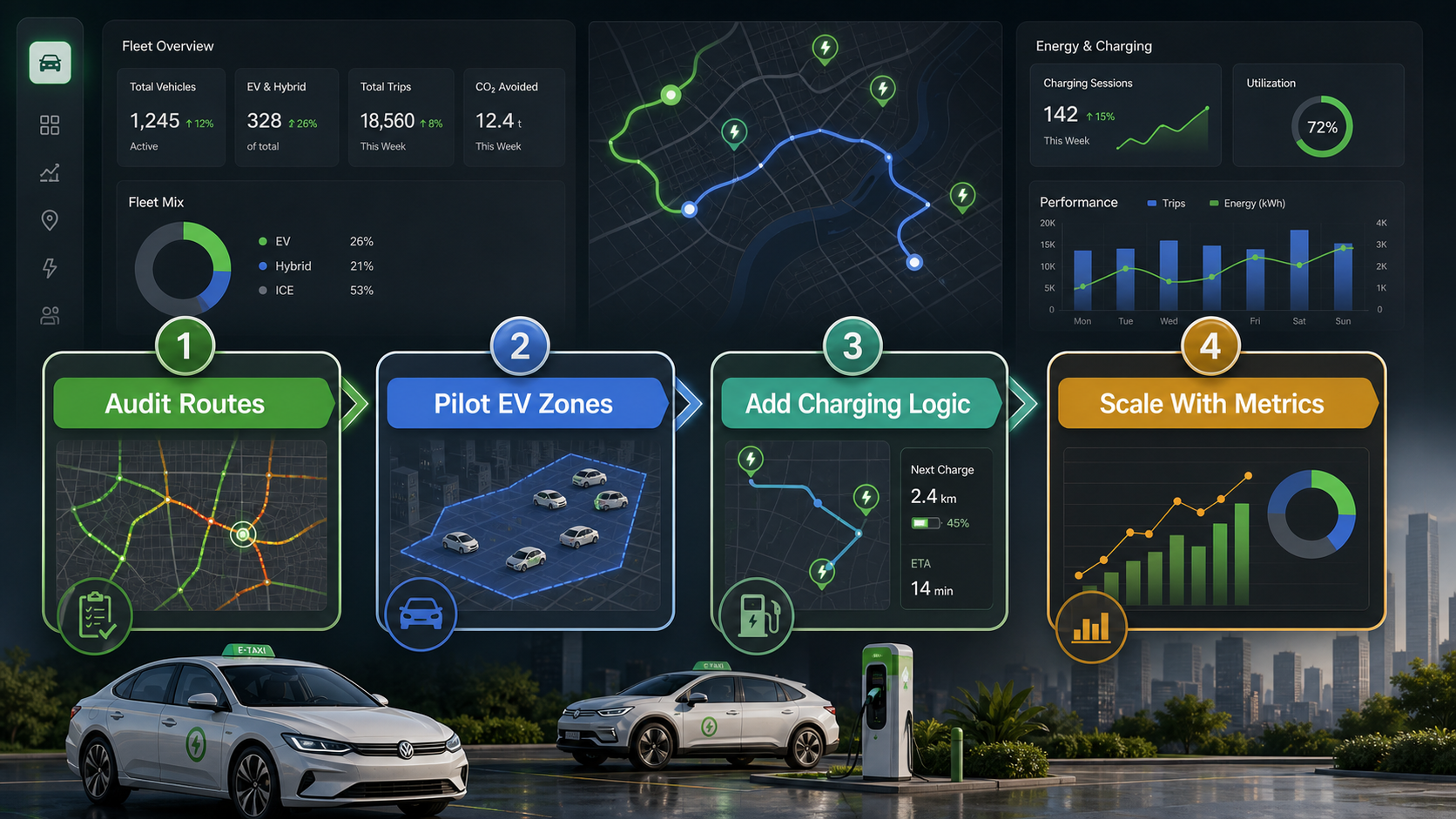
A green taxi platform does not need to launch with every advanced feature at once. A staged roadmap lowers risk and gives the operator time to learn from real trip data.
| Stage | Product focus | Operational question |
|---|---|---|
| Audit routes | Analyze trip length, zones, peak demand, idle time, and driver shifts | Where can EV or hybrid vehicles serve reliably first? |
| Pilot EV zones | Add green ride labels, vehicle tags, limited dispatch rules, and rider feedback | Which customers choose green rides and how does service quality change? |
| Add charging logic | Track battery state, charging windows, depot hubs, and public charger options | Can the fleet stay available without costly downtime? |
| Scale with metrics | Expand dashboards, incentives, partner integrations, and reporting | Which rollout path improves margin, reliability, and sustainability together? |
The Build vs Buy Decision Tool is useful at this stage because some operators can start with existing dispatch or fleet systems while building only the differentiated rider, driver, analytics, or green-fleet modules.
Metrics That Prove The App Is Working
Eco-friendly features should be measured like product features, not just brand copy. The dashboard should show whether greener rides are being requested, accepted, completed, and repeated. It should also show whether EV utilization is improving without hurting wait times or driver earnings.
- Green ride adoption: share of trips where riders choose EV, hybrid, shared, or lower-emission options.
- EV utilization: completed trips, active hours, and revenue per EV compared with other vehicle groups.
- Charging downtime: time spent charging or waiting for charging compared with active service time.
- Empty miles: distance driven without passengers before and after route and dispatch improvements.
- Service quality: arrival time, cancellation rate, support tickets, ratings, and repeat bookings for green rides.
- Cost per trip: energy, maintenance, incentives, charging fees, and platform costs by vehicle type.
These metrics help the operator avoid two common mistakes: promoting green rides that are not operationally reliable, or hiding useful sustainability data that could improve fleet planning and customer trust.
Common Mistakes To Avoid
The most common mistake is treating electric vehicles as a marketing add-on rather than an operating system change. If charging, dispatch, routing, driver scheduling, and service zones are not connected, the app may create bad assignments and frustrated customers.
Another mistake is overpromising environmental impact without clear measurement. Use conservative claims, define how metrics are calculated, and avoid making trip-level promises that the platform cannot support. Customers and corporate buyers are more likely to trust simple, verifiable reporting than exaggerated claims.
Finally, do not ignore drivers. A green fleet rollout needs driver education, fair incentives, clear charging expectations, and easy support. If the driver app makes EV work harder or less profitable, adoption will suffer even if the rider app looks polished.
How NextPage Approaches Green Taxi App Development
NextPage approaches eco-friendly taxi booking apps as a combined product, platform, and operations problem. We map the rider experience, driver workflows, dispatch rules, vehicle data, charging dependencies, payment flows, admin controls, analytics, and rollout stages before recommending a build plan.
For a version-one launch, we usually prioritize the features that make greener rides reliable: vehicle tagging, route and range rules, rider choice, driver visibility, admin controls, and measurement. More advanced features such as charging partner integrations, predictive dispatch, loyalty incentives, and corporate sustainability reporting can follow after real usage data proves where they matter most.
A greener taxi app should make sustainable transport easier for the rider and easier to operate for the business. When the software supports both sides, electric and hybrid fleet adoption becomes a practical growth strategy instead of a one-off campaign.