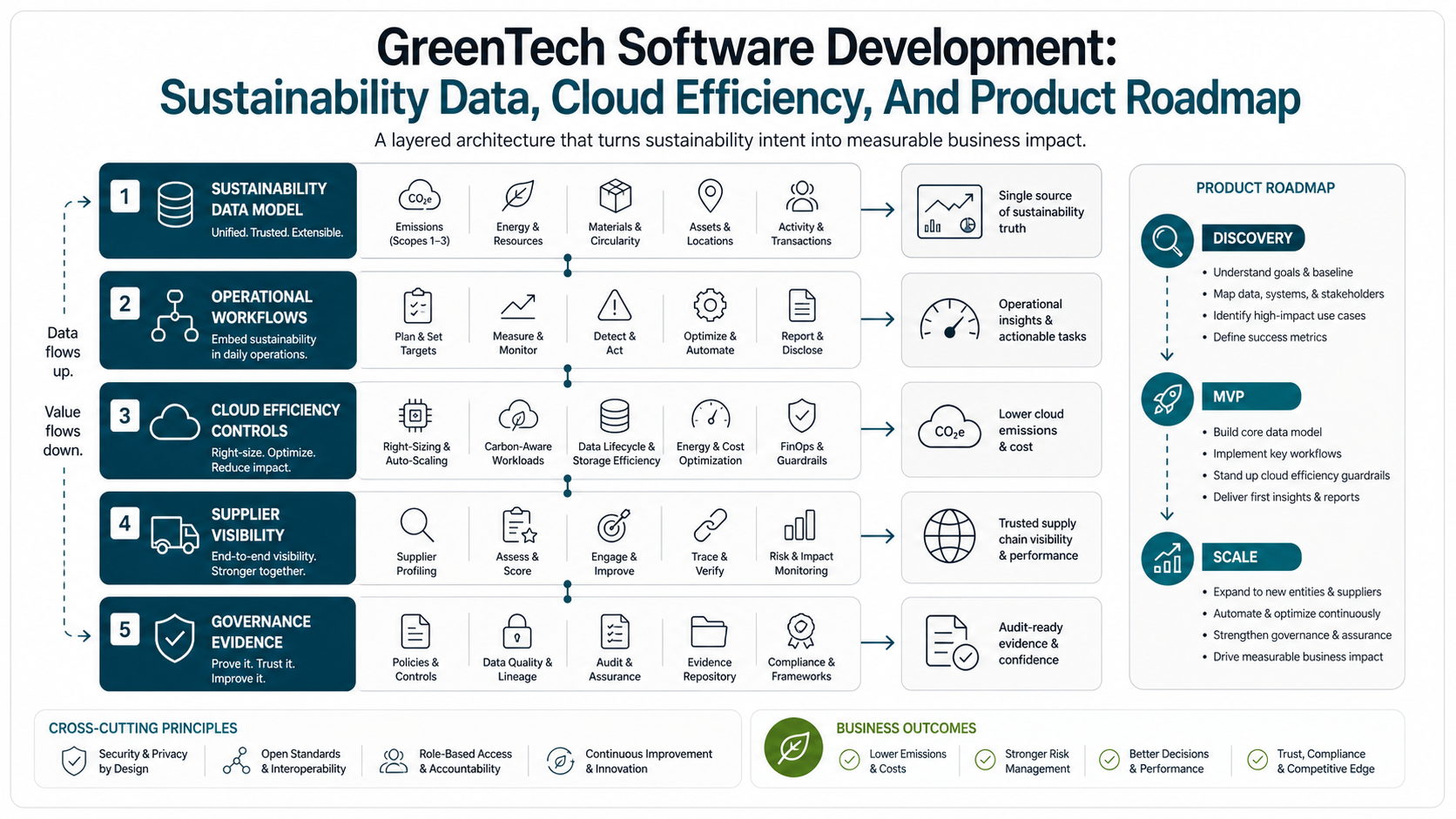

GreenTech software development means building digital products that make sustainability measurable, operational, and economically useful. It is not only a green UI theme, an ESG dashboard, or a one-time cloud cleanup. A serious GreenTech roadmap connects emissions data, cloud efficiency, workflow automation, supplier visibility, product analytics, and audit evidence so leaders can reduce waste while still shipping reliable software.
The best starting point is a business workflow with measurable waste: cloud resources running idle, routes planned without fuel or energy data, suppliers with incomplete emissions records, inventory that creates avoidable returns, or reporting that takes weeks of spreadsheet work. From there, software teams can define the data model, integrations, controls, and product roadmap needed to turn sustainability goals into daily operating decisions.
Quick Answer: What Should A GreenTech Software Roadmap Include?
A GreenTech software roadmap should include five parts: a sustainability data model, operational workflows that can act on that data, cloud and infrastructure efficiency controls, reporting evidence for leadership or compliance, and a phased delivery plan that starts with one measurable use case.
Do not begin with a broad platform promise. Begin with one decision the software should improve. For example, a logistics team may want to reduce failed delivery attempts, a SaaS company may want to lower idle cloud spend, or a manufacturer may want supplier-risk visibility before procurement decisions. Each case needs different data, integrations, governance, and operating metrics.
| Roadmap Layer | What It Answers | Typical Software Work |
|---|---|---|
| Sustainability data | What impact are we measuring? | Data model, source mapping, quality checks, units, ownership. |
| Operational workflow | Who can act on the signal? | Approvals, alerts, exception queues, role-based dashboards. |
| Cloud efficiency | Where does the product itself waste resources? | Autoscaling, storage lifecycle, region choices, workload scheduling. |
| Evidence and reporting | What proof can be reviewed? | Audit trails, calculation notes, exportable reports, change history. |
| Product roadmap | What ships first, next, and later? | MVP scope, integration waves, analytics, automation, governance. |
Why GreenTech Software Is Not Just Reporting
Many sustainability software projects start as reporting projects. That is understandable because leadership needs a number. But reporting alone rarely changes the system that created the waste. Useful GreenTech software gives people a way to make better choices before the report is due.
For a product team, that might mean showing carbon, cost, and latency tradeoffs when choosing a cloud region. For operations, it may mean alerting procurement when supplier records are incomplete. For logistics, it may mean routing or batching work differently. For engineering, it may mean finding underused resources, oversized services, noisy observability pipelines, or expensive batch jobs that can run at better times.
The Green Software Foundation's Software Carbon Intensity specification is useful here because it frames software emissions as a rate tied to a functional unit, not just a total. That forces teams to ask what the application does per request, user, transaction, batch job, or device. The same thinking makes business software easier to optimize because the team can compare impact against useful work.
Start With A Business Use Case, Not A Sustainability Slogan
The first product decision is where sustainability and business value overlap. A use case should have a workflow owner, a measurable baseline, and a decision that can change after software is introduced.
- Cloud efficiency: reduce idle compute, oversized databases, excessive logs, or long-running batch jobs.
- Supply-chain visibility: collect supplier attributes, shipment data, documentation, and risk alerts in one workflow.
- Fleet or energy operations: combine asset telemetry, route constraints, usage patterns, and maintenance triggers.
- Product analytics: identify features, journeys, or devices that create avoidable resource usage.
- Reporting automation: replace fragile spreadsheet collection with traceable data pipelines and review states.
If the use case depends on multiple systems, plan it like any serious custom software development project. The work is less about adding a sustainability module and more about designing the right data contracts, permissions, workflows, and decision points.
Build The Sustainability Data Model First
A GreenTech application needs clear data boundaries. Otherwise, the dashboard becomes a collection of rough numbers that nobody trusts. Start by mapping the entities that matter: facilities, suppliers, products, orders, shipments, cloud services, users, devices, jobs, and reports. Then define which metrics are measured directly, estimated from models, imported from vendors, or entered manually with review.
| Data Area | Questions To Resolve | Implementation Notes |
|---|---|---|
| Activity data | Which business event creates the impact? | Orders, API calls, shipments, invoices, machine hours, cloud jobs. |
| Impact factors | Which conversion factor applies? | Keep factor source, version, geography, and effective date. |
| Ownership | Who can approve or correct records? | Use role-based review, comments, and change history. |
| Data quality | Which records are incomplete or stale? | Flag missing units, suspicious ranges, duplicates, and late supplier updates. |
| Evidence | Can the number be explained later? | Store source links, calculation method, assumptions, and export snapshots. |
This is where GreenTech software often fails. Teams want dashboards before they have agreed on units, ownership, and acceptable estimates. A smaller, trusted model is better than a broad dashboard that cannot survive review. If the product needs role-specific sustainability, cost, operations, or supplier views, use the same discipline as an operational dashboard requirements checklist: define the decision, metric owner, refresh cadence, source of truth, and action threshold before designing charts.
Design Cloud Efficiency Into The Product
Cloud efficiency is one of the most practical GreenTech starting points because it usually improves cost and sustainability together. AWS, Azure, and Google Cloud all publish sustainability guidance, but the product team still has to translate platform advice into application-level decisions.
For teams already planning a cloud move, the sustainability roadmap should sit beside the architecture roadmap. A cloud migration services engagement can include workload inventory, autoscaling policy, storage lifecycle, observability retention, and region decisions instead of treating sustainability as a post-migration report. If the move is application-specific, connect this to an application migration services plan so legacy dependencies, downtime windows, and rollback needs are not ignored. When the app is already in cloud, a focused cloud performance optimization services review can turn latency, utilization, storage, logging, and cost signals into a practical efficiency backlog.
| Cloud Decision | GreenTech Question | Buyer Risk |
|---|---|---|
| Compute sizing | Are services provisioned for real usage or peak guesses? | Overprovisioning wastes budget and energy. |
| Storage lifecycle | Can old logs, exports, and media move to cheaper tiers or expire? | Retention sprawl creates cost, privacy, and audit risk. |
| Batch scheduling | Can non-urgent work run when demand or grid intensity is lower? | Poor scheduling raises cost without improving the user experience. |
| Architecture pattern | Should this be serverless, containerized, event-driven, or long-running? | The wrong pattern can hide idle resources or create scaling limits. |
| Observability | What traces are needed, and for how long? | Unlimited logs make the monitoring system part of the waste. |
For Google Cloud programs, a Google Cloud migration services plan should also define how cost, workload, and sustainability signals will be reviewed after cutover. Migration is not finished when the app runs in the new environment. It is finished when the team can operate it with evidence.
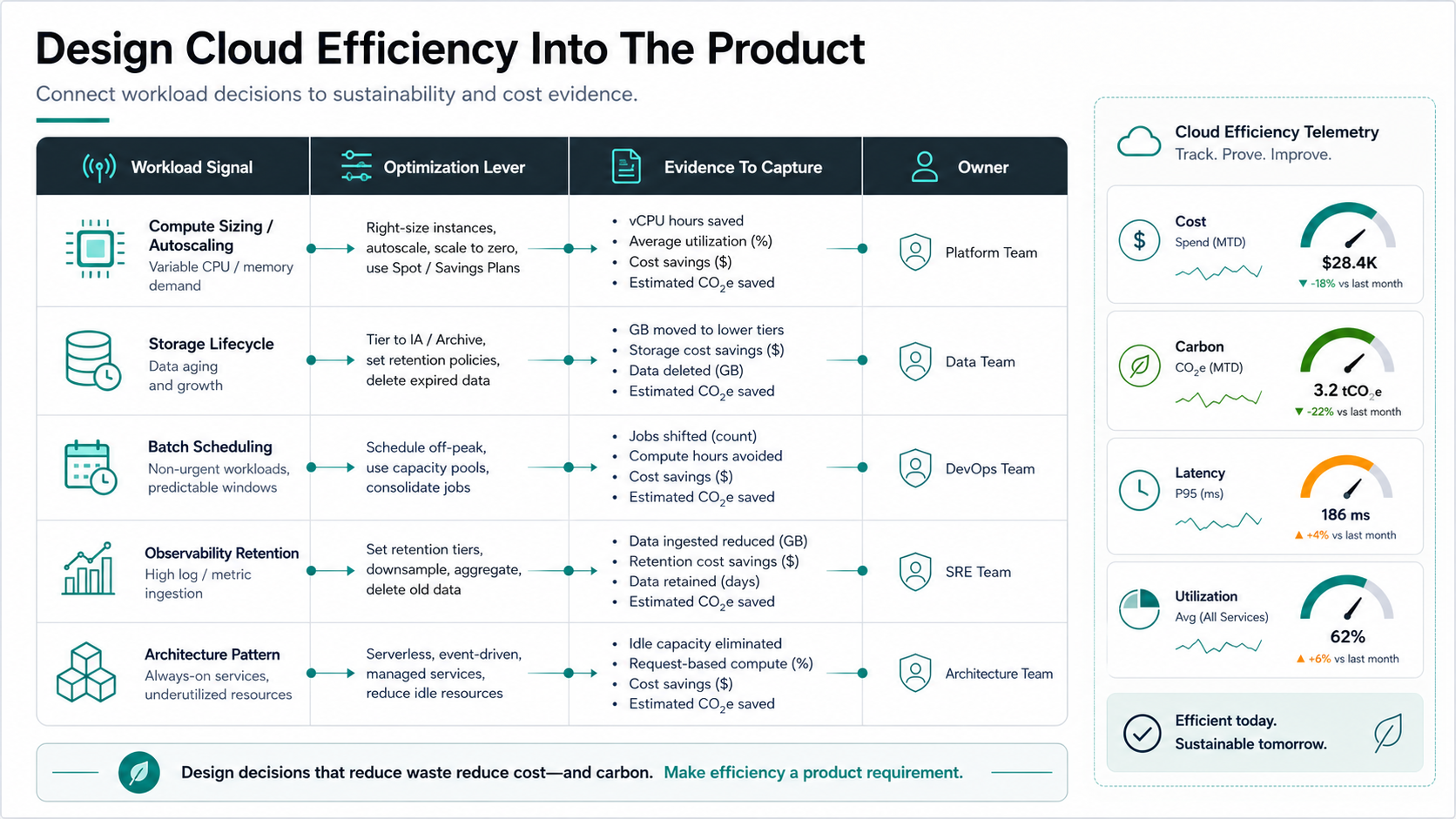
A good efficiency backlog should be measurable. Track utilization, request latency, vCPU hours avoided, storage lifecycle movement, log volume, data-retention days, carbon estimate methodology, cloud spend, and the owner for each change. The cloud performance audit checklist is a useful companion when the team needs to separate architecture bottlenecks from cloud waste and observability gaps.
Use A Roadmap Matrix To Choose The First Release
The first release should be narrow enough to ship and important enough to change behavior. A roadmap matrix keeps the team from building disconnected features. For each release, map the data source, workflow owner, decision signal, integration, evidence output, and success metric. Use the Custom Software Cost Estimator when the roadmap needs a quick budget range for dashboards, integrations, workflow automation, reporting exports, and governance controls.
| Release | Scope | Success Metric |
|---|---|---|
| MVP | One workflow, one dashboard, one evidence export. | Baseline established and reviewed by the workflow owner. |
| Release 2 | Add integrations and exception queues. | Manual follow-up and spreadsheet reconciliation decrease. |
| Release 3 | Add optimization recommendations or automation. | Operational decisions change based on trusted signals. |
| Scale | Expand to more business units or product lines. | Governance, quality checks, and reporting remain consistent. |
Connect Supplier And Operational Visibility
Sustainability data is rarely inside one system. Supplier profiles may live in procurement tools, invoices in finance systems, shipment data in logistics platforms, and product data in an ERP. The software value comes from connecting these sources into a workflow that people can trust.
Do not start by asking every supplier for every possible field. Start with the fields that support a real decision: approved vendor status, region, material category, shipment mode, certificate date, risk tier, missing evidence, and owner. Then build escalation paths for incomplete records. For fleet, mobility, or asset-heavy products, NextPage's automotive software development services patterns around connected data, fleet workflows, and analytics can be adapted to sustainability and efficiency goals. For supply-chain and operations teams that need live exception queues, supplier scorecards, and leadership reporting, custom dashboard development services can keep sustainability metrics tied to operating decisions instead of static reports.
Where AI Can Help, And Where It Should Not
AI can help GreenTech software classify documents, detect anomalies, summarize supplier evidence, forecast demand, recommend workload changes, or prioritize exceptions. But AI should not become an unreviewed source of truth for sustainability claims. Keep calculation methods, factor versions, and human approvals visible.
A practical AI feature might flag duplicate supplier records, identify missing units, summarize a certificate, or rank cloud services with unusual usage. A risky AI feature would invent emissions factors, fill gaps without confidence labels, or generate ESG claims without evidence. GreenTech products need explainability because sustainability numbers affect procurement, compliance, investor communication, and operational planning. If AI is part of the roadmap, treat it like any other governed workflow: define allowed actions, confidence thresholds, review owners, audit logs, and rollback paths before automation reaches production.
Governance And Audit Evidence Matter Early
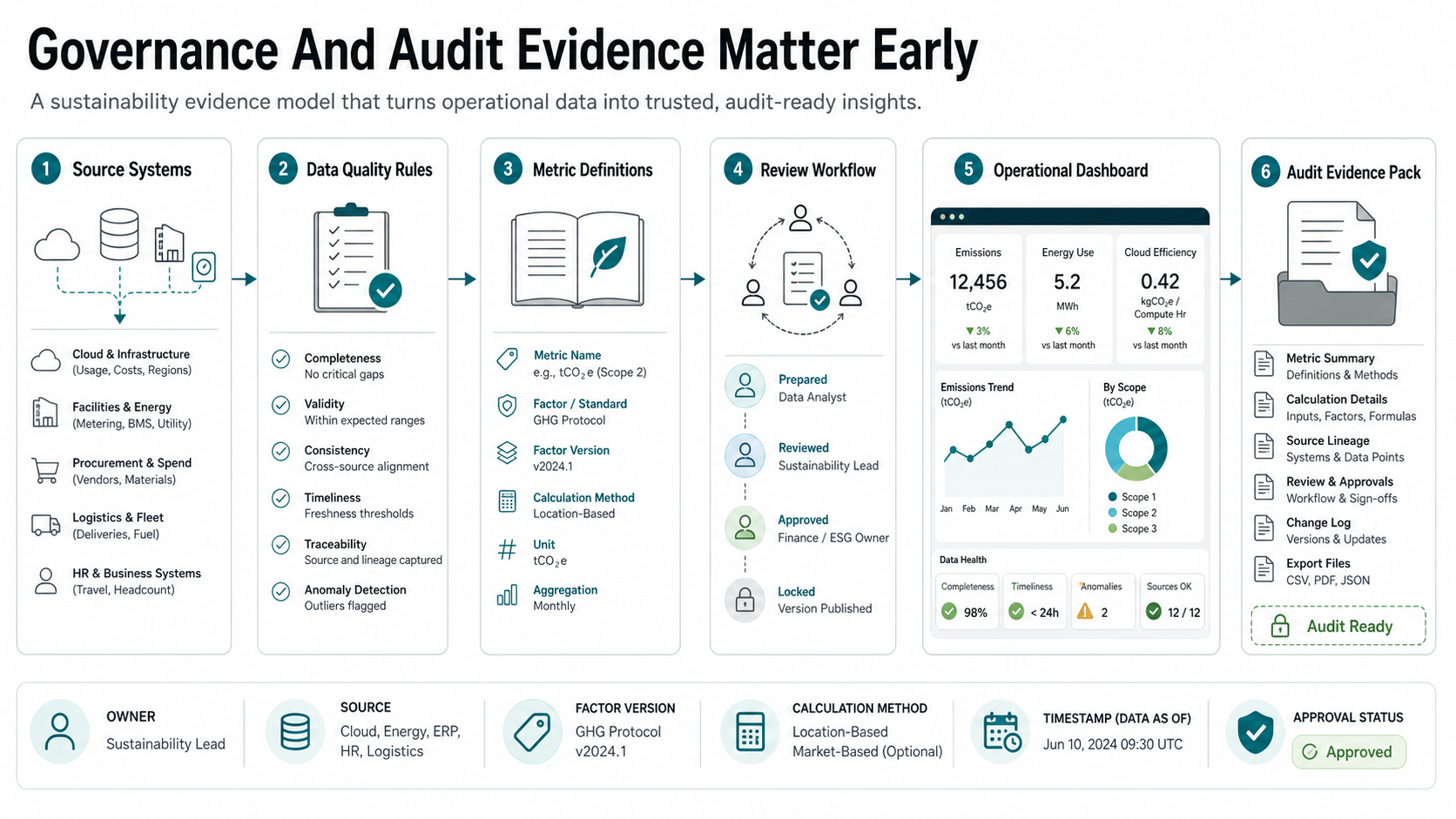
Governance is not only for regulated companies. Any team that publishes sustainability metrics needs to explain how data was collected, transformed, reviewed, and changed. Build evidence into the workflow from the start.
- Store source system, timestamp, owner, and calculation method for each material metric.
- Version impact factors and keep the effective date visible.
- Separate measured data from estimated data.
- Use approval states for records that affect external reporting.
- Log corrections and preserve a reason for each change.
- Give finance, operations, engineering, and leadership different views of the same governed model.
This is also why a scalable software development services mindset matters. The first version may be small, but the architecture should support more data volume, more teams, more integrations, and stricter reporting over time.
GreenTech Software Implementation Phases
A realistic GreenTech roadmap moves in phases. Each phase should produce something useful, not just a design artifact. For delivery teams, this usually overlaps with DevOps consulting services because cloud efficiency, observability retention, CI/CD evidence, environment schedules, and rollback safety all affect whether the product can operate sustainably after launch.
- Discovery: choose the workflow, baseline, owners, data sources, and success metric.
- Data model: define entities, units, quality rules, factor sources, and evidence requirements.
- MVP build: ship ingestion, dashboard, review states, and one export or report.
- Workflow integration: add alerts, approvals, supplier follow-up, or cloud optimization actions.
- Automation: recommend actions, detect anomalies, and reduce manual reconciliation.
- Governance scale: add role-specific reporting, audit trails, quality monitoring, and multi-team rollout.
Keep the roadmap tied to adoption. If the first release produces numbers but no decisions change, the product needs workflow design, not more charts.
Plan Operating Cost And Maintenance From Day One
GreenTech software should not become expensive software that only reports waste somewhere else. Include operating cost, support effort, data maintenance, and feature ownership in the roadmap. A sustainability product that needs constant manual imports, fragile spreadsheets, or hand-built monthly reports will lose trust and budget quickly.
| Operating Area | Metric To Watch | Maintenance Risk |
|---|---|---|
| Cloud infrastructure | Cost per workflow, utilization, storage growth, and idle capacity | Optimizations disappear when teams add new environments without ownership. |
| Data pipelines | Freshness, completeness, error rate, and source-change incidents | Supplier, ERP, cloud, or finance schema changes break reports silently. |
| Dashboards | Active users, decision cadence, stale metrics, and unresolved data-quality flags | Leadership stops trusting charts when definitions drift. |
| Workflow automation | Exception volume, approval time, action completion, and false alerts | Teams ignore alerts that do not map to accountable work. |
| Governance | Change approvals, audit exports, factor-version updates, and access reviews | External claims become hard to defend when evidence is not versioned. |
For budgeting, compare build cost with long-term support and optimization cost. The software maintenance cost guide is relevant because sustainability products need ongoing data-quality checks, integration updates, cloud tuning, reporting changes, and security review after the first release.
Common GreenTech Software Mistakes
The first mistake is building a dashboard before fixing the data. A beautiful dashboard with unclear units, stale records, or missing ownership will lose trust quickly.
The second mistake is treating cloud efficiency as only an infrastructure task. Product behavior, background jobs, analytics events, observability settings, and feature design all affect resource usage.
The third mistake is chasing too many metrics. A GreenTech MVP should focus on the few metrics that change a decision. Teams can expand once the data model and workflow are stable.
The fourth mistake is using sustainability language without evidence. Buyers, employees, and auditors need to see methodology, assumptions, and ownership. Software should make those details easier to review.
How NextPage Can Help
NextPage helps teams build sustainability-aware business software that is useful beyond reporting. We can help define the first GreenTech use case, map the data model, design integrations, modernize cloud workloads, build dashboards, add workflow automation, and create governance evidence that leadership can trust.
If your sustainability goals are stuck in spreadsheets or your cloud and operations teams need a practical roadmap, start with a focused discovery sprint. The right first release should make one high-value decision easier, faster, and more evidence-based.