
You can accelerate a healthcare app timeline, but only if compliance, architecture, integration, and QA start earlier instead of being squeezed at the end. The fastest safe path is not "build screens first and fix healthcare details later." It is a parallel delivery plan: define the clinical workflow, map protected health information, confirm regulatory boundaries, secure integration access, build a narrow MVP, and keep release evidence current as the product changes.
For a focused patient, provider, or clinic workflow, a realistic first release often fits into a 12 to 20 week planning band when scope is tight and integrations are available. Products with EHR integration, telemedicine, remote monitoring, AI triage, clinical decision support, or multi-role operations usually need a longer roadmap because discovery, vendor review, security, data mapping, and validation cannot be skipped without creating rework. If you are still deciding what belongs in the first release, use NextPage's MVP Scope Builder before estimating the delivery schedule.
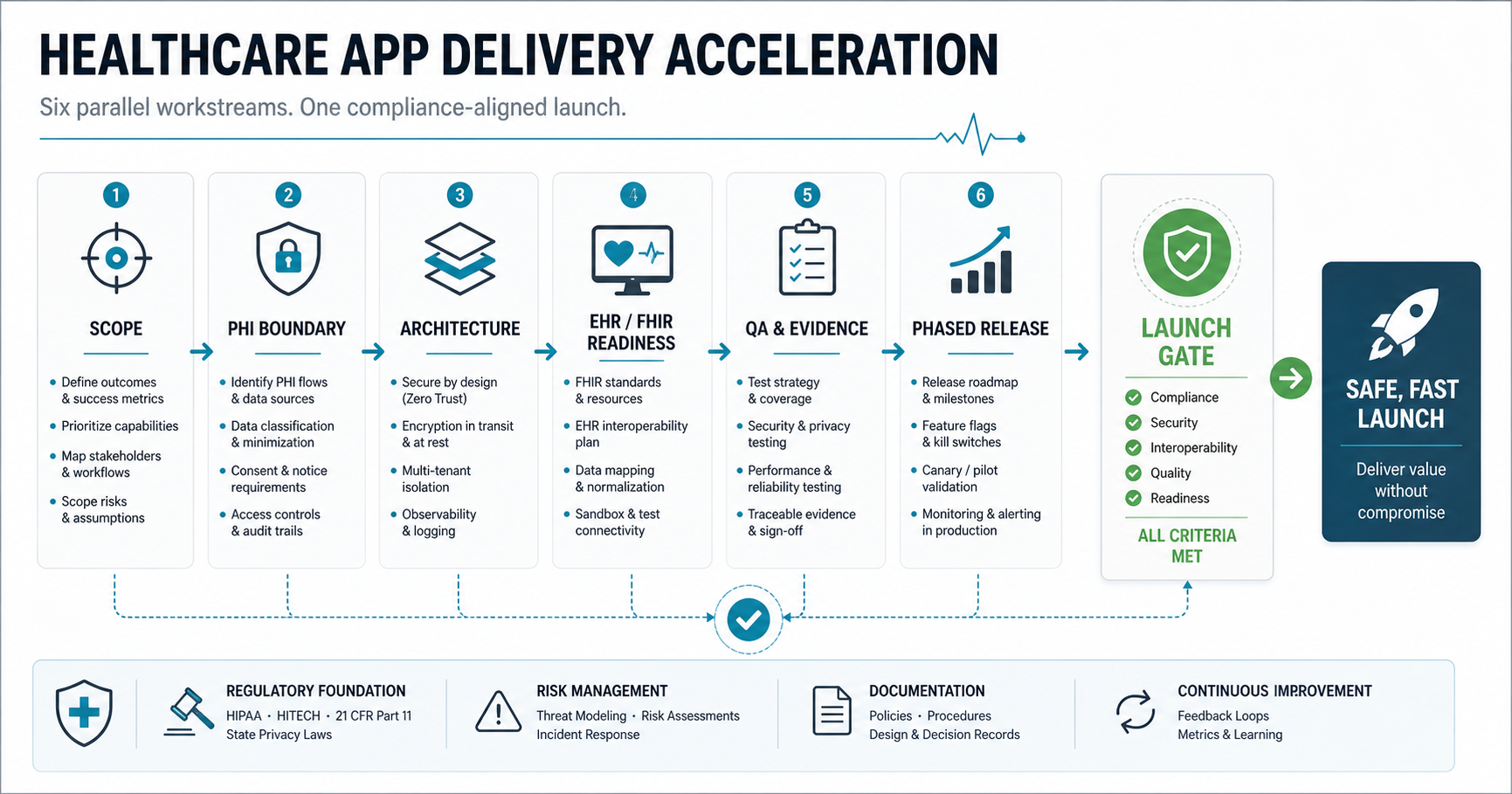
Quick Answer: How To Speed Up Healthcare App Delivery
The safest way to speed up healthcare app development is to run four workstreams in parallel: product discovery, compliance architecture, integration readiness, and QA evidence. Product teams lose time when these are treated as sequential phases. They gain time when each sprint reduces uncertainty in the next one.
| Timeline Lever | What To Start Early | What Not To Shortcut |
|---|---|---|
| Scope | One core patient, provider, or admin workflow with clear release outcomes. | Access control, consent, audit trails, exception states, and support ownership. |
| Compliance | PHI data map, vendor/BAA review, retention rules, and observability boundaries. | Privacy/security review, threat modeling, and evidence capture. |
| Integration | FHIR/EHR sandbox access, API contracts, sample data, launch context, and owner approvals. | Real data mapping, error handling, reconciliation, and rate-limit behavior. |
| Build | Reusable design system, role-based components, backend foundations, and test data. | Clinical workflow validation and state management. |
| Release | Smoke tests, device matrix, security checks, app-store/privacy assets, and rollout plan. | Regression, permissions testing, and incident response readiness. |
Why Healthcare App Timelines Slip
Healthcare apps rarely slip because the login screen took too long. They slip because the team discovers late that the product stores protected health information in more places than expected, the EHR sandbox is not ready, the workflow has more roles and exception paths than the wireframes showed, or the release needs evidence that nobody planned to collect.
General advice about faster delivery through planning, technology choice, and experienced teams is useful, but it is incomplete for real healthcare software. In healthcare, acceleration must include risk controls. A faster team without integration access, PHI boundaries, and clinical workflow validation still gets stuck late. NextPage's related telemedicine app development cost guide goes deeper into cost drivers such as video, EHR integration, compliance, and AI triage.
A Practical Healthcare App Delivery Roadmap
A safer acceleration plan overlaps discovery, compliance, integration, build, QA, and release workstreams instead of rushing healthcare checks at the end. A useful healthcare roadmap is not a waterfall plan. It is a set of gates that reduce delivery risk every week.
| Phase | Primary Outcome | Acceleration Move |
|---|---|---|
| 1. Discovery and classification | Define user roles, clinical workflow, PHI boundary, and whether medical-device or clinical decision support questions may apply. | Run compliance and product discovery together, not after design approval. |
| 2. Architecture and vendor review | Choose hosting, identity, audit logging, data retention, analytics, error tracking, and vendor boundaries. | Review BAAs, PHI handling, and observability tools before engineering sprints depend on them. |
| 3. Integration readiness | Secure EHR/FHIR sandbox access, define USCDI data needs, confirm API limits, and build sample payloads. | Build integration spikes before the main sprint plan promises a fixed delivery date. |
| 4. MVP build | Ship the narrow workflow with role-based permissions, admin controls, notifications, and custom software development support tooling. | Reuse patterns and components, but keep clinical states explicit. |
| 5. QA and release evidence | Validate workflows, devices, security, privacy disclosures, app-store assets, and incident support. | Automate smoke checks and collect evidence throughout the build. |
If the product includes wearable or connected-device data, compare the plan with NextPage's wearable app development guide. Device syncing, noisy data, permissions, and health-data interpretation often change the release plan more than the app UI does.
Start Compliance Before Screens Are Final
Compliance is a delivery input, not a final checklist. For US healthcare software workflows, teams should identify whether HIPAA applies, where PHI is created or stored, which vendors touch it, what audit logs are needed, and which user actions need consent or revocation paths. HHS Security Rule guidance frames this as safeguarding electronic protected health information, so delivery teams should translate that into architecture decisions: identity, access controls, encryption, logs, incident response, backups, vendor boundaries, and evidence ownership.
FDA guidance should also be treated as an early classification checkpoint when software performs medical purposes or influences clinical decisions. The FDA continues to use a risk-based approach for device software functions and mobile medical applications, with oversight focused on the subset of functions that meet the device definition and could create patient risk if they fail. This post is not legal advice, but a delivery plan should identify those questions early enough to involve counsel or regulatory specialists if needed.
For EHR-facing apps, interoperability planning matters too. HL7's US Core Implementation Guide is based on FHIR R4 and defines minimum constraints and RESTful interactions for accessing patient data. ONC's HTI-1 updates also make interoperability and information-sharing requirements part of the certification landscape. Do not promise a compressed timeline until the team knows which data classes, launch context, authentication model, and vendor approvals are required.
EHR/FHIR Release Evidence Gate
Use an EHR and release evidence gate to decide whether the healthcare app can promote, hold, fix, or monitor a release. Healthcare acceleration becomes safer when the team defines release evidence before engineering promises a date. For EHR-facing apps, the gate should prove that integration, compliance, security, QA, and rollout owners are ready at the same time.
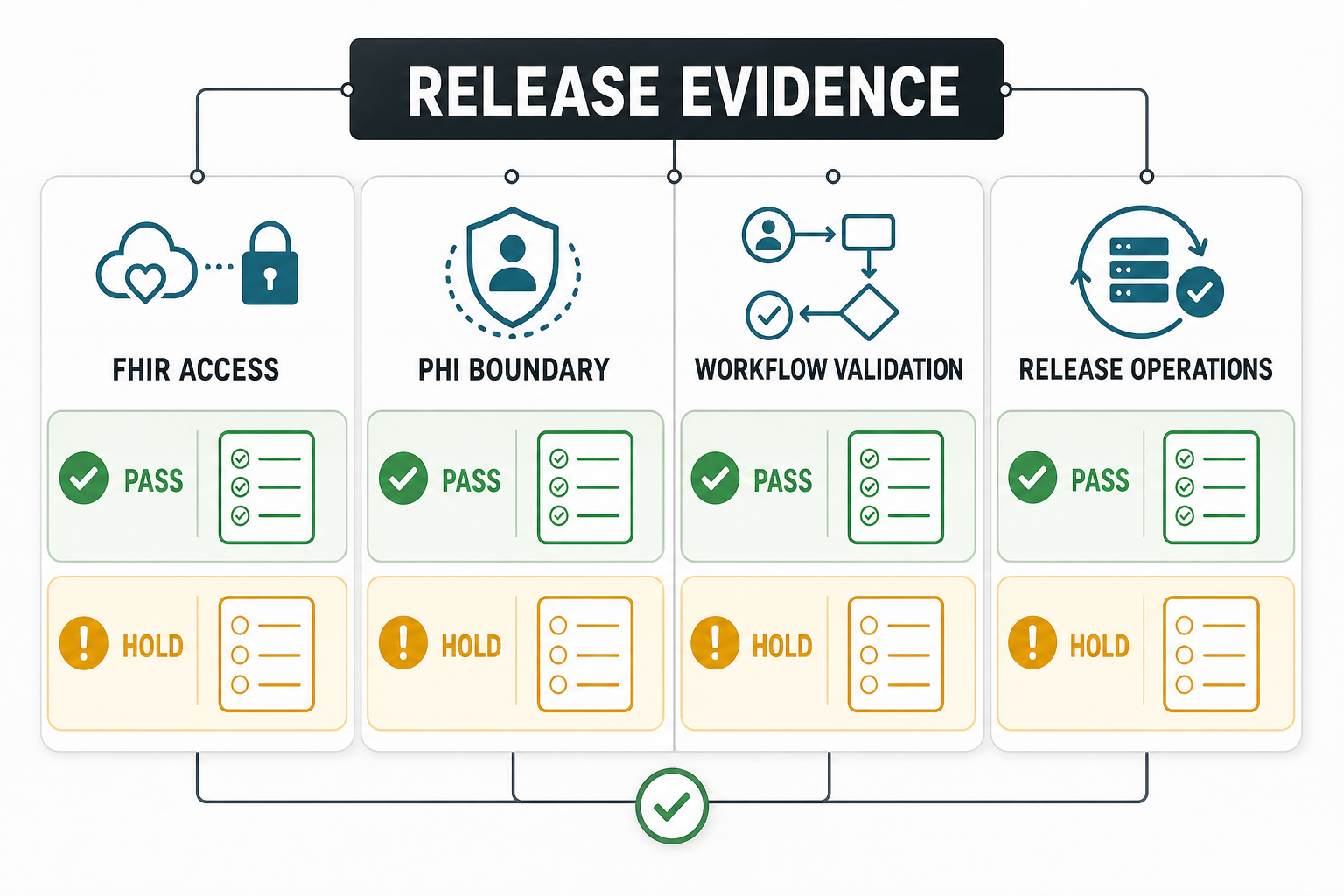
| Gate Area | Evidence To Collect | Hold The Release When |
|---|---|---|
| FHIR and EHR access | Sandbox credentials, API scopes, sample payloads, launch context, rate limits, and vendor approval path. | Access is not approved, the data model is still guessed, or reconciliation rules are unclear. |
| PHI and vendor boundary | PHI map, BAA/vendor review, logging boundary, data retention rule, and analytics redaction plan. | PHI can leak into unsupported tools, logs, support views, or third-party analytics. |
| Workflow validation | Patient, provider, admin, support, and exception-path tests with consent and permission states. | The product only passes happy-path tests or one role can see another role's data. |
| Release operations | Regression run, device/browser matrix, rollback owner, incident path, training notes, and phased rollout plan. | There is no rollback plan, no support owner, or defects are being accepted without explicit risk ownership. |
When EHR scope is material, pair this gate with NextPage's EHR integration roadmap so the app plan includes API access, data migration, compliance, testing, and rollout risk before the build is committed.
Safe Acceleration Vs Unsafe Shortcuts
The fastest healthcare delivery plans compress waiting time, not evidence, security, or clinical workflow validation. Some acceleration choices reduce waste. Others simply move risk to the week before launch.
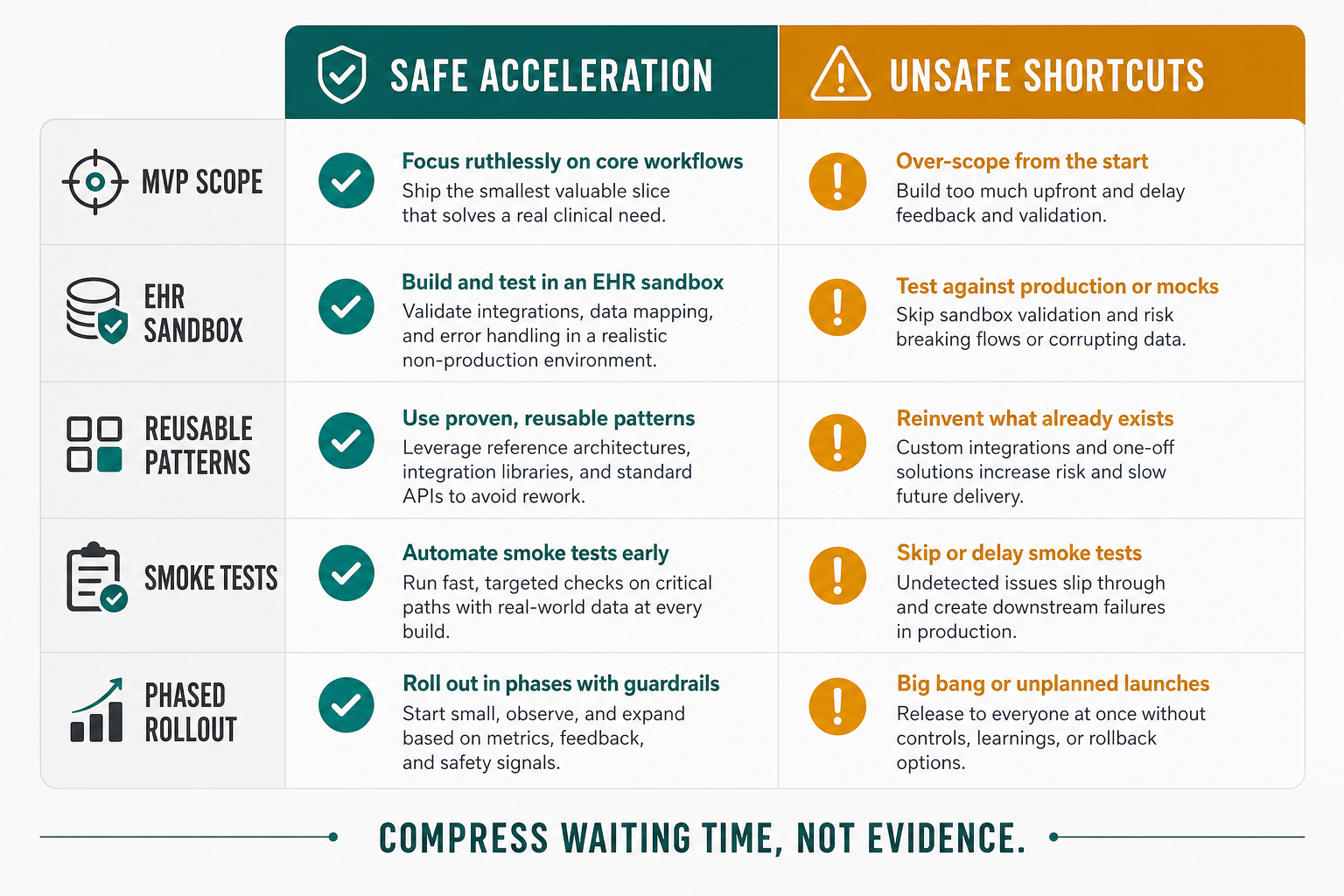
| Safe Acceleration | Why It Works | Unsafe Shortcut |
|---|---|---|
| Trim the MVP to one high-value workflow. | Reduces feature, role, and data complexity. | Keeping every stakeholder request and cutting QA time. |
| Open EHR/FHIR sandbox work during discovery. | Finds auth, mapping, and vendor constraints early. | Mocking integrations until the final sprint. |
| Use reusable mobile/backend patterns. | Speeds common flows while preserving architecture quality. | Hard-coding clinical states that will change later. |
| Automate smoke tests for login, permissions, appointments, payments, and notifications. | Keeps regression visible as scope changes. | Manual-only testing with no repeatable release evidence. |
| Plan phased rollout by clinic, user group, or feature flag. | Limits blast radius and improves feedback quality. | One big launch with no rollback or support process. |
Team Shape For A Faster Healthcare MVP
A healthcare delivery team needs more than mobile app development capacity. The minimum effective team usually includes product ownership, UX, backend/API engineering, mobile or web engineering, QA, DevOps/security, and someone accountable for healthcare workflow and compliance decisions. A single person may cover multiple roles in a smaller MVP, but the responsibilities still exist.
For budget and timeline bands, the Custom Software Cost Estimator is a better starting point than a generic hourly-rate conversation because healthcare complexity depends on roles, integrations, security, and release evidence. Use staff augmentation only when your internal product and compliance ownership is strong. Use a managed delivery model when the same partner must coordinate architecture, implementation, QA, release readiness, and post-launch support.
QA And Release Readiness Should Run From Sprint One
Healthcare QA should cover more than happy-path feature acceptance. Test role permissions, consent states, PHI exposure, audit events, failed integrations, notification delivery, offline or poor-network states, accessibility, device coverage, and support workflows with mobile app testing services when device and release coverage must be repeatable.
Late QA creates the illusion of speed until one defect forces design, backend, compliance, and support changes at the same time. Before launch, use a release checklist that includes app-store/privacy requirements, crash reporting, logging boundaries, support escalation, incident response, rollback plan, and analytics events that do not leak sensitive data. NextPage's mobile app QA and launch checklist is a useful companion for this stage, and the mobile app performance optimization checklist helps add speed, API, monitoring, and performance gates.
How To Compress The Plan Without Compressing Evidence
The best timeline compression comes from removing waiting time, not removing controls. Run the PHI map while UX explores the workflow. Request EHR sandbox access while the MVP is being scoped. Build API contract tests before the full integration is ready. Draft privacy disclosures, app-store assets, and support playbooks while engineering builds the first vertical slice.
Use NextPage's MVP Scope Builder to decide which workflow is allowed into the first release. If wearable, remote-monitoring, or connected-device data is part of the roadmap, the healthcare wearable app development services page shows the extra patient-app, data-sync, monitoring, and support decisions that change scope.
- Week 1: define launch workflow, user roles, PHI boundary, and integration assumptions.
- Week 2: request vendor access, review BAA needs, define test data, and write release evidence criteria.
- Weeks 3-6: build a vertical slice with authentication, permissions, audit events, and one clinical workflow.
- Weeks 7-10: harden integration, support paths, notifications, offline/poor-network states, and analytics boundaries.
- Weeks 11+: run phased UAT, security checks, regression, app-store/privacy review, and controlled rollout.
Sample Timeline Bands
Use these as planning bands, not quotes. Real timelines change with stakeholder speed, integration availability, regulatory scope, design maturity, data readiness, and vendor approvals.
| Product Scope | Typical First-Release Band | Why It Changes |
|---|---|---|
| Focused healthcare MVP with basic patient/admin workflow | 12-20 weeks | Scope discipline, simple data model, limited integrations. |
| Telemedicine or appointment workflow with payments and notifications | 16-28 weeks | Video, scheduling, payments, privacy, device QA, and support operations. |
| EHR-integrated patient/provider workflow | 20-36+ weeks | FHIR/API access, data mapping, vendor approvals, reconciliation, and testing. |
| Remote monitoring, AI triage, or clinical decision support | 28-52+ weeks | Device data, model/evidence review, regulatory questions, safety monitoring, and stronger validation. |
The better question is not "How do we build faster?" It is "Which uncertainties can we remove this week?" For most healthcare products, the answer is scope, data boundary, integration access, and release evidence.
Common Healthcare Delivery Acceleration Mistakes
- Estimating before vendor access is real: EHR/FHIR readiness can change the timeline more than UI complexity.
- Treating HIPAA as a launch-week checklist: data boundaries, vendor access, audit logs, and retention rules should shape architecture early.
- Using mock integrations too long: mocks are useful for UI progress, but they hide auth, data mapping, limits, and reconciliation risk.
- Cutting QA to preserve a date: healthcare defects usually create cross-functional rework across design, backend, support, security, and compliance.
- Launching to every role at once: phased rollout by clinic, group, feature flag, or workflow lowers blast radius and improves feedback quality.
- Ignoring post-launch maintenance: pair launch planning with mobile app maintenance so fixes, monitoring, and incident response have owners.
If the release plan needs extra coverage, pair this article with the Mobile App Testing Checklist Before Launch. For short-term release capacity, QA testing staff augmentation services can help cover device, browser, API, regression, and app-store readiness work without confusing speed with skipped validation.
How NextPage Helps Healthcare Teams Move Faster Safely
NextPage helps healthcare and healthtech teams plan first-release scope, design compliant product architecture, build mobile and web workflows, integrate APIs, and validate launch readiness without pretending healthcare software is a generic app build. Start with the MVP Scope Builder if the first-release scope is still unclear. Use the Custom Software Cost Estimator if leadership needs a budget and timeline band. Then bring the resulting scope into a discovery call so the team can pressure-test workflow, compliance, integration, and release assumptions before sprint commitments are made.