
Dating app development is not just a swipe interface with chat attached. A Tinder-like app has to solve a harder product problem: help the right people discover each other, make first contact feel low-friction, protect users from abuse, and create enough trust that people return after the first match.
For founders and product teams, the strongest dating app ideas usually start with a narrow audience, a clear matching promise, and a careful release plan. The core product needs profiles, discovery, matching, chat, safety, monetization, analytics, and admin operations working together from the first version.
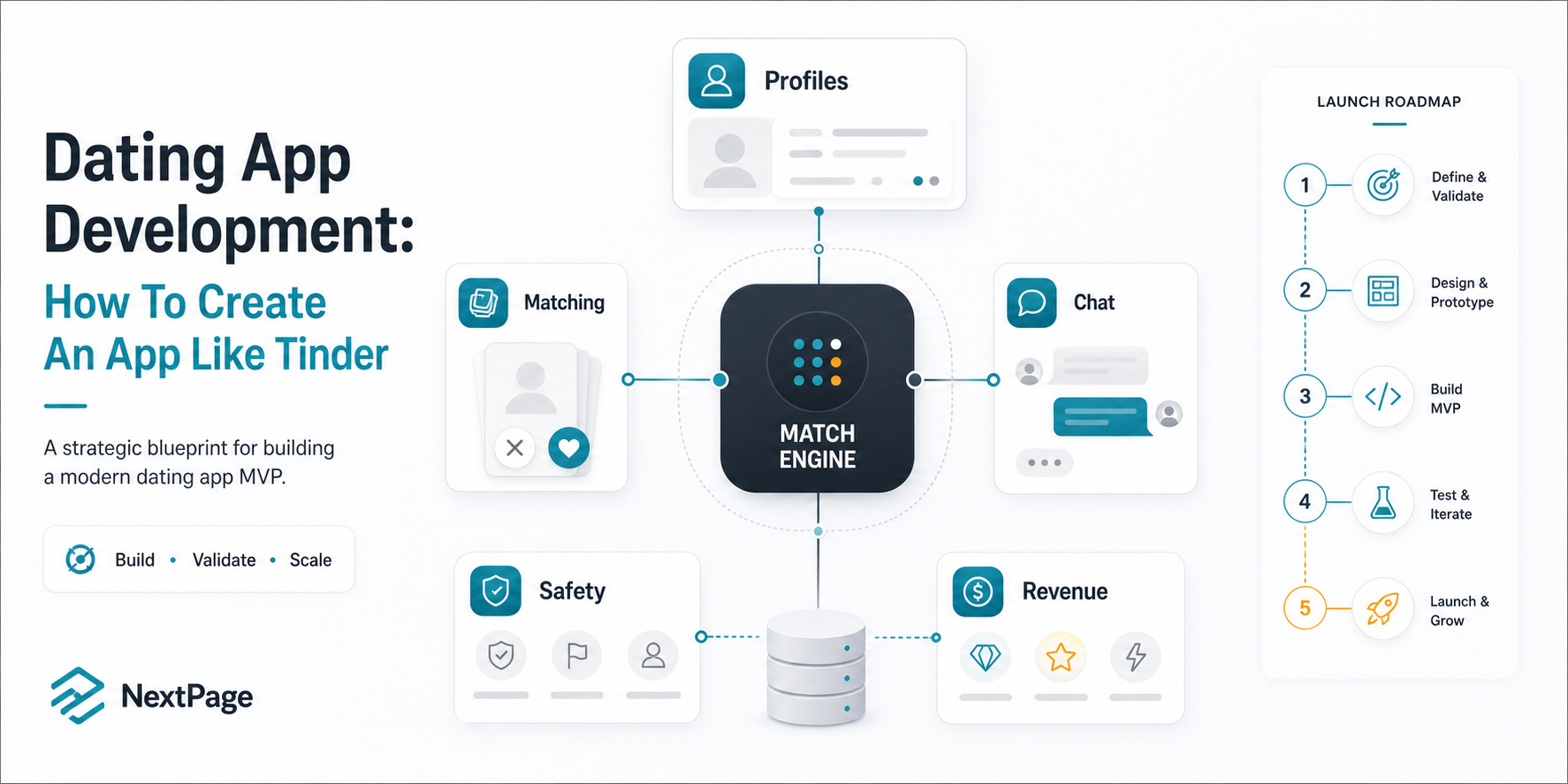
Quick Answer: How Do You Create An App Like Tinder?
To create an app like Tinder, define the audience and positioning first, then build a focused MVP with onboarding, profile creation, photo and preference controls, location-aware discovery, swipe or card-based matching, mutual-match chat, push notifications, reporting, moderation tools, analytics, and a simple monetization model. Treat it as a specialized mobile app development project with strong backend, safety, and retention requirements rather than only a front-end cloning exercise.
The first release should prove that users can create a credible profile, see relevant recommendations, match with mutual interest, communicate safely, and understand why they should come back. Once that loop works, the product can add premium filters, boosts, subscriptions, social verification, AI-assisted recommendations, events, communities, and deeper personalization.
What The Original Post Needed
The production candidate was selected because it was missing the basics that help a blog post perform: featured image, featured alt text, useful excerpt, strong SEO title, meta description, and inline visuals. The original topic had buyer intent, but it needed a more practical structure for readers comparing dating app features, Tinder-like architecture, cost drivers, safety requirements, and launch decisions.
This optimization keeps the slug and original idea while turning the article into a clearer development guide with current product strategy, implementation sequencing, internal links, and structured FAQs.
Define The Dating App Positioning Before Features
Most dating apps fail because they look generic. Before choosing features, decide who the app serves and why that audience would trust a new option. The answer could be professional networking, faith-based dating, local communities, serious relationships, shared hobbies, video-first introductions, LGBTQ+ safety, privacy-first matching, or curated offline events.
Positioning affects every product decision. A casual swipe app needs fast discovery and lightweight profiles. A serious-relationship app needs richer onboarding, compatibility signals, verification, and thoughtful messaging prompts. A niche community app needs strong moderation and member quality controls. Start narrow enough that the matching promise feels specific.
Dating App MVP Features
A dating app MVP should include enough functionality to complete the core loop without overbuilding every advanced idea. Users need to join, create profiles, discover compatible people, express interest, match mutually, chat safely, and receive reminders when something important happens.
| Area | MVP Requirement | Why It Matters |
|---|---|---|
| Onboarding | Phone, email, social, or OTP login with basic profile setup | Reduces fake accounts and gets users into the app quickly |
| Profiles | Photos, bio, age, location range, intent, interests, privacy controls | Gives the matching system useful signals and users enough context |
| Discovery | Card stack, filters, recommendations, distance logic, pass/like actions | Creates the habit-forming browsing loop |
| Matching | Mutual like gate, match screen, basic ranking rules | Prevents unsolicited messaging and keeps interactions intentional |
| Chat | Text messages, media controls, typing state, read state, block/report | Turns matches into conversations while preserving safety |
| Admin | User management, reports, moderation queue, content review | Gives the business control over trust and quality |
If budget is limited, keep the first release focused. The pattern is similar to other marketplace-style apps: define the core transaction, build the smallest version of the trust loop, then expand feature depth. The NextPage guide on building a delivery app like Domino's is a useful comparison because it also shows how discovery, ordering, operations, and notifications must connect cleanly.
Dating App Matching Architecture
The matching system is the heart of a Tinder-like app. It should combine user preferences, location constraints, profile completeness, behavior signals, safety limits, and ranking rules. In the MVP, the algorithm can be rule-based. As data grows, teams can add smarter recommendations, compatibility scoring, and experimentation.
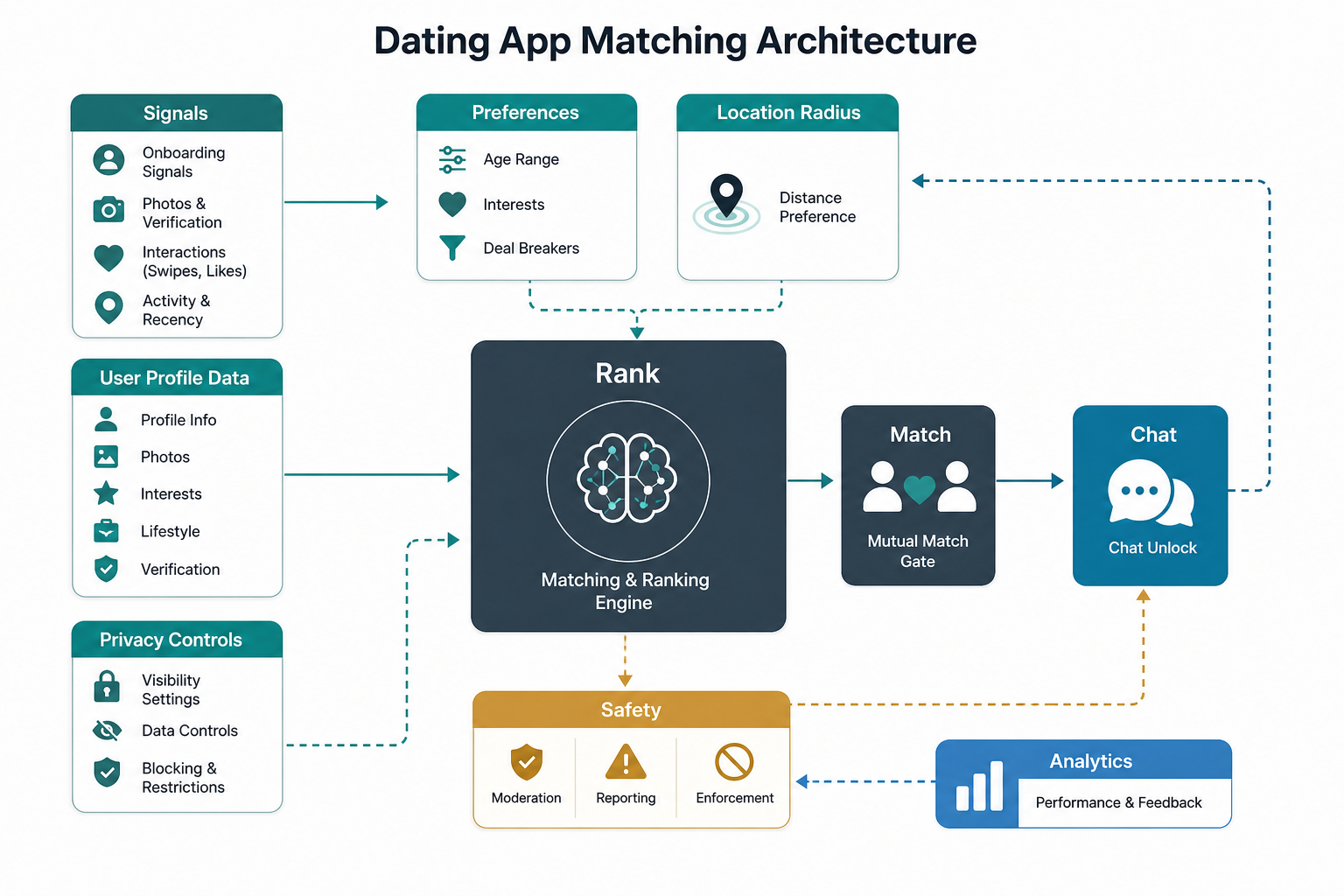
Do not start with an opaque algorithm that nobody can debug. Begin with explicit rules: active users first, completed profiles first, preference overlap, reasonable distance, recently engaged users, and safety restrictions. Then measure match quality, response rate, conversation starts, reports, and churn before adding more complexity.
Native, Cross-Platform, Or Web?
Dating apps are usually mobile-first because location, notifications, photos, and fast browsing matter. Native iOS and Android can deliver strong performance and platform-specific polish, while cross-platform frameworks can reduce build effort when the team needs to validate quickly. A web app can support admin operations, content moderation, landing pages, and customer support workflows.
The right choice depends on budget, target audience, performance needs, and launch timeline. If you are comparing platform approaches, the guide to native vs cross-platform mobile app development can help frame the tradeoffs before engineering begins.
Dating App MVP Roadmap
Dating app development should move through stages. The MVP proves the matching loop. The growth stage improves retention and monetization. The scale stage adds deeper trust, automation, analytics, and experimentation.
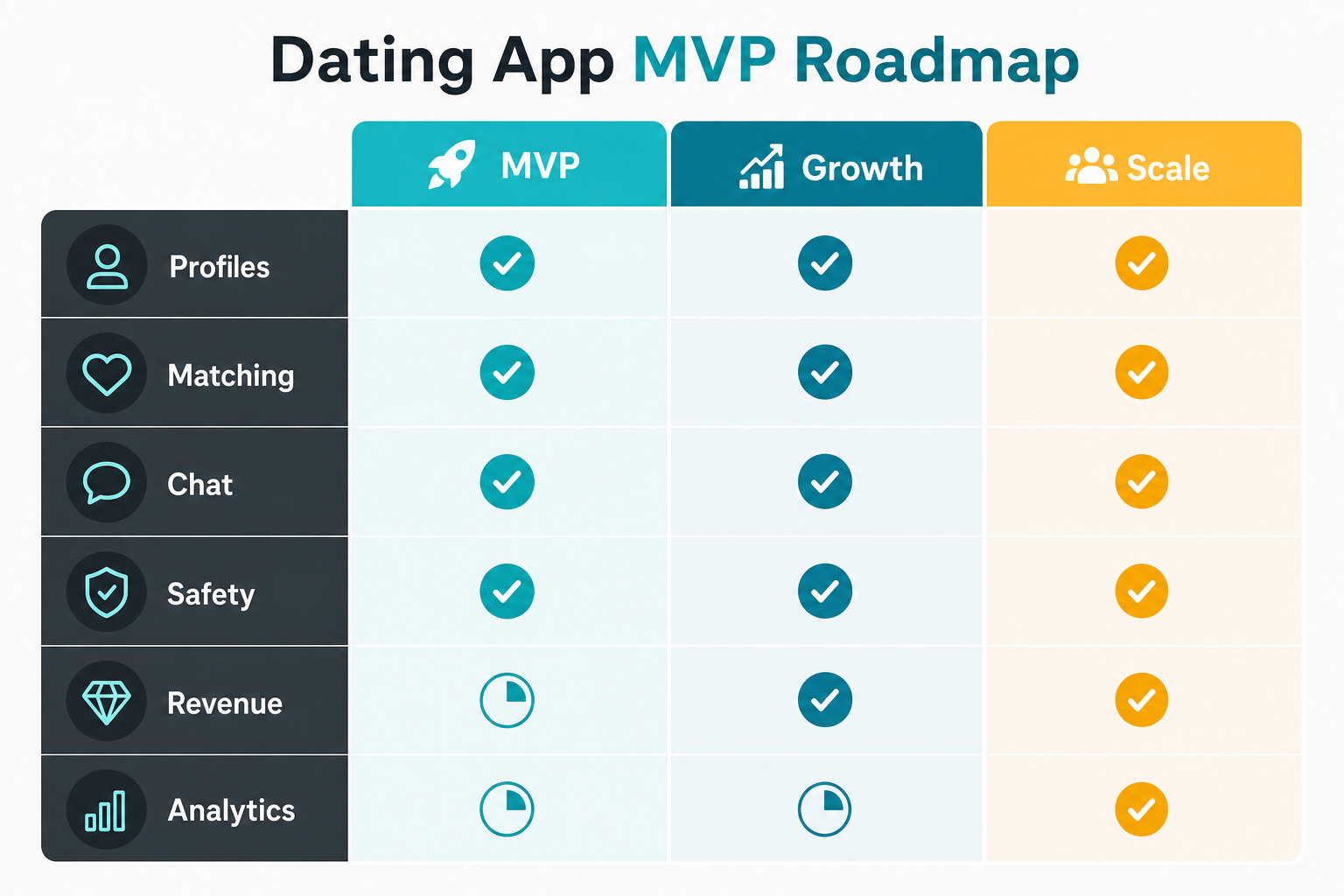
In the MVP, ship the fewest features needed for quality matches. In the growth stage, improve onboarding, prompts, recommendations, premium filters, boosts, and push notification timing. At scale, add fraud detection, advanced moderation, experimentation infrastructure, CRM journeys, segmented pricing, and data pipelines.
Trust, Safety, And Moderation
Safety is not a late-stage feature for dating apps. It shapes user confidence, marketplace quality, and brand reputation. Plan for profile verification, photo review, block and report flows, moderation queues, message abuse detection, location privacy, consent controls, and clear community guidelines from the start.
The admin dashboard matters as much as the user interface. Moderators need fast access to reported profiles, message context, risk signals, previous actions, and escalation history. Without these tools, the team will struggle to keep the community healthy as usage grows.
Monetization, Trust, And Retention
Dating app monetization can include subscriptions, premium filters, likes, boosts, profile visibility, virtual gifts, read receipts, travel mode, and curated events. The challenge is balancing revenue with trust. If monetization makes the app feel unfair or manipulative, retention suffers.
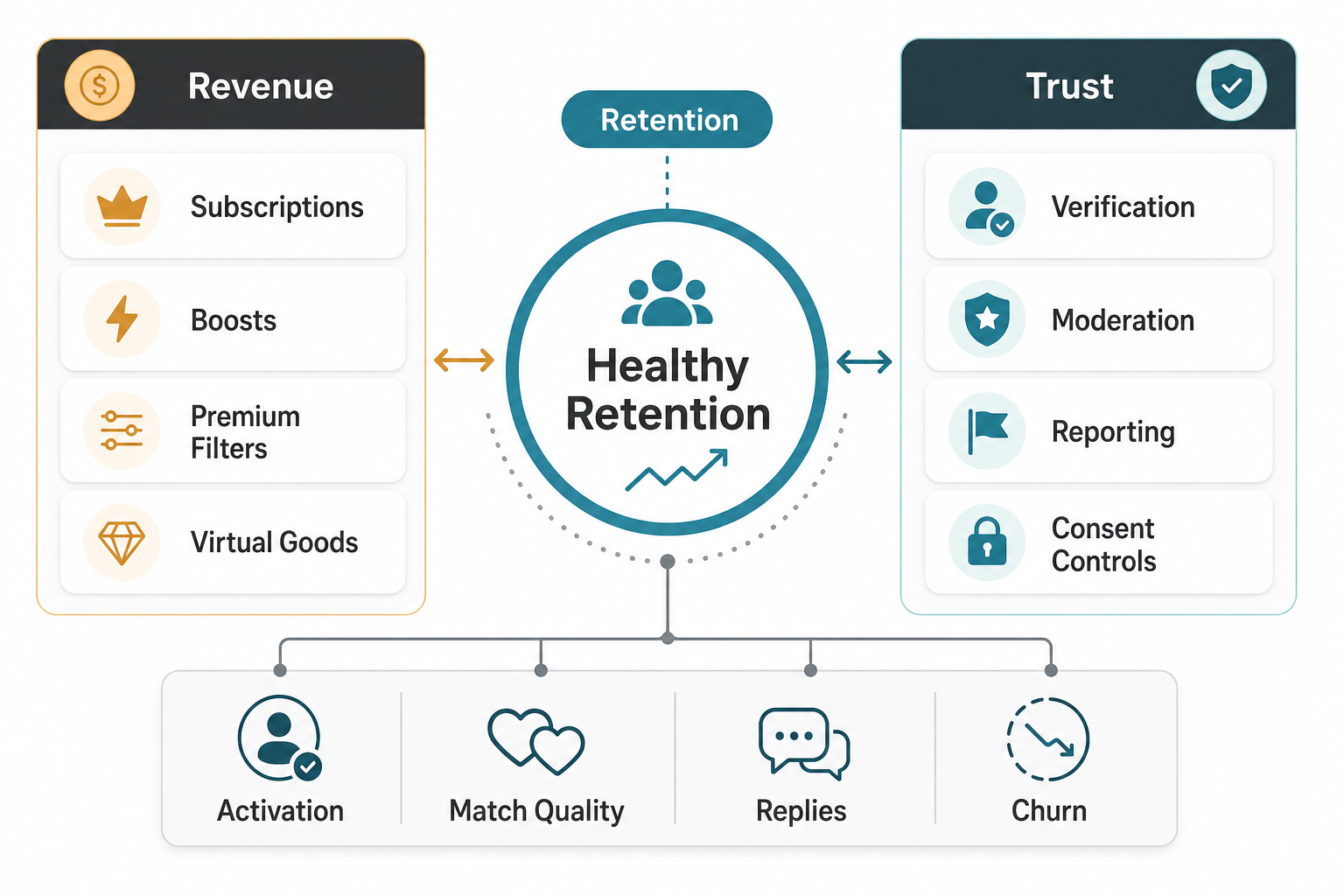
Measure monetization alongside product quality. Track activation, profile completion, likes sent, mutual matches, first messages, reply rate, conversation depth, reports, subscription conversion, refund rate, and churn. The goal is not just more paid actions. The goal is better matches, safer conversations, and sustainable revenue.
Dating App Development Cost Drivers
Dating app cost depends on platform choice, design quality, profile depth, matching logic, chat features, media handling, moderation tools, verification, admin dashboards, subscriptions, analytics, cloud infrastructure, and launch support. A narrow MVP costs far less than a multi-platform dating platform with AI recommendations, fraud detection, live video, and complex monetization.
Use the custom software cost estimator to compare scope levels before committing to a roadmap. For a broader view of how workflows, integrations, and operations shape budgets, the guide to eCommerce app development cost is a relevant comparison because marketplace-style apps share many cost drivers.
Launch And App Store Optimization Plan
A dating app launch needs more than publishing to the stores. You need enough local or niche density for users to see relevant profiles, enough moderation coverage to handle early reports, and enough measurement to understand whether the matching loop works.
Prepare app store assets, screenshots, descriptions, keywords, privacy details, and onboarding copy early. The supporting guide on App Store Optimization for app listings can help shape the launch checklist once the product promise is clear.
Metrics That Matter After Launch
- Profile completion rate and verification completion rate
- Daily active users by city, niche, or cohort
- Swipe-to-like ratio and like-to-match ratio
- Match-to-message rate and reply rate
- Report rate, block rate, and moderation response time
- Subscription conversion, upgrade triggers, and churn
- Retention by first-session behavior and first-match timing
Final Recommendation
To build an app like Tinder, start with the matching promise, not the swipe mechanic. The interface is easy to copy. The harder work is creating a focused audience, trustworthy profiles, relevant recommendations, safe messaging, useful moderation, and a monetization model that does not damage user confidence.
Build the first version around a tight dating loop, measure quality carefully, and expand only after users prove they are returning for better matches. That approach gives the product a stronger chance than launching a broad feature set without community density or trust.