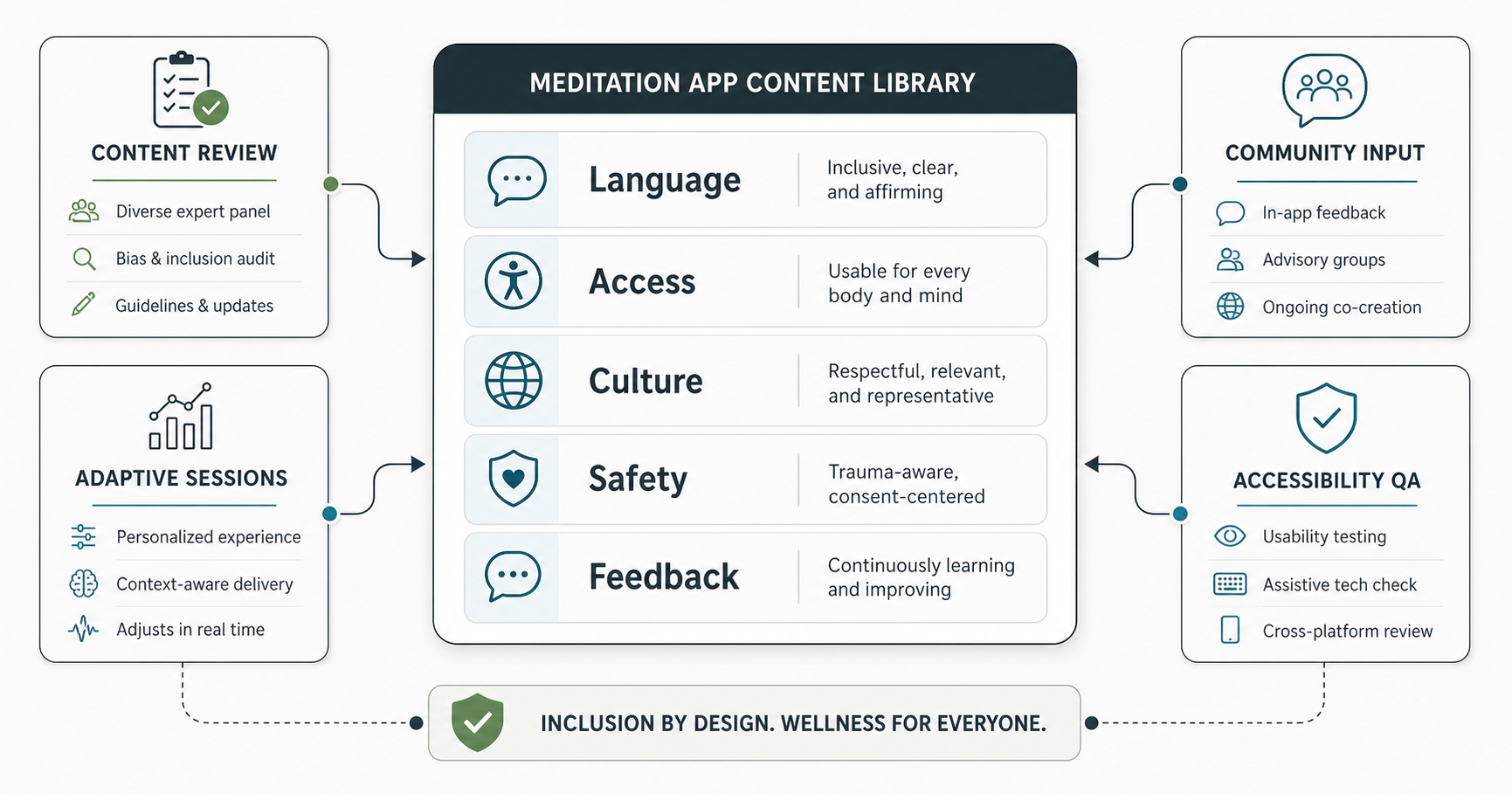

Meditation apps can feel calm on the surface and still exclude people in practice. A user may need captions, shorter sessions, a different language, less spiritual framing, trauma-aware guidance, a teacher who sounds familiar, or a way to opt out of a practice that does not fit their culture or body. Inclusive meditation practices turn those needs into product decisions rather than afterthoughts.
For founders and product teams, inclusion is not a decorative content theme. It affects onboarding, content operations, accessibility QA, personalization, privacy, community trust, and long-term retention. If you are planning a new wellness product, NextPage's mobile app development team can help connect these choices to the actual app architecture, content workflow, and launch roadmap.
What Inclusive Meditation Means In A Mental Wellness App
Inclusive meditation means the app gives more people a respectful way into mindfulness without assuming one culture, one body, one language, one attention span, or one belief system. It does not require every user to meditate the same way. It gives users clear choices and explains the context behind each practice.
A strong inclusive meditation library usually includes secular breathing exercises, culturally rooted practices where the context is handled carefully, body-based grounding options, visual or sound-light alternatives, short sessions for beginners, and longer programs for users who want depth. The product should also make clear that meditation content is supportive self-care content, not a replacement for professional mental health care or emergency support.
Why Inclusion Affects Product Quality
Inclusion improves product quality because it reduces avoidable friction. When users cannot understand a guide, cannot hear the session, cannot read the interface, do not see their reality represented, or feel pressured into a practice that does not fit them, the app loses trust quickly. Mental wellness products need especially careful UX because the user may arrive tired, anxious, distracted, or skeptical.
Good inclusive design also helps teams make better prioritization decisions. The same discovery work that identifies cultural gaps can reveal onboarding issues, content gaps, and accessibility barriers. NextPage's guide to user interfaces in mental wellness app development is a useful companion when deciding how calm UI, feedback, and trust signals should work together.
A Practical Inclusion Framework For Meditation App Teams
The easiest way to make inclusion operational is to treat it as a repeatable product loop. Research the audience, co-create with qualified reviewers, localize language and context, adapt the experience for access needs, and measure trust signals after launch.
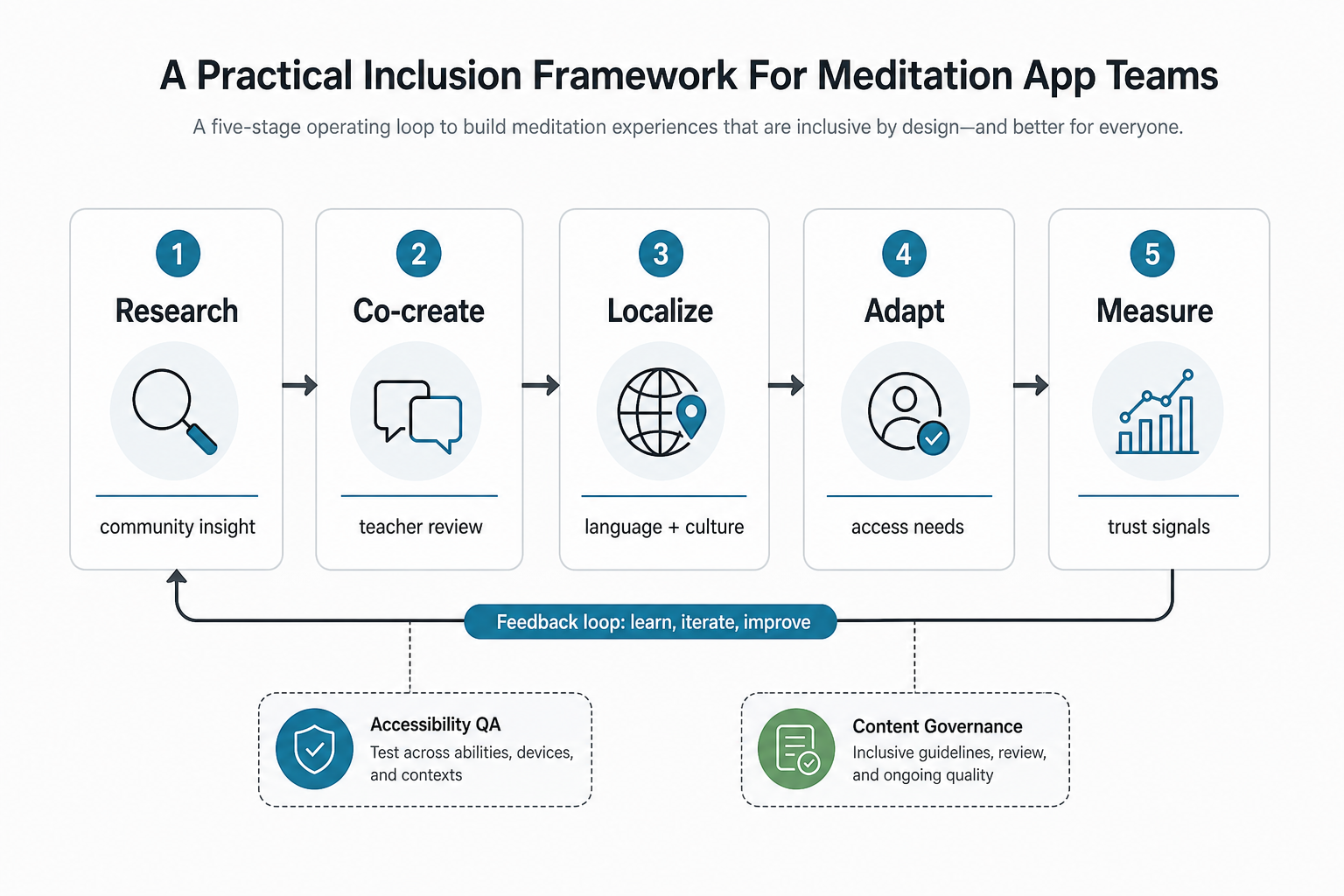
Research should include interviews, support logs, app reviews, accessibility findings, and community feedback. Co-creation should involve meditation teachers, mental health advisors where appropriate, accessibility reviewers, and people with lived experience. Localization should preserve meaning, not just convert words. Adaptation should cover interface, audio, pacing, sensory needs, and device constraints. Measurement should watch completion, drop-off, qualitative feedback, safety reports, and content quality reviews.
Design The Content Library Around Choice And Context
A narrow meditation library often assumes that every user wants the same voice, tone, practice length, and philosophical framing. An inclusive library is broader and better organized. It lets users choose by goal, duration, energy level, tradition, language, teacher, sensory preference, and support need.
Content cards should explain what a session includes before the user starts. For example, a grounding exercise can say whether it uses breath focus, body scanning, visualization, silence, affirmations, movement, or spiritual language. This helps users avoid content that may feel uncomfortable or inappropriate for their situation.
Teams building larger wellness platforms should also plan the CMS, tagging model, reviewer roles, and publishing workflow early. These are not only content concerns; they are custom software development decisions that affect how safely the app can scale.
Feature Decisions That Make Meditation More Accessible
Accessibility in meditation apps goes beyond color contrast. Audio-first products still need readable transcripts, captions for video, keyboard and screen-reader support, adjustable playback speed, clear focus states, simple navigation, and alternatives for users who do not want to close their eyes or focus on breath.
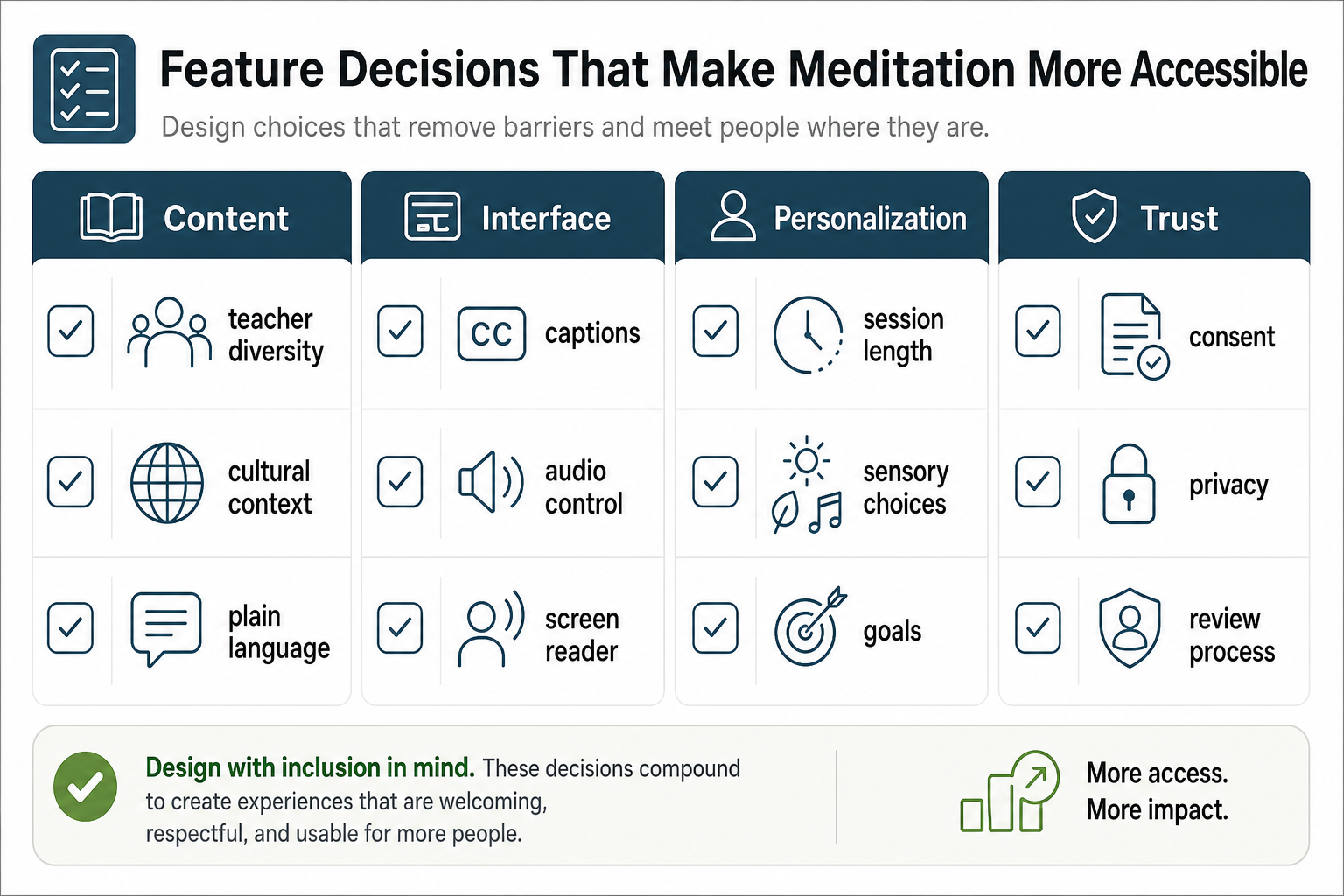
Useful accessibility features include captions and transcripts, session previews, volume and background-sound controls, haptic-light options, large tap targets, readable typography, reduced-motion preferences, language switching, reminders that can be paused, and progress states that do not shame users for missing a day.
Localize Language, Teachers, And Cultural Context
Translation alone rarely creates inclusion. Meditation language can carry cultural, religious, emotional, and clinical implications. A literal translation may sound awkward or may change the meaning of a practice. Teams should localize session scripts with reviewers who understand the audience, the practice, and the product's safety boundaries.
Representation also matters. A meditation app can include teachers with different accents, ages, cultural backgrounds, accessibility needs, and practice styles without reducing people to tokens. The goal is to give users a credible choice of guides and contexts. The MindGarden wellness app case study shows how a wellness product can combine guided content, routines, progress, and subscriptions inside one mobile experience.
Personalize Without Stereotyping Users
Personalization can make meditation more inclusive when it gives users control. It becomes risky when the app infers sensitive identity traits or pushes people into narrow categories. Ask users what they want to customize: session length, topic, guide voice, reminders, sensory intensity, language, spiritual framing, beginner level, and accessibility settings.
Use recommendations cautiously. Recommend based on explicit preferences and recent behavior, then let users edit or reset their profile. Avoid claims that the app can diagnose, treat, or fix a mental health condition. For planning user groups and preference models, the NextPage article on user personas in app development can help teams separate useful cohorts from lazy stereotypes.
Build Trust, Safety, And Privacy Into The Experience
Mental wellness apps should make privacy and consent easy to understand. Users need to know what data is stored, what is optional, how reminders work, and whether sensitive journal entries, mood notes, or session history can be deleted. If the app includes AI, community features, coaching, or mood tracking, the trust bar is even higher.
Product teams should define review rules before launch: who approves content, how harmful feedback is handled, when professional review is required, and how the app routes users toward crisis or clinical resources when the product is not appropriate for their needs. Inclusive meditation is partly about welcoming more users; it is also about knowing when an app should step back.
Create A Community Feedback Loop
Inclusive meditation practices should evolve with the audience. Add feedback prompts after sessions, invite advisory input from underrepresented users, review support tickets for recurring barriers, and give content teams a way to update scripts without waiting for a full app release.
For early-stage products, this does not need to be complex. A monthly content review, accessibility bug queue, localization review checklist, and user interview rhythm can catch many issues. As the app grows, feedback should become part of analytics, CMS workflow, and roadmap planning. The broader wellness app development guide is useful for connecting these operating habits to launch planning.
A Lean Roadmap For Inclusive Meditation Features
Start with the foundations: accessible player controls, transcripts or captions, clear session descriptions, opt-in reminders, privacy settings, and a content review checklist. Next, add multilingual content, teacher diversity, personalized session filters, and community feedback. Later, add advanced recommendations, coach review workflows, deeper analytics, and integrations only when the safety and governance model is ready.
This roadmap keeps inclusion practical. It lets a team ship a useful first version while building toward a richer content and personalization system. The result is a meditation app that feels calmer because the product has done the hard work behind the scenes: respecting context, offering choice, and testing the experience with the people it claims to serve.
Conclusion
Inclusive meditation practices are not only about adding more sessions to a content library. They require product strategy, accessible interface design, localized content operations, privacy-aware personalization, and ongoing community review. When those pieces work together, a mental wellness app can welcome more users without making vague promises or flattening cultural differences.
The best inclusive meditation apps give people a choice of language, guide, pace, sensory mode, context, and support level. They explain what each practice is, avoid pressure, and make it easy to change direction. That is what turns inclusion from a value statement into a better product experience.