
An Instagram commerce app MVP should turn proven social demand into an owned checkout and operations flow, not rebuild Instagram. If posts, reels, ads, or creator campaigns are already creating demand, the first product release should help buyers move from discovery to product selection, checkout, order updates, support, and repeat purchase with less manual handoff.
The practical roadmap starts with four decisions: what traffic will keep happening on Instagram, what experience must move to your own web or mobile surface, which systems need to sync behind the scenes, and which metrics prove the next build phase. For many brands, the MVP is a mobile-first campaign storefront with catalog sync, cart and checkout, CRM/order capture, basic fulfillment visibility, attribution events, and an admin view for support.
If you need to define that first release quickly, start with NextPage's MVP Scope Builder. If budget is the constraint, use the Custom Software Cost Estimator before adding native app, loyalty, automation, or creator marketplace features.
Quick Answer: What Should An Instagram Commerce MVP Include?
| MVP Layer | Release-One Scope | Usually Later |
|---|---|---|
| Social demand capture | Campaign links, product tagging readiness, UTM rules, creator or ad landing paths. | Full creator marketplace, affiliate commission engine, advanced social listening. |
| Storefront | Mobile-first landing pages, product detail, variants, offer blocks, trust proof, cart. | Personalized merchandising, loyalty, subscriptions, AI recommendations. |
| Checkout | Payment gateway, shipping rules, taxes where needed, abandoned checkout capture, confirmation. | Wallets, complex promotions, split payments, marketplace settlement. |
| Operations | Order capture, CRM handoff, inventory status, fulfillment notes, support visibility. | Warehouse automation, returns portal, ERP automation, advanced routing. |
| Analytics | UTMs, pixel/events, Conversion API planning, source-of-order reporting, cohort dashboard. | Multi-touch attribution model, predictive LTV, automated campaign optimization. |
The goal is not to replace Instagram as a discovery channel. The goal is to reduce the gap between interest and purchase while giving the business a system it controls: product data, checkout rules, customer records, order status, fulfillment workflow, and performance data. NextPage's social commerce app development services page is the most direct service path for this kind of build.
The Instagram-To-Owned-Commerce Operating Map
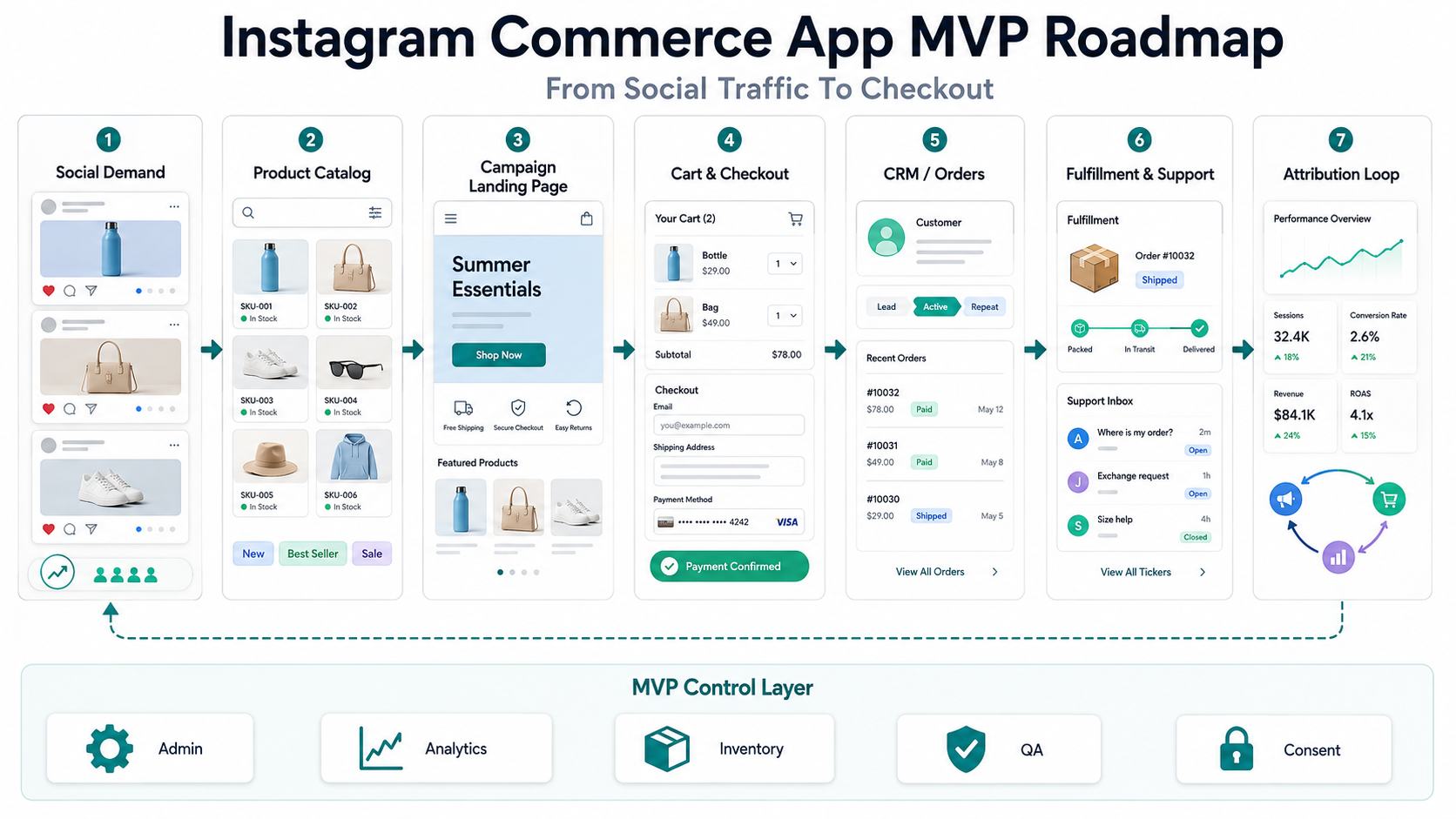
The source case study that triggered this queued post describes Instagram ads, local audience targeting, lookalike audiences, creative testing, calls to action, follower growth, and order lift for a florist. That is a marketing win. The product question comes next: what happens when the campaign works and the team needs to handle more orders, support, repeat customers, inventory, and attribution?
An MVP roadmap should map the full operating loop:
- Demand signal: posts, reels, ads, influencer traffic, DMs, comments, story links, or product tags create intent.
- Product context: catalog, pricing, availability, bundles, location limits, shipping rules, and offer copy stay accurate.
- Conversion surface: landing page, mobile storefront, PWA, or app lets buyers choose and check out cleanly.
- Order operations: CRM, admin, inventory, fulfillment, support, and notification workflows receive usable data.
- Attribution loop: campaigns, products, cohorts, and repeat purchases are visible enough to decide the next investment.
Start With Platform Reality, Not Wishful Feature Lists
Instagram commerce is not a uniform technical platform for every merchant. Product tagging, shops, checkout behavior, catalog eligibility, ads surfaces, and regional availability can vary by account type, country, shop configuration, commerce policies, and current Meta changes. Treat Instagram as the demand and merchandising layer, then verify what your specific account can support before designing the checkout path.
For an MVP, this means the product plan should support more than one route:
- Tagged product to owned checkout: use product tags or shop surfaces where available, then complete purchase on the owned site or app when that is the configured flow.
- Ad or reel to campaign storefront: send traffic to a fast landing page with the exact promoted product, offer, trust proof, and checkout.
- DM or comment demand to assisted checkout: capture high-intent conversations into CRM, quote, or cart workflows without relying on screenshots and spreadsheets.
- Creator or affiliate traffic to tracked offer pages: give each campaign a clean URL, coupon, UTM structure, or source code.
The release should be resilient when platform features change. A business should not lose its order process because a product tag, link sticker, or checkout option behaves differently next month.
Instagram Commerce MVP Phase Matrix
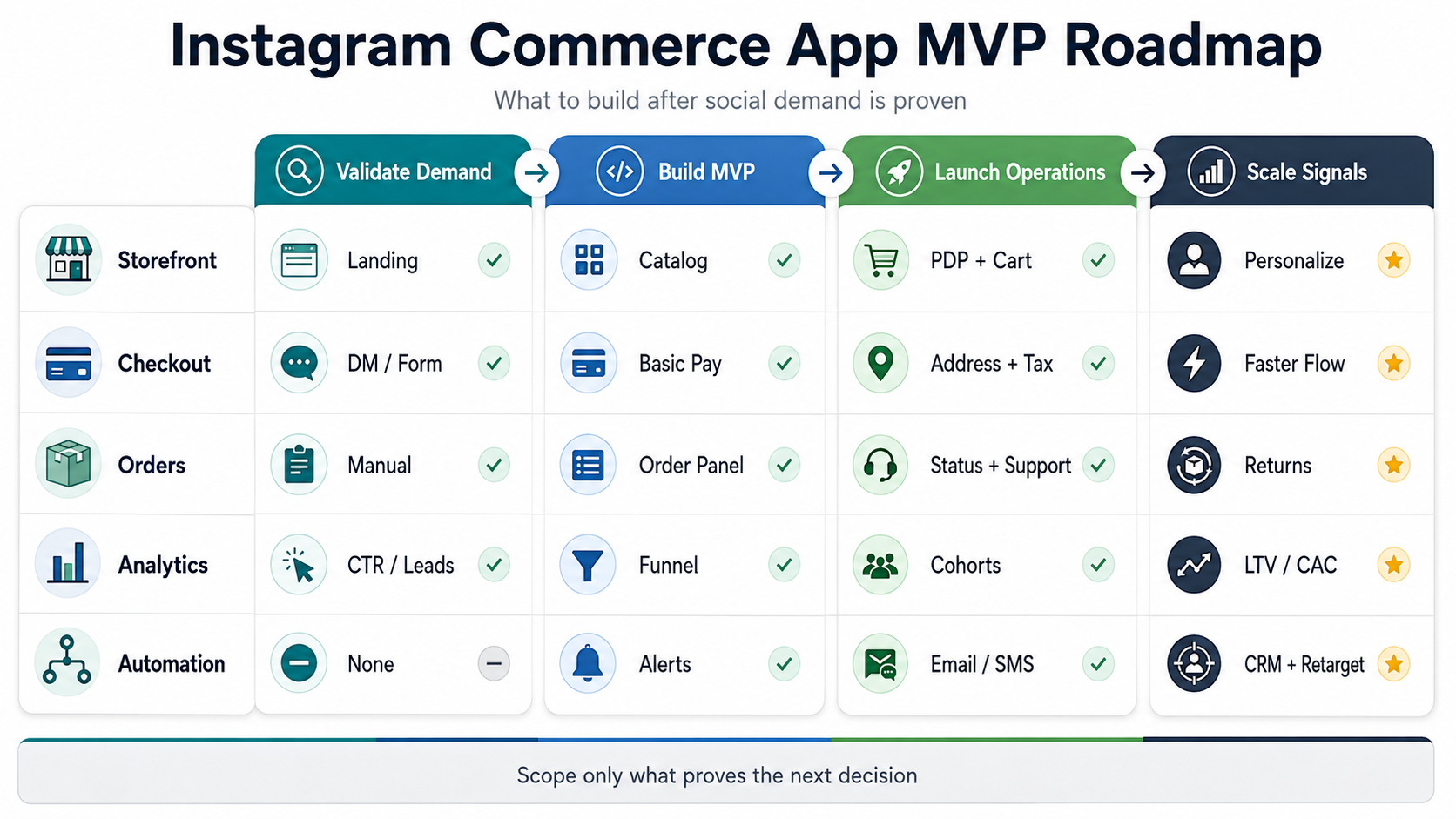
Most teams overbuild because they jump from "Instagram is working" to "we need an app." Sometimes they do. Often they first need a disciplined owned commerce layer that can be launched, measured, and improved before native app investment.
| Phase | Main Decision | Build Scope | Evidence To Watch |
|---|---|---|---|
| Validate Demand | Which offers, products, locations, and audiences convert? | Campaign pages, UTMs, product feed cleanup, offer testing, lead/order capture. | Click-to-product rate, add-to-cart rate, qualified DMs, product demand by source. |
| Build MVP | Can buyers complete an order without manual follow-up? | Mobile storefront, checkout, payment, order admin, CRM capture, basic notifications. | Checkout completion, payment success, support tickets, fulfillment accuracy. |
| Launch Operations | Can the team handle volume reliably? | Inventory rules, fulfillment handoff, support view, refund/cancellation path, reporting. | Late orders, stock issues, support time, repeat purchase, campaign margin. |
| Scale Signals | What deserves automation or app investment? | Loyalty, app install path, personalization, creator codes, advanced attribution, ERP sync. | LTV, repeat rate, paid CAC payback, creator ROI, operational cost per order. |
Choose The Right First Surface: Landing Page, PWA, Or App
The first product decision is where the buyer should land after Instagram. A native mobile app can be valuable for repeat purchase, loyalty, push notifications, saved preferences, and high-frequency use. But a native app is not always the correct first release after a successful campaign.
Use this rule of thumb:
- Campaign landing page: best for testing a narrow offer, seasonal drop, local service, waitlist, or limited product bundle.
- Mobile-first storefront or PWA: best when buyers need browsing, cart, checkout, order tracking, account capture, and repeat web visits.
- Native app: best when retention, push, personalized experience, loyalty, offline behavior, camera/location features, or frequent purchase justify app-store friction.
For budget planning, compare the scope against NextPage's eCommerce app development cost guide and mobile app development cost guide. Both show why user roles, integrations, admin, and QA usually drive cost more than screen count.
Catalog And Offer Architecture Come Before Checkout
Instagram commerce traffic is often highly specific: a reel shows one product, a post promotes one arrangement, a creator mentions one bundle, or an ad tests one local offer. The owned commerce surface should preserve that context. Sending every tap to a generic homepage wastes intent.
For release one, define:
- Which products or services can be sold directly from social traffic.
- Which variants, bundles, service areas, dates, delivery slots, or add-ons matter.
- How the product catalog syncs with Meta Commerce Manager, Shopify, WooCommerce, custom backend, or an internal spreadsheet during the first phase.
- How sold-out, location-restricted, or seasonal items are handled.
- Which offer pages are campaign-specific and which become evergreen storefront pages.
For retailers with stock, delivery slots, or fulfillment constraints, the pattern starts to look like operational commerce rather than a simple brochure site. NextPage's grocery app development cost guide is a useful adjacent reference because it shows how inventory, slots, substitutions, delivery, and admin workflow can quickly change scope.
Checkout Should Be Boring, Fast, And Observable
Checkout is not the place to be clever in the MVP. It should be fast, mobile-safe, payment-ready, and instrumented. The team needs to know where buyers drop, which campaign brought them in, which offer converted, and which operational problem followed the order.
Release-one checkout should usually include payment gateway integration, order confirmation, abandoned checkout capture where appropriate, email or WhatsApp/SMS notifications, basic tax/shipping logic, coupon or campaign code support, and failure handling. If the product is a service rather than an item, add booking slots, deposit rules, cancellation terms, and staff confirmation states.
Do not let checkout live outside operations. The admin team needs order source, customer notes, payment status, fulfillment status, delivery or pickup details, and support history. Otherwise the campaign may look profitable while the team is quietly losing margin to manual coordination.
CRM, Orders, And Support Are The Real Differentiator
The difference between a marketing campaign and a commerce system is what happens after the first order. A useful MVP captures buyer data in a structured way and moves it into the tools the team already uses: CRM, order management, inventory, helpdesk, email platform, WhatsApp workflow, or accounting handoff.
For a small team, a first release may only need a strong admin dashboard and simple exports. For a scaling brand, the MVP may need CRM sync, inventory updates, fulfillment status, customer tags, campaign source fields, refund notes, and support assignments. Either way, decide early which system is the source of truth for customer, product, order, and campaign data.
This is where custom development can outperform off-the-shelf links. The value is not one more storefront template. It is a workflow that preserves campaign context from the first tap through order completion and repeat purchase.
Attribution: Track Enough To Make The Next Decision
Attribution does not need to be perfect in an MVP, but it must be useful. A founder should be able to answer: which Instagram campaigns drove qualified traffic, which products converted, which creator or audience segment produced repeat buyers, and which order types created support or fulfillment problems.
At minimum, plan UTM conventions, campaign-specific landing paths, pixel or event tracking, server-side event planning where useful, coupon/source codes, and a dashboard that connects orders to acquisition source. If paid media is part of the model, Conversion API planning should be considered early so signal quality does not depend only on browser-side tracking.
The key is decision-grade data. If the data cannot tell you whether to build a native app, expand the product catalog, change fulfillment, invest in creators, or pause a weak offer, the analytics layer is too shallow.
What Not To Build In The First Release
A social commerce roadmap can get bloated quickly. Delay features that do not prove the next business decision.
- Full native app before repeat behavior is clear: validate mobile web conversion and repeat demand first unless app-only features are essential.
- Complex loyalty and referral systems: start with simple post-purchase capture, email/WhatsApp follow-up, and repeat-offer tests.
- AI personalization: useful later, but weak if product data, events, inventory, and customer cohorts are still messy.
- Deep ERP automation: connect only the order, stock, and finance fields that release one genuinely needs.
- Creator marketplace tooling: use tracked URLs and campaign codes before building portals, payout rules, and commission engines.
A Practical Build Roadmap
- Discovery: document current Instagram funnel, best products/offers, manual order flow, customer questions, fulfillment constraints, and campaign goals.
- Platform check: verify account type, commerce eligibility, catalog setup, product tagging options, checkout path, ad account events, and regional limitations.
- MVP scope: choose landing page, mobile storefront, PWA, or app surface; define release-one catalog, checkout, admin, CRM/order flow, and analytics.
- Design and content: create campaign-specific product pages with clear offer, proof, delivery rules, support path, and checkout action.
- Build and integrate: connect catalog, payment, order capture, CRM/helpdesk, notification, and attribution events.
- QA: test mobile checkout, payment failure, stock change, campaign tracking, refund/cancellation, support handoff, and fulfillment edge cases.
- Soft launch: run limited campaigns, inspect order quality, support load, conversion, and fulfillment accuracy.
- Scale decision: decide whether to add native app, loyalty, automation, creator tooling, inventory sync, or deeper ERP integration based on evidence.
How NextPage Plans Instagram Commerce MVPs
NextPage starts by separating social demand from product infrastructure. The Instagram account, ads, creators, and content strategy may create the traffic, but the owned system must handle product context, checkout, order data, customer support, operations, and learning loops.
A practical estimate should list the surface, catalog source, checkout rules, CRM/order handoff, fulfillment workflow, analytics events, admin permissions, QA scenarios, and launch assumptions. Once those are visible, you can trim scope without breaking the path from social traffic to paid order.
Use the MVP Scope Builder to decide what belongs in release one. Use the Custom Software Cost Estimator for a first budget band. When the operating model is clear, NextPage can help build the social commerce storefront, mobile app, checkout flow, admin, CRM/order integrations, attribution layer, and launch QA plan.