
Quick Answer: Secure Payment Gateway Integration For Travel Apps
Secure payment gateway integration in a travel app should connect checkout, booking confirmation, fraud review, refunds, supplier payouts, reconciliation, and support workflows. The goal is not only to collect money. The goal is to protect traveler trust while keeping every booking state accurate when payments succeed, fail, are delayed, or need to be reversed.
For most travel products, the payment layer should support cards, wallets, local payment methods, multi-currency pricing, saved traveler profiles, cancellation rules, partial refunds, vouchers or credits, webhook verification, and clear operational dashboards. If the product needs iOS, Android, backend APIs, booking inventory, notifications, and payment recovery, treat payments as part of the full mobile app development workflow instead of a plugin added at the end.
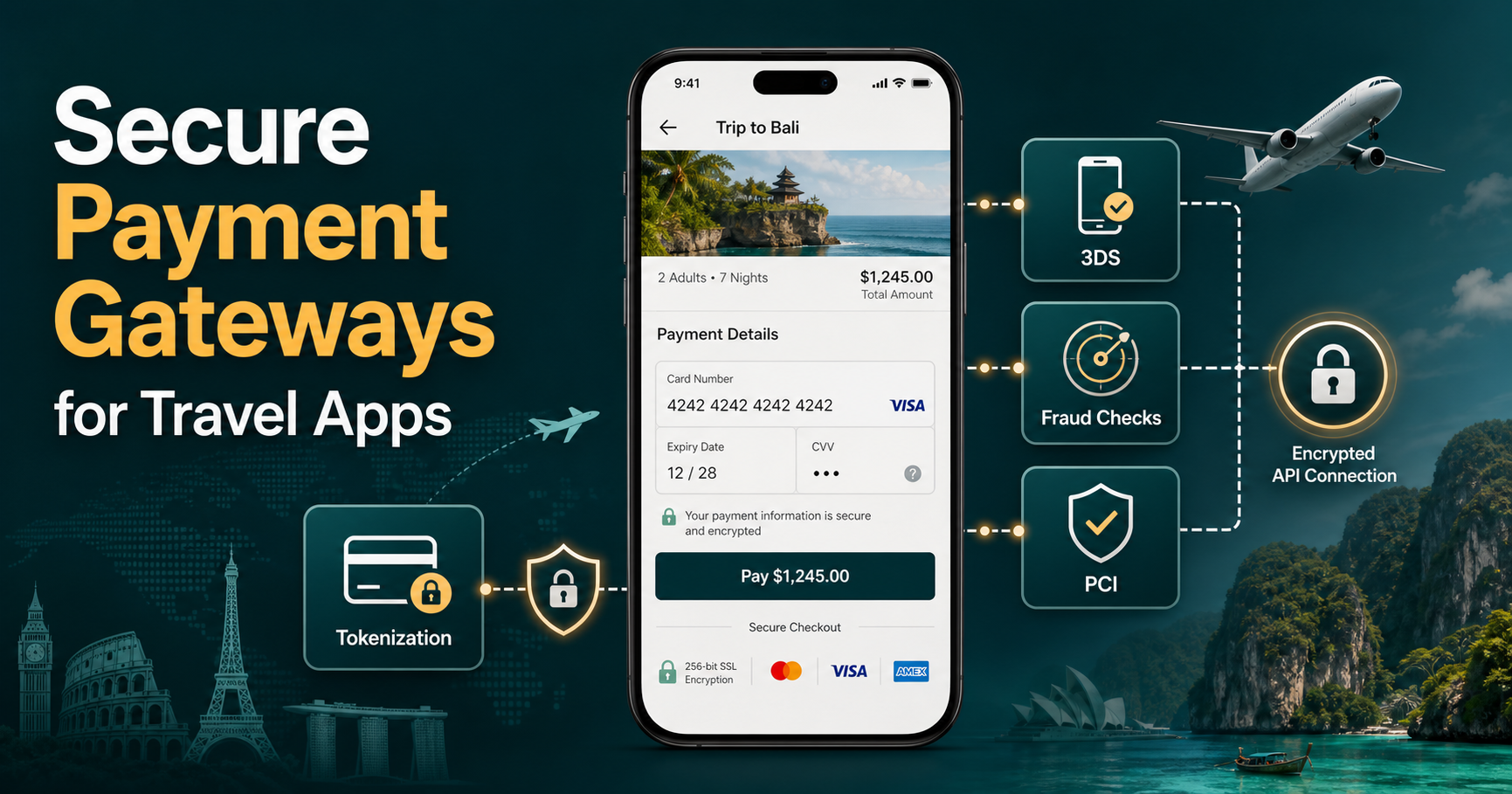
Why Travel Payments Are Harder Than Standard Checkout
Travel checkout is more complex than a normal product purchase because availability, price, currency, supplier confirmation, cancellation policy, and traveler identity can all affect the payment result. A hotel room, flight seat, tour slot, or car rental may become unavailable while the user is still paying. The app may need to hold inventory, authorize payment, confirm the booking with a supplier, and then capture or reverse the transaction depending on the outcome.
Travel businesses also deal with high-ticket purchases, international cards, chargebacks, itinerary changes, multi-passenger orders, split payments, agent-assisted bookings, loyalty credits, and refunds that depend on supplier policy. If these workflows are specific to the operating model, custom software development is often safer than forcing a generic checkout flow to handle travel exceptions.
Travel Payment Feature Stack
A reliable travel payment feature set should be designed around the full booking lifecycle.
| Feature Area | What It Should Cover | Why It Matters |
|---|---|---|
| Checkout methods | Cards, wallets, UPI or local methods where relevant, net banking, saved methods, and guest checkout. | Travelers expect quick payment choices without losing trust during high-value bookings. |
| Booking state | Created, payment pending, authorized, paid, supplier confirmed, failed, cancelled, refunded, and disputed states. | The app must know whether money and inventory are aligned. |
| Currency and pricing | Display currency, charge currency, taxes, fees, foreign exchange notes, and price-change handling. | Travelers need clear totals before committing to a trip. |
| Risk controls | 3DS or SCA flows, fraud scoring, velocity checks, device signals, and manual review paths. | Travel bookings are frequent fraud and chargeback targets. |
| Refunds and changes | Partial refunds, cancellation fees, vouchers, travel credits, supplier penalties, and refund status tracking. | Post-booking changes are normal in travel. |
| Operations | Webhook logs, reconciliation exports, payment search, support notes, payout reports, and alerts. | Support and finance teams need evidence when travelers ask what happened. |
For a wider commerce perspective, NextPage's guide to payment gateways and checkout security explains why payment work must include failed payment recovery, refunds, and order-level visibility.
Gateway Selection Scorecard For Travel Payments
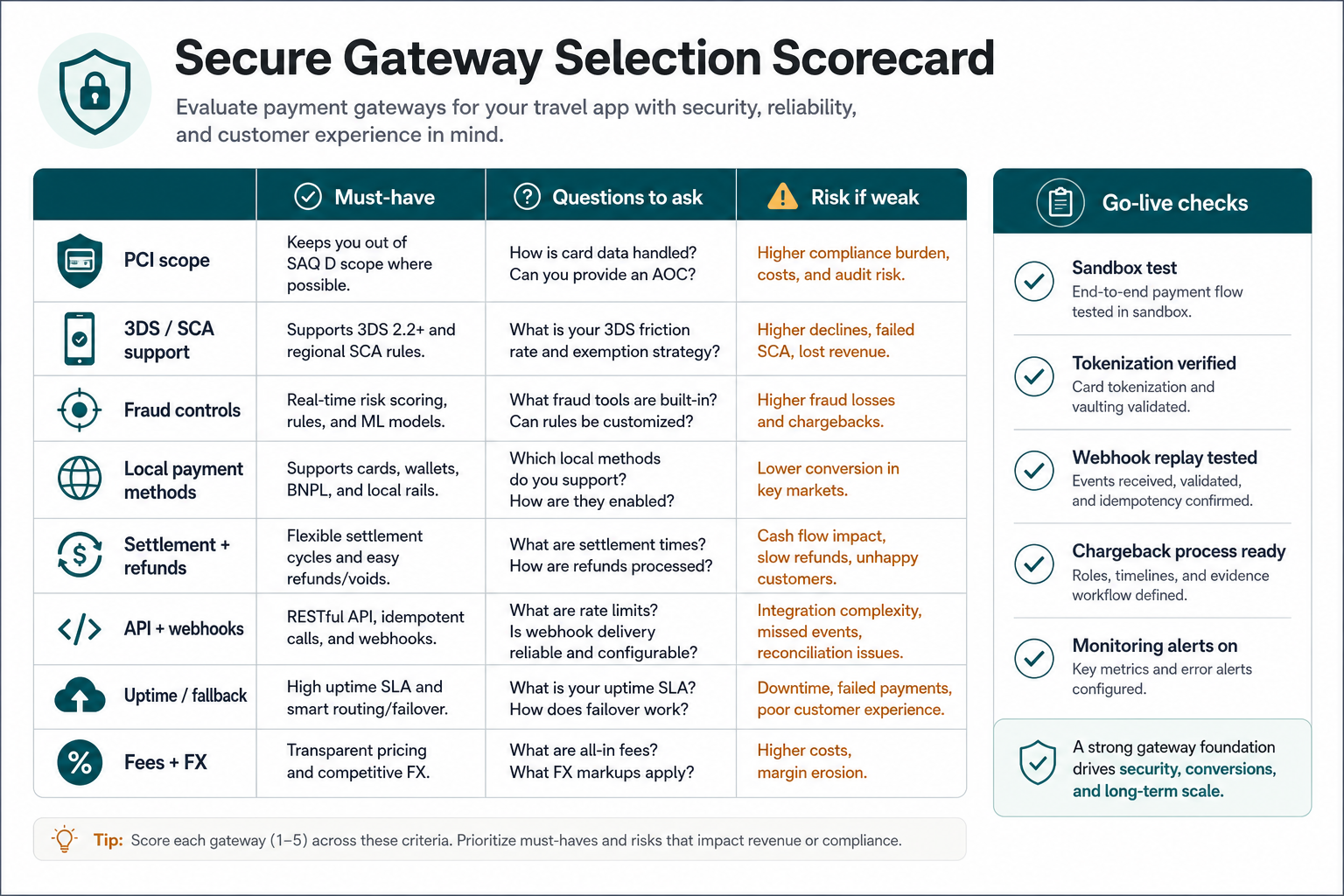
Do not select a gateway only by transaction fee. Travel teams should score each provider by PCI scope, 3DS or SCA support, fraud tooling, local payment coverage, settlement and refund behavior, API quality, webhook reliability, fallback options, currency support, chargeback handling, and support workload. International cards may improve traveler reach but add currency, dispute, and risk review complexity. Wallets can improve mobile conversion but need strong fallback behavior. Pay-later or installment options can increase order value but may change cancellation and refund handling.
Cost planning should include gateway fees, tax on fees, international surcharges, refund costs, chargeback fees, payout fees, reconciliation effort, support workload, and engineering time. The payment and checkout costs section in NextPage's ecommerce cost guide is a useful reference when estimating the hidden work around payment APIs.
Integration Architecture For Booking Payments
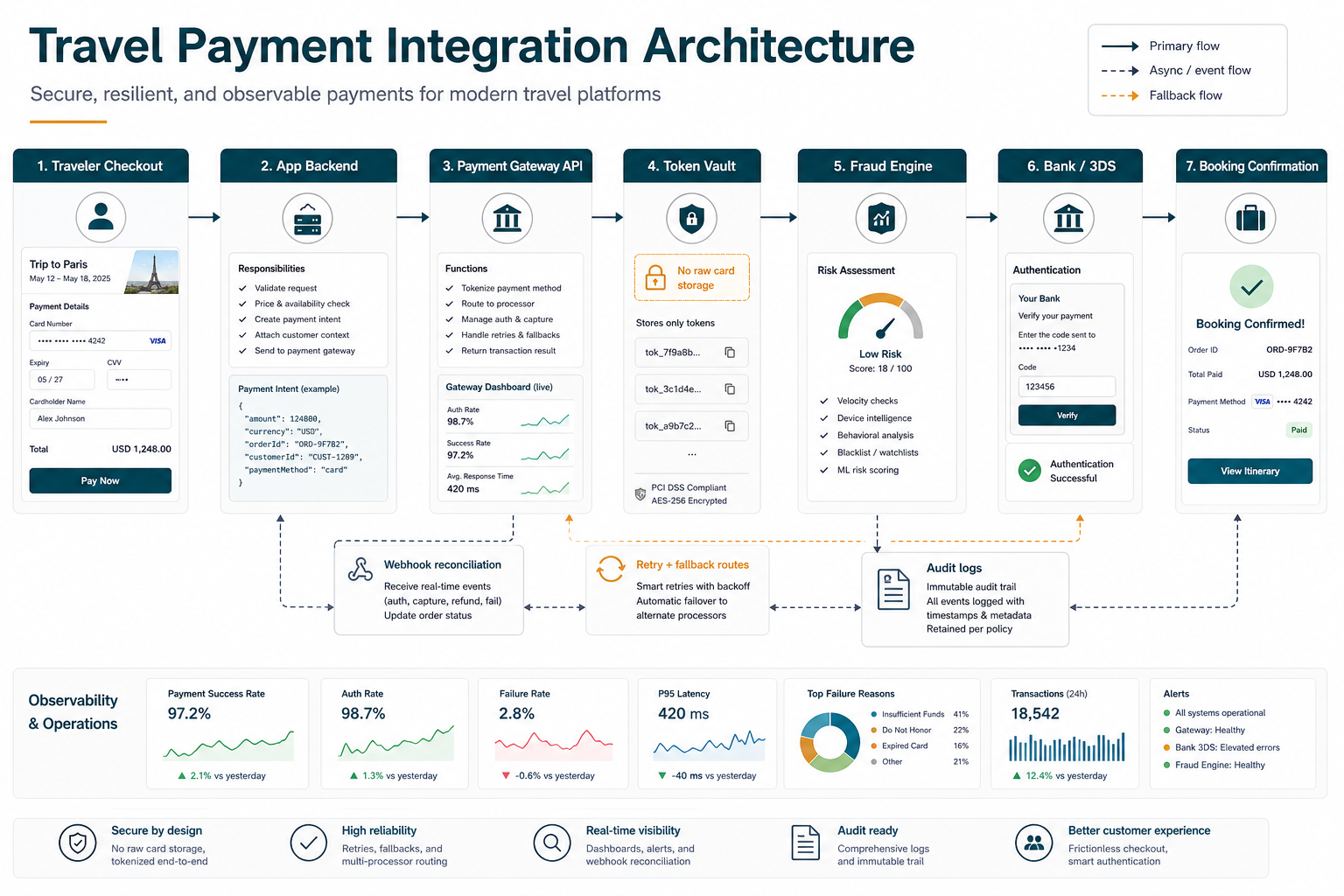
A production architecture should start with the booking backend, not the payment button. The backend creates a booking attempt, reserves or checks inventory, calculates the final amount, creates a payment session, and stores gateway references. The traveler completes hosted checkout or an SDK flow. The backend then verifies the payment through signed webhooks or server-side status checks before confirming the booking and notifying the supplier.
Never rely only on a client-side success callback. Mobile apps can be backgrounded, redirects can fail, and webhooks can arrive late or more than once. Use idempotency keys, signed webhook verification, order state transitions, retry queues, and audit logs. Booking products in healthcare, travel, and local services share this same need for secure payment integration that stays aligned with confirmation, reminders, and refunds.
Security, Compliance, And Fraud Controls
Payment security should reduce exposure of sensitive data. Prefer hosted checkout, tokenized payment methods, gateway SDKs, and server-side verification so the travel app does not unnecessarily handle card data. Confirm PCI-DSS responsibilities, 3DS or strong customer authentication behavior, KYC requirements, restricted business categories, webhook signing, dashboard permissions, and audit trails before launch.
Fraud controls need product decisions, not only gateway settings. Define when the app should step up authentication, block an order, hold a booking for review, request support verification, or allow a trusted traveler through faster. High-value international bookings, last-minute bookings, mismatched traveler details, repeated failed attempts, and unusual route patterns may need different rules.
Refunds, Cancellations, And Supplier Payouts
Travel refunds often depend on timing, supplier rules, and whether part of the itinerary is already confirmed. The app should separate customer-visible cancellation policy from internal payment actions. A refund may be full, partial, delayed, converted into wallet credit, or blocked by a non-refundable supplier policy. Support teams need a clear timeline of original charge, booking confirmation, cancellation request, refund request, gateway response, and final settlement.
If the travel platform pays hotels, guides, drivers, agents, or other suppliers, payout design matters too. Decide whether the platform holds funds, splits settlements, pays after service completion, handles disputes, or reconciles invoices separately. These choices affect compliance, accounting, gateway selection, and admin tooling.
Implementation Plan For Travel App Teams
- Map booking states: define every state from quote and inventory hold through payment, confirmation, cancellation, refund, dispute, and payout.
- Choose payment methods by market: match cards, wallets, bank methods, local rails, and currency support to the traveler base.
- Design backend verification: use signed webhooks, server-side status checks, idempotency, retries, and immutable payment logs.
- Plan support workflows: give support teams searchable payment references, refund status, failure reasons, and booking timeline evidence.
- Model costs and scope: estimate gateway fees, integration time, QA, monitoring, support, and finance operations before launch.
- Test failure paths: simulate abandoned checkout, late webhooks, duplicate callbacks, payment success with supplier failure, partial refund, chargeback, and currency mismatch.
If your team needs early budget framing, use the Custom Software Cost Estimator. If you are deciding between a packaged booking platform and a custom travel payment workflow, the Build vs Buy Decision Tool can help compare cost, control, timeline, and differentiation.
Testing And Monitoring Checklist
Travel payment QA should cover successful payments, failed payments, abandoned sessions, network interruptions, app backgrounding, duplicate webhooks, delayed supplier confirmation, inventory expiry, refund errors, cancellation windows, chargebacks, and support overrides. Test mobile redirects, wallet handoffs, browser fallbacks, currency display, tax and fee calculations, and accessibility of payment error states.
After launch, monitor checkout conversion, payment success rate by method, failed reason codes, refund turnaround, chargeback rate, reconciliation gaps, gateway latency, webhook failure rate, support ticket volume, and supplier payout exceptions. The same operational mindset used for booking and operations reliability applies here: the user experience depends on backend events staying observable and recoverable.
Final Recommendation
Integrate travel payments as a booking operating system, not as a standalone payment button. The payment gateway should support the markets you serve, but the product architecture must also handle inventory, confirmation, fraud review, cancellation rules, refunds, reconciliation, and support evidence.
Start with the few payment methods that match your launch markets, design booking state carefully, verify every gateway event server-side, and make failure paths visible to support and finance teams. Once the core workflow is dependable, add more payment methods, currencies, supplier payout rules, and automation where real booking data proves the need.