
Quick Answer: What Should A Laundry App Include?
A useful laundry app should let customers schedule pickup, choose services, see pricing, track order status, pay securely, receive notifications, and contact support. Behind the customer app, the business also needs pickup staff workflows, laundry partner operations, admin controls, pricing rules, service areas, payment reconciliation, quality checks, and reporting.
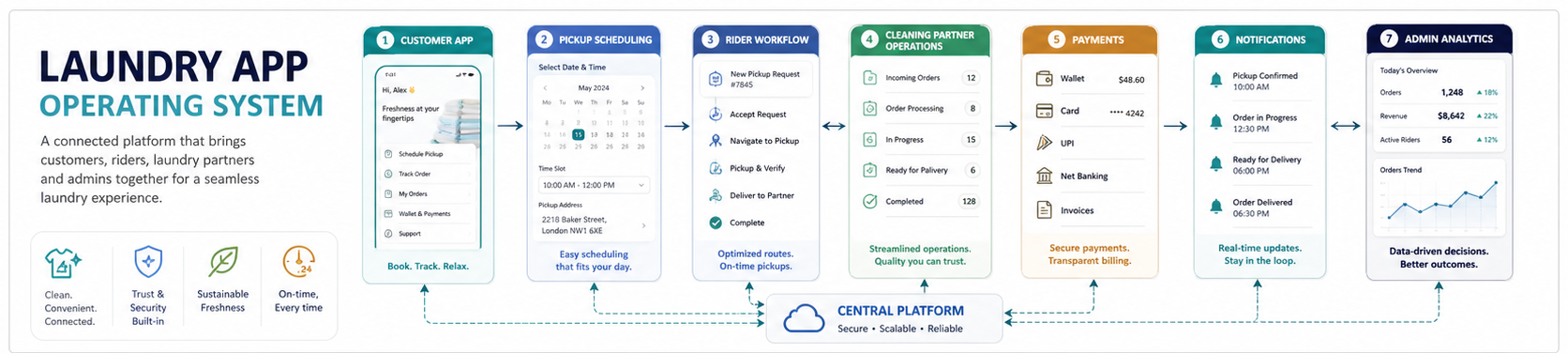
The best first release is not a long feature list. It is the smallest operating system that can move an order from booking to pickup, cleaning, quality review, delivery, payment, and post-service support without manual coordination outside the product. Treat the project as mobile app development plus operations software, not only as a customer-facing ordering screen.
Define The Laundry App Model Before Features
Start by choosing the business model. Some laundry apps are single-brand pickup and delivery products. Others connect customers with multiple laundry partners, run subscription plans, serve hotels or offices, or support neighborhood dry-cleaning stores with digital ordering. Each model changes the user roles, admin needs, pricing logic, and integration depth.
A single-brand app can keep operations simpler because the business controls service quality and fulfillment. A marketplace model needs partner onboarding, commission rules, service availability, ratings, dispute handling, and stronger admin governance. If the product needs partner panels, staff dashboards, payment splits, and custom workflows, it becomes a custom software development project with mobile apps attached.
Laundry App MVP Scope

A practical MVP should prove that customers can place orders and the operations team can fulfill them reliably. Keep advanced automation for later, but do not remove the operational controls needed to run the service in the real world.
| Area | MVP Scope | Why It Matters |
|---|---|---|
| Customer app | Signup, saved addresses, service selection, pickup slot, order estimate, payment, live status, notifications, support, and ratings. | Customers need a simple way to book laundry without calling or guessing order status. |
| Pickup workflow | Assigned pickups, route view, customer contact, item count, pickup confirmation, delivery proof, and exception notes. | Pickup staff need field workflows that reduce missed orders and manual updates. |
| Laundry partner panel | Incoming orders, item verification, cleaning status, quality checks, ready-for-delivery updates, and issue reporting. | Cleaning teams need visibility into work queues and service commitments. |
| Admin console | Users, orders, pricing, service areas, coupons, partners, payments, refunds, support tickets, reports, and roles. | The business needs control over pricing, fulfillment, service quality, and cash flow. |
For a related on-demand service pattern, the NextPage guide on building a Domino's-style delivery app is useful because it shows how ordering, payments, tracking, and operations need to work together.
Laundry App Feature Roadmap
Customer App Features
The customer app should make recurring laundry care feel predictable. Core features include account setup, address management, service categories, garment or bag details, pickup scheduling, price estimates, promo codes, payment methods, order history, order status, delivery slot selection, support, ratings, and subscription options. The related article on laundry app benefits, features, and services gives additional service-level context.
Pickup And Delivery Features
Pickup and delivery workflows need route assignments, task lists, customer contact masking, item count capture, photos when needed, proof of pickup, proof of delivery, failed-attempt reasons, and status updates. If the product uses live tracking, borrow the same discipline used in GPS integration for taxi booking apps: location updates must balance accuracy, battery use, privacy, and reliability.
Laundry Partner Features
Laundry partners or in-house cleaning teams need work queues, item verification, service instructions, stain or damage notes, priority orders, ready-for-delivery status, quality checks, and issue escalation. If the product supports multiple partners, add service capacity, turnaround times, ratings, commission rules, and partner-level reporting.
Admin And Support Features
The admin console should manage service areas, pricing, taxes, coupons, subscriptions, refunds, cancellations, staff roles, partner access, order exceptions, customer support, and reporting. For service businesses that also need appointment-style scheduling, compare the operational patterns in doctor appointment booking app development.
Design The Order Lifecycle
The order lifecycle is the heart of laundry app development. A clean lifecycle avoids confusion between the customer, pickup staff, cleaning team, and admin team.
- Book: customer chooses service, address, pickup slot, item estimate, and payment method.
- Confirm: system validates service area, slot capacity, pricing assumptions, and pickup assignment.
- Pick up: staff confirm items, capture exceptions, and update order status.
- Process: laundry team verifies items, performs cleaning, records issues, and marks the order ready.
- Deliver: staff schedule delivery, confirm handoff, and collect proof of delivery.
- Review: customer rates the service, support handles disputes, and admin reviews metrics.
This lifecycle should be visible in the product, not hidden in spreadsheets or messages. It is also where automated notifications can reduce support tickets.
Laundry App Architecture

The architecture usually includes customer mobile apps, pickup staff apps, web admin tools, and partner dashboards connected to an API layer. Behind that, split the system into domains: authentication, customer profiles, address and service zones, booking, pricing, order status, pickup assignment, partner workflow, payments, notifications, support, reporting, and audit logs.
External integrations may include maps, payment gateways, SMS, email, WhatsApp, CRM, accounting, analytics, and storage for order photos or receipts. If the product becomes a broader service marketplace, use stronger role-based access and tenant-aware data boundaries from the start.
Laundry App Development Cost Drivers
The cost of laundry app development depends on workflow depth, not only the number of screens. A simple booking app is smaller than a multi-role platform with live tracking, partner management, subscriptions, refunds, analytics, and custom admin operations.
| Cost Driver | Lower Complexity | Higher Complexity |
|---|---|---|
| Business model | Single laundry business with fixed services and one city. | Marketplace, multiple partners, multiple cities, commissions, and partner dashboards. |
| Scheduling | Basic pickup slots and manual assignment. | Capacity rules, route planning, recurring orders, and automated dispatch. |
| Pricing | Fixed service prices and simple coupons. | Weight-based pricing, item-level pricing, taxes, subscriptions, wallets, and refunds. |
| Tracking | Status updates such as picked up, in process, and delivered. | Live pickup tracking, route visibility, proof capture, and exception workflows. |
| Integrations | Payments, SMS, email, and analytics. | CRM, accounting, WhatsApp, maps, partner systems, and data warehouse integrations. |
If you need an early range before detailed discovery, the Custom Software Cost Estimator can help separate MVP scope from later automation.
Step-By-Step Development Process
- Discovery: map customer segments, service categories, pricing rules, pickup zones, fulfillment capacity, partner model, support process, and success metrics.
- Product design: prototype customer booking, pickup staff flows, partner work queues, admin order management, and support workflows.
- Architecture planning: define APIs, data model, order statuses, payment flows, notification events, role permissions, and integration boundaries.
- MVP build: implement the mobile apps, admin console, backend services, payment flow, notifications, QA, and deployment pipeline.
- Operational testing: test missed pickups, late deliveries, item disputes, payment failures, refund requests, capacity limits, support escalations, and partner delays.
- Launch and improve: track repeat orders, pickup success, turnaround time, support volume, customer retention, and partner performance before adding automation.
Operations And Quality Controls
Laundry apps win or lose trust through service reliability. Add quality controls around item count, garment notes, stain or damage reporting, service instructions, photos when appropriate, ready-for-delivery checks, and support escalation. Customers care less about the technology than whether clothes return on time and in the expected condition.
Food delivery products face a similar trust problem around timing, payment, and order status. The post on food delivery app development benefits is useful when thinking about convenience, repeat ordering, and operational transparency.
Security, Privacy, And Payments
Laundry apps handle addresses, phone numbers, payment details, order history, staff assignments, and sometimes photos of garments or receipts. Use secure authentication, encrypted transport, payment-token handling, role-based admin permissions, audit logs, and clear privacy rules for customer data and staff location data.
Payment design should support upfront payment, cash collection where needed, refunds, wallet credits, subscription billing, promo codes, and reconciliation. Admin users should not need database access to resolve common payment or order issues.
Launch Metrics To Track
Useful laundry app metrics include booking conversion, pickup completion rate, missed pickup rate, average turnaround time, delivery success rate, repeat order rate, subscription conversion, payment success, refund rate, support tickets per order, partner SLA performance, and revenue per active customer.
After the app is stable, compare operational metrics with marketing metrics. High installs do not matter if pickup completion, turnaround time, and repeat orders are weak.
Common Mistakes To Avoid
- Building only the customer app: laundry operations also need pickup, partner, support, and admin workflows.
- Underestimating order status: unclear status updates create avoidable support tickets.
- Ignoring service-area capacity: pickup slots should reflect real staff and partner capacity.
- Making pricing too vague: unclear item, weight, tax, and subscription rules reduce trust.
- Skipping exception handling: stains, missing items, late pickup, failed delivery, and refunds need designed workflows.
How NextPage Can Help
NextPage can help plan and build a laundry app as a complete service operating system: customer apps, pickup workflows, partner dashboards, admin tools, backend APIs, payment flows, notifications, analytics, and launch support. The strongest first step is a product discovery sprint that turns the laundry business model into user roles, order lifecycle, MVP scope, architecture, and a realistic build plan.
If you are planning a laundry, dry-cleaning, pickup-and-delivery, or local services platform, start with the operational workflow. Once the workflow is clear, the feature roadmap, cost range, and engineering sequence become much easier to defend.