
Quick Answer: How Do You Keep Control In IT Outsourcing?
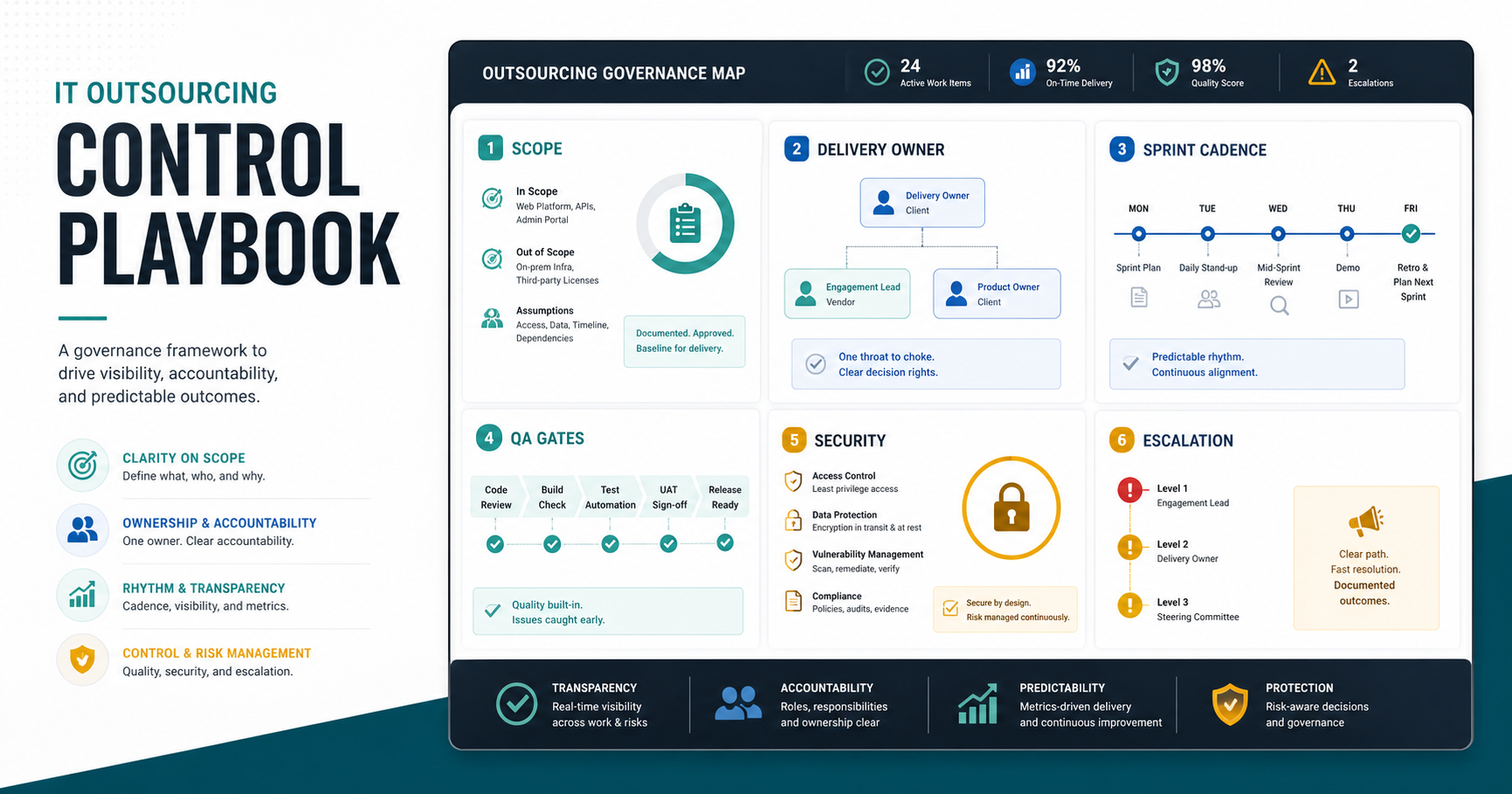
You keep control in IT outsourcing by making ownership explicit before work starts. The buyer should own business priorities, budget, acceptance decisions, and product context. The outsourcing partner should own delivery discipline: sprint planning, technical execution, quality gates, reporting, security hygiene, and escalation when risks appear.
Loss of control usually does not happen because the team is remote. It happens because scope, decision rights, code quality, communication cadence, and contract responsibilities are vague. A strong outsourcing setup gives every important workflow an owner, a checkpoint, evidence, and an escalation path.
Why Outsourcing Feels Out Of Control
Outsourcing feels risky when the vendor behaves like a separate black box. Work disappears into a remote team, status arrives late, quality problems surface near release, and decisions are made without enough business context. The result is not only missed deadlines. It is a loss of trust in the delivery model.
The root cause is usually weak governance. If nobody owns backlog health, acceptance criteria, code review, QA evidence, deployment readiness, or budget visibility, the buyer has to discover problems after they have already become expensive. This is why outsourced custom software development needs a management system, not just more developer capacity.
The Control Model For Outsourced Software Teams
A practical control model separates strategy ownership from delivery ownership. The client keeps control of the business problem and the partner takes responsibility for the engineering system. That split keeps the team fast without leaving critical decisions undefined.
| Control Area | Client Owns | Partner Owns | Evidence To Review |
|---|---|---|---|
| Scope | Business priority, budget, and acceptance decisions. | Backlog grooming, estimates, delivery plan, and dependency warnings. | Prioritized backlog, sprint goals, and change log. |
| Architecture | Business constraints and long-term product direction. | Technical design, code quality, performance, and maintainability. | Architecture notes, PR reviews, and technical debt register. |
| Quality | Definition of acceptable user outcomes. | Test plan, QA execution, bug triage, and release readiness. | QA reports, demo recordings, test coverage, and defect trends. |
| Security | Data sensitivity, access approvals, and compliance expectations. | Least-privilege access, secure development practices, and offboarding. | Access list, secret handling, audit notes, and security checklist. |
| Communication | Decision speed and stakeholder availability. | Status rhythm, blockers, risks, and escalation prompts. | Weekly report, decision log, blocker list, and demo notes. |
If you are comparing delivery models, NextPage's guide to software development outsourcing to India gives a broader view of staff augmentation, dedicated teams, managed outsourcing, and product pods. The right model is the one that matches how much delivery ownership you need from the partner.
Set A Control Cadence Before Development Starts
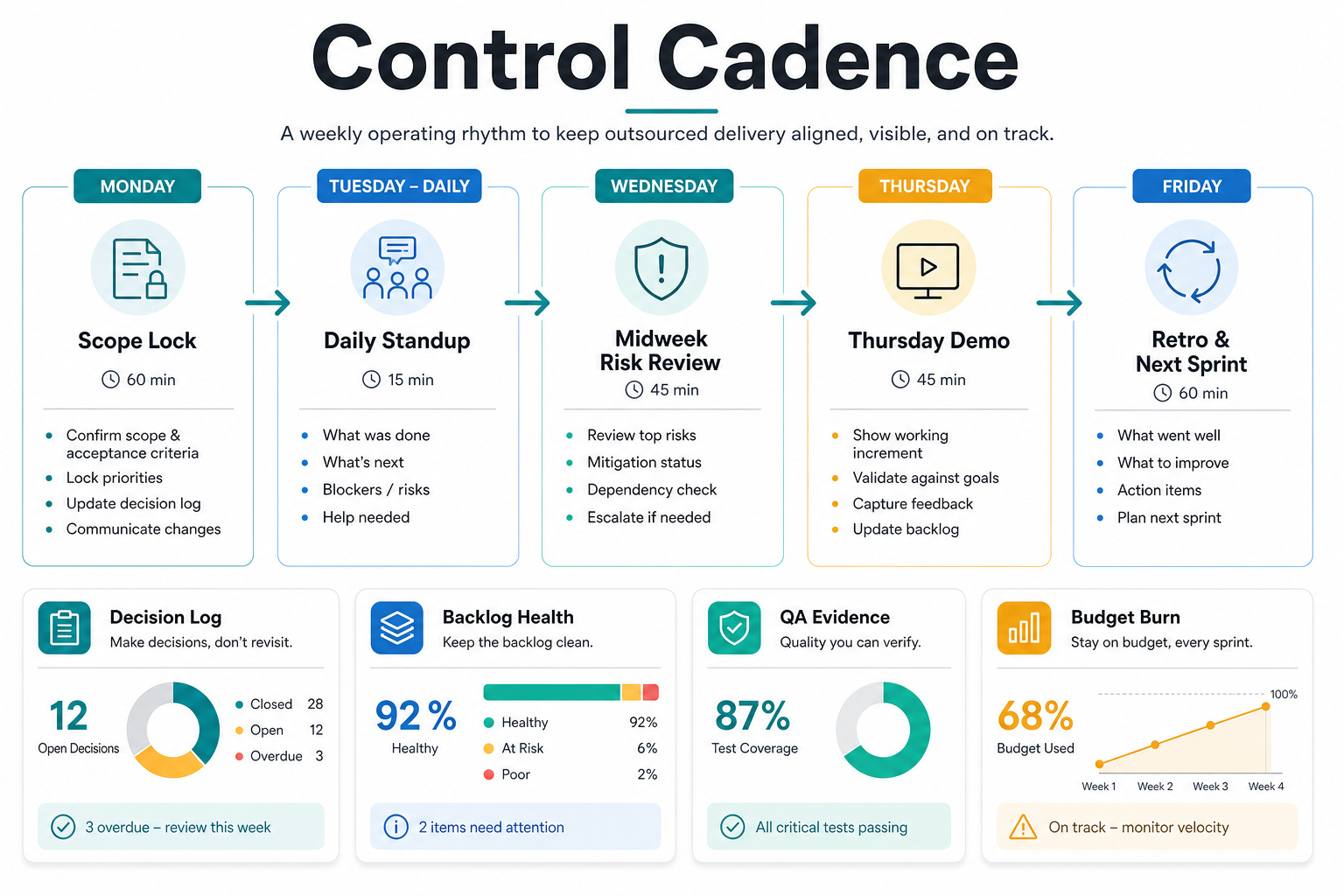
The best outsourcing relationships have a predictable rhythm. A weekly cadence might include Monday scope lock, short daily async updates, a midweek risk review, a Thursday demo, and a Friday retrospective with next-sprint commitments. The exact days matter less than the discipline of reviewing the same evidence every week.
Use a decision log for scope changes, a risk log for unresolved blockers, a QA evidence folder for tested work, and a budget tracker for burn. This gives stakeholders a factual view of progress instead of relying on optimistic status messages. If the outsourced team is building a consumer or business app, align the cadence with your mobile app development partner or web product release process so demos and QA reviews happen before release pressure builds.
Choose The Right Outsourcing Contract Controls
The contract should describe more than payment terms. It should define deliverables, acceptance criteria, change control, IP ownership, confidentiality, subcontracting limits, security expectations, replacement terms, communication cadence, support windows, and exit obligations.
| Contract Clause | Why It Matters | What To Avoid |
|---|---|---|
| Acceptance criteria | Prevents arguments about whether work is done. | Vague language such as "as discussed" or "standard quality". |
| Change control | Keeps scope, timing, and cost decisions visible. | Informal changes that never reach the backlog or budget. |
| IP ownership | Confirms who owns source code, designs, documentation, and inventions. | Ambiguous third-party asset and subcontractor language. |
| Security and access | Protects repos, environments, data, secrets, and production systems. | Shared credentials, broad admin access, and no offboarding checklist. |
| Escalation | Creates a path when quality, communication, or delivery slips. | Waiting until the milestone date to discover a serious issue. |
For long-running teams, include replacement and continuity terms. A good partner should be able to explain what happens if a developer leaves, underperforms, or needs specialist support. If the cost model is still unclear, compare the contract scope with the Custom Software Cost Estimator so budget expectations are tied to complexity, integrations, roles, and risk.
Risk Ownership Matrix For IT Outsourcing
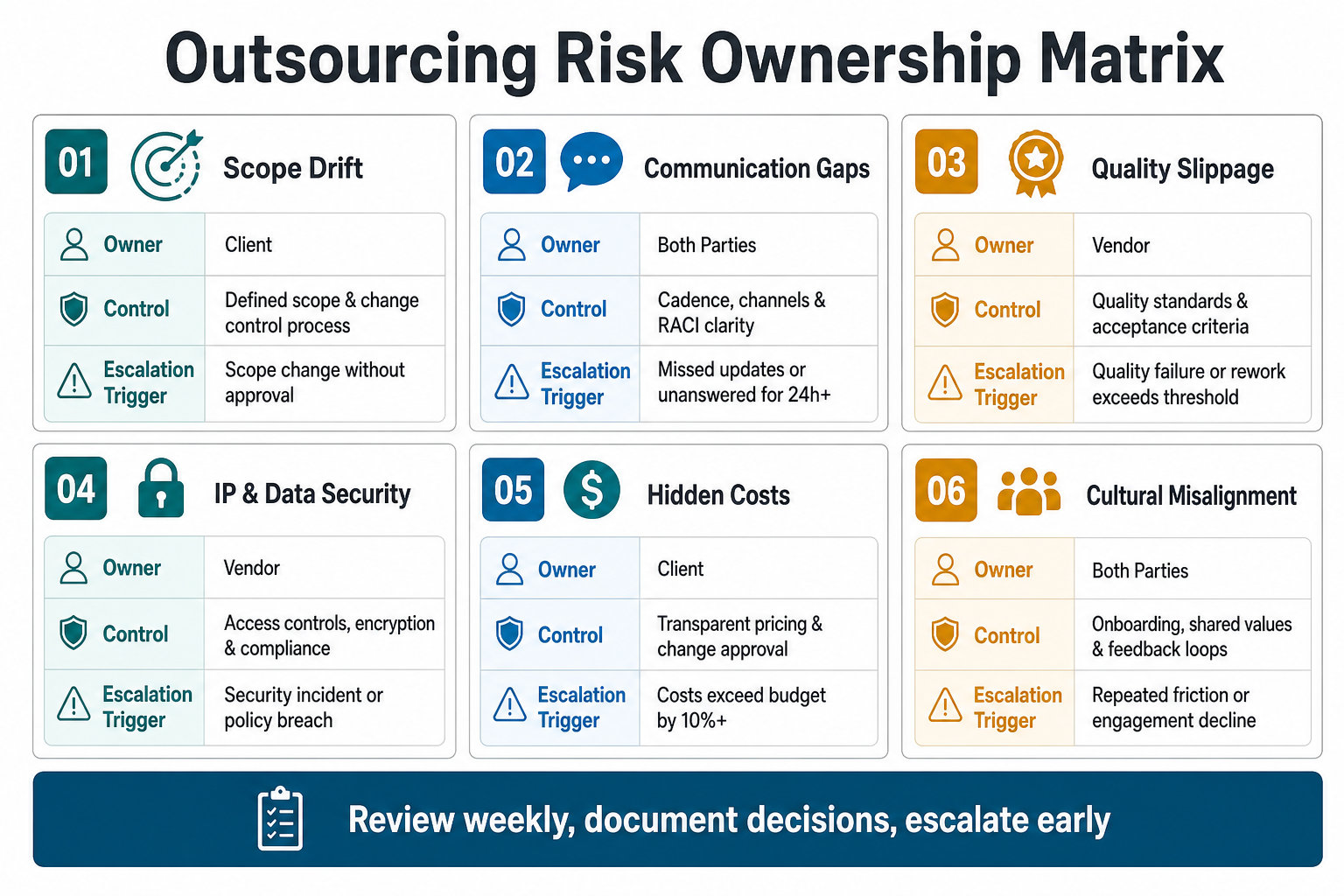
Most outsourcing risks can be managed if they are assigned early. Scope drift belongs in the backlog and change log. Communication gaps belong in the cadence and decision log. Quality risk belongs in QA evidence, code review, and release criteria. IP and security risk belongs in access control, repo ownership, contracts, and offboarding.
Hidden cost risk is usually the hardest to see. A low hourly rate can still become expensive if the client must supply every missing layer of PM, QA, architecture, and DevOps. The Dedicated India Team Cost Calculator is useful when you need to compare raw developer capacity with a more complete managed team shape.
Protect IP, Code, And Sensitive Data
Protecting intellectual property starts before repository access is granted. Use NDAs, work-for-hire or assignment clauses where appropriate, clear subcontractor rules, private repositories, branch protections, least-privilege access, separate production permissions, and offboarding checklists. Do not share broad cloud, database, analytics, or payment access just because a vendor asks for convenience.
Use role-based access and remove access quickly when roles change. Keep secrets in a managed secret store, not in chat messages or local files. Record who can deploy, who can approve pull requests, who can view production data, and who can rotate credentials. These controls reduce risk without slowing down the team when they are built into the onboarding process.
Control Communication With Remote Development Teams
Remote outsourcing works best when communication is intentionally layered. Use async status updates for routine progress, live calls for decisions and ambiguity, recorded demos for evidence, and written decision logs for anything that affects scope, budget, architecture, or release timing.
Timezone overlap matters, but it is not the whole answer. A team with two good overlap hours and strong async discipline can outperform a team with more overlap but no clear decisions. The goal is not to talk all day. The goal is to make blockers visible, decisions fast, and delivery evidence easy to inspect.
How To Select A Partner Without Losing Control
Ask every potential partner to explain how they will help you keep control. The answer should cover team composition, delivery owner, sprint cadence, QA process, code review, reporting, security, escalation, and replacement terms. If the vendor only talks about rates and resumes, you may be buying staffing rather than an accountable delivery system.
For ongoing capacity, compare the partner's process with the assumptions in the guide to dedicated development team cost in India. For proof that complex software delivery needs role-aware workflows, media handling, mobile surfaces, and AI support to stay organized, review the FieldIQ portfolio case study.
Warning Signs That Control Is Slipping
- Status is optimistic but evidence is thin: demos, QA notes, and merged code do not match the reported progress.
- Scope changes happen in chat: decisions are not reflected in the backlog, estimate, or budget.
- Quality appears late: bugs surface during release week because QA was treated as a final step.
- No single delivery owner exists: every issue gets passed between developers, PMs, and account managers.
- Access is too broad: too many people can view data, deploy code, or access secrets.
- Budget burn is unclear: the team cannot connect time spent to delivered outcomes.
When these signals appear, reduce scope, tighten the cadence, clarify owners, and insist on delivery evidence. If the partner cannot operate transparently at a smaller scope, scaling the team will usually make control worse.
Final Recommendation
IT outsourcing succeeds when control is designed into the relationship. Choose the right engagement model, assign ownership, run a visible weekly cadence, protect IP and access, review QA evidence, and escalate early. A remote team can move quickly, but only when the operating model gives both sides clarity.
The practical next step is to document your first 90 days: scope, team roles, decision makers, communication rhythm, QA gates, security controls, budget checkpoints, and escalation triggers. Once those are visible, outsourcing becomes a managed delivery model instead of a leap of faith.