
A modern custom software tech stack is not a list of fashionable frameworks. It is the set of frontend, backend, data, cloud, AI, security, integration, testing, and observability choices that make a specific business workflow reliable. The right stack for a customer portal, internal operations platform, AI-enabled SaaS product, or regulated data system depends on user roles, data sensitivity, integration depth, release risk, team skills, and the pace at which the product must change.
For most 2026 custom software projects, a practical default starts with a typed web stack, a proven relational database, clear API boundaries, managed cloud services, automated testing, observability from day one, and an explicit AI/security governance layer. That does not mean every product should use the same tools. It means every stack decision should be traceable to a workflow requirement, operating constraint, or business risk.
If you are planning a build, use the stack conversation to answer three questions first: what must the software do for the business, what can go wrong if it fails, and who will maintain it after launch? The answers matter more than whether the frontend is fashionable or the backend language is trending.
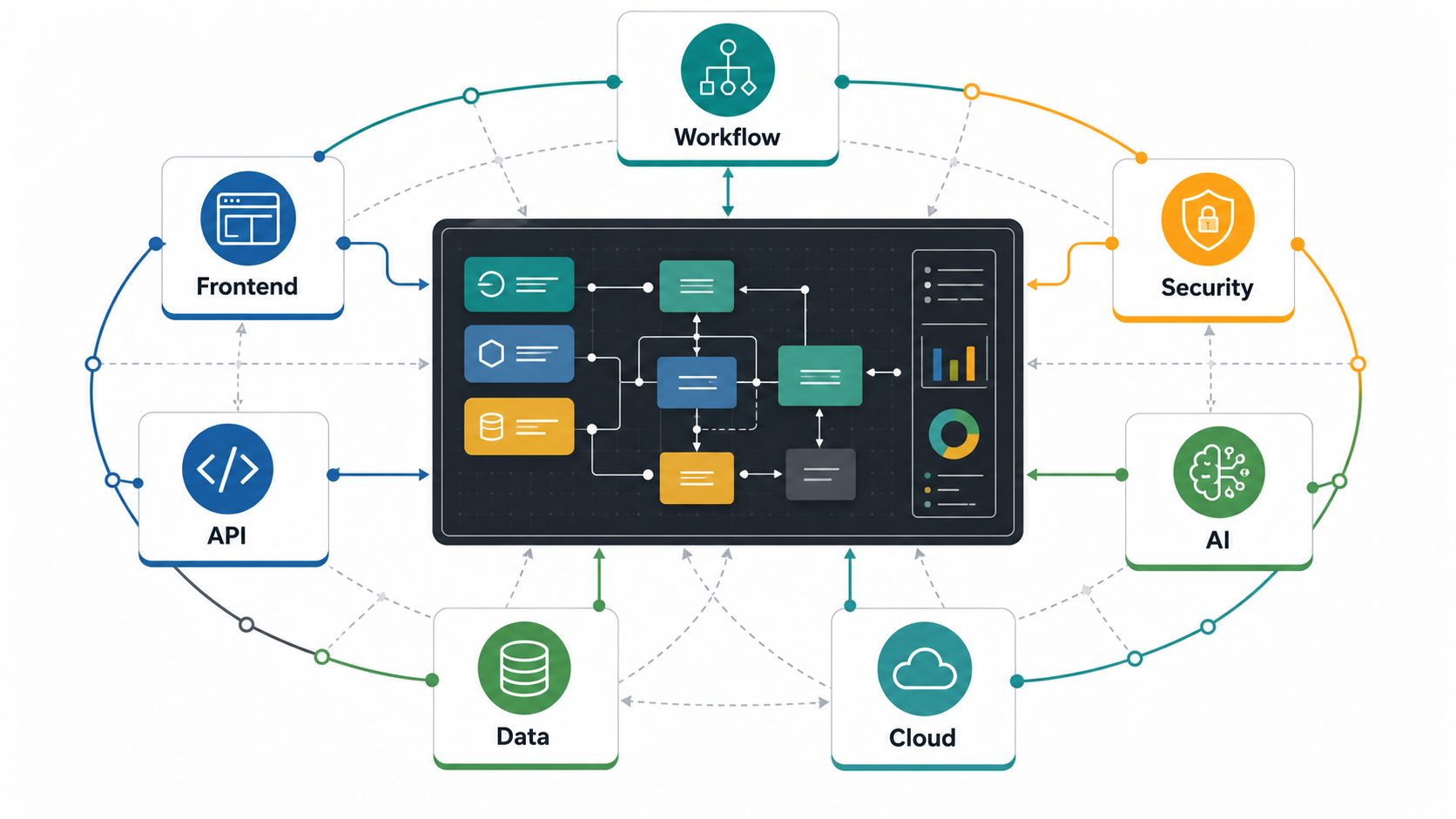
What A Modern Custom Software Stack Includes
A complete stack covers more than the code used to render screens. It includes the product architecture, runtime environment, data model, integration style, release process, security controls, and monitoring model. Buyers often ask, "Should we use React, Next.js, .NET, Python, Node.js, PostgreSQL, or AWS?" A better starting question is, "Which stack lets this workflow stay maintainable as roles, data, approvals, integrations, and AI features grow?"
| Stack Layer | Decision To Make | Buyer Risk If Ignored |
|---|---|---|
| Product workflow | Map roles, states, approvals, exceptions, and reporting needs before tool selection. | The team ships screens that do not match operations. |
| Frontend | Choose web, mobile, or cross-platform UI based on user context, SEO, offline needs, and speed. | UX rewrites, accessibility gaps, or slow feature delivery. |
| Backend and API | Decide whether a modular monolith, API-first service, or distributed model fits ownership and scale. | Microservices too early, or a single codebase that becomes hard to split. |
| Data | Pick the system of record, analytics path, search approach, and retention rules. | Reporting gaps, data duplication, and painful migrations. |
| Cloud and runtime | Balance managed services, portability, cost, compliance, and operational skills. | Vendor lock-in, cost surprises, or fragile deployments. |
| AI layer | Define where LLMs, RAG, agents, automation, and human review belong. | AI pilots that cannot be governed or measured. |
| Security and observability | Design identity, permissions, audit logs, testing, traces, metrics, and rollback gates. | Production incidents that are hard to diagnose or prove. |
This is why custom software development should begin with architecture decisions, not a copied tool list. The same React/Postgres/cloud stack can be sensible for one business and risky for another if the workflow, data, or compliance context is different.
Technology Stack Decision Scorecard
Use the stack decision as a risk-scoring exercise before choosing tools. A technology that is low risk for one workflow can become high impact for another if it changes integration depth, team ramp-up, data sensitivity, cloud operations, AI readiness, or release confidence. The goal is to compare options against the business system you are actually building, not against a generic trend list.
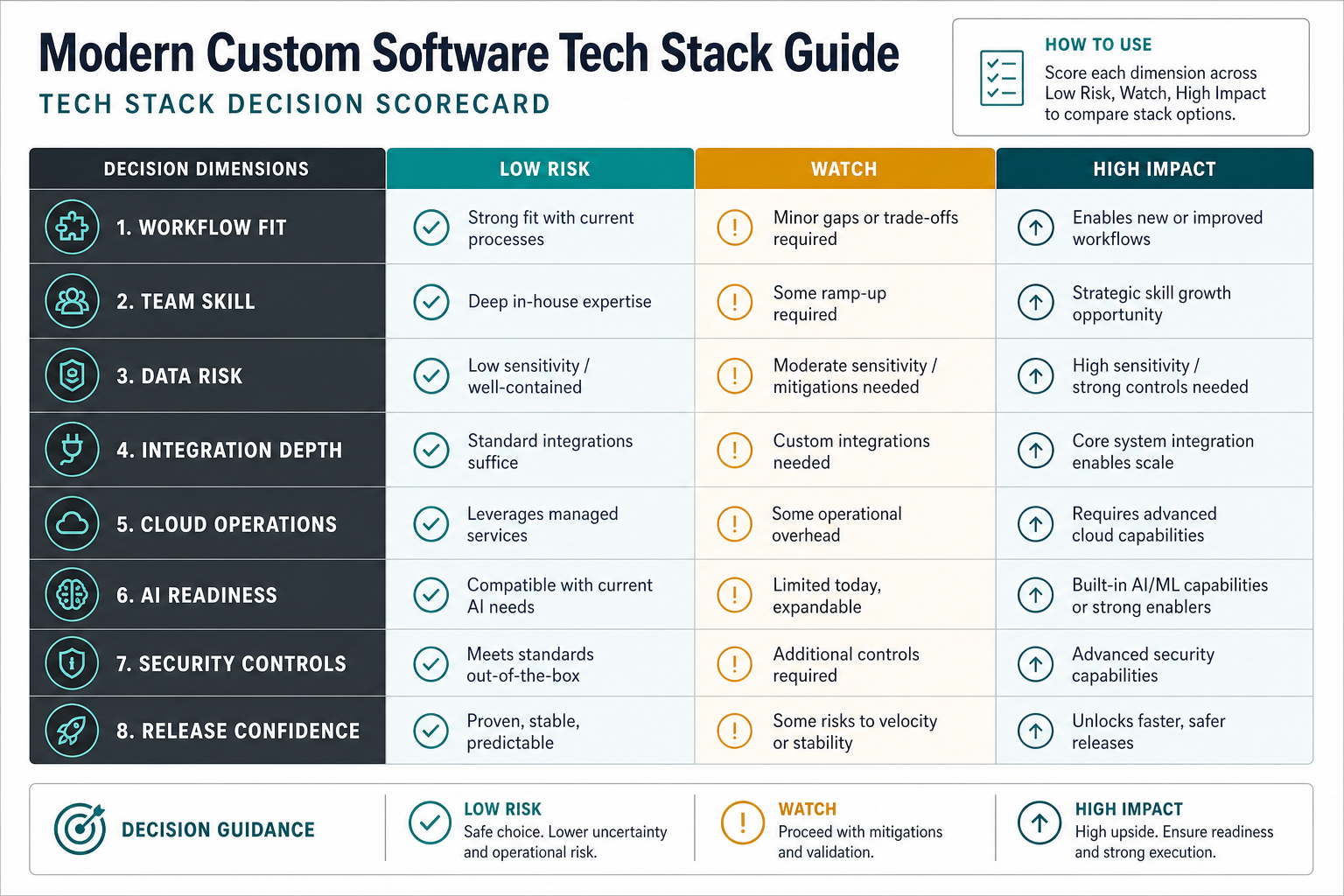
A useful scorecard should expose tradeoffs early. If a proposed stack scores high on AI readiness but weak on team skill and operations, plan extra discovery, proof-of-concept work, or support coverage. If it scores low risk everywhere, confirm that the stack still leaves enough room for future integrations, analytics, and scale.
The Practical Default Stack For 2026
For many business web applications, a conservative 2026 default is a typed web application, PostgreSQL as the system of record, a modular backend, managed cloud hosting, CI/CD, automated tests, observability, secure secret management, and a clear path for AI or analytics. Competitor pages increasingly converge on a similar pattern: modern frontend frameworks, Postgres, B2B-ready auth, structured observability, preview environments, and rollback planning.
That default exists because it optimizes for hiring, maintainability, predictable operations, and a large ecosystem. Gartner's 2026 strategic trends also make clear that AI-native development, AI security, confidential computing, provenance, preemptive cybersecurity, and geopatriation are now part of the stack conversation, not side topics. CNCF and SlashData reported 15.6 million developers using cloud-native technologies, with hybrid and multi-cloud strategies rising among developers. The signal is clear: modern stacks must handle software delivery, infrastructure reality, and AI governance together.
| Product Situation | Good Default | When To Reconsider |
|---|---|---|
| MVP or founder-led product | Full-stack framework, managed database, managed auth, simple deployment, and narrow integrations. | When compliance, complex workflows, or custom permissions are core from day one. |
| B2B SaaS or portal | React or Next.js-style frontend, typed backend, PostgreSQL, RBAC, tenant model, audit logs, and observability. | When multiple clients, mobile apps, or high-throughput APIs need independent release paths. |
| Internal operations platform | Workflow-first backend, strong permissions, reporting schema, integrations, queue jobs, and admin tooling. | When the system must support offline field work or heavy real-time collaboration. |
| AI-enabled product | Core app stack plus retrieval, evaluation, prompt/version control, human review, and AI usage logging. | When sensitive data, regulated decisions, or agentic actions require stronger governance. |
| Regulated or enterprise build | Typed backend, auditability, deployment controls, data residency planning, enterprise identity, and vendor review. | When the organization already has approved platforms or mandated cloud providers. |
The point is not to force every project into a single architecture. The point is to start from a proven baseline and deviate only when the product, team, risk, or operating model justifies the extra complexity.
Frontend Choices: Web, Mobile, And Admin Interfaces
Frontend decisions should follow user behavior. A public content-heavy site needs SEO, fast page loads, accessibility, and clear analytics. A B2B portal needs form reliability, role-aware navigation, tables, dashboards, and predictable component behavior. A field workflow may need mobile-first interaction, camera access, offline mode, push notifications, or native performance.
React and Next.js remain strong default choices for many web applications because they combine ecosystem depth, hiring availability, rendering options, and full-stack primitives. But the best frontend stack is the one that lets the team ship accessible workflows consistently. A simpler admin panel in a mature backend framework can beat a complex frontend if the product is mostly operational forms and reports. A native or cross-platform mobile app can beat responsive web if users work in warehouses, vehicles, clinics, or low-connectivity environments.
For buyer planning, separate the visible interface from the workflow engine. In web app development, the maintainability problem usually appears when screens own too much business logic. Keep business rules, permissions, validation, and workflow state in a backend or shared domain layer so the product can later support multiple interfaces without rewriting core behavior.
Backend And API Architecture
The backend is where most custom software risk lives. It defines roles, workflows, state transitions, integrations, background jobs, notifications, reporting, and data consistency. A modular monolith is often the right first architecture for a custom platform because it gives one deployable system with clear internal boundaries. Teams should split services only when there is a real ownership, scaling, security, or deployment reason.
Common backend choices such as Node.js, .NET, Java/Spring, Python, Ruby, Go, and PHP/Laravel can all work. The better question is whether the team can hire for the stack, operate it in production, integrate with required systems, and keep the codebase understandable. For many business platforms, boring typed code, clear module boundaries, documented API contracts, and well-tested background jobs matter more than raw benchmark performance.
Use API-first design when the product will support web, mobile, partners, automation, or future AI agents. Use internal service boundaries even inside one codebase. Document major decisions as architecture decision records so future maintainers know why the team chose managed auth, a queue system, a data warehouse, a search engine, or a cloud provider.
Data Stack Decisions: System Of Record, Analytics, Search, And AI Context
PostgreSQL is a strong default system of record for many custom products because it supports transactional integrity, relational modeling, JSON fields when appropriate, extensions, reporting paths, and a mature ecosystem. MySQL, SQL Server, document databases, time-series databases, graph stores, vector databases, and warehouses can also fit when the product has the right data shape.
The mistake is treating "database" as one decision. A modern product often needs several data paths: a transactional store for operations, a cache for speed, a queue for async work, object storage for files, a warehouse for analytics, a search index for discovery, and vector retrieval for AI-assisted knowledge flows. Each should have an owner, retention policy, backup model, and migration path.
If AI is part of the roadmap, design the data layer for traceability. RAG and agent workflows need source ownership, document freshness, permissions, retrieval evidence, evaluation examples, and audit logs. The model choice matters, but the data contract usually determines whether the AI feature can be trusted.
Cloud, Runtime, And Deployment Model
Cloud decisions should follow operational maturity. Managed services and DevOps planning are useful when they reduce undifferentiated infrastructure work. Serverless can be excellent for spiky workloads and fast teams, but background processing, long-running jobs, predictable latency, or compliance requirements may push the architecture toward containers, managed Kubernetes, virtual machines, or a hybrid model.
CNCF's 2025 cloud-native reporting shows the market moving beyond one pattern: backend developers use cloud-native technologies heavily, while hybrid, multi-cloud, and distributed cloud models continue to grow. For a buyer, this means portability and governance should be explicit decisions. You do not need Kubernetes on day one for every app, but you do need a deployment model that supports logs, metrics, secrets, rollbacks, backups, migration discipline, and cost visibility.
When growth is likely, evaluate scalable software development as a roadmap question, not an infrastructure shopping list. Build for the next credible order of magnitude, then design clean boundaries so the system can evolve when actual demand appears.
AI-Ready Secure Stack Architecture
An AI-ready stack needs more than model access. It needs reliable source systems, clear APIs, retrieval or context pipelines, permission-aware workflows, evaluation data, usage logs, and release gates. Teams planning AI development services should treat these controls as core architecture so AI features can move from assistant-style suggestions to governed workflow automation when the business is ready.
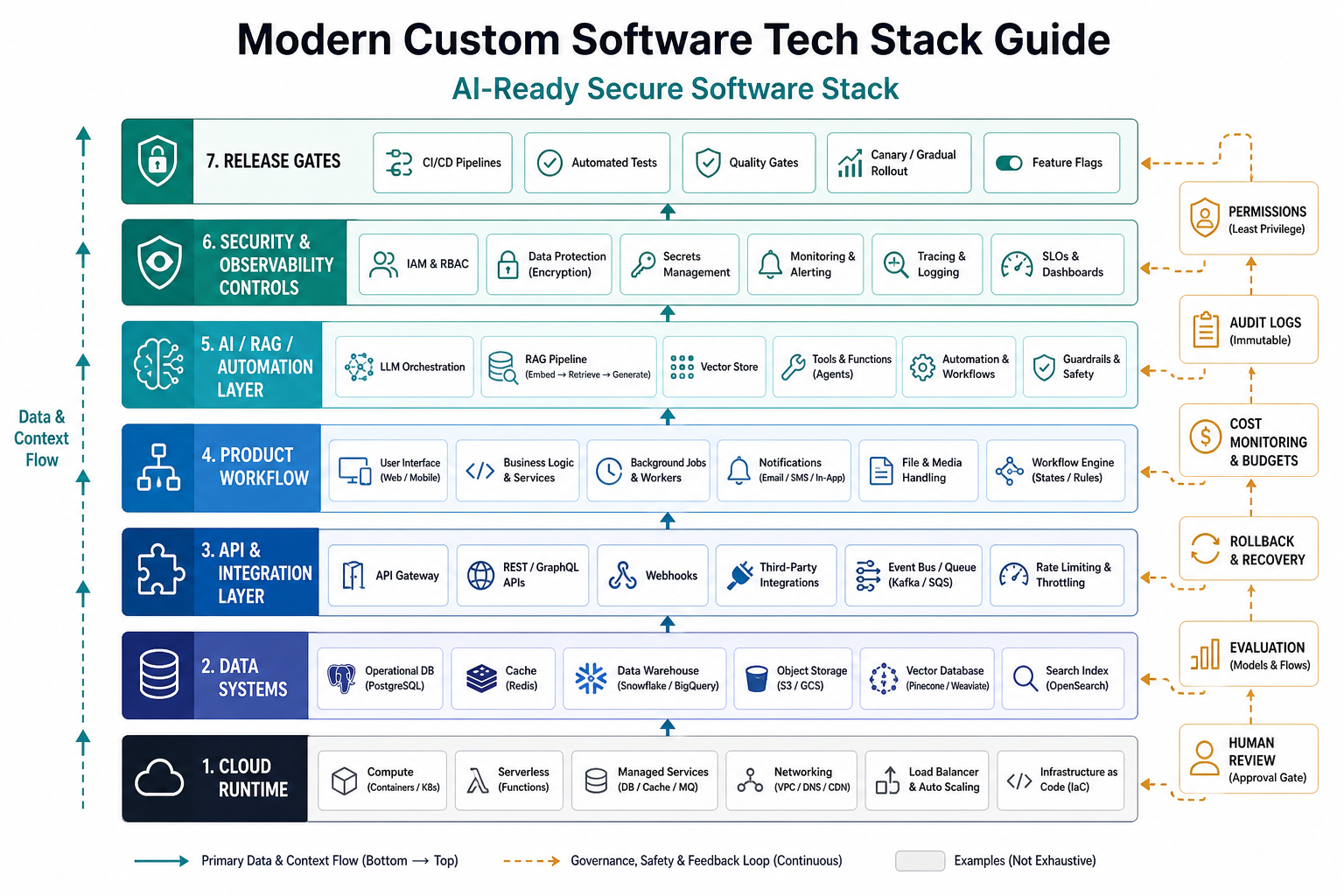
For private knowledge, support automation, or internal copilots, connect the data layer to a controlled enterprise RAG implementation plan rather than indexing content as an afterthought. For systems that take action, use the AI Agent Readiness Assessment to check workflow clarity, data readiness, integration access, human review, and governance before giving an agent production authority.
AI Layer And Automation Readiness
AI is now part of stack planning even when it is not in version one. A custom platform may later need AI search, summarization, support agents, workflow recommendations, document extraction, forecasting, anomaly detection, or coding/operations assistants. Adding those safely requires data readiness, permission boundaries, evaluation, usage logs, and human review paths.
Do not bolt AI onto an unclear workflow. First decide which business decision or task the AI improves. Then decide where the AI sits: inside a form, behind a search box, in a support workflow, in a background enrichment job, or as an agent with tool access. The risk rises as AI moves from suggesting to acting. Agentic features need scoped credentials, approvals, rollback, observability, and incident response.
Gartner's 2026 trend list includes AI-native development platforms, multiagent systems, domain-specific language models, and AI security platforms. For custom software buyers, the lesson is not "add every AI trend." It is to keep the product architecture ready for controlled AI adoption without allowing ungoverned tools to touch sensitive workflows.
Security, Observability, And Release Gates
Security and observability are stack layers, not final-stage checkboxes. Authentication must include users, organizations, roles, permissions, lifecycle management, SSO readiness, and audit logs. Authorization should be tested as carefully as UI behavior. Secrets, environment variables, backups, logs, file storage, and security testing readiness need explicit handling before production.
Observability should cover frontend errors, Core Web Vitals, API latency, queue failures, database performance, integration retries, business events, and user-impacting incidents. Without traces, structured logs, and dashboards, the team can ship a modern-looking product that becomes impossible to support.
Release gates are where stack quality becomes visible. Use automated tests for critical paths, controlled migrations, preview environments, rollback plans, and post-release checks. For high-risk workflows, connect the build plan with software QA testing services so performance, security readiness, and regression evidence are designed into delivery.
How To Choose The Right Stack
Use a weighted decision model instead of a tool popularity contest. Score each option against the product's workflow complexity, team skills, hiring market, timeline, budget, integration needs, compliance risk, performance profile, portability, and maintenance plan. A stack that is technically elegant but hard to staff can be worse than a familiar stack with clear conventions.
| Decision Question | What To Look For | Red Flag |
|---|---|---|
| Can the team ship with it? | Existing skill, hiring availability, documentation, and ecosystem support. | The stack is chosen mainly for novelty or resumes. |
| Can it model the workflow? | Clear domain boundaries, validation, permissions, and state management. | Business rules spread across UI components and scripts. |
| Can it integrate? | API contracts, webhooks, queues, file handling, retries, and monitoring. | Integrations are treated as simple form submissions. |
| Can it be operated? | Deployments, logs, metrics, alerts, backups, rollback, and incident ownership. | No one owns production behavior after launch. |
| Can it evolve? | Modular design, migration strategy, ADRs, test coverage, and dependency policy. | The architecture assumes every first choice will remain perfect. |
Before funding a build, estimate scope through the Custom Software Cost Estimator. Stack decisions affect budget through integrations, permissions, QA, cloud operations, AI features, and reporting depth. For more budget context, the custom software development cost guide explains why workflow and risk usually matter more than screen count.
Common Stack Mistakes To Avoid
The first mistake is choosing microservices before there is a team or product reason. Distributed systems add deployment, tracing, data consistency, and ownership overhead. Start modular; distribute later when boundaries are proven.
The second mistake is outsourcing architecture to a vendor default. A development partner may have a preferred stack, but that preference should still be tested against your workflow, data, security, and maintenance needs. Ask why a tool is chosen, what tradeoff it creates, and what exit path exists if the product grows differently than expected. The custom software development company checklist gives buyer-side questions for security, architecture, delivery, and post-launch ownership.
The third mistake is planning AI without planning governance. If an AI feature touches customer data, internal documents, pricing, approvals, support, finance, healthcare, or legal workflows, the stack needs permissions, audit trails, evaluation, and human review from the beginning.
The fourth mistake is ignoring operational cost. Open-source software is not automatically cheap, managed services are not automatically expensive, and cloud-native is not automatically scalable. The cost that matters is the total cost to build, secure, operate, debug, hire for, and evolve the system.
NextPage Point Of View
The safest tech stack is usually the one that makes the business workflow clear, keeps data trustworthy, supports controlled change, and gives the team enough visibility to operate the product after launch. Buyers should not ask for "the latest stack." They should ask for a stack rationale that ties each technology to a user journey, data flow, integration, security control, release gate, and maintenance owner.
NextPage can help turn a rough platform idea into an architecture plan, MVP scope, delivery roadmap, and cost range. Review the NextPage portfolio when you want examples of custom platforms, dashboards, APIs, and workflow-heavy delivery work. If you are deciding between a fast-start stack, custom backend, AI-ready architecture, or enterprise-grade platform, start with the estimator and then use the output as the basis for an architecture planning call.