
Quick Answer: How Language Learning Apps Make Money
Language learning apps usually make money through a mix of freemium access, paid subscriptions, in-app purchases, certification, tutoring, ads, school or business licensing, and partnerships. The best model depends on who is learning, how often they return, how much content the product owns, and whether the app can prove measurable progress.
For most new products, the safest path is to launch a useful free learning loop, package the strongest habit-forming features into a subscription, and add paid upgrades only when they improve the learner's outcome. Monetization should be designed during mobile app development, not bolted on after the lessons are built.
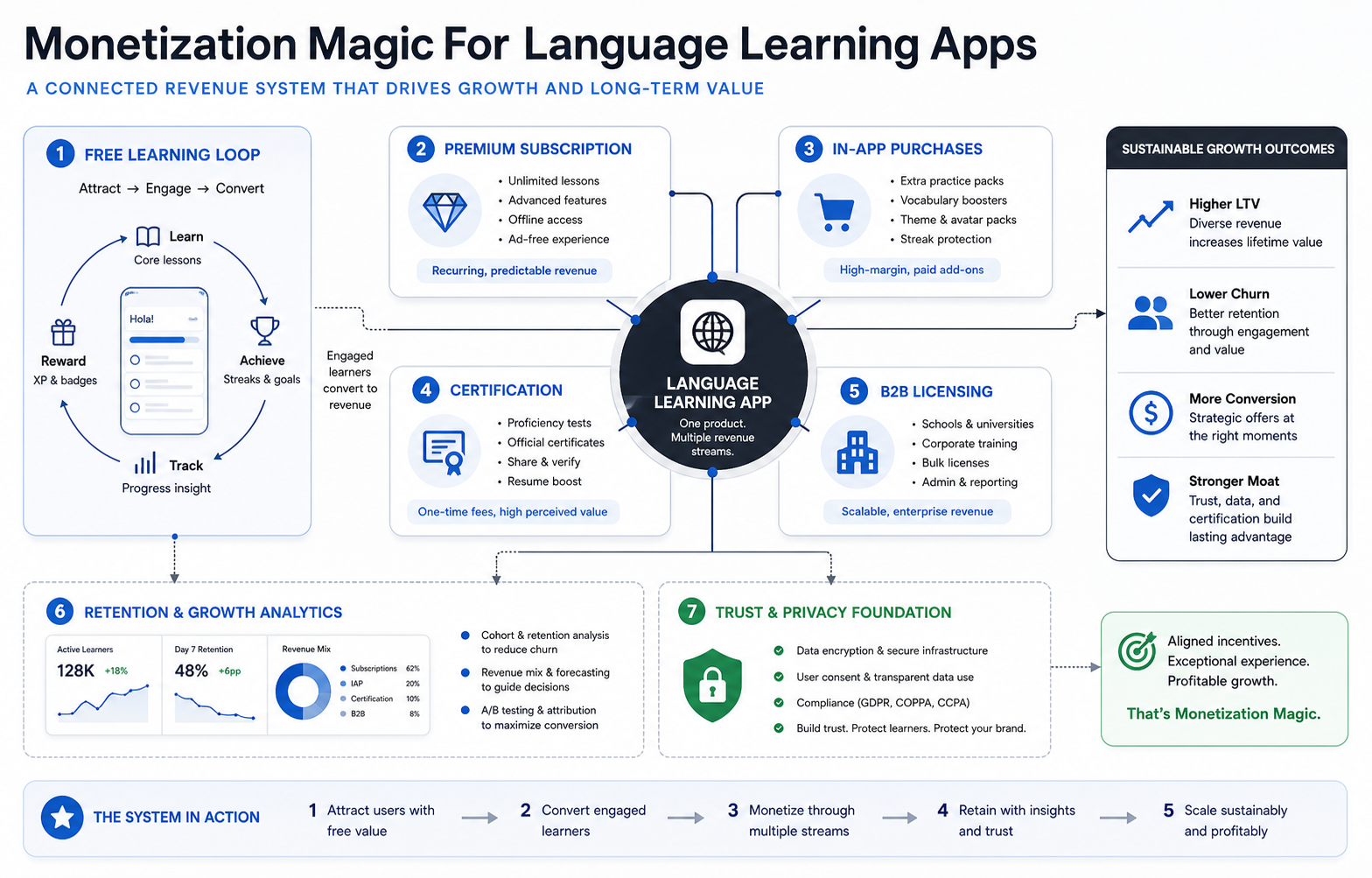
Why Language Learning Apps Need A Product-Led Revenue Model
Language learning is a retention business. Users do not pay only because lessons exist; they pay when the app helps them build a habit, feel progress, remove friction, and reach a practical goal such as travel confidence, exam preparation, workplace communication, or cultural fluency.
That means revenue strategy must be tied to product design. A subscription will struggle if daily lessons feel repetitive. In-app purchases will feel exploitative if the free product withholds basic progress. Ads can harm trust if they interrupt practice. B2B licensing will fail if the admin, reporting, and privacy model are not ready for schools or companies.
If the app includes adaptive practice, speech scoring, AI tutors, or recommendation systems, the monetization roadmap should also account for AI development services, data quality, consent, and model evaluation before those features become part of the paid promise.
Choose The Language Learning App Business Model First
Before selecting payment mechanics, define the business model. A casual vocabulary app, kids learning product, exam-prep platform, live tutoring marketplace, workplace language training tool, and travel phrasebook app all need different monetization logic.
| Product Model | Best Monetization Fit | What Must Be Strong |
|---|---|---|
| Self-paced consumer app | Freemium plus subscription | Daily habit loop, content depth, streaks, progress proof |
| Exam or certification prep | Course bundles, subscriptions, certification fees | Curriculum structure, assessments, score improvement evidence |
| Live tutoring marketplace | Commission, packages, subscriptions | Scheduling, tutor trust, payments, quality control |
| Corporate or school learning | B2B licensing and admin seats | Reporting, privacy, roles, onboarding, support |
| Travel or niche language app | One-time packs and premium modules | Offline mode, specific use cases, localization quality |
For nearby planning context, compare the product model with NextPage's guide to language app features and technology choices and the broader overview of online education app formats.
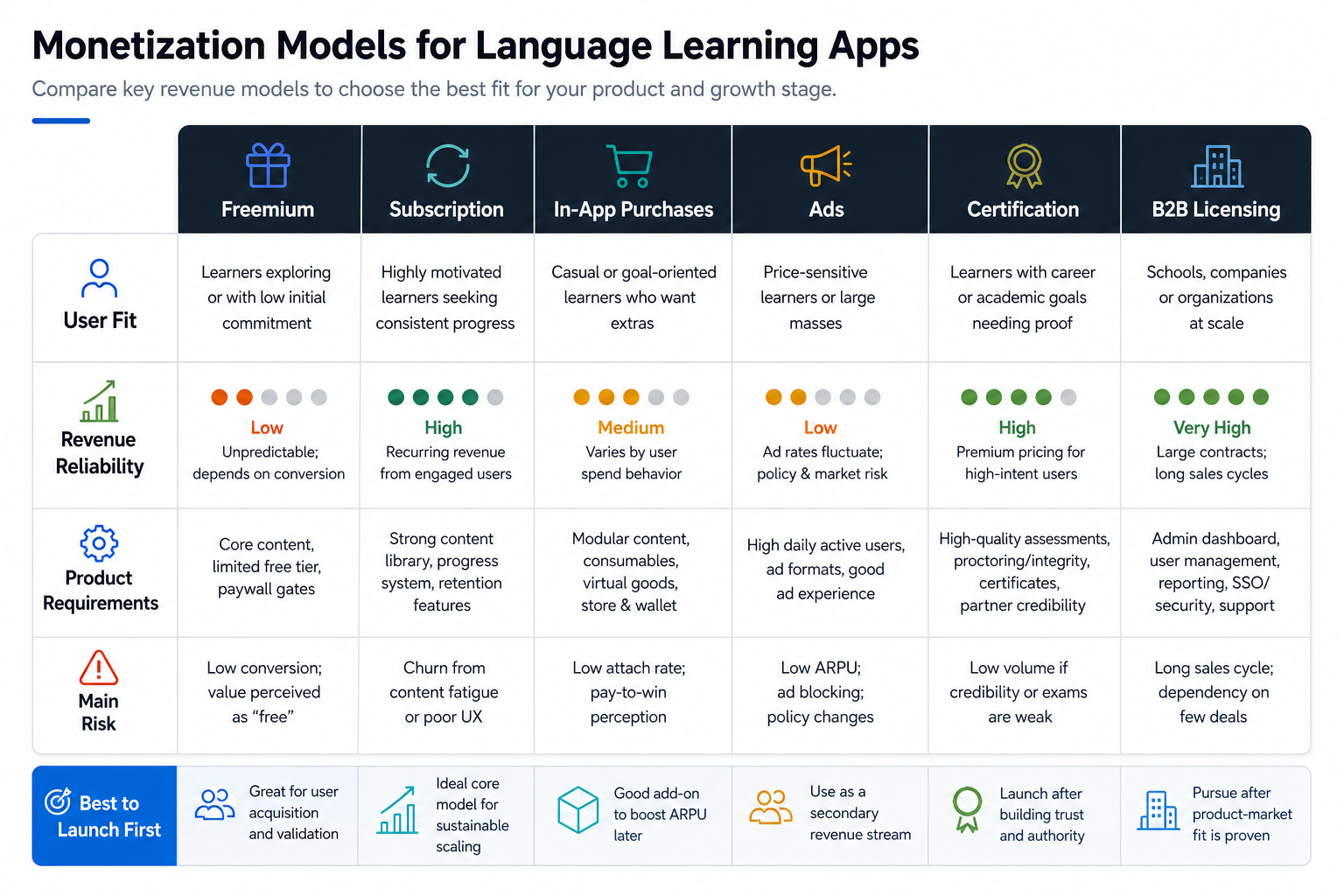
Monetization Models For Language Learning Apps
Freemium Model
Freemium works when the free product proves the learning habit and the paid product removes meaningful limits. A good free tier might include basic lessons, limited practice, streaks, and progress tracking. Premium can unlock advanced lessons, offline access, richer review, speech practice, AI feedback, downloadable resources, and deeper personalization.
The paywall should appear after the user understands the value. Locking the first useful lesson creates abandonment. Unlocking everything too early creates weak upgrade motivation. The best freemium design gives learners enough progress to trust the product and then asks them to pay for faster, deeper, or more personalized outcomes.
Subscription Model
Subscriptions fit language learning because practice is recurring. Monthly and annual plans can include full course access, advanced grammar, pronunciation review, personalized learning paths, family plans, tutor credits, or classroom features. Annual plans work best when the app can make the long-term journey feel credible.
Pricing should map to user intent. A casual learner may pay for convenience and streak support. A professional learner may pay for role-specific vocabulary, speaking practice, and progress reports. An exam learner may pay for structure, mock tests, and score confidence.
In-App Purchases And Language Packs
In-app purchases work well for discrete upgrades: specialist vocabulary packs, travel phrasebooks, pronunciation clinics, exam modules, offline downloads, certificates, tutoring credits, or conversation simulations. They should feel like useful additions, not a way to sell back the product's core promise in fragments.
Ads, Sponsorships, And Partnerships
Ads can monetize free users, but they must be handled carefully. Interrupting lessons, speaking practice, or assessments can reduce trust and retention. If ads are used, keep them away from high-focus learning moments and consider sponsorships or relevant education partnerships instead of generic interruption-based ad units.
B2B Licensing, Certification, And Schools
B2B licensing can produce more stable revenue than consumer subscriptions, but it requires admin features. Schools and employers need seat management, usage reports, privacy controls, role-based access, onboarding, support workflows, and proof that learners are progressing.
Education commerce patterns are visible in NextPage's CodeCamp Studio case study, where acquisition pages, enrollment flows, payments, CRM handoff, and operations data are connected into one education platform.
Design The Free-To-Paid Upgrade Path
The free-to-paid path should follow the learner's journey. Start with onboarding that identifies goal, level, time commitment, and language. Use the first few sessions to create early progress, then introduce premium when the learner reaches a clear constraint: more practice, a harder lesson path, speech scoring, offline access, tutoring, or a goal-specific plan.
Useful upgrade triggers include completed beginner module, seven-day streak, repeated practice of difficult words, exam goal selection, upcoming travel date, or request for conversation feedback. Avoid generic popups that appear before the app understands the learner.
If first-release scope is uncertain, the MVP Scope Builder can help separate launch-critical learning and monetization features from later-phase experiments.
Use Data To Improve Language Learning Revenue
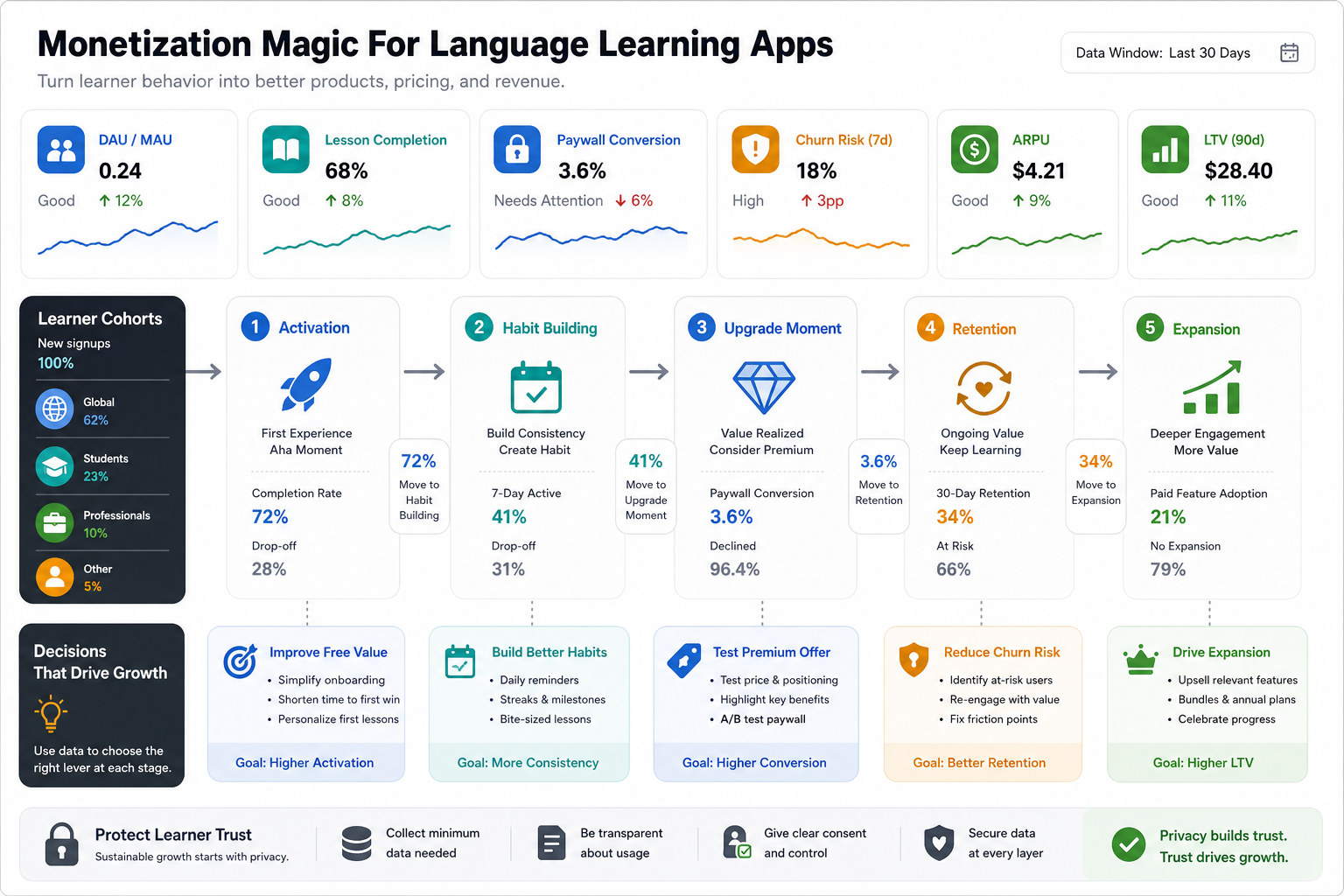
Monetization gets stronger when the team measures learning behavior and revenue behavior together. Track activation, lesson completion, streak formation, cohort retention, free-to-paid conversion, paywall view rate, trial start rate, trial-to-paid conversion, churn, ARPU, LTV, refund rate, and support volume.
Segment users by goal, level, language, region, learning frequency, and willingness to pay. A traveler who needs phrases next week should not see the same offer as a professional preparing for client calls or a student preparing for an exam.
Data use must stay transparent. Language apps can collect sensitive learning goals, voice samples, age information, performance history, and location context. Privacy, consent, deletion, parental controls, and secure analytics are part of monetization because trust affects retention.
Development Cost And Technical Scope
The cost to build a monetized language learning app depends on content depth, user roles, platform choice, AI features, offline mode, speech recognition, payments, subscriptions, analytics, admin tools, localization, and integrations. A basic content-and-quiz MVP is much smaller than a multi-language adaptive product with speech scoring, tutor marketplace workflows, and B2B reporting.
For cost planning, use the education app development cost guide and the Custom Software Cost Estimator to frame budget, timeline, integration, team, and AI assumptions. For platform choice, compare native versus cross-platform mobile app development before committing to iOS, Android, or shared code.
Features That Support Monetization
- Goal-based onboarding: captures why the learner is using the app and shapes the first learning path.
- Progress proof: shows completed lessons, retained vocabulary, speaking improvement, and readiness milestones.
- Personalized review: turns weak areas into practice sessions that justify premium value.
- Offline learning: supports commuters, travelers, and users in low-connectivity contexts.
- Speech and listening practice: creates a higher-value skill loop than flashcards alone.
- Payments and subscriptions: need reliable checkout, plan management, receipts, refunds, and app-store compliance.
- Admin and reporting: are essential for schools, employers, tutors, and larger learning programs.
For marketplace-style education workflows, the LessonBridge tutoring platform case study shows how tutor discovery, booking, availability, student records, payments, and administration can work together.
Pricing And Packaging Recommendations
Start with simple pricing. A free plan, monthly premium plan, annual premium plan, and one or two optional add-ons are easier to test than a crowded pricing page. Keep the value difference obvious: free for habit discovery, premium for deeper learning, and add-ons for specific goals such as exams, travel, tutoring, or certification.
Use trials carefully. A trial should expose the user to the premium habit loop, not only remove ads for a few days. If the app uses AI tutoring or speech analysis, make the trial include enough feedback that the user understands why the paid feature matters.
Common Monetization Mistakes To Avoid
- Paywalling the learning moment too early: users need to feel progress before they trust the product enough to pay.
- Adding ads in high-focus sessions: interruptions can reduce learning quality, retention, and brand trust.
- Selling too many disconnected packs: fragmented monetization can make the product feel confusing or unfair.
- Ignoring content operations: paid learning products need fresh lessons, review quality, localization, and curriculum maintenance.
- Underbuilding admin features for B2B: schools and companies need reporting, roles, privacy, onboarding, and support.
- Optimizing only for conversion: monetization without learner outcomes creates churn.
Launch Roadmap For A Profitable Language Learning App
- Define the learner segment: choose casual, travel, exam, professional, kids, school, or corporate learning before choosing monetization.
- Build the core learning loop: onboarding, lessons, review, progress, reminders, and habit mechanics.
- Add the first paid path: subscription, course pack, certification, or tutoring credits based on the strongest value promise.
- Instrument the funnel: measure activation, retention, paywall conversion, churn, support, refunds, and learning outcomes.
- Expand revenue channels: add B2B licensing, certifications, partnerships, or marketplace features only after the core product retains users.
Final Recommendation
Build the monetization model around the learner's progress, not around a list of payment options. A language learning app earns durable revenue when free users feel early value, paid users receive visibly better outcomes, and the product team can measure retention, conversion, and learning quality without weakening trust.
The strongest plan is usually a focused free learning loop, a clear subscription upgrade, optional goal-specific add-ons, careful data use, and a roadmap that can expand into B2B, certification, tutoring, or AI-assisted learning once the product has proven habit and outcomes.