
Quick Answer: How Should A Photo Editing App Make Money?
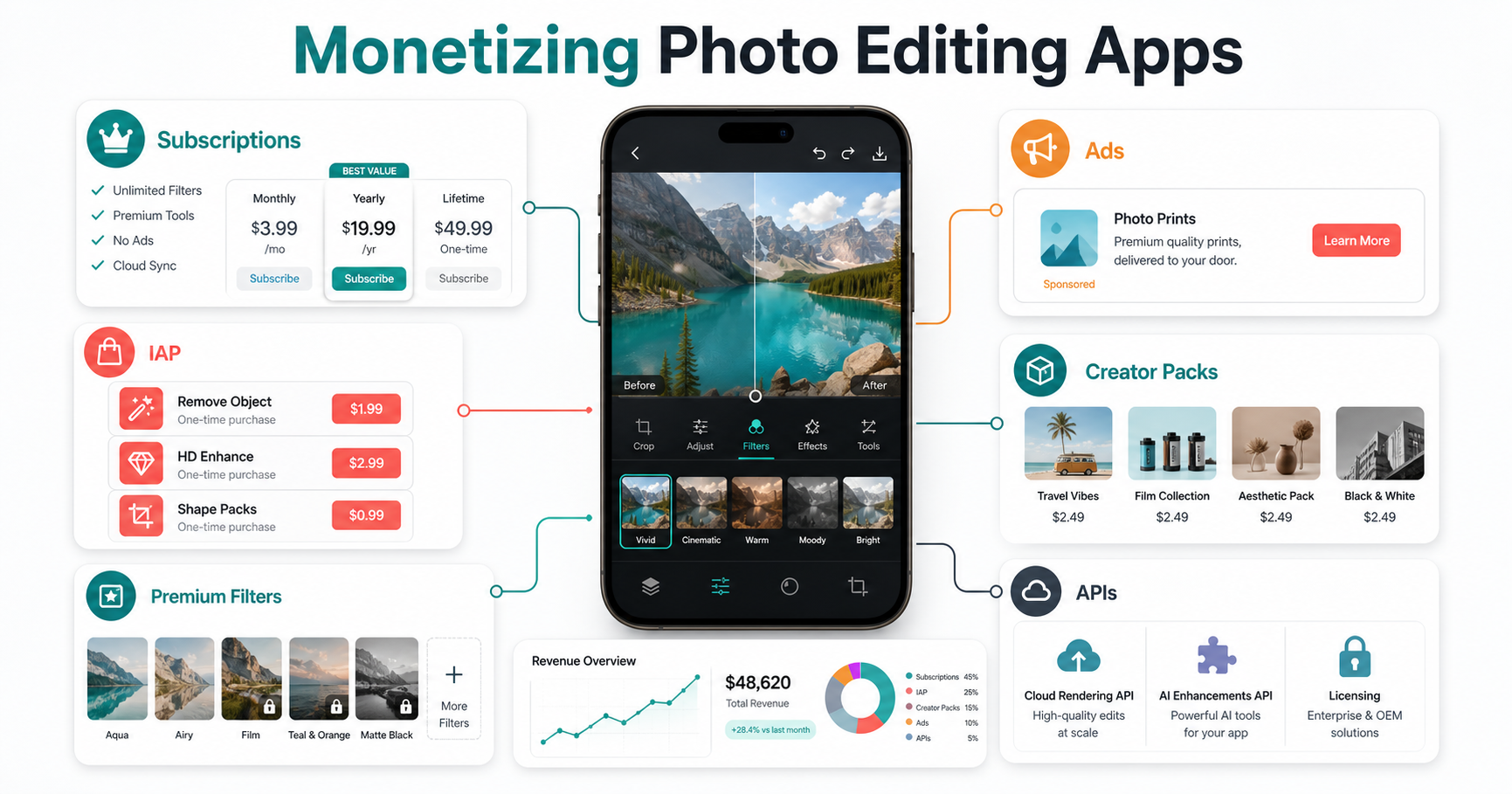
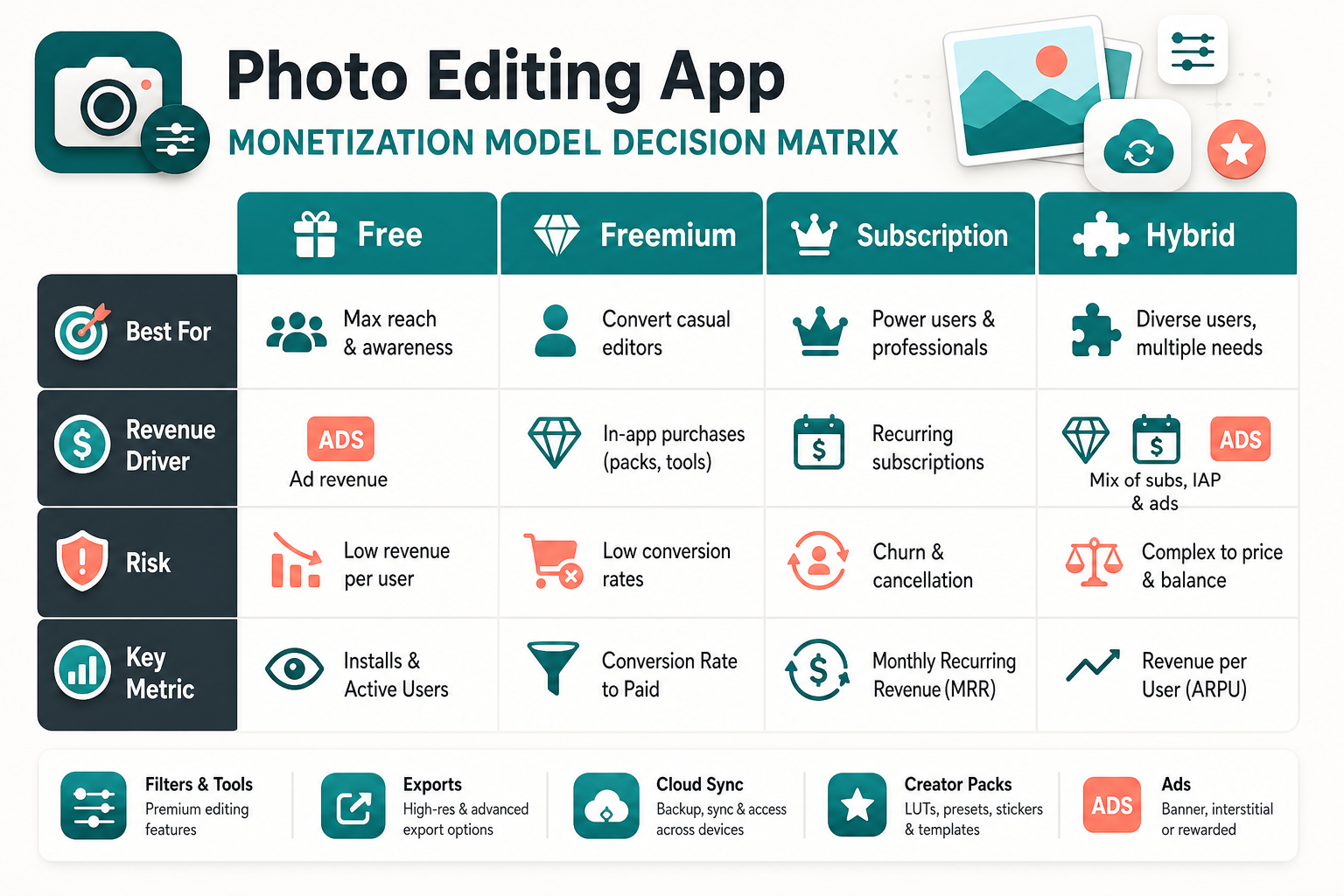
A photo editing app usually monetizes best with a hybrid model: a free editing experience that proves value quickly, paid in-app purchases for high-intent creative upgrades, and a subscription tier for people who need ongoing premium filters, cloud sync, batch exports, AI enhancements, and new content packs. Ads can support a large free audience, but they should not interrupt the core editing flow where trust, speed, and creative control matter most.
The right monetization mix depends on the product stage, user segment, content cadence, and technical platform. A casual filter app may start with freemium packs and rewarded ads. A professional editor should prioritize subscriptions, high-resolution exports, cloud storage, and creator workflows. If you are still shaping the product, work with a mobile app development partner to connect pricing, billing, analytics, and feature gating before launch rather than after users have already formed habits.
Why Photo Editing App Monetization Needs Product Strategy
Photo editing apps compete in a crowded category where users expect a generous free experience, fast results, and frequent creative updates. Monetization cannot be pasted on as a paywall after the app is built. The paid moments need to align with natural value moments: exporting a polished image, unlocking a premium preset, removing an object, saving edits across devices, publishing to a social channel, or creating a batch workflow.
That is why monetization planning should sit beside feature planning. NextPage has separate guidance on must-have features for a powerful photo editing app and advanced editing tools; this article focuses on turning those features into sustainable revenue without damaging retention.
Compare The Main Monetization Models
In-App Purchases For Premium Tools And Content
In-app purchases work well when users can understand the value of a specific upgrade immediately. Examples include premium filters, object removal credits, high-resolution exports, creator preset packs, background replacement, watermark removal, seasonal templates, or one-time access to a specialist workflow.
This model is useful for casual editors who do not want a monthly commitment. It also gives product teams a low-friction way to test what users value before packaging a subscription. The risk is fragmented value: if every helpful feature is separately priced, users may feel nickel-and-dimed. Keep the catalogue focused, bundle related features, and use analytics to retire packs that do not convert.
Subscriptions For Ongoing Creative Value
Subscriptions fit photo editing apps when the product delivers continuing value: fresh presets, AI tools, cloud sync, batch editing, storage, collaboration, brand kits, cross-device access, or priority rendering. The paywall should appear after the user has seen the result they want, not before the first meaningful edit.
Subscription pricing also has platform economics to consider. Apple and Google both publish fee programs where many smaller developers or subscription products may qualify for lower service fees, often around 15%, while rules vary by storefront, region, billing option, and developer eligibility. Treat this as a finance and compliance input when forecasting net revenue.
Freemium For Discovery And Conversion
A freemium model gives users a useful free editor and reserves premium value for power workflows. Good free features might include cropping, basic filters, resizing, and simple sharing. Paid features might include AI enhancement, object removal, RAW workflows, batch exports, advanced color grading, brand templates, or cloud history.
The free tier should be strong enough to build trust but narrow enough to make premium value visible. If the free app feels broken, people uninstall. If the free app gives away every high-value outcome, paid conversion stays weak. Use onboarding to guide users toward one high-value edit and then test paywall timing around that moment.
Ads Without Damaging The Editing Experience
Advertising can work for a large casual audience, especially through rewarded placements that unlock a filter, template, or export. Banner ads and interstitials are more risky because they can interrupt a creative workflow and reduce perceived product quality. If ads are part of the plan, keep them away from precision editing screens and monitor retention, session length, crash rate, and review sentiment after each placement change.
Sponsored Content, Creator Packs, And Brand Partnerships
Photo editing apps can monetize through sponsored presets, campaign templates, branded frames, photographer packs, or marketplace-style creator content. This works best when the content improves user output rather than feeling like an ad. The partnership model also needs content moderation, approval workflows, revenue sharing, and disclosure rules.
Social workflows can amplify this model. If sharing is part of your roadmap, review how social sharing integration can enhance a photo editing app before building creator packs in isolation.
APIs, SDKs, And Licensing For B2B Revenue
Some photo editing products can create business revenue beyond the consumer app by licensing filters, image enhancement APIs, rendering infrastructure, or white-label editing modules. This is more complex than consumer monetization because buyers expect documentation, uptime, usage metering, access controls, and support commitments.
API monetization is usually a later-stage move unless the editing engine is already a defensible technical asset. It should not distract from consumer retention if the main app has not yet found repeat usage.
Choose The Right Model By Product Stage
| Product Stage | Recommended Revenue Model | What To Validate |
|---|---|---|
| MVP | Freemium plus one or two paid upgrades | Which edit outcomes users value enough to pay for |
| Early growth | Hybrid IAP and subscription tests | Paywall timing, trial conversion, and churn reasons |
| Established consumer app | Subscription with content packs and selected IAP | Monthly recurring revenue, retention, and content cadence |
| Professional or creator tool | Subscription, cloud sync, storage, advanced exports | Workflow depth, account expansion, and support cost |
| Platform or editing engine | API licensing or partner integrations | Usage metering, uptime expectations, and enterprise demand |
If you need a quick starting point for scope and budget, use the MVP scope builder to separate launch features from later monetization experiments. For a fuller cost view, the custom software cost estimator can help frame the engineering effort behind billing, analytics, cloud media, and admin tooling.
Build The Billing And Entitlement Architecture Early
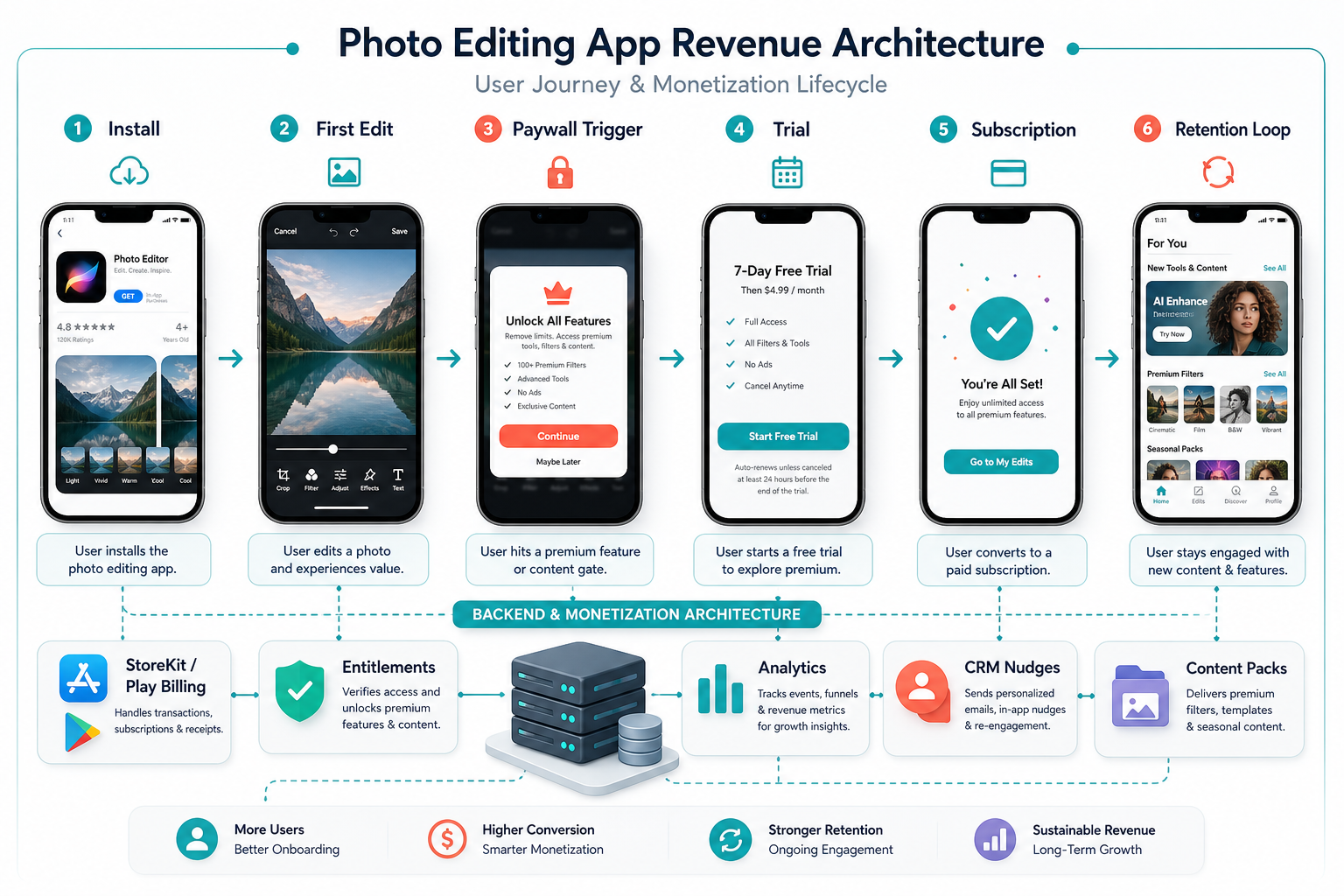
Monetization is not just a pricing page. A production app needs store billing integration, receipt validation, entitlement checks, subscription status handling, refund and cancellation awareness, analytics events, paywall experiments, content-pack delivery, and customer-support visibility. These systems should be designed before the app has thousands of users because retrofitting access rules can create support issues and revenue leakage.
For iOS and Android apps, the billing layer should stay separate from the editing experience. The app should ask a backend or entitlement service whether the user has access, then unlock features consistently across devices. This is especially important for subscriptions, cloud sync, and paid content packs.
Design Paywalls Around Value Moments
A paywall converts better when it appears after a user experiences value. In a photo editing app, strong paywall triggers include exporting a high-resolution image, applying an AI enhancement, saving a preset, using batch editing, removing a watermark, syncing edits to the cloud, or selecting a premium creator pack.
Avoid blocking too early. If the first screen is a subscription wall, users may leave before they understand the editor. A better pattern is to let them create something useful, preview the premium result, and then present a clear upgrade choice. App store listing work also matters because the promise users see before installing should match the monetization path inside the product. NextPage's guide to App Store Optimization is useful when aligning screenshots, feature claims, and conversion messaging.
Track Metrics That Explain Revenue Quality
Revenue alone does not explain whether a monetization model is healthy. Track activation rate, first-edit completion, paywall view rate, trial start rate, trial-to-paid conversion, monthly recurring revenue, ARPU, churn, refund rate, ad revenue per active user, feature usage by paying users, and support tickets by monetization feature.
Segment those metrics by audience. A social creator, casual editor, small business marketer, and professional photographer may respond to very different offers. The best model is often a portfolio: subscriptions for serious repeat users, IAP for casual creative upgrades, and ads or sponsored content for users who will not pay directly.
A Practical Monetization Roadmap
- Define the core free value. Give users enough editing power to trust the app and complete a satisfying first edit.
- Choose paid feature gates. Gate outcomes that are valuable, understandable, and expensive to support, such as AI enhancement, cloud history, premium exports, or creator packs.
- Instrument the funnel. Track install, onboarding, first edit, premium preview, paywall, trial, purchase, cancellation, and retention events.
- Start with a simple offer. Launch with one subscription tier and a limited set of IAP packs before adding complex pricing.
- Test paywall timing. Compare upgrade prompts after premium preview, export, cloud sync, and content-pack selection.
- Review net revenue. Include store service fees, refunds, taxes, payment rules, ad fill rates, and infrastructure costs in revenue forecasts.
- Build retention content. Add new filters, templates, editing challenges, and education so the subscription has a reason to renew.
Common Mistakes To Avoid
- Charging before trust exists: Users need to see edit quality before they pay.
- Overloading the free tier: If every valuable result is free, the paid plan has no reason to exist.
- Interrupting creative flow with ads: Ads should not break concentration on editing screens.
- Ignoring platform fees: Store commissions, regional billing rules, and eligibility programs affect pricing and margin.
- Skipping entitlement architecture: Paid access must work across devices, restores, refunds, cancellations, and support cases.
- Treating content packs as decoration: Packs should help users create better images, not just add catalogue clutter.
Conclusion
Monetizing photo editing apps works best when revenue design follows user value. In-app purchases are useful for specific premium upgrades, subscriptions support ongoing creative workflows, freemium lowers adoption friction, ads can subsidize casual users, partnerships can expand content, and APIs can open B2B revenue when the editing engine is strong enough.
The strongest strategy is rarely one model in isolation. Build a free experience that proves value, package premium outcomes clearly, design billing and entitlements early, and keep testing against retention rather than short-term conversion alone. If your team is planning a photo editing product, NextPage can help turn monetization assumptions into a buildable product roadmap, mobile architecture, and launch plan.