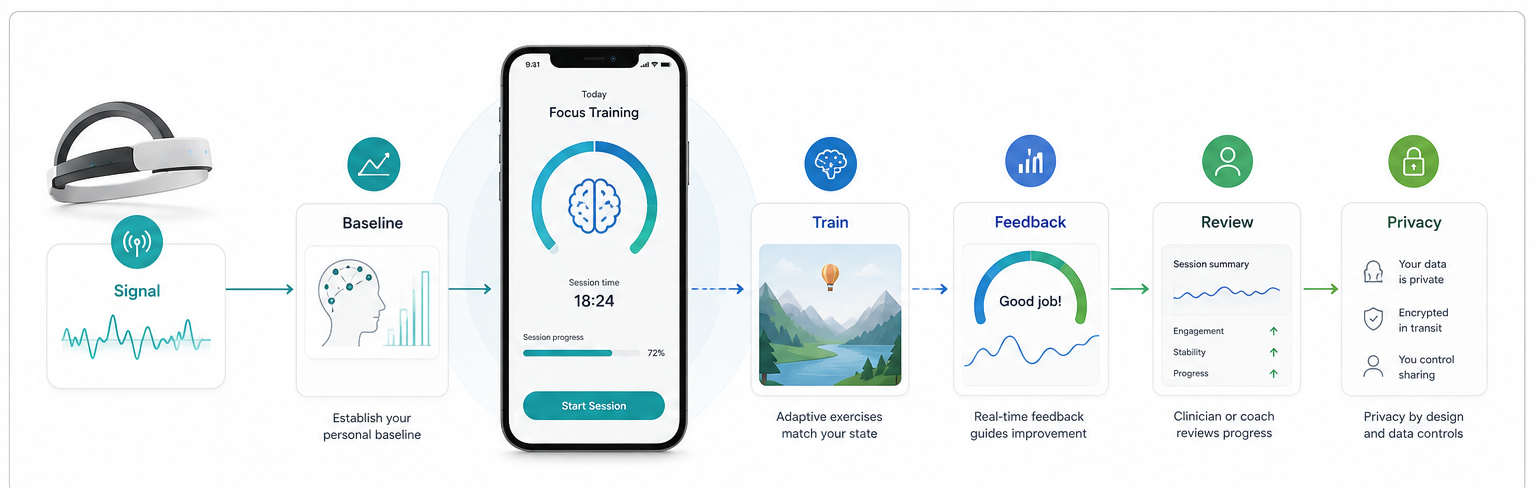

Neurofeedback apps are becoming a serious product direction inside mental wellness software, but the promise is easy to overstate. The useful version is not a magic brain-training app. It is a carefully designed system that can collect a signal, explain what the signal means, guide the user through practice, measure progress, and protect sensitive wellness data.
For founders, clinics, wellness brands, and product teams, the opportunity is to make biofeedback and brain-training experiences more accessible without weakening safety, privacy, or evidence standards. That requires strong mobile UX, clean device integration, content governance, and a clear boundary between supportive wellness guidance and clinical care. NextPage's mobile app development team can help turn those constraints into an app architecture that is realistic to build and maintain.
Quick Answer: How Neurofeedback Apps Improve Mental Wellness Apps
Neurofeedback apps improve mental wellness apps by adding real-time feedback loops. A headset, wearable, or paired sensor captures a signal; the app interprets that signal into a simple state; the user practices focus, breathing, relaxation, or attention exercises; and the product shows progress in a way the user can understand. The result can support self-regulation, focus training, stress recovery, and habit formation when the experience is designed with careful claims and clear guardrails.
The strongest products usually combine neurofeedback with standard wellness features: onboarding, goals, session history, education, reminders, coach or clinician review where appropriate, accessibility settings, and data consent controls. The weakest products rely on vague "rewire your brain" language without explaining the signal, the limitations, or what the app can and cannot do.
What Neurofeedback Means In A Mental Wellness Product
Neurofeedback is a biofeedback method where users receive feedback related to brain activity or a proxy signal. Consumer products may use EEG headsets, heart-rate variability, breathing sensors, attention metrics, or other wearable inputs. The app turns those signals into feedback such as visual changes, sound cues, session scores, or progress trends.
Brain-training apps are broader. They can include cognitive exercises, attention drills, memory tasks, mindfulness routines, and stress-management practices without direct brain-signal input. A neurofeedback app may include brain training, but a brain-training app is not automatically neurofeedback unless it closes the loop with a relevant signal.
The Product Signal Loop Behind Neurofeedback Apps
A useful neurofeedback experience depends on a repeatable loop: sense the signal, interpret it, adapt the session, let the user practice, then measure progress. If any step is weak, the app feels unreliable. Users may not know whether they are improving, whether the device is connected, or whether the score means anything.
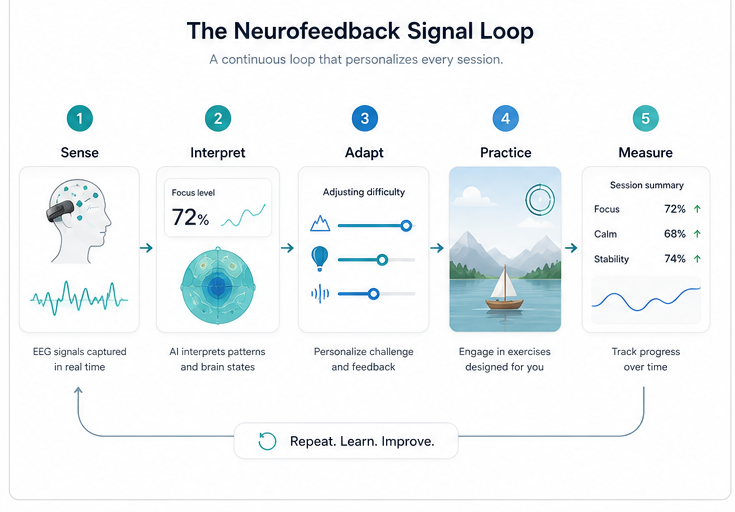
The sensing layer should make device status obvious. The interpretation layer should avoid mysterious scoring. Adaptation should be subtle enough that users still understand what changed. Practice content should be short, repeatable, and accessible. Measurement should track meaningful trends rather than pushing users into daily streak anxiety.
High-Value Use Cases For Neurofeedback Mental Wellness Apps
The most practical use cases are not about turning every user into a cognitive athlete. They are about helping people notice patterns and practice skills. Common use cases include relaxation training, focus sessions, breath regulation, pre-sleep wind-down routines, stress recovery, attention practice, and guided reflection after high-pressure work.
Neurofeedback can also support coach-guided or clinician-adjacent workflows when the product has the right review model. In those cases, the app may collect session summaries for a professional to review, but it should still make consent, data access, escalation paths, and disclaimers extremely clear. NextPage's guide to user interfaces in mental wellness app development is a useful companion for designing calm, trustworthy, and non-overwhelming wellness experiences.
Core Features A Neurofeedback App Should Include
A strong first version needs more than a training screen. It should include onboarding that explains the signal, device pairing and calibration, session previews, real-time visual or audio feedback, progress history, plain-language insights, privacy controls, accessibility settings, and a content management workflow for guided exercises.
Teams should also plan admin tools early. Product, clinical, content, and support teams need a way to review session content, update safety copy, inspect device issues, and analyze completion without exposing unnecessary sensitive data. These are custom software development decisions, not only wellness content decisions.
Device And Data Architecture Decisions
Neurofeedback apps often depend on hardware and signal quality. Product teams should decide whether the app supports one headset, multiple wearables, or a hardware-agnostic input layer. They also need a fallback experience when Bluetooth pairing fails, the sensor loses contact, or the signal becomes too noisy to interpret.
The data model should separate raw signals, derived metrics, user-facing insights, consent records, and support diagnostics. That separation helps the product avoid over-collection and keeps future reporting manageable. Teams estimating build scope can use the custom software cost estimator to separate launch-critical workflows from later analytics and device expansion.
Privacy, Safety, And Claims Matter More Than The Dashboard
Brain and wellness data can feel more sensitive than ordinary app analytics. Users need to know what is collected, why it is collected, whether it is shared, how long it is retained, and how they can delete it. Consent should be active and easy to revisit. Privacy settings should be part of onboarding, not hidden at the bottom of an account page.
Claims need the same discipline. A wellness neurofeedback app can say it supports practice, focus, relaxation, or self-awareness when the product experience supports those outcomes. It should avoid promising diagnosis, treatment, cure, or guaranteed anxiety reduction unless the product is built and regulated for that purpose. If AI is used for summaries or recommendations, NextPage's AI development services can help design evaluation, guardrails, and review workflows before launch.
A Practical Implementation Roadmap
The safest roadmap is staged. Start with an MVP that proves device pairing, session flow, consent, and progress tracking. Then add evidence workflows, safety review, accessibility improvements, and scale-ready analytics. This keeps the product useful without pretending that every advanced feature belongs in version one.
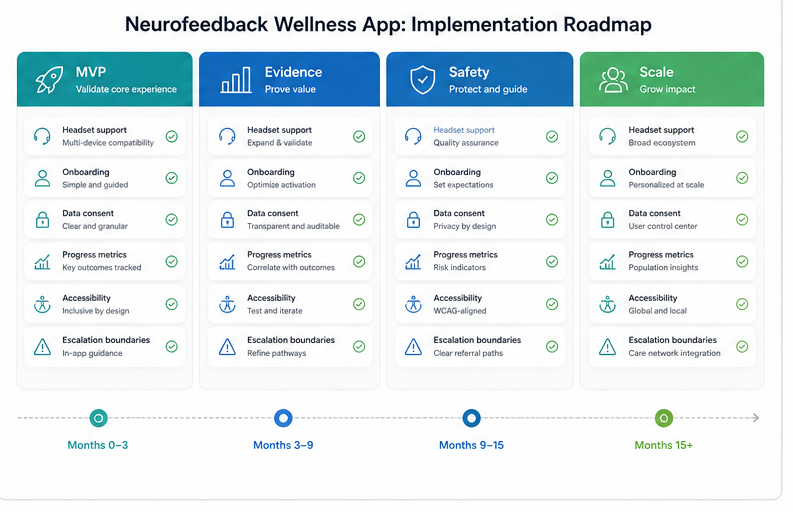
The MVP should include one supported device path, a small set of exercises, calibration, readable feedback, consent, and basic analytics. The evidence phase should compare session metrics with user-reported outcomes and drop-off data. The safety phase should define review rules, escalation copy, and referral boundaries. The scale phase can add more devices, personalization, professional dashboards, or integrations only after the core loop is stable.
Personalization And AI In Neurofeedback Apps
Personalization can make neurofeedback apps more useful when it adapts difficulty, session length, reminders, or educational content based on explicit preferences and session trends. It becomes risky when the app infers mental health conditions or makes opaque recommendations from sensitive signals.
Keep personalization explainable. Tell users why a session changed, let them reset or edit preferences, and avoid pressure-based streak mechanics. If the roadmap includes agentic guidance or automated coaching, read the comparison of generative AI, AI agents, and agentic AI before deciding how autonomous the product should become.
Accessibility And Inclusive Design Requirements
Neurofeedback apps should work for users who cannot rely only on sound, color, tiny motion, long sessions, or dense charts. Include captions or transcripts for instructional content, clear focus states, readable typography, screen-reader support, reduced-motion options, plain-language summaries, and alternatives for users who cannot wear a specific headset comfortably.
Inclusive design also means avoiding shame. Progress states should not punish missed sessions or frame low scores as failure. Wellness apps should help users return to practice gently. The broader wellness app development guide can help teams connect accessibility, onboarding, retention, and monetization choices.
A Relevant Wellness App Pattern
Neurofeedback products often need the same foundations as other wellness platforms: guided content, routine building, subscriptions, progress history, and user trust. The MindGarden wellness app case study shows how a wellness experience can combine guided routines, progress tracking, and monetization while keeping the product simple enough for repeated use.
That pattern matters because neurofeedback should not feel like a lab instrument dropped into a consumer app. The signal layer is only valuable when the surrounding product helps users understand what to do next.
Metrics That Show Whether The App Is Working
Measure more than downloads and session starts. Useful product metrics include calibration success, device pairing success, first-session completion, repeat sessions, abandonment points, accessibility setting usage, support tickets, opt-out rates, consent changes, and user-reported usefulness. For higher-risk products, professional review metrics and adverse feedback workflows should also be tracked.
Healthcare-adjacent products should budget for compliance and secure architecture earlier than a general wellness app would. The NextPage guide to healthcare app development cost is useful when the app touches sensitive health workflows, professional review, or regulated integrations.
Common Mistakes To Avoid
The first mistake is treating neurofeedback as a marketing label instead of a validated product loop. The second is burying data consent. The third is showing complex brainwave visuals without explaining what the user can do. The fourth is shipping AI recommendations without review. The fifth is assuming one headset, one culture, one language, or one session style will work for every user.
A better approach is narrower and more credible: define one wellness outcome, prove the signal loop, design for accessibility, write conservative claims, and add advanced personalization only after users trust the basics.
Conclusion
Neurofeedback apps can improve mental wellness apps when they turn sensor data into understandable, respectful, and repeatable practice. The product needs more than a polished dashboard. It needs reliable device handling, clear signal explanations, adaptive sessions, consent controls, privacy-aware analytics, accessibility support, and careful safety language.
The best neurofeedback wellness products will be measured by trust as much as novelty. They help users notice patterns, practice self-regulation, and return to sessions without pressure. That is the difference between a gadget-driven experience and a mental wellness app that people can actually keep using.