
Quick Answer: What Should An Offshore Staff Augmentation Checklist Cover?
An offshore staff augmentation checklist should prove that your team is ready to manage remote contributors before contracts are signed. At minimum, confirm communication cadence, time-zone overlap, backlog ownership, IP and access controls, QA gates, sprint reporting, replacement coverage, and escalation rules.
Staff augmentation is not a shortcut around engineering management. It gives you extra developers, QA engineers, DevOps specialists, or designers, but your internal team still owns direction, acceptance, code review, release decisions, and product context. If those controls are weak, offshore hiring turns small communication gaps into rework, security exposure, and missed deadlines.
Use this checklist before you hire. If too many items are missing, either fix your internal process first or consider a managed India-based team where QA, coordination, and team leadership are part of the model. For role and monthly budget planning, use the Dedicated India Team Cost Calculator after you know which controls you can own internally. If the work needs broader delivery ownership, compare the checklist against NextPage's software outsourcing India service path before adding isolated resumes.
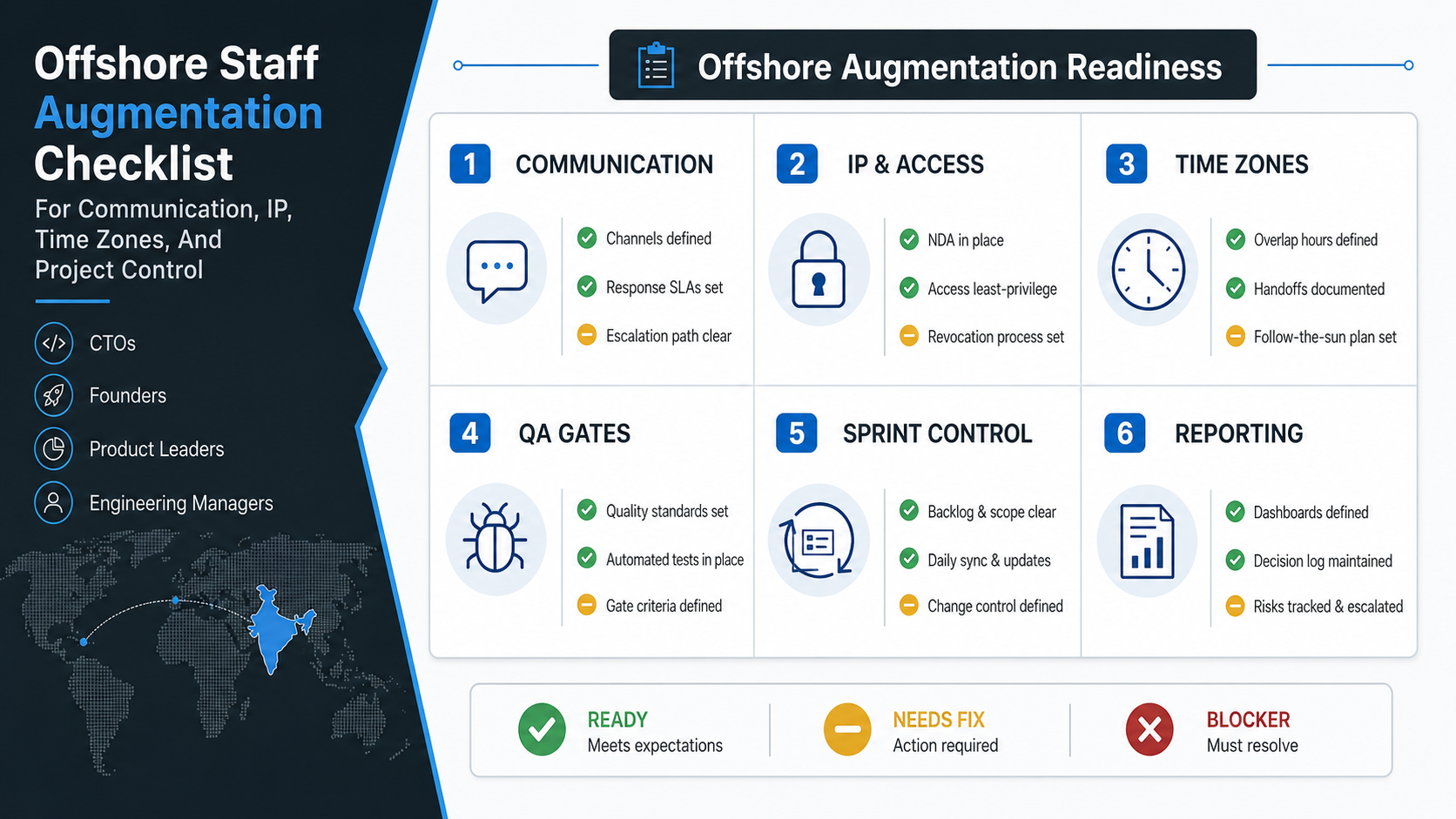
The Offshore Staff Augmentation Readiness Scorecard
Start with a simple scorecard. Mark each row as ready, needs fix, or blocker. A blocker does not mean you cannot outsource. It means you should not add remote contributors until the control is owned by someone.
| Area | Ready Means | Blocker Signal |
|---|---|---|
| Backlog | Tickets have acceptance criteria, priority, owner, and dependencies | Developers must infer what to build from vague notes |
| Communication | Daily overlap, async updates, escalation path, and decision log exist | Questions wait a full day or get answered in scattered chats |
| Access | Least-privilege repo, environment, credential, and offboarding rules exist | Shared credentials or production access are handed out casually |
| IP and contracts | IP assignment, confidentiality, data handling, and code ownership are written | The contract talks about rates but not ownership or security |
| QA | Definition of done includes tests, review, regression, and release signoff | External developers can merge work without clear quality gates |
| Reporting | You receive sprint goals, demo evidence, blockers, burn, and risks | Updates are only timesheets or generic status lines |
If you want a broader partner evaluation framework, pair this article with the offshore software development checklist, which covers governance, IP, security, and QA before you hire. Teams still deciding between individual contributors and a managed pod should also review staff augmentation vs managed dedicated team before they commit to a model.
1. Communication Plan
Communication is the first failure point in offshore staff augmentation because contributors are usually embedded in your process, not managed as a separate project. Write the working agreement before onboarding.
- Daily overlap window: define the exact hours for questions, pairing, reviews, and unblockers.
- Primary channels: specify where tickets, architecture decisions, urgent blockers, and team chat live.
- Response expectations: decide what requires same-day response and what can wait for async review.
- Decision log: keep architecture, scope, and acceptance decisions in a place new contributors can read.
- Escalation path: name who handles blockers when a developer is stuck, absent, or waiting on access.
A healthy offshore setup does not rely on more meetings. It relies on fewer unanswered questions. The goal is to make work visible before time zones turn a small ambiguity into a one-day delay.
Communication And Time-Zone Handoff SLA Board
Time-zone overlap should be designed as an SLA, not described as a vague promise. A working handoff board names the overlap window, where questions are asked, how pull requests are reviewed, what counts as a blocker, and where decisions are recorded. This turns offshore collaboration into a repeatable operating rhythm instead of a series of delayed chat messages.
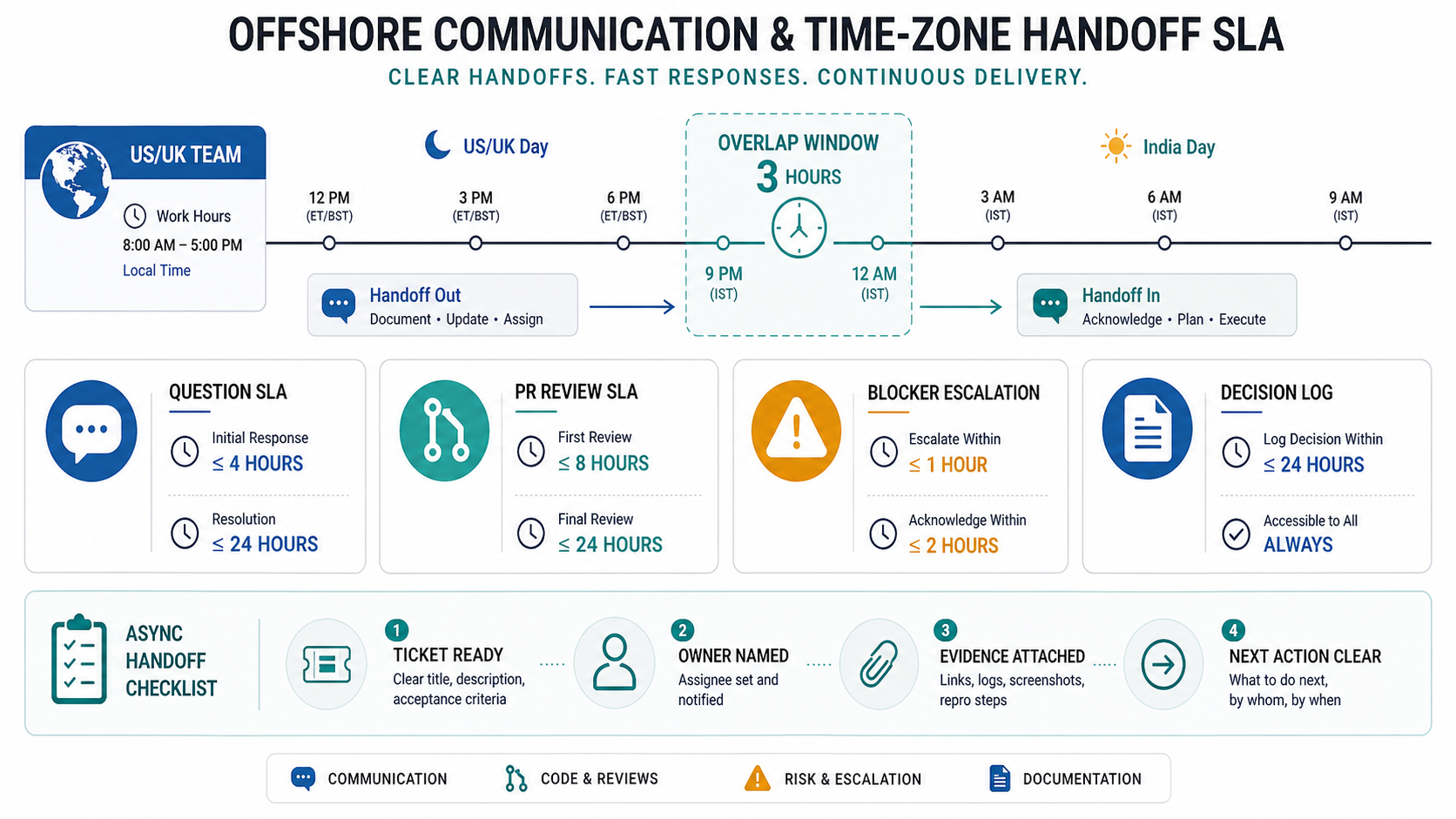
| Handoff Control | Minimum Rule | Evidence To Review |
|---|---|---|
| Overlap window | Reserve fixed hours for planning, demos, code review, and blocker removal. | Calendar blocks, named attendees, and timezone-specific availability. |
| Question SLA | Set response expectations for normal questions, urgent blockers, and production issues. | Escalation channel, response target, and backup owner. |
| PR review | Assign reviewers before the offshore day starts, with review timing written in the ticket. | Branch rules, reviewer assignment, and PR checklist. |
| Async handoff | Every task should include owner, next action, acceptance criteria, and evidence links. | Ticket template, decision log, screenshots, logs, or demo link. |
For teams that cannot guarantee this cadence, a managed software team in India is usually safer because delivery rituals, QA coordination, reporting, and continuity are part of the engagement model.
2. Time-Zone And Handoff Rules
Time zones are manageable when handoffs are designed. They become expensive when every decision requires synchronous clarification. For India-based capacity, many US, UK, Canada, and international teams create a fixed overlap block for sprint planning, demos, code review, and blocker resolution.
| Control | Checklist Question | Evidence To Ask For |
|---|---|---|
| Overlap | Which hours are guaranteed for live collaboration? | Calendar blocks and named attendees |
| Async handoff | What must be documented before the offshore day starts? | Ticket template, Loom/video notes, or decision log |
| Review cycle | When are pull requests reviewed? | PR SLA and reviewer assignment |
| Blockers | What happens if a developer is blocked after overlap ends? | Escalation channel and next-day triage rule |
If your internal team cannot provide overlap or timely review, staff augmentation may not be the right model. The comparison guide on staff augmentation vs managed dedicated team explains when a managed pod is safer.
3. IP, Access, And Security Controls
Offshore contributors need enough access to work, but not enough access to create avoidable risk. The checklist should separate repository access, environment access, data access, and production access.
- Use named accounts, never shared credentials.
- Apply least-privilege access for repositories, cloud systems, databases, analytics, and third-party tools.
- Keep production access exceptional, logged, time-bound, and approved.
- Mask or synthesize sensitive customer data for development and QA.
- Write IP assignment and confidentiality terms into the contract.
- Define offboarding: account removal, credential rotation, device/data return, and knowledge transfer.
These rules are not just legal hygiene. They protect delivery continuity. When access is controlled and documented, you can scale people up or down without losing ownership of code, credentials, or environment knowledge. If the engagement includes multiple roles, ask whether NextPage's hire dedicated developers in India model would reduce access, QA, and continuity risk by bundling senior review and QA support with developer capacity.
Offshore Control Matrix For Access, QA, And Release Risk
Before new offshore contributors touch a repository, convert the checklist into a control matrix. Each control should name an owner, an evidence artifact, and a blocker condition. This makes vendor conversations concrete and gives internal leaders a way to reject unsafe shortcuts without turning every decision into a subjective debate.
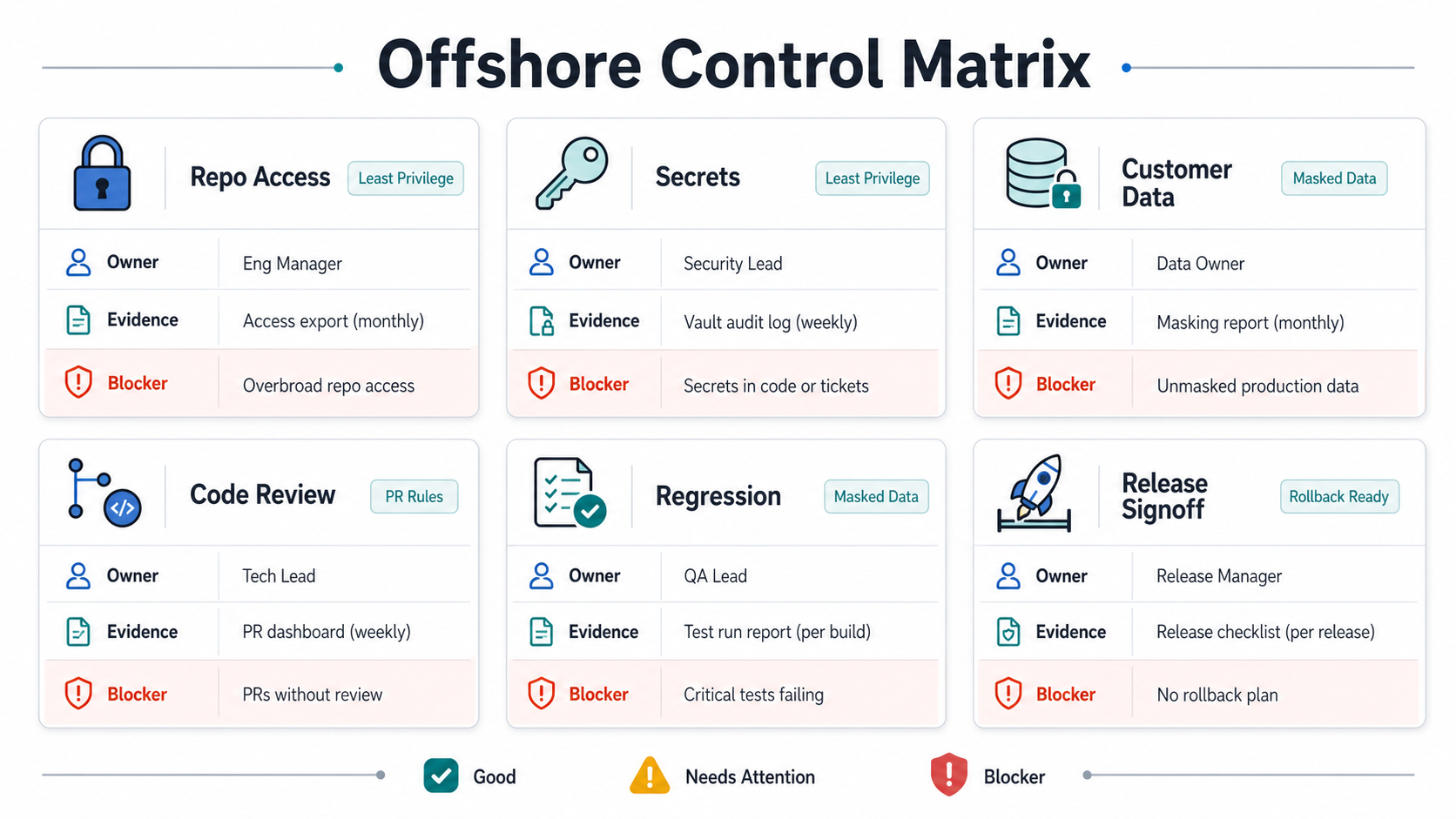
| Control | Owner | Evidence | Blocker |
|---|---|---|---|
| Repo access | Engineering manager | Named accounts, least-privilege roles, access export. | Shared accounts or broad write access. |
| Secrets | Security or DevOps owner | Vault usage, secret rotation, no secrets in tickets. | Credentials shared through chat, email, or code. |
| Customer data | Data owner | Masked fixtures, approved test data, environment policy. | Unmasked production data in dev or QA. |
| Code review | Tech lead | PR rules, reviewer checklist, required checks. | External developers can merge without review. |
| Regression | QA lead | Regression checklist, test run report, defect severity rules. | Critical paths are untested before release. |
| Release signoff | Product or release owner | Release notes, rollback plan, approval record. | No named owner can approve production changes. |
This matrix also helps compare staff augmentation with outsourcing. If the buyer owns every row confidently, augmentation can work. If ownership is missing, review software development outsourcing to India and the loss-of-control outsourcing guide before adding more people.
4. Backlog Ownership And Acceptance Criteria
Offshore staff augmentation works best when your internal team owns the backlog. Developers should not have to guess priority, acceptance criteria, edge cases, or who signs off the work.
Before onboarding, create a ticket template with user story, business reason, technical notes, acceptance criteria, dependencies, test expectations, owner, and release target. For bugs, include reproduction steps, expected behavior, actual behavior, severity, environment, logs, screenshots when useful, and rollback notes.
The more senior the external contributor, the more they can help refine tickets. But refinement is still a managed process. If nobody owns it, staff augmentation becomes vague outsourcing without the governance of a managed team.
5. QA And Release Gates
Do not treat QA as an optional add-on after developers start. Offshore augmentation should plug into your definition of done from day one.
| Gate | Minimum Control | Owner |
|---|---|---|
| Code review | Every PR has reviewer, checklist, and required checks | Internal lead or assigned senior engineer |
| Unit/integration tests | Test expectations are written per ticket | Developer plus reviewer |
| QA acceptance | QA verifies acceptance criteria before release | Internal QA or partner QA |
| Regression | Critical flows are retested before production | QA owner |
| Release signoff | Named owner approves release notes and rollback plan | Product or engineering owner |
If your team lacks QA capacity, include QA in the role mix. The dedicated development team cost in India guide shows why QA, PM, and senior review roles often matter as much as developer count. For release-heavy products, pair the gate with a regression testing checklist so critical flows are not left to memory.
6. Sprint Reporting And Project Control
Project control is not about micromanaging offshore developers. It is about seeing progress, blockers, risks, and decisions early enough to act.
- Sprint goal: one clear outcome per sprint, not only a list of tasks.
- Demo evidence: working software, not just status notes.
- Burn and capacity: planned versus actual effort, absences, and utilization risks.
- Risk log: dependencies, access blockers, unclear requirements, technical debt, and release risk.
- Decision requests: items waiting for client-side input with owner and due date.
For larger or ongoing work, the software outsourcing India path can combine team capacity with delivery governance when staff augmentation alone would leave too much project control on your internal leads.
7. Replacement Coverage And Continuity
Ask what happens if a developer leaves, underperforms, or becomes unavailable. Good offshore staffing plans include replacement timelines, knowledge-transfer expectations, documentation requirements, and codebase continuity.
For critical roles, avoid single-person dependency. Pairing, code review, runbooks, and shared architecture notes make replacement less disruptive. If a vendor cannot explain how knowledge survives a person change, the low hourly rate is hiding continuity risk. A 90-day pilot like the one in which IT services should be outsourced first can prove whether the operating model is ready before the team expands.
Vendor Kickoff Questions
Use these questions during vendor calls and kickoff planning:
- Who manages the offshore developer day to day: our lead, your lead, or both?
- What overlap hours can you commit to, and how do you handle urgent blockers?
- How do you verify English communication, written updates, and async handoff quality?
- What IP, confidentiality, access, and offboarding terms are standard?
- Can we interview and approve each contributor before onboarding?
- What happens if a developer does not meet expectations after two sprints?
- How do you report progress: demos, sprint notes, burn reports, test evidence, or only timesheets?
- Can this engagement evolve into a managed dedicated team if the roadmap expands?
Red Flags Before You Sign
Pause the engagement when you see these warning signs:
- The proposal sells resumes but has no onboarding, QA, or reporting plan.
- The vendor cannot explain IP assignment or repository access rules.
- Time-zone overlap is described vaguely as "flexible" without exact hours.
- The rate card excludes QA, PM, senior review, or replacement coverage but the roadmap needs them.
- Your internal team has no owner for tickets, reviews, or releases.
- The vendor resists weekly demos or measurable delivery evidence.
When these red flags appear, do not simply negotiate price. Fix the operating model. Sometimes the answer is better staff augmentation controls. Sometimes the answer is to hire dedicated developers in India with product leadership and QA support included.
NextPage's Practical Recommendation
If you already have a strong internal delivery process, use offshore staff augmentation for targeted capacity. Keep the roles narrow, document onboarding, enforce QA gates, and make one internal lead accountable for direction and review.
If your process is still forming, do not add people before fixing controls. Run discovery, clarify tickets, define access rules, and decide who owns QA. If the roadmap is large or internal leads are stretched, move toward a managed dedicated India team instead of pretending individual contributors can self-manage the delivery system.
Before signing, turn the checklist into a scorecard. If most controls are ready, augmentation can accelerate delivery. If several are blockers, invest in governance first. The cheapest offshore team is rarely cheap when communication, IP, QA, and release control are missing.
Final Takeaway
Offshore staff augmentation works when external contributors join a clear operating system. It fails when buyers expect remote developers to compensate for unclear priorities, weak QA, loose access, or missing leadership.
Use the checklist before hiring. Confirm communication, time zones, IP, access, backlog ownership, QA gates, reporting, and continuity. Then choose the model honestly: staff augmentation when you can manage the work, or a managed dedicated team when the work needs an owned delivery lane.