
An on-demand app MVP should prove the full service loop, not copy every feature from Uber, DoorDash, Urban Company, or Instacart. The first release needs enough product, dispatch, payment, provider, admin, and support workflow to complete real jobs reliably. Everything else should be judged by whether it helps you validate demand, fulfillment capacity, repeat usage, and unit economics.
For most founders, release one should cover customer discovery, booking or ordering, provider availability, basic matching or manual dispatch, payment authorization, status updates, admin operations, support handoff, and analytics. Advanced route optimization, subscriptions, dynamic pricing, AI recommendations, provider financing, loyalty, and fully automated dispute handling can usually wait until the operating model is proven.
If you are still deciding what belongs in release one, start with NextPage's MVP Scope Builder. If budget is the immediate question, use the Custom Software Cost Estimator to turn roles, integrations, and launch assumptions into a realistic planning band.
Quick Answer: What Should An On-Demand App MVP Include?
| MVP Area | Release-One Scope | Usually Phase Two |
|---|---|---|
| Customer app | Signup, location/address, browse/search, request or order, checkout, status, notifications, support. | Loyalty, referrals, subscriptions, AI recommendations, complex personalization. |
| Provider app | Onboarding, availability, accept/reject, task details, status updates, navigation handoff, earnings view. | Advanced scheduling, team management, provider financing, automated performance coaching. |
| Dispatch | Manual or rules-based assignment, service zones, time windows, capacity checks, exception handling. | Dynamic batching, ML dispatch, route optimization, surge pricing, predictive capacity. |
| Payments | Customer payment, refunds, basic commissions, payout records, failure handling. | Multi-party splits, escrow, wallets, complex settlement, tax reporting, fraud automation. |
| Admin operations | Users, providers, orders/jobs, disputes, refunds, coupons, zones, reporting, permissions. | BI warehouse, automated SLA enforcement, vendor portals, advanced workflow automation. |
A lean on-demand MVP can often be planned around 12 to 20 weeks when the business model is clear, integrations are limited, and dispatch can start as manual or rules-based. A production marketplace with multiple roles, payments, live tracking, custom admin, and third-party integrations commonly requires a larger budget and timeline. NextPage's mobile app development cost guide gives broader cost context for the platform and QA choices behind that estimate.
The Operating Loop To Prove First
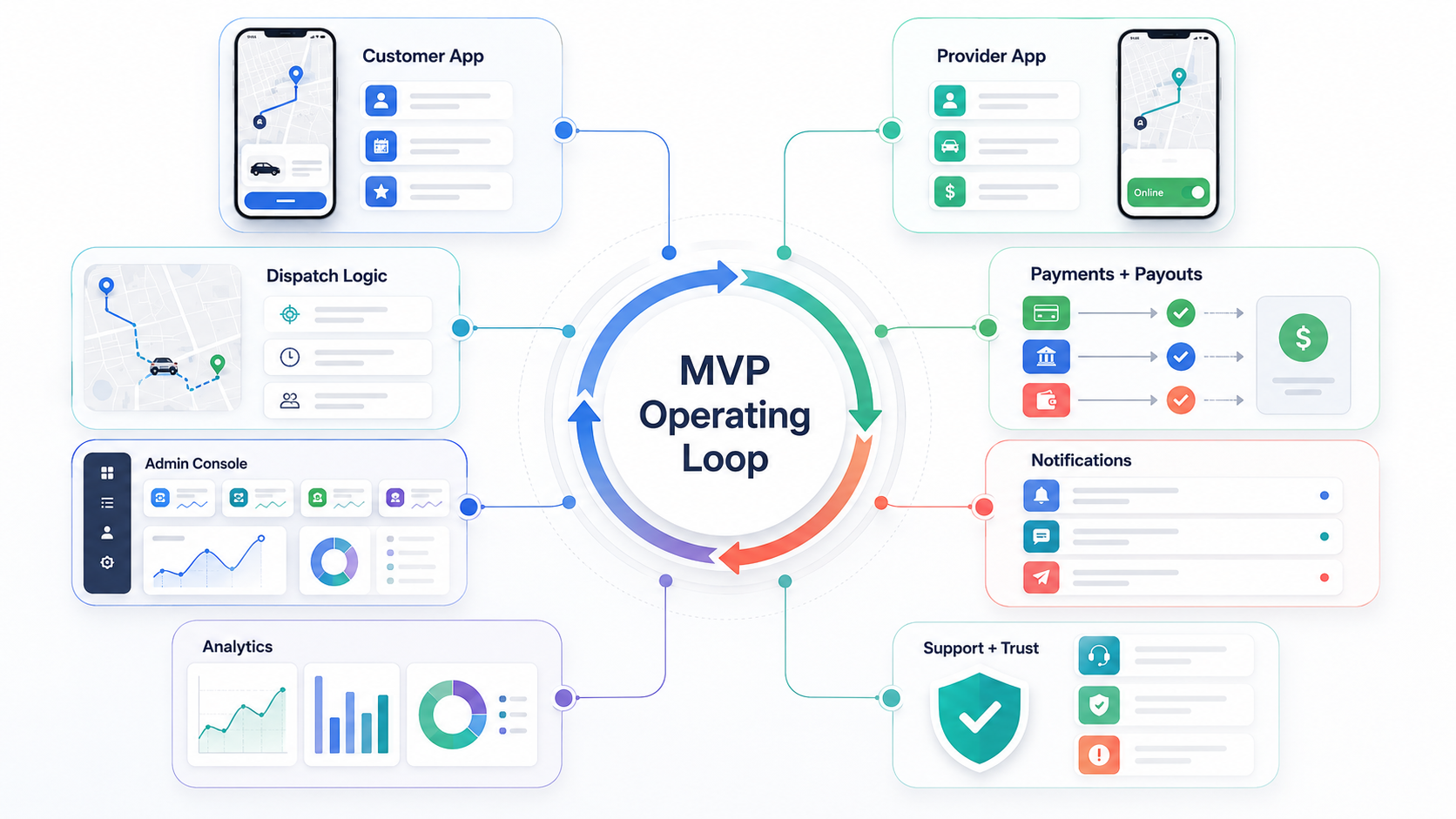
The mistake many on-demand products make is estimating screens before estimating operations. A customer app screen may look simple, but the service behind it has to answer harder questions: who can fulfill this request, where are they, when are they available, what happens if they reject it, how is payment captured, how are refunds handled, and who sees exceptions in admin?
For a delivery, booking, home-service, repair, beauty, logistics, healthcare-at-home, rental, or local services marketplace, the MVP should prove this operating loop:
- Demand capture: customers can describe what they need, where they need it, and when.
- Supply readiness: providers can onboard, show availability, and accept work.
- Matching or dispatch: the platform can assign jobs manually, by rules, or by simple proximity/capacity logic.
- Fulfillment tracking: every job has visible states, timestamps, and support context.
- Payment and payout: the system can collect, refund, record commissions, and prepare payouts without spreadsheet chaos.
- Admin recovery: operations can intervene when providers cancel, customers complain, payment fails, or delivery misses the SLA.
Choose The Marketplace Model Before Choosing Features
On-demand app MVP development changes sharply depending on the marketplace model. A single-operator delivery app is not the same as a multi-vendor marketplace, and a scheduled services platform is not the same as real-time dispatch.
| Model | Release-One Implication | Main Risk |
|---|---|---|
| Owned service team | Start with customer app, dispatcher/admin console, staff/provider workflow, and basic payment. | Manual operations may not scale, but the first release is easier to control. |
| Two-sided marketplace | Provider onboarding, profiles, reviews, commissions, payout records, and dispute workflow matter early. | Trust, supply quality, and payment settlement create operational load. |
| Scheduled booking | Availability, calendars, cancellation rules, reminders, and rescheduling are central. | Double-booking and late cancellations hurt retention. |
| Real-time dispatch | Location, routing handoff, availability, assignment rules, and live status become core. | ETA accuracy, provider acceptance, and support exceptions decide experience quality. |
| Hyperlocal delivery | Zones, store/merchant handoff, pickup proof, driver app, and customer notifications need care. | Thin margins make failed delivery and support costs expensive. |
If your idea is closer to local delivery, study adjacent dispatch-heavy systems such as NextPage's restaurant delivery management software work. If it is closer to a buyer/seller marketplace, the marketplace app development cost guide is a better companion because trust, seller onboarding, commissions, and admin tooling become more important.
MVP Vs V2 Scope Matrix
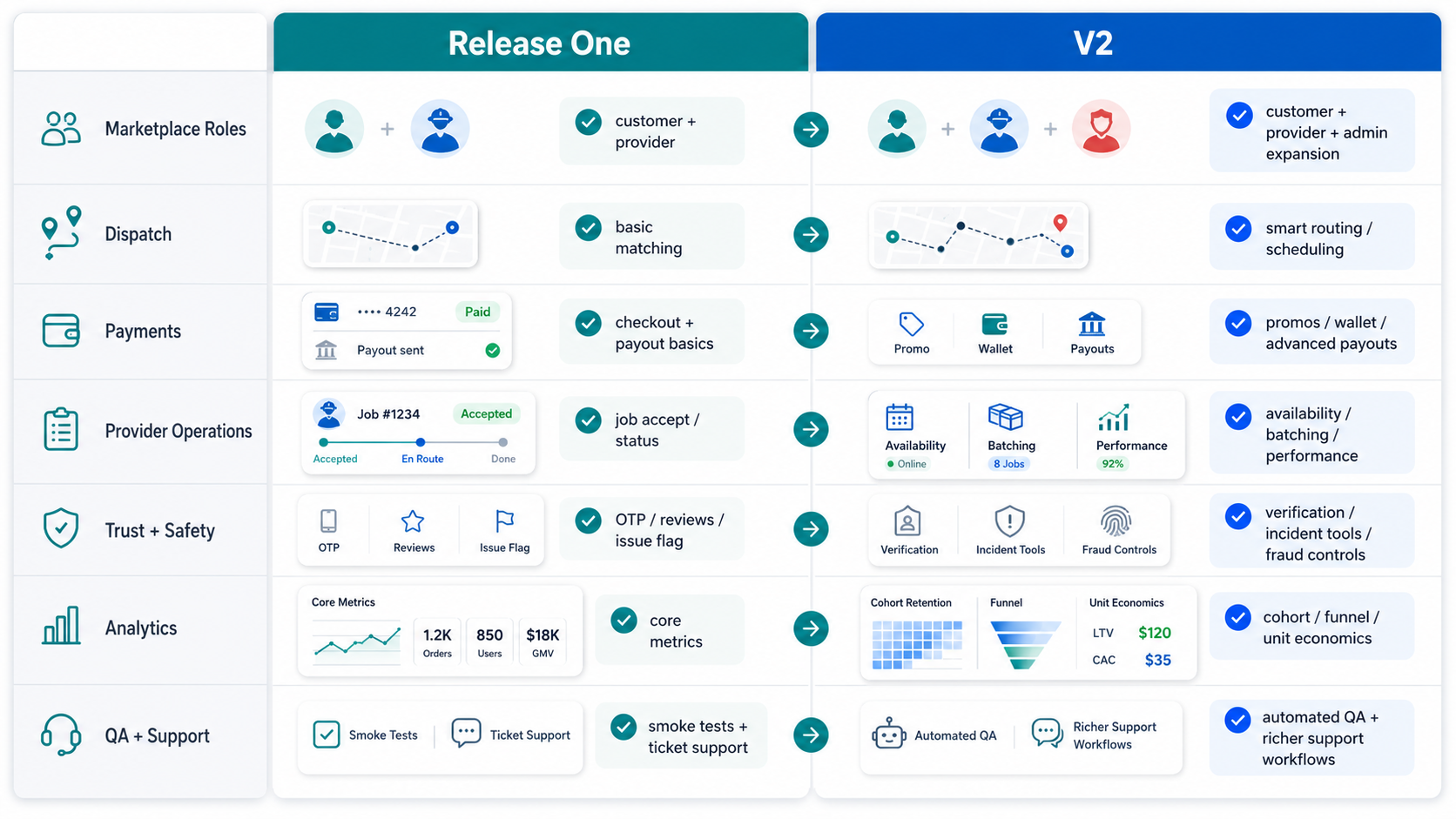
Release one should be just strong enough to survive real transactions. If a feature does not help customers place requests, providers fulfill them, admins recover exceptions, or leadership learn from early usage, challenge it.
- Keep in MVP: role-based onboarding, customer request/order flow, provider availability, admin assignment, payment capture, status notifications, support notes, basic analytics, and operational reports.
- Delay until V2: advanced AI matching, dynamic pricing, loyalty, subscriptions, advanced chat automation, marketplace financing, complex referral systems, and deep BI dashboards.
- Do not skip: admin permissions, audit trails for payment/refund changes, support visibility, provider verification basics, and QA for failed payments and cancelled jobs.
Dispatch: Manual, Rules-Based, Or Automated?
Dispatch is usually the heart of an on-demand app. It determines who receives the job, what the customer sees, how providers accept work, and how operations recover when the first choice fails. For an MVP, manual or rules-based dispatch is often more valuable than premature automation because it lets the team understand exceptions before encoding them.
A practical path is to start with service zones, provider availability, simple priority rules, admin assignment, and status updates. Once the platform has enough volume, add acceptance windows, fallback rules, capacity limits, batching, route optimization, or predictive assignment. NextPage's taxi app development cost guide is a useful adjacent reference because taxi and ride-style products expose how dispatch, driver states, maps, payments, and support drive complexity.
For map-heavy products, treat routing as both implementation work and recurring operating cost. Google Maps Platform's Routes API uses pay-as-you-go pricing based on request type and feature tier, so route previews, ETA refreshes, traffic-aware routing, and tracking frequency should be designed intentionally instead of called on every screen refresh.
Payments And Payouts Are Not Just Checkout
Marketplace payments become a product and compliance decision. If the platform collects money from customers and pays providers, the MVP needs a clear model for payment capture, platform fees, refunds, cancellations, chargebacks, payout timing, provider verification, and support access.
Stripe Connect is a common route for marketplace and platform payments because it supports onboarding connected accounts, collecting payments, and paying sellers or service providers. The important planning point is that payment scope includes identity verification, account capabilities, dispute handling, platform fees, refund rules, and payout records. Do not estimate it as a single \"payment gateway\" task.
For very early validation, some founders begin with manual payout operations after customer payment is captured. That can be acceptable if volume is low and the legal/compliance model is reviewed. For a production marketplace, payout records, provider onboarding, and reconciliation should be visible in admin from the start.
Native, Cross-Platform, Or Web-First?
Many on-demand apps eventually need mobile apps because notifications, provider acceptance, location, route handoff, camera proof, repeat purchasing, and app-store presence matter. But the first release does not always need full native builds for every role.
A customer-facing mobile-first web app can validate some scheduled services or B2B workflows. A cross-platform app can reduce duplicated effort when iOS and Android must launch together. Native development can be justified when performance, location behavior, device APIs, or a polished consumer experience are non-negotiable. NextPage's native vs cross-platform mobile app development guide explains the tradeoffs in more detail.
The practical MVP decision is this: build native where the workflow depends on device behavior, and stay web/admin-first where operations need fast iteration.
The Admin Console Is The Real MVP Backbone
Admin tooling is where on-demand products either stabilize or collapse. Customers and providers will create exceptions: wrong addresses, missed arrival windows, unavailable providers, failed payments, refund requests, safety concerns, duplicate accounts, low-quality service, no-shows, and disputes. The admin console needs enough control for operations to handle these without developer intervention.
At minimum, include user/provider search, job/order detail, assignment controls, status overrides, refund and cancellation records, dispute notes, provider verification state, service zone controls, coupon visibility, notification logs, and reports. Add role permissions early. The person issuing a refund should not always be the person changing provider payout rules.
Trust, Safety, And App Store Readiness
On-demand apps often include user-generated content, provider profiles, ratings, chat, addresses, identity data, and payment information. That makes trust and safety a release-one concern. Apple updated its App Store Review Guidelines on February 6, 2026, and marketplace-style apps still need careful handling around user-generated content moderation, payments, privacy, safety, and review notes.
For an MVP, keep trust practical: provider verification, profile review, report/block flows where interaction exists, support escalation, refund policy visibility, consented location usage, privacy disclosures, and clear app review notes. If the app handles regulated categories such as healthcare, finance, transport, alcohol, or childcare, add domain-specific compliance planning before development starts.
QA Scenarios That Matter More Than Screen Count
An on-demand app needs QA automation testing services coverage around money, timing, location, provider acceptance, and admin overrides. Test the ugly paths, not just the happy path.
- Customer payment succeeds but provider rejects the job.
- Provider accepts but cancels after pickup or travel starts.
- Customer changes address after assignment.
- Payment authorization succeeds but capture fails.
- Refund is partial because cancellation policy applies.
- Provider app loses network during a status transition.
- Admin overrides assignment while customer notifications are pending.
- Map/routing API is slow, quota-limited, or temporarily unavailable.
These cases are why low-cost MVP quotes can be misleading. The visible app may be small, but the system is running real operations.
Launch Readiness Evidence Before Build Kickoff
Before funding the full MVP, align the product, operations, and engineering teams around a small evidence pack. It should prove the first city, category, or provider cohort can actually complete work, not just that the screens look credible.
| Evidence Area | What To Confirm | Why It Matters |
|---|---|---|
| Demand signal | Target segment, request frequency, acquisition channel, and repeat-use assumption. | Prevents building a marketplace before there is a repeatable demand source. |
| Supply plan | Provider onboarding path, verification depth, capacity, acceptance rules, and support owner. | Shows whether fulfillment can keep up with early customer promises. |
| Payment model | Customer charge timing, refund policy, provider payout timing, commission, and reconciliation owner. | Avoids late rebuilds around money movement, disputes, and accounting evidence. |
| Launch boundary | City, zone, category, provider cohort, platform surface, and manual operations limit. | Keeps the MVP small enough to launch while still proving the operating loop. |
| Measurement plan | Request-to-acceptance rate, completion rate, cancellation reasons, support load, refund rate, and repeat usage. | Turns the soft launch into useful product and operations data. |
This evidence pack also makes vendor estimates more honest. If timeline is still unclear after scope lock, compare assumptions against the mobile app development timeline guide before committing to a release date.
A Practical On-Demand MVP Roadmap
- Discovery: define service model, roles, geography, dispatch style, payment model, and support policy.
- Scope lock: separate release-one workflow from V2 automation using the MVP Scope Builder.
- Architecture: choose customer/provider/admin surfaces, backend model, payment provider, maps/routing approach, notification stack, analytics, and observability.
- Build: implement request/order flow, provider workflow, admin assignment, payment states, notifications, and reports.
- Operational QA: test cancellations, refunds, provider rejection, failed payment, late arrival, routing failure, and support escalation.
- Soft launch: limit by city, zone, provider cohort, or service category before scaling supply and automation.
- V2 planning: use actual request, acceptance, completion, cancellation, refund, support, and repeat-use data to prioritize automation.
How NextPage Estimates On-Demand App MVPs
NextPage estimates on-demand MVPs by mapping the operating model first: customer role, provider role, dispatch method, payment and payout path, service geography, admin recovery workflow, integrations, QA risk, and post-launch support. Screen count is secondary. Two apps can both have customer and provider screens, but one may require real-time dispatch, multi-party payments, strict verification, and route tracking while the other can start with scheduled bookings and manual assignment.
A useful estimate should list assumptions clearly: platforms, user roles, provider onboarding depth, service categories, dispatch rules, payment provider, maps/routing usage, notification channels, admin permissions, reporting, support workflow, QA coverage, and launch geography. Once those assumptions are visible, you can trim scope without breaking the operating loop.
For a first budget pass, use the Custom Software Cost Estimator. For scope discipline, use the MVP Scope Builder. Then turn the validated release-one plan into a delivery roadmap with platform, QA, and operations milestones.