
A physical AI software roadmap should start with the manufacturing decision you want to improve, then work backward into sensors, edge inference, simulation, integrations, safety gates, and rollout. Physical AI is not useful because it sounds futuristic. It is useful when software can observe real operating conditions, reason over enough context, recommend or trigger an action, and keep humans in control where downtime, safety, quality, or cost risk is material.
This roadmap is for manufacturing operations leaders, plant technology teams, and product owners planning AI-enabled equipment or workflow automation. Start with readiness: data, sensors, constraints, integration access, operator review, measurable ROI, and the operating boundaries for any automated action. The AI Agent Readiness Assessment is a practical first step when the workflow touches real-world operations and needs governance.
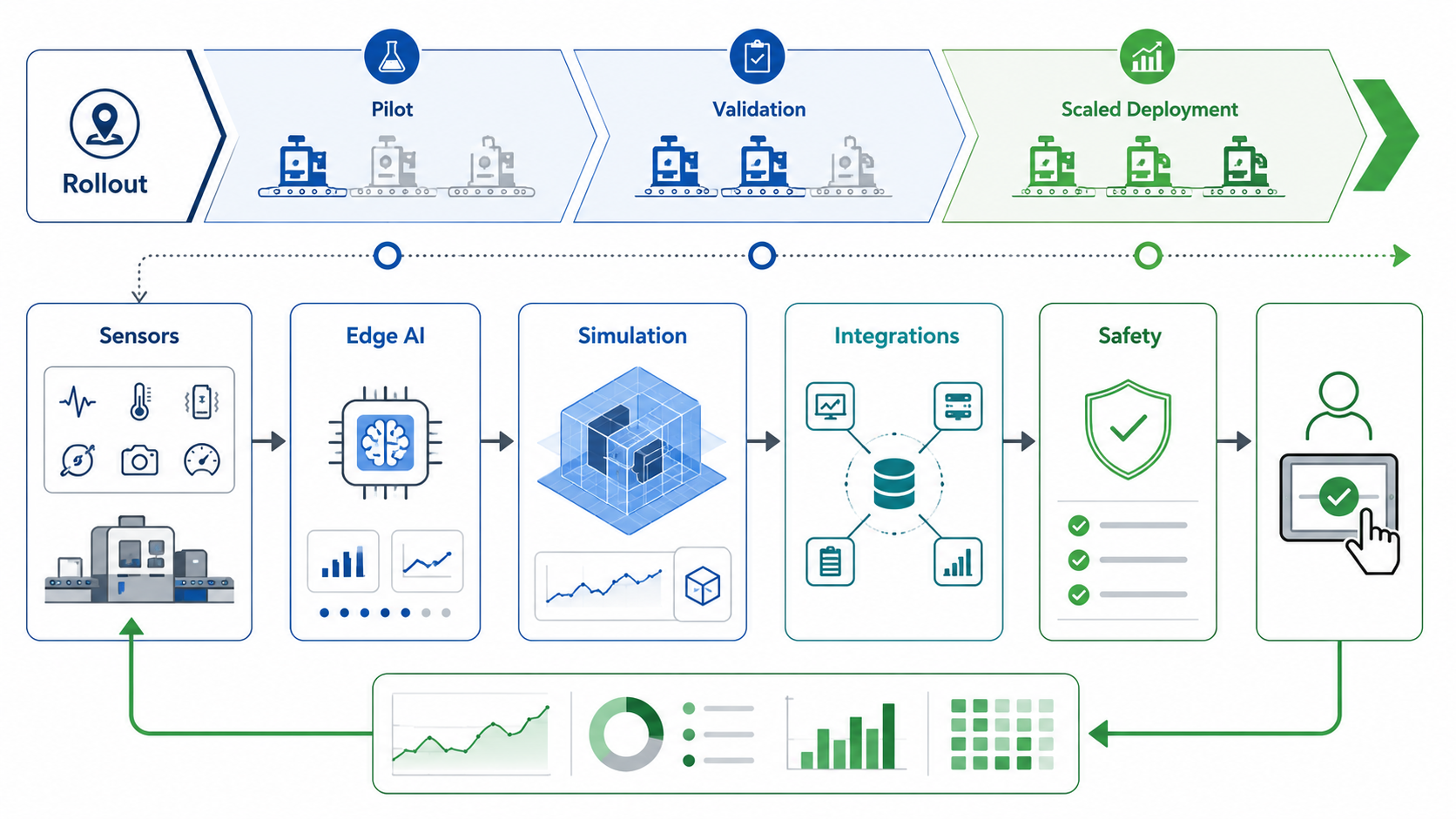
Quick Answer: What Should A Physical AI Software Roadmap Include?
A physical AI software roadmap should include use-case selection, sensor and machine data mapping, edge-vs-cloud architecture, simulation or digital-twin validation, MES/ERP/CMMS integrations, safety gates, operator approval, monitoring, ROI metrics, and phased rollout. The first release should be narrow enough to verify in a real plant environment without putting production stability at risk.
Good starting use cases include predictive maintenance, quality inspection triage, operator guidance, energy optimization, safety anomaly detection, downtime root-cause analysis, and process recommendations. If maintenance is the strongest use case, NextPage's predictive maintenance software with IoT and AI roadmap is the closest companion.
Start With The Physical Workflow, Not The Model
Choose a workflow where AI can improve a specific decision: detect drift before failure, classify defects, recommend process adjustments, route a maintenance task, or alert an operator to a risk condition. Avoid vague mandates such as "add physical AI to the factory." The roadmap needs a named asset, line, process, decision owner, and measurable outcome. If the opportunity is broad, compare it against adjacent AI in manufacturing use cases before funding custom engineering.
| Use Case | Required Signals | Risk Control |
|---|---|---|
| Predictive maintenance | Sensor streams, maintenance logs, fault history, operating conditions. | Human review before work orders affect production schedules. |
| Quality inspection | Images, defect labels, inspection outcomes, product specs. | Sample review and escalation for uncertain classifications. |
| Operator guidance | Process state, SOPs, machine context, shift notes. | Recommendations only until supervisors approve automation. |
| Energy optimization | Machine load, energy usage, schedule, environmental data. | Bounded recommendations and rollback thresholds. |
| Safety anomaly detection | Equipment, location, environmental, and incident signals. | Low false-negative tolerance and immediate human escalation. |
Physical AI Pilot Readiness Scorecard
Before a physical AI pilot is funded, score the workflow against six gates. A weak score does not mean the idea is bad; it means the roadmap should invest in data, integration, controls, or operating ownership before model work starts.
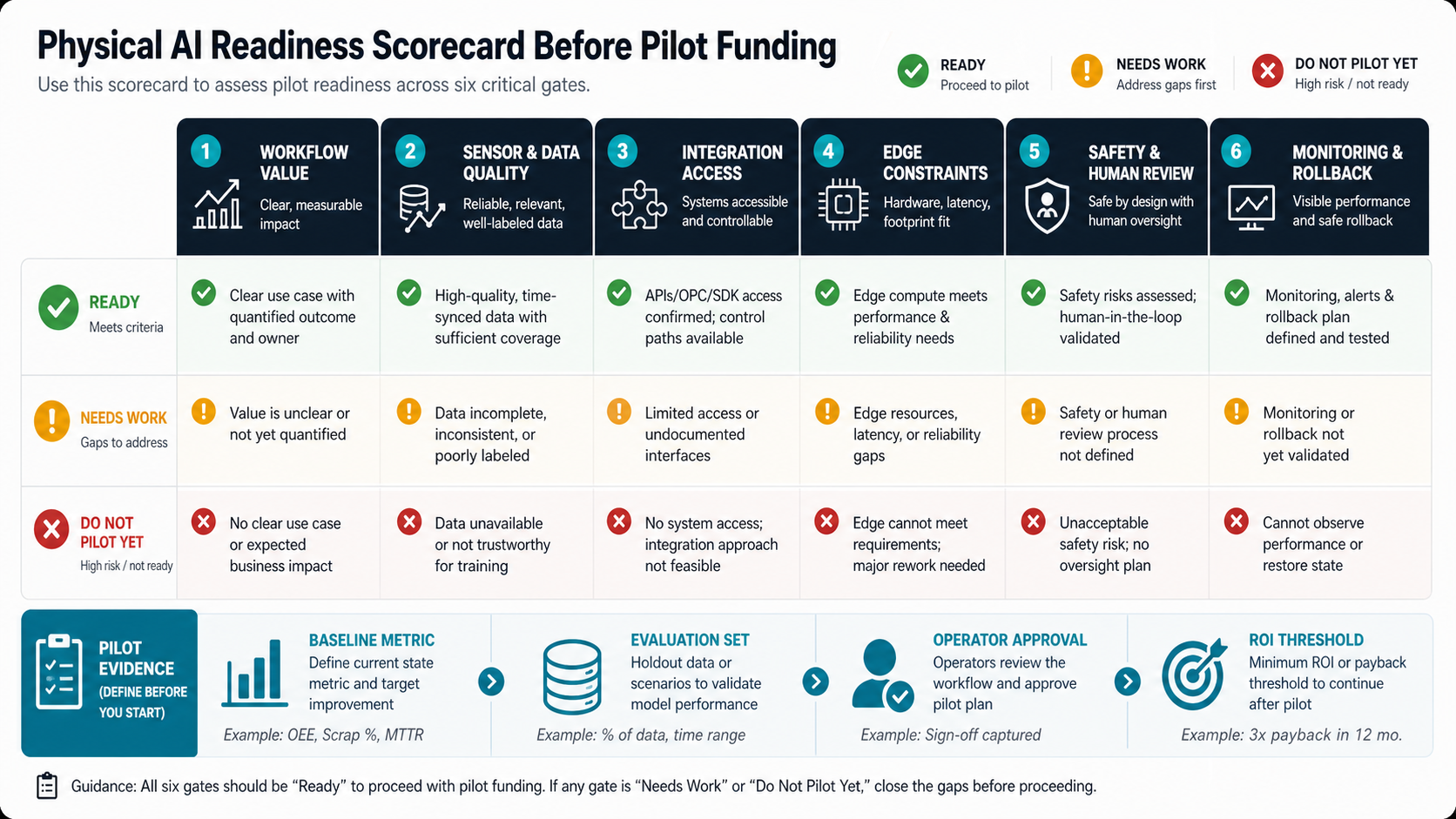
| Gate | Ready Signal | Do Not Pilot Yet If |
|---|---|---|
| Workflow value | One decision owner can name the action, baseline, and target metric. | The idea is only a dashboard or generic automation mandate. |
| Sensor and data quality | Signals connect to asset, product, batch, shift, and operating mode. | Key readings are missing, delayed, untrusted, or detached from outcomes. |
| Integration access | MES, ERP, CMMS, QMS, historian, or edge systems can be read safely. | The team cannot access the systems where decisions become work. |
| Edge constraints | Latency, offline behavior, hardware, update, and support limits are known. | The architecture assumes stable cloud connectivity for a real-time action. |
| Safety and review | Approval states, fallback rules, overrides, and audit logs are defined. | The system would change production behavior without accountable review. |
| Monitoring and rollback | Model quality, drift, adoption, alerts, and rollback are owned. | No one owns production behavior after the demo works. |
This is where the roadmap connects to business case discipline. Use an AI automation ROI calculator to compare the pilot against downtime, scrap, energy, inspection, or response-time improvements before expanding scope.
Build The Sensor And Data Foundation
Physical AI depends on reliable data from machines, sensors, PLCs, SCADA systems, vision systems, historians, MES, CMMS, ERP, and operator inputs. Before model work, define which signals exist, how often they update, how accurate they are, who owns them, and how missing or delayed data should be handled.
The hardest work is often identity and context. A sensor reading must connect to the right asset, product, batch, shift, operating mode, maintenance event, and quality result. Without that mapping, the model may find patterns that cannot be acted on. For many plants, the first software work is not model training; it is custom manufacturing software that makes operational data trustworthy enough for AI.
Decide What Runs At The Edge, In The Cloud, And In Simulation
Use edge inference when latency, network reliability, privacy, or production continuity matters. Use cloud services when the workflow needs heavier analysis, model retraining, fleet-wide learning, dashboards, or integrations that do not require millisecond response. Use simulation or digital-twin environments when changes must be tested before they influence real operations. For visual workflows, the edge AI vs cloud computer vision decision is often the fastest way to expose latency, bandwidth, privacy, and support tradeoffs.
| Layer | Best Fit | Watch Closely |
|---|---|---|
| Edge inference | Fast anomaly detection, local quality checks, offline continuity. | Hardware limits, update process, drift, and monitoring. |
| Cloud AI | Fleet analytics, model training, dashboards, cross-site learning. | Latency, network, data transfer, security, and cost. |
| Simulation | Testing policies, process recommendations, rollout scenarios. | Model fidelity and mismatch between simulated and live conditions. |
For custom model work, machine learning development services should include data readiness, feature engineering, evaluation, monitoring, and retraining plans, not only model training. When cameras or inspection images are part of the workflow, computer vision development services should also cover annotation quality, edge deployment, operator review, and exception handling.
Physical AI Architecture: From Signal To Governed Action
A production roadmap should show how a physical signal becomes a governed action. The pattern is usually sensor capture, edge filtering or inference, cloud learning and fleet analytics, simulation validation, business-system integration, human approval, and monitored rollout. Each handoff needs ownership, latency expectations, failure behavior, and audit evidence.
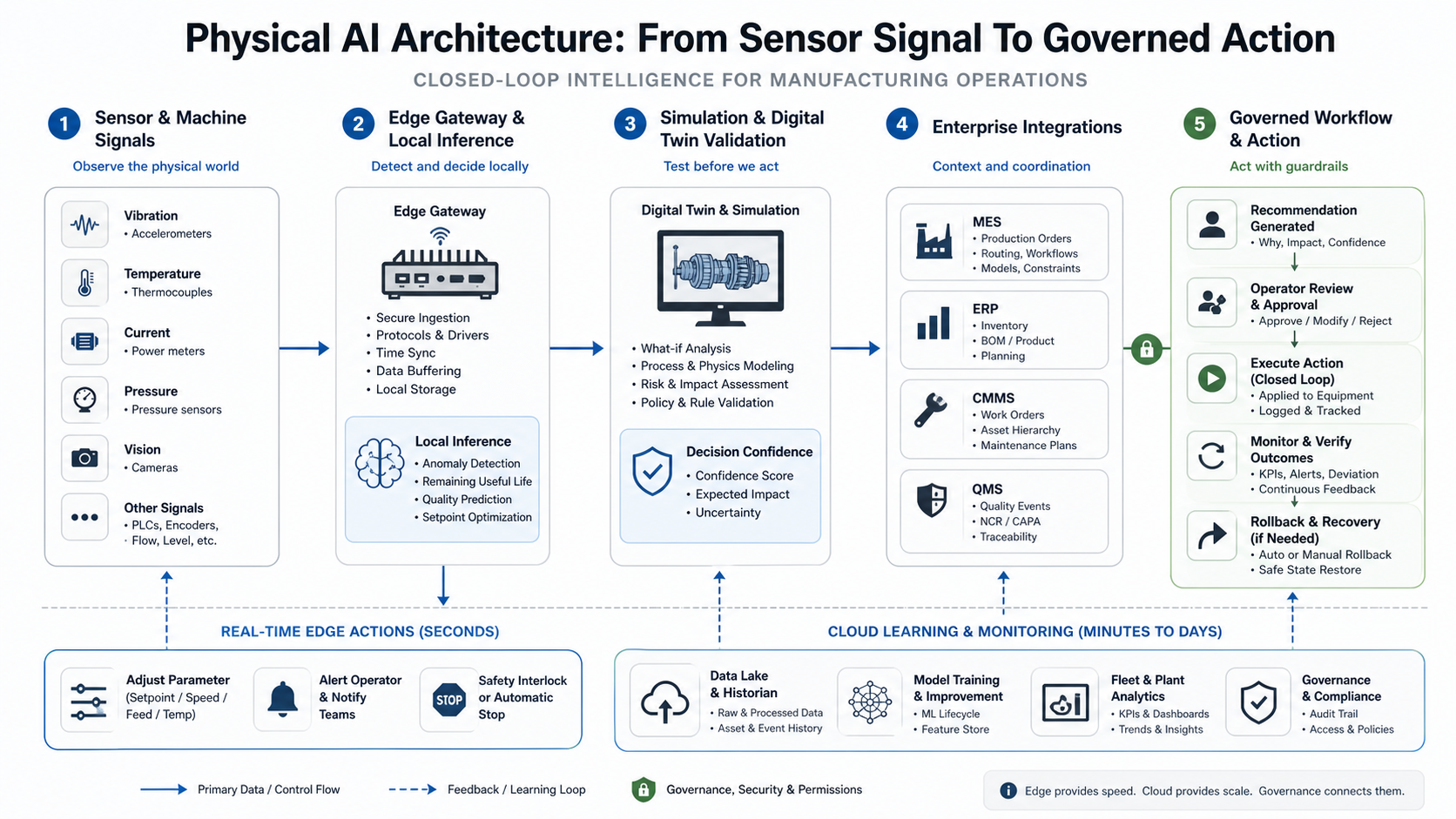
Do not let the model own the whole loop. Let the model produce a recommendation, risk score, classification, or trigger. Let workflow software route it to the right owner with evidence, approval rules, and rollback. This is also where AI agents for manufacturing workflows can help coordinate context across ERP, MES, CMMS, WMS, IoT, quality, and reporting systems without bypassing supervisors.
Connect MES, ERP, CMMS, And Operator Workflows
A physical AI recommendation has value only if it reaches the right system and person. Plan integrations with MES for production state, ERP for orders and inventory, CMMS for maintenance work, QMS for inspection outcomes, historians for time-series context, and dashboards or mobile tools for operators. If the ERP or MES is hard to connect, treat ERP integration modernization services as a roadmap dependency instead of hiding that risk inside the AI estimate.
Decide which actions are read-only, which create tasks, which suggest changes, and which can write back automatically. In most plants, automatic writeback should come late. Start with evidence-rich recommendations, then approved task creation, then tightly bounded automation after the operating team trusts the loop.
Design Safety Gates And Human Review
Physical-world AI needs stronger controls than a reporting dashboard. Define thresholds where the system must escalate, stop, ask for approval, or fall back to the previous process. Capture every recommendation, source signal, confidence, operator decision, and outcome for audit and improvement.
Human review is not a failure. It is part of the rollout model. Operators and supervisors should be able to accept, reject, annotate, and correct recommendations. Those corrections become the evaluation set for the next release.
Physical AI Rollout Roadmap
Phase 1: readiness discovery. Choose one asset, line, or process. Map signals, owners, systems, constraints, safety rules, and baseline metrics.
Phase 2: data and integration foundation. Create the event model, connect source systems, clean labels, define asset identity, and build read paths.
Phase 3: offline evaluation and simulation. Test recommendations against historical data and simulated scenarios before influencing live operations.
Phase 4: assisted pilot. Show recommendations to operators, require approval, track acceptance, false positives, missed events, and operational impact.
Phase 5: governed expansion. Add sites, assets, or limited automated actions only after reliability, safety, and ROI metrics are stable.
Monitoring And Release Gates For Physical AI
Physical AI should not move from demo to plant rollout without release gates. Track model metrics such as precision, recall, false positives, false negatives, drift, latency, and uptime, but also track workflow evidence: operator acceptance, override rate, time to action, avoided downtime, scrap reduction, and support tickets. A model can be technically accurate and still fail if it creates alerts no one trusts.
Release gates should include a frozen evaluation set, representative edge cases, deployment versioning, device health checks, rollback rehearsals, and a defined owner for threshold changes. For safety-critical workflows, keep human review active until the operating team has enough production evidence to tighten or expand automation permissions.
Measure ROI With Operational Metrics
Physical AI ROI should connect to manufacturing outcomes: downtime avoided, maintenance cost reduced, yield improved, scrap reduced, energy saved, inspection time reduced, safety incidents prevented, and operator response time improved. Also measure model and software costs: edge hardware, data pipelines, cloud, monitoring, integration maintenance, and review effort.
Do not scale a physical AI system because a demo looked accurate. Scale it when production metrics show it improves decisions without increasing operational risk. A useful expansion gate combines operating impact, user adoption, support burden, model quality, integration reliability, and rollback confidence.
How NextPage Can Help
NextPage helps manufacturing teams turn AI ideas into software roadmaps: sensor data mapping, edge/cloud architecture, simulation strategy, integrations, operator approval flows, monitoring, and rollout plans. The strongest first release is usually narrow, measurable, and deeply connected to the plant workflow. For broader programs, AI development services can combine discovery, data engineering, application integration, model operations, and production hardening.
Physical AI becomes practical when the software loop is trustworthy. Start with the decision, prove the data, keep humans in control, and expand permissions only after evidence supports the next step.