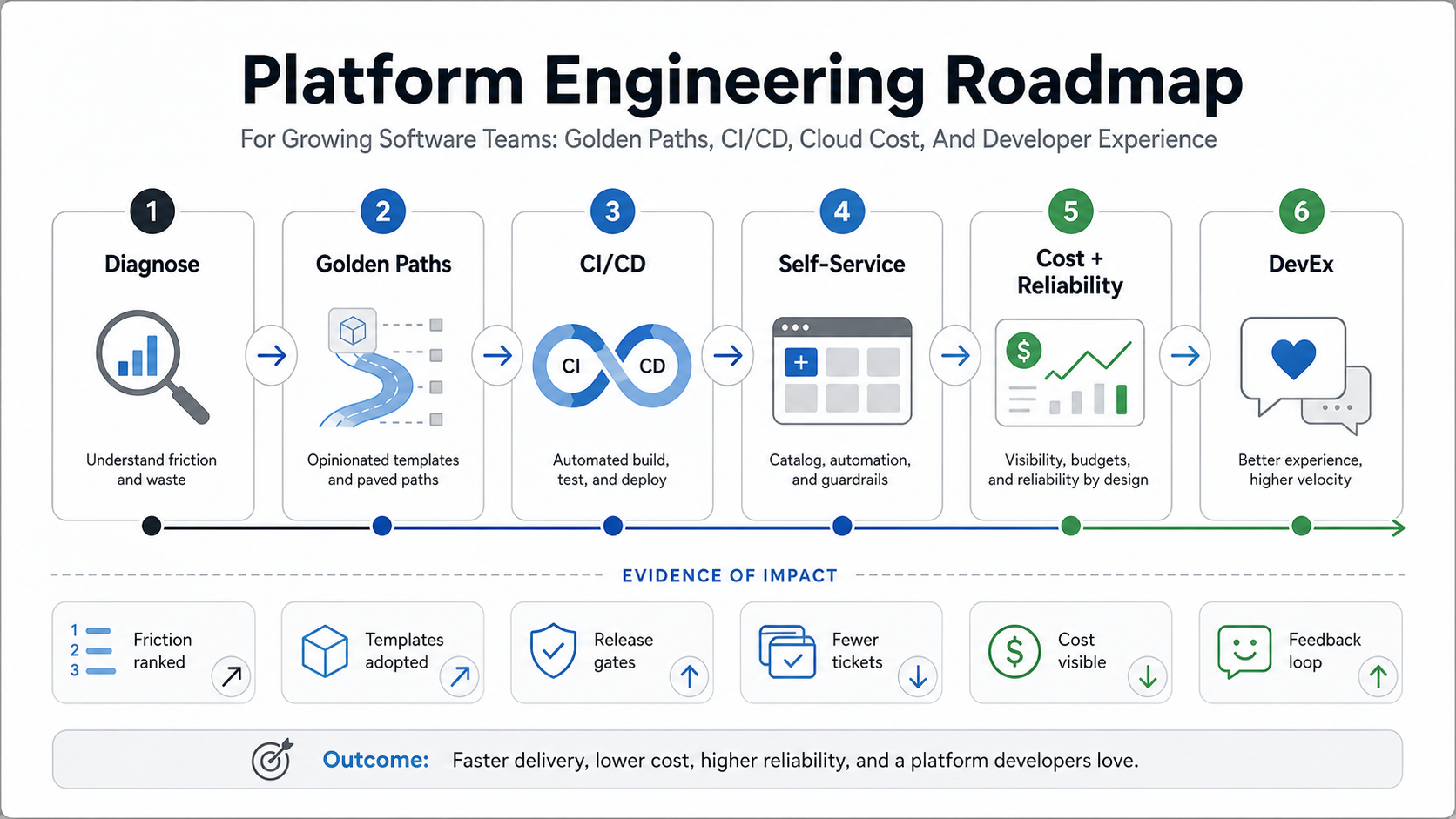

A platform engineering roadmap should start with the delivery friction your teams feel every week, not with a tool purchase. The goal is to give product teams a paved, supported way to build, test, deploy, observe, and operate software without forcing every squad to become experts in cloud infrastructure, CI/CD internals, security policy, and cost governance.
For a growing software organization, the practical roadmap is usually: diagnose repeated delivery pain, define two or three golden paths, standardize CI/CD and environments, add self-service infrastructure, make cloud cost visible inside engineering workflows, measure developer experience, then improve the platform as an internal product. That sequence keeps platform engineering useful instead of becoming another internal portal nobody adopts.
If your release process already depends on scattered scripts, manual approvals, fragile environments, or senior engineers decoding deployment failures, start with a DevOps consulting services review before you build a full internal developer platform. The first win is not a portal; it is a repeatable path teams trust.
Quick Answer: What A Platform Engineering Roadmap Includes
A strong platform engineering roadmap includes six layers: delivery diagnosis, golden paths, CI/CD standards, self-service infrastructure, cost and reliability guardrails, and developer experience feedback. Each layer should remove a measurable source of cognitive load for product teams.
| Roadmap Layer | What It Standardizes | Proof It Is Working |
|---|---|---|
| Diagnosis | Release bottlenecks, environment drift, cloud waste, ownership gaps, and repeated support tickets. | Top friction points ranked by frequency, cost, and business risk. |
| Golden paths | Approved ways to create services, deploy changes, provision dependencies, and observe production. | Teams voluntarily use the path because it is faster than custom workarounds. |
| CI/CD standards | Build parity, test gates, security scans, artifact handling, approvals, rollback, and release evidence. | Shorter lead time, fewer broken releases, cleaner audit trail. |
| Self-service | Templates, service catalog, infrastructure requests, secrets, logs, dashboards, and runbooks. | Fewer platform tickets for routine work. |
| Cost and reliability | Cloud spend signals, SLOs, deployment guardrails, observability, and incident loops. | Cost and reliability are visible before production surprises. |
Why Platform Engineering Matters In 2026
DevOps is being pulled in several directions at once: AI-assisted development increases code and change volume, cloud bills are under closer executive scrutiny, security and compliance checks are shifting earlier, and product teams still need to ship faster. Current DORA guidance frames platform engineering as a sociotechnical discipline that gives teams shared tools, workflows, and golden paths. CNCF guidance similarly treats platforms as internal products rather than a pile of infrastructure automation.
That matters because AI can speed up code generation without fixing downstream disorder. If testing, review, deployment, environments, observability, and cost controls remain fragmented, more code can simply reach the bottleneck faster. Platform engineering becomes the delivery system that converts individual productivity into organization-level throughput.
DORA's platform engineering capability guidance emphasizes reducing developer cognitive load through self-service golden paths, while the CNCF Platform Engineering Maturity Model frames platform growth across investment, adoption, interfaces, operations, and measurement. In practical terms, the roadmap should prove that the platform is easier to use than the old workaround, not just that a portal exists.
The mistake is assuming every company needs a large internal developer platform immediately. Many teams first need simpler foundations: stable environments, consistent pipelines, clear release gates, cost visibility, and ownership. If your SaaS team is still fighting deployment basics, NextPage's DevOps consulting for SaaS teams guide is a better starting point than a platform portal wishlist.
Platform Engineering Roadmap Stages
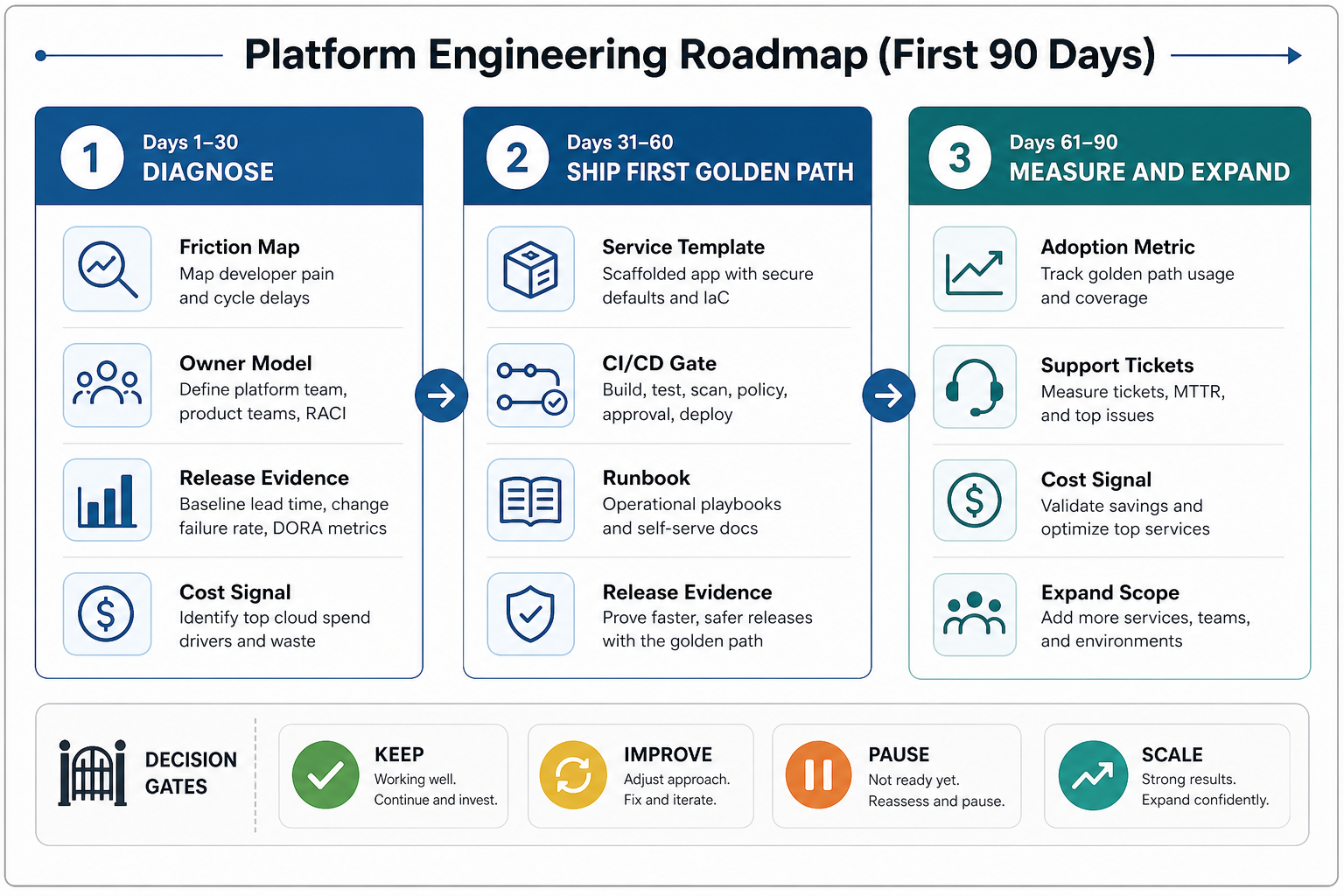
The roadmap should be staged so each phase earns trust with developers and leadership. A useful first release should be narrow, measurable, and boring enough that teams adopt it voluntarily.
- Diagnose the delivery system. Map how a change moves from idea to production. Track handoffs, wait states, failed builds, environment requests, manual approvals, late security findings, rollback gaps, and cloud cost surprises.
- Pick the first golden paths. Start with the workflows product teams repeat most often: creating a web service, deploying an API, provisioning a database, adding a queue, shipping a frontend, or exposing a dashboard.
- Standardize release evidence. Define build, test, security, review, artifact, deployment, rollback, and incident evidence that every team can produce without custom ceremony.
- Productize self-service. Add templates, service catalog, docs, paved CLI or portal actions, runbooks, and ownership metadata only after the underlying path works.
- Add cost and reliability feedback. Put cloud usage, SLO signals, deployment health, and quality gates where engineering teams make decisions.
- Run the platform as a product. Maintain a roadmap, adoption metrics, feedback channels, support SLOs, release notes, and a real prioritization process.
First 90 Days Of A Platform Engineering Roadmap
The first 90 days should create proof, not a platform department. In days 1-30, map the delivery system, rank the biggest friction points, assign platform ownership, and baseline lead time, failed builds, support tickets, cloud waste, and developer sentiment. In days 31-60, ship one golden path for a common workflow such as a new API service, frontend app, or data job. In days 61-90, measure adoption, support load, release evidence, cost signals, and developer feedback before expanding the scope.
This sequence keeps the platform team accountable to outcomes. If adoption is weak, improve the path before adding more templates. If the path is useful but cost or reliability signals are still unclear, add observability and budget controls before a portal rollout. If the path is working, scale it to the next product team or workflow. The point is to prove the platform reduces friction in real delivery work.
Diagnose Before Building An Internal Developer Platform
Before choosing Backstage, Humanitec, Port, cloud-native templates, or custom portal work, interview product teams and inspect delivery telemetry. Ask where teams lose time, where they wait for specialists, where deploys fail, where cloud costs surprise leaders, and where compliance work arrives too late.
Good diagnosis produces a ranked backlog of platform opportunities. For example, a team may discover that environment setup takes three days, production deploys require five Slack approvals, test failures are hard to classify, service ownership is unclear, and cloud cost only appears in finance reports after spend has already happened. Those problems require different roadmap items.
If the current architecture is already brittle, do not hide modernization debt behind a platform layer. Pair platform planning with NextPage's Legacy Software Modernization Scorecard so leaders can separate delivery-system issues from application debt.
Design Golden Paths That Teams Will Use
A golden path is an opinionated, supported route through a common engineering workflow. It is not a rigid rule that blocks every exception. It should make the preferred path faster, safer, and clearer than the custom path.
The first golden path should be narrow enough to finish and important enough to matter. A common example is a production-ready service template that includes repository structure, CI workflow, container build, security scan, infrastructure module, environment promotion, observability hooks, ownership metadata, rollback instructions, and cost tags.
| Golden Path | What It Includes | Common Escape Hatch |
|---|---|---|
| New API service | Repo template, tests, container build, deployment pipeline, logs, alerts, docs, and cost tags. | Custom runtime or special network boundary. |
| Frontend app | App shell, design system, preview deploys, accessibility checks, analytics, and release workflow. | Unusual rendering model or regulated hosting need. |
| Data job | Job template, secrets, schedule, retries, monitoring, lineage, and failure alerts. | High-volume or sensitive data processing path. |
| AI-enabled workflow | Prompt/version control, model access, evaluation, logging, cost caps, and human review. | Private model hosting or regulated data boundary. |
Keep the first path boring. A boring golden path that removes 20 routine support tickets per month is more valuable than a sophisticated portal that only the platform team understands.
CI/CD And Release Standards
Platform engineering should make delivery safer without turning the platform team into a new approval bottleneck. Standard CI/CD should cover build parity, test levels, vulnerability checks, artifact retention, promotion rules, deployment strategy, rollback, environment variables, and release notes.
This is where many organizations get practical ROI quickly. A consistent CI/CD baseline reduces one-off pipeline maintenance, makes QA evidence easier to collect, and gives leadership a clearer picture of release risk. NextPage's QA automation testing services can support the quality-gate side of the roadmap when teams need automated regression, API, UI, and release-readiness coverage.
Do not force every team into identical tests. Standardize the evidence categories and minimum gates; let implementation vary by product risk. The supporting CI/CD testing strategy guide can help teams decide which checks belong in every release gate. A payments workflow, internal dashboard, mobile app, and AI workflow should not have the same test depth, but each should have an explicit release contract.
Cloud Cost And Reliability Controls
Platform teams should treat cloud cost and reliability as design constraints, not cleanup work. Cost-aware deployment means services carry ownership tags, environments have lifecycle rules, previews expire, scaling policies are visible, and product teams can see the cost impact of architecture decisions.
Reliability controls work the same way. The platform should make it normal to define SLOs, expose logs and traces, connect alerts to owners, document rollback, and learn from incidents. When reliability is only an operations concern, developers get feedback too late. When reliability is built into the golden path, teams make better design choices before launch.
If cloud performance optimization, cloud migration, or cloud foundation work is part of the roadmap, align it with delivery standards rather than treating it as an infrastructure-only project. Platform work should reduce friction for future applications, not just move the current mess to a new account structure.
Developer Experience Scorecard
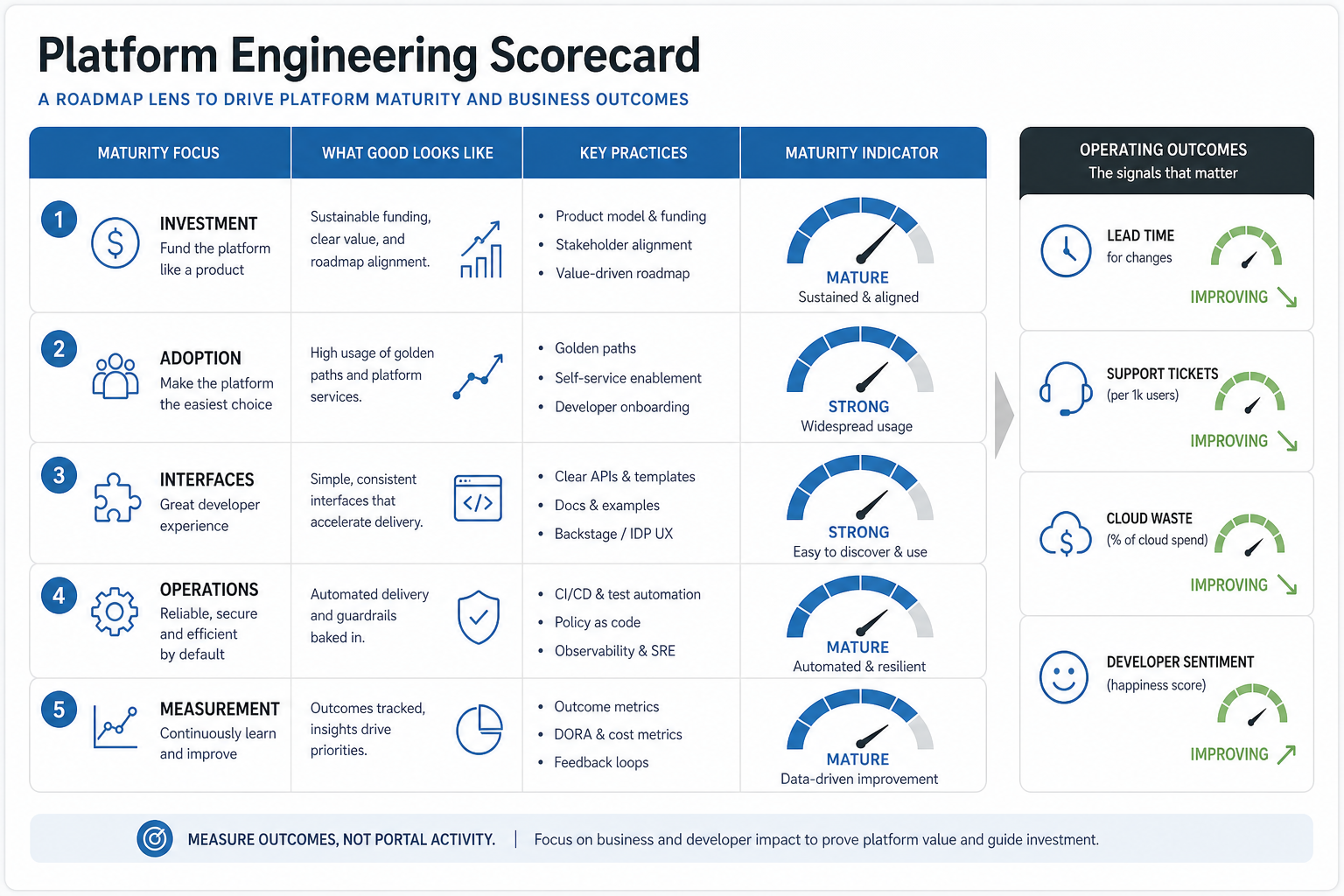
Platform success should be measured through adoption and outcomes, not just the number of templates created. A useful scorecard balances delivery, reliability, cost, and developer experience.
| Metric Group | Useful Signals | What To Avoid |
|---|---|---|
| Delivery | Lead time, deployment frequency, failed build reasons, time to first deploy, release wait states. | Counting commits as productivity. |
| Reliability | Change failure rate, incident frequency, rollback success, alert quality, SLO health. | Only tracking uptime without ownership context. |
| Cost | Spend by service/team, idle environments, preview expiry, cost per workflow, budget alerts. | Finance-only reports that arrive after the fact. |
| Developer experience | Self-service adoption, support-ticket volume, onboarding time, docs usefulness, survey feedback. | Assuming portal usage means developer trust. |
DORA metrics remain useful for software delivery performance, but platform teams also need direct developer feedback. A golden path that technically works but produces confusing errors is still a developer experience problem. The platform backlog should include documentation, error messages, onboarding, and workflow clarity alongside infrastructure automation.
Use the CNCF maturity dimensions as a review lens: investment confirms the platform has durable ownership, adoption proves teams use the golden path, interfaces measure whether APIs/templates/docs are clear, operations shows the platform can be supported, and measurement confirms outcomes are visible. This prevents teams from overvaluing portal activity while ignoring whether delivery is actually faster and safer.
Team Model And Operating Rules
A platform team should behave like a product team serving internal customers. That means a named product owner or technical lead, a visible roadmap, intake rules, support expectations, release notes, user research, and a way to say no to bespoke work that does not fit the platform strategy.
The operating model usually includes three collaboration patterns:
- Self-service: product teams use documented paths without waiting for platform specialists.
- Enabling support: platform engineers pair with teams on early adoption, unusual use cases, and feedback loops.
- Governed exceptions: teams can leave the golden path when business or technical context justifies it, but the exception is visible and owned.
For companies that need faster delivery but cannot staff a large platform team immediately, a dedicated engineering pod can help implement the first golden paths; the Dedicated India Team Cost Calculator is a useful planning input before committing to a larger internal platform team. The Custom Software Cost Estimator can frame the budget range for internal platform tooling, while NextPage's scalable software development services and custom software development teams can support roadmap execution while internal leaders retain architecture and product ownership.
Common Platform Engineering Mistakes
The most common mistake is building for the platform team instead of developers. If a workflow requires developers to understand the platform team's internal abstractions before they can ship, the platform has moved complexity rather than reducing it.
Other common mistakes include starting with a portal before fixing pipelines, copying another company's golden paths without matching your stack, treating cost as a finance-only issue, measuring adoption without sentiment, ignoring security and QA evidence until late, and making the platform team the owner of every production problem.
Platform engineering should not remove product-team ownership. It should make ownership easier by giving teams better defaults, clearer feedback, and safer ways to operate software.
How NextPage Can Help
NextPage helps growing software teams turn delivery friction into a practical platform roadmap: DevOps assessment, CI/CD standardization, cloud foundation, QA automation, internal tooling, observability, modernization, and dedicated delivery support. The goal is not to sell a generic internal developer platform. The goal is to define the smallest platform capability set that removes real blockers for your teams.
If your teams are slowed by fragile releases, inconsistent environments, cloud cost surprises, or repeated DevOps handoffs, start with a readiness review. We can map the current delivery system, rank golden path opportunities, define platform metrics, and build a phased roadmap your engineering teams can actually adopt.