
Quick Answer: What Should A Post-Quantum Cryptography Migration Checklist Include?
A post-quantum cryptography migration checklist should start with a cryptographic inventory, then rank systems by data sensitivity, data lifetime, external exposure, vendor dependency, operational criticality, and migration difficulty. The first practical work is not replacing every algorithm at once. It is finding where RSA, finite-field Diffie-Hellman, elliptic-curve Diffie-Hellman, ECDSA, and related quantum-vulnerable choices are used across applications, TLS endpoints, certificates, APIs, SDKs, mobile apps, firmware, databases, cloud services, signing workflows, CI/CD, backups, and third-party platforms.
As of 2026, NIST has approved the first three post-quantum cryptography standards: FIPS 203 for ML-KEM key establishment, FIPS 204 for ML-DSA signatures, and FIPS 205 for SLH-DSA signatures. NIST has also moved the migration conversation toward practical transition planning, key-encapsulation guidance, and cryptographic agility. That means the right checklist is a software delivery program: inventory first, pilot where interoperability can be tested, demand vendor roadmaps, keep rollback paths, and collect audit evidence.
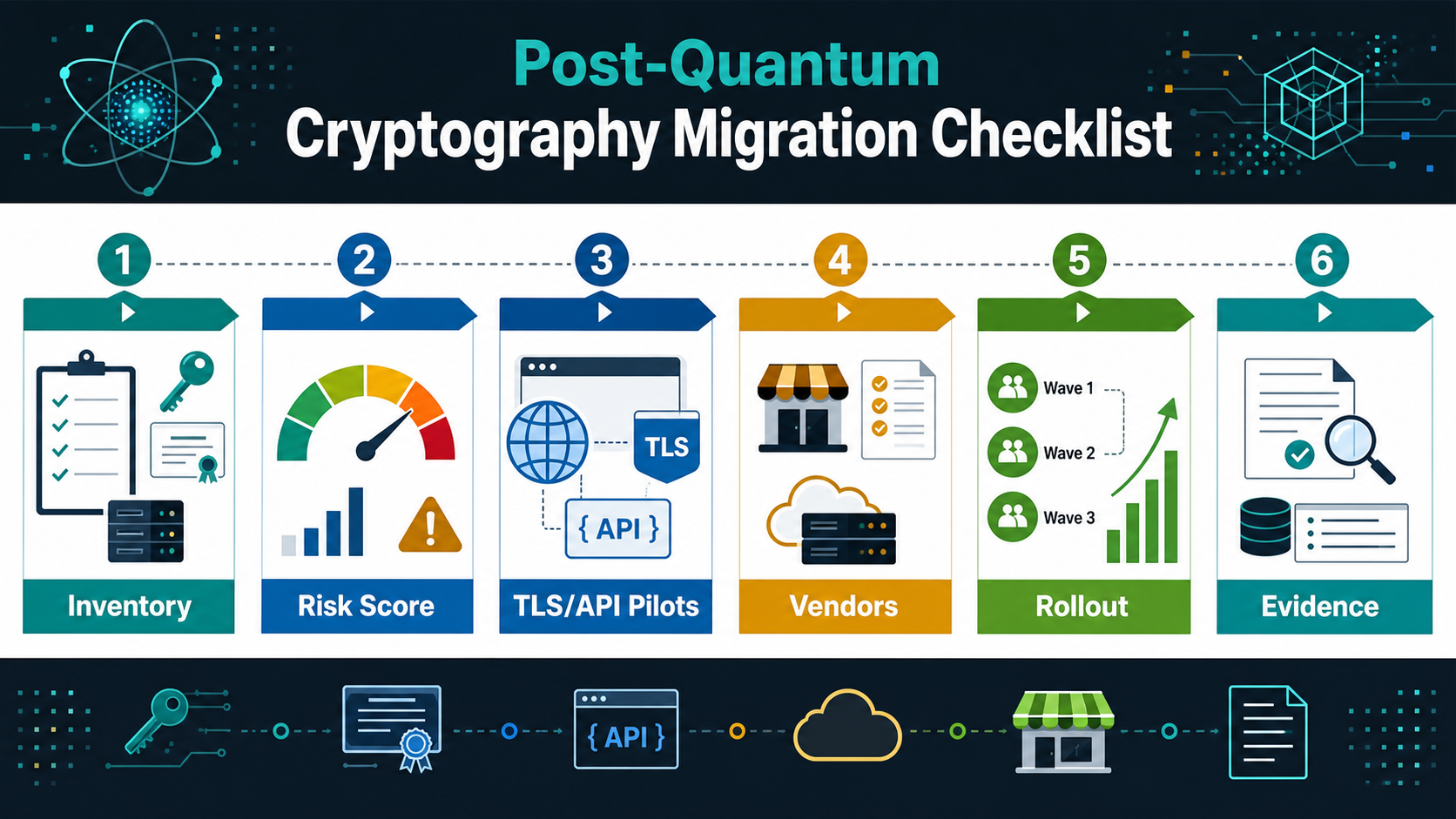
This guide is for CTOs, CISOs, product leaders, and regulated software teams that manage long-lived sensitive data, cloud workloads, customer-facing APIs, mobile apps, embedded devices, or vendor-heavy platforms. If your application estate is old enough that nobody can quickly explain where encryption and signing happen, pair this checklist with an application migration readiness audit or the Legacy Software Modernization Scorecard before making broad cryptography changes.
Why Start Before A Cryptographically Relevant Quantum Computer Exists?
The business reason is data lifetime. Some attackers can collect encrypted traffic or archived files today and decrypt them later if the protected information remains valuable when stronger quantum computers arrive. This harvest-now-decrypt-later risk matters most for health records, financial data, government data, intellectual property, legal archives, identity records, authentication material, and sensitive B2B contracts.
The engineering reason is migration time. Cryptography is rarely isolated in one library. It appears in TLS termination, mutual TLS, SSO, certificates, mobile SDKs, browser compatibility, payment integrations, database encryption, message queues, file transfer, firmware updates, document signing, package signing, CI/CD, backups, vendor platforms, and operational scripts. A rushed algorithm swap can break clients, certificates, hardware devices, compliance evidence, and rollback plans.
The current official guidance points in the same direction: create an inventory, build a roadmap, understand dependencies, and prepare crypto-agile systems before broad production changes. That is why a PQC migration should be managed like a modernization and release-readiness program, not like a one-time library upgrade.
1. Build A Cryptographic Inventory
Start with an inventory that is useful to engineers, not a vague spreadsheet. For each system, capture the application owner, data type, data retention period, cryptographic use, algorithm, library, key length or parameter set, certificate authority, protocol, external dependency, vendor owner, renewal date, deployment environment, and whether the cryptography is directly controlled by your team.
| Inventory Area | What To Capture | Why It Matters |
|---|---|---|
| TLS And Certificates | Public sites, API gateways, mTLS, internal service mesh, certificate algorithms, expiry dates, client compatibility. | TLS changes are visible to customers, partners, bots, mobile apps, and legacy clients. |
| Application Code | Crypto libraries, custom wrappers, token signing, password reset links, data encryption, API auth, dependency versions. | Old code often hides direct algorithm choices or outdated libraries. |
| Data Stores And Backups | Encrypted fields, key management, backup encryption, retention windows, export workflows. | Long-lived data should be prioritized before short-lived operational traffic. |
| Mobile, Desktop, And Edge Clients | SDK versions, pinned certificates, offline storage, firmware update signing, app-store release cadence. | Client update cycles can be slower than server changes. |
| Vendors And Cloud Services | SaaS security docs, KMS/HSM capabilities, certificate automation, API roadmap, contract obligations. | You cannot migrate dependencies you do not control without vendor commitments. |
If your estate has many old integrations, use the dependency mapping approach from the legacy application modernization roadmap. PQC migration is easier when teams already know which systems depend on which APIs, jobs, certificates, and data flows.
2. Score Systems By Quantum Migration Priority
Do not prioritize by technology fashion. Prioritize by risk. Give every system a score for data sensitivity, data lifetime, exposure, cryptographic control, vendor dependency, operational criticality, and replacement difficulty. The highest score should not automatically mean “migrate first tomorrow”; it means the system deserves earlier discovery, vendor questions, proof-of-concept planning, and budget attention.
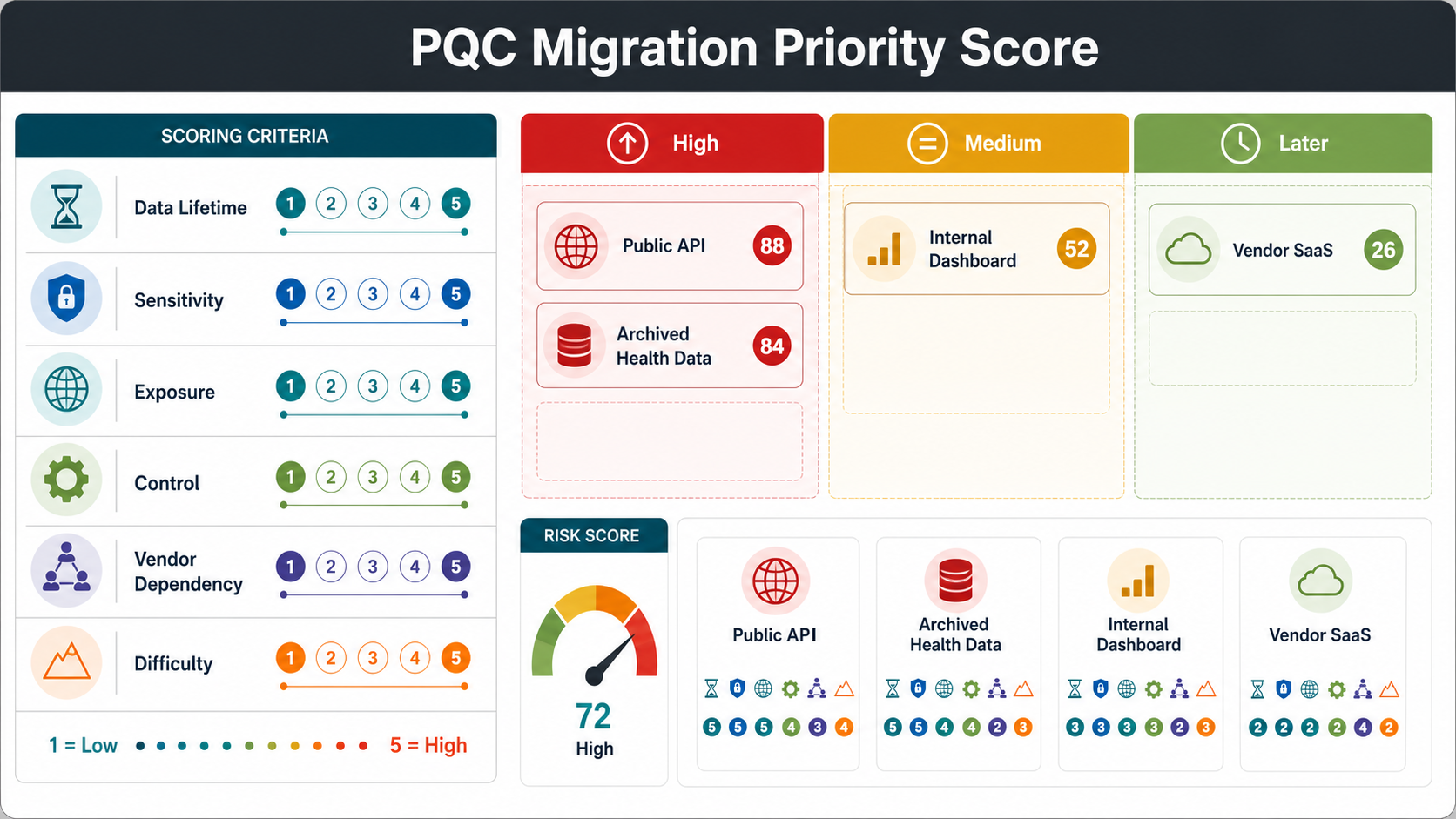
- High priority: long-lived sensitive data, public APIs, regulated workflows, customer identity, payment-adjacent systems, signed firmware, high-value B2B integrations, and systems with hard vendor deadlines.
- Medium priority: internal apps with sensitive data, partner portals, older SaaS integrations, admin tools, and systems with normal client update paths.
- Lower priority: short-lived, low-sensitivity internal traffic where libraries and platforms will be upgraded naturally before data becomes exposed.
This scoring keeps the program pragmatic. A low-risk internal dashboard should not delay inventory and pilot work for a public API that exchanges long-lived customer data with enterprise clients. When older systems score high because they cannot upgrade libraries or certificates safely, use a modernization risk review before choosing a cryptography path.
3. Plan TLS, API, And Certificate Pilots Carefully
TLS and certificates will be one of the most visible parts of the transition. Current IETF work around hybrid ECDHE plus ML-KEM for TLS 1.3 shows the practical direction: combine classical and post-quantum mechanisms during the transition so teams can test interoperability while standards, certificate automation, libraries, CDN behavior, and vendor support mature.
For software teams, the pilot checklist should include:
- Pick non-critical but realistic endpoints first, such as a staging API, partner sandbox, internal service mesh segment, or controlled employee-facing route.
- Record baseline handshake latency, certificate size, error rates, client compatibility, CDN behavior, WAF behavior, observability, and logging coverage.
- Test mobile apps, older browsers, SDKs, API clients, server-to-server integrations, bots, monitoring probes, partner systems, and certificate pinning assumptions.
- Define rollback steps before changing production endpoints.
- Keep certificate automation, expiry monitoring, incident runbooks, and release notes updated with the pilot details.
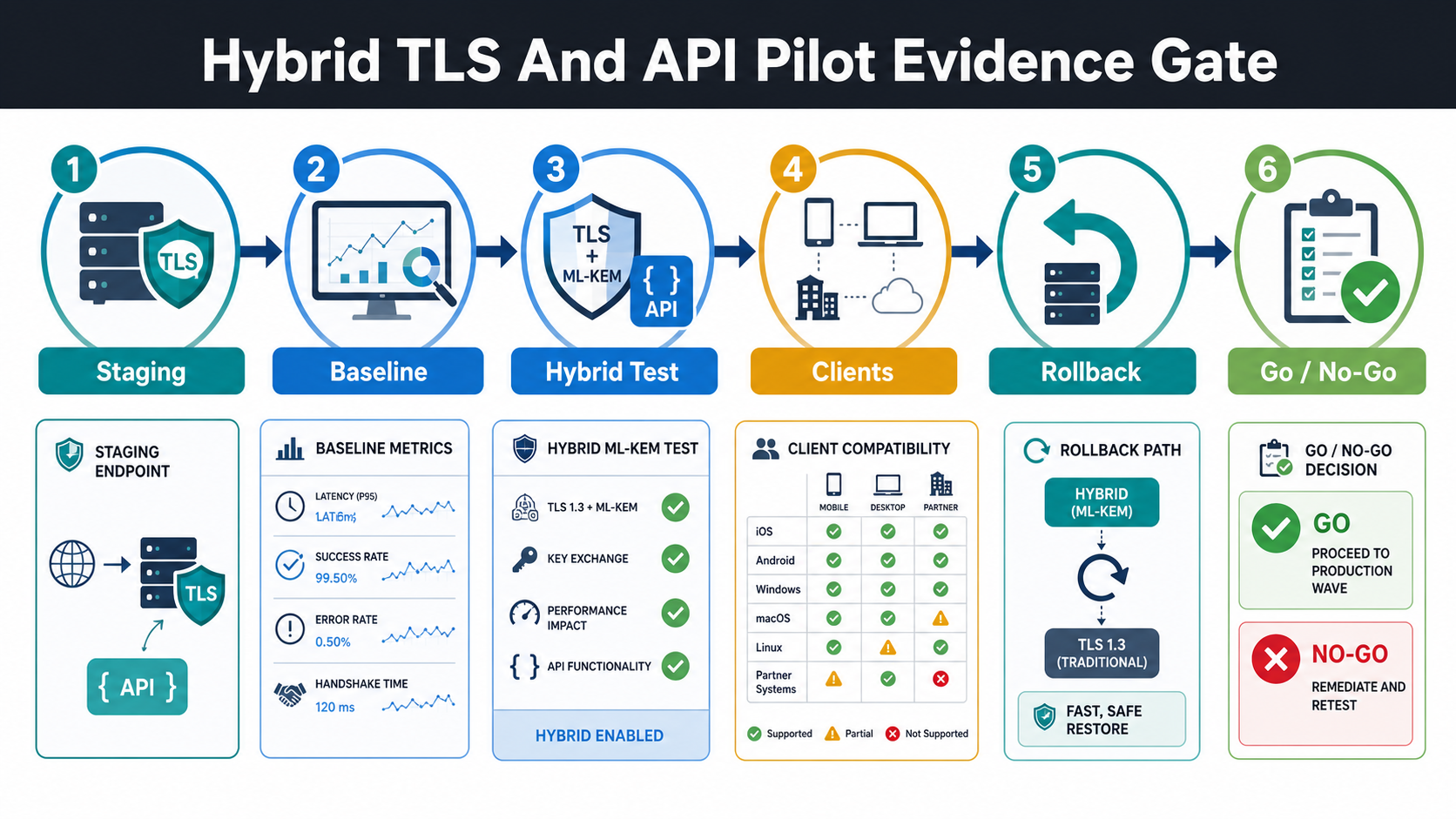
Cloud-hosted systems should connect this work to the same readiness discipline used in cloud migration services: workload inventory, dependency mapping, security controls, rollout windows, observability, cost visibility, and rollback criteria. If the pilot affects web apps, portals, APIs, or customer-facing integrations, include security testing services or web application penetration testing in the release gate so protocol changes do not hide broken authentication, access control, or API validation behavior.
4. Ask Vendors And Cloud Providers Better Questions
Most teams will not control every cryptographic surface. SaaS platforms, identity providers, payment gateways, certificate authorities, cloud KMS/HSM services, API vendors, device vendors, observability vendors, and managed databases all need review. Ask vendors for specifics, not broad claims.
- Which PQC standards, hybrid modes, or crypto-agility features are on the roadmap, and for which products?
- Which customer-controlled settings will change, and which will be automatic?
- How will certificates, keys, signatures, logs, exports, backups, and APIs be affected?
- What compatibility impact is expected for old clients, SDKs, appliances, mobile apps, browsers, or partner integrations?
- What audit evidence, implementation dates, test environments, and customer notices will be available?
- How will vendor changes affect your data residency, backup, retention, and disaster recovery model?
Where sensitive records move between systems, borrow controls from data migration planning: field mapping, validation evidence, rollback paths, access controls, and post-cutover reconciliation. PQC readiness is not only a cryptography issue; it is also a dependency, procurement, vendor-management, and evidence issue.
5. Build Crypto Agility Into New Software
New systems should avoid hard-coded algorithms and hidden cryptography choices. A crypto-agile design makes it possible to update algorithms, parameter sets, libraries, certificate policies, key-management patterns, and protocol negotiation without rewriting the product. NIST's crypto-agility guidance reinforces this operating idea: teams need strategy, governance, inventory, testing, and upgrade pathways, not only new algorithm names.
Good engineering practices include centralizing cryptographic wrappers, using maintained libraries, separating policy from implementation, automating certificate and key rotation, adding algorithm metadata to logs where safe, keeping dependency upgrades routine, documenting approved algorithms, testing protocol negotiation in CI, and making fallback behavior explicit. This is also where legacy modernization matters: if a critical app cannot safely upgrade its crypto library, the real blocker may be an outdated runtime, brittle deployment, missing tests, unsupported infrastructure, or unclear ownership.
For new product work, make crypto agility part of the architecture review. For legacy systems, pair the inventory with the modernization scorecard so leadership can see which systems need stabilization, refactoring, migration planning, or replacement before cryptography changes are realistic.
6. Use Phased Rollout Waves
A realistic PQC migration roadmap usually has five waves:
- Discovery: inventory systems, owners, algorithms, data lifetime, certificates, keys, vendors, client dependencies, and known exceptions.
- Risk ranking: choose priority systems using sensitivity, retention, exposure, operational impact, and migration complexity.
- Pilots: test hybrid TLS, signing, key-management, or vendor changes in controlled environments with monitoring and rollback.
- Production waves: migrate low-blast-radius production surfaces first, then critical systems after client and vendor compatibility is proven.
- Governance: update standards, procurement questions, CI/CD checks, runbooks, audit evidence, renewal calendars, and exception reviews.
This mirrors broader migration discipline. The teams that succeed are usually not the teams with the most dramatic roadmap; they are the teams with clear owners, testable phases, realistic dependency maps, and evidence that each wave worked. The AWS database migration checklist is a useful comparison point because it treats security, validation, cutover, and rollback as first-class work rather than launch-week cleanup.
7. Collect Evidence As You Go
For regulated or enterprise environments, evidence matters as much as implementation. Keep records of the inventory, risk scoring method, vendor responses, pilot results, affected systems, approved exceptions, rollout dates, monitoring dashboards, incident plans, rollback tests, and post-change validation. Evidence helps security, compliance, procurement, customer-success, and executive teams answer the same question: which cryptographic risks are known, which are reduced, and which remain accepted for now?
Borrow evidence habits from the data migration checklist: define proof before the first rehearsal, record exceptions, set owner signoff, and make rollback criteria measurable. For security review, the OWASP vulnerability assessment guide is a useful model for turning findings, remediation, and retesting into release evidence.
How NextPage Helps With PQC Migration Planning
NextPage helps teams turn security and migration goals into executable software plans. For PQC readiness, that usually means mapping applications and dependencies, identifying legacy systems that cannot upgrade cleanly, planning cloud and API rollout waves, improving test coverage, and creating the evidence package needed for stakeholders.
If your team needs a starting point, begin with a cryptographic inventory and modernization risk review. For older systems, the Legacy Software Modernization Scorecard can help prioritize brittle applications before they block security work. For cloud-heavy estates, a cloud migration assessment can combine dependency mapping, security controls, and rollout planning into one roadmap.