
Quick Answer: Real Estate IoT Platform Development
Real estate IoT platform development is the software work that turns building devices, facility systems, tenant workflows, and portfolio reporting into one operating layer. The platform may ingest data from HVAC, lighting, access control, elevators, occupancy counters, air quality monitors, submeters, water systems, cameras, and security devices. It then turns that data into dashboards, alerts, automations, tenant app features, predictive maintenance workflows, and ROI evidence.
The cost and timeline depend on integration depth, device variety, building count, data quality, mobile app scope, analytics needs, security controls, and whether the team is building a pilot or a portfolio platform. A focused smart-building MVP may start with one building, a few device categories, a facility dashboard, and energy or maintenance reporting. A portfolio-grade platform adds multi-building permissions, normalized telemetry, tenant mobile workflows, AI alerts, BMS integrations, compliance reporting, and executive ROI views.
Use NextPage's IoT app development services path when the core challenge is telemetry, device data, cloud architecture, and post-launch support. If the building product includes tenant-facing mobile workflows, pair that plan with mobile app development so access, service requests, notifications, permissions, and release operations are designed as part of the same product.
Why Smart Buildings Need A Software Platform
Smart buildings often start with separate vendors: HVAC controls, lighting systems, access control, occupancy sensors, cameras, elevators, energy meters, and tenant apps. Each system may have its own dashboard. That can work for a small pilot, but it becomes difficult when property teams need portfolio-level operations, consistent tenant experiences, and reliable ROI reporting.
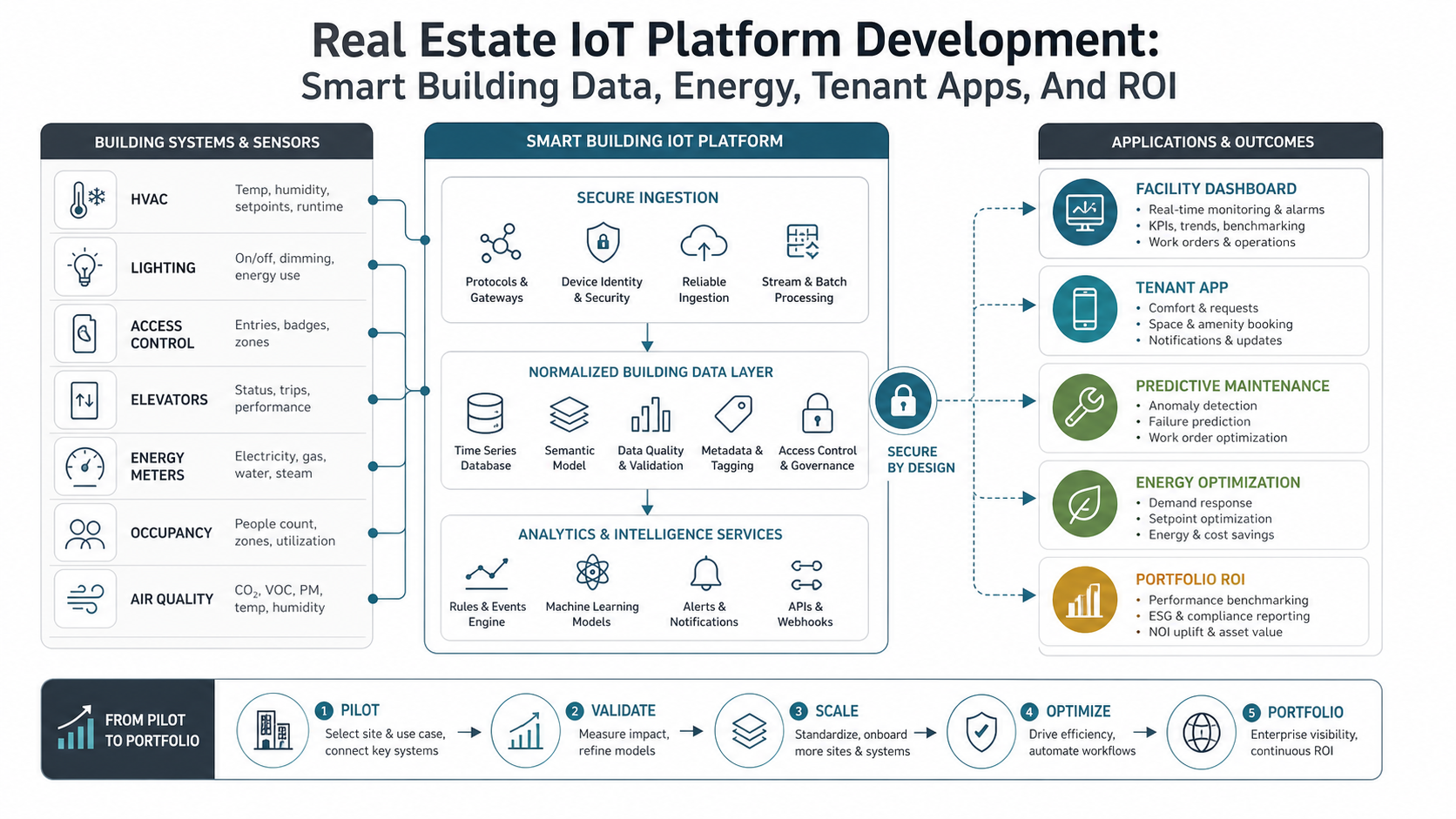
The software platform is the layer that makes building data useful. It normalizes device events, stores telemetry, applies rules, routes alerts, gives facility teams a single view, connects tenant-facing workflows, and exposes the metrics executives need: energy savings, work order reduction, uptime, comfort, utilization, and payback period.
Current smart-building coverage often lists use cases such as energy management, predictive maintenance, occupancy tracking, automated access control, and air quality monitoring. Those use cases are real, but they do not happen just because devices exist. They need data pipelines, permissions, alert rules, integrations, and operational ownership. That is why real estate IoT platform development should be scoped as custom operating software, not only as device installation.
2026 Smart Building Context: Why The Software Layer Matters
The smart building market is moving from isolated automation systems toward integrated platforms. Grand View Research estimates the global smart building market at $164.7 billion in 2026 and projects $554.0 billion by 2033, with IoT-enabled building management, energy efficiency, automation, and AI-driven analytics as major growth drivers. That growth creates more choices, but also more integration risk.
NIST's building systems cybersecurity work highlights the same direction from a risk angle: HVAC and other building services are increasingly connected internally, externally, and through cloud service partners. Building owners now need security, governance, and lifecycle controls that fit building systems, not just office IT.
The practical takeaway is simple: do not buy devices faster than the organization can govern, integrate, and act on their data. A modern platform should make the safe path visible for property operations, facility teams, tenants, security, finance, and executives.
Real Estate IoT Platform Architecture
A practical platform architecture has five layers. The first is the device and gateway layer: sensors, meters, controllers, BMS connectors, edge gateways, and protocols. The second is ingestion: secure device onboarding, telemetry collection, data validation, event streams, and API adapters. The third is the platform core: device registry, building model, user roles, rules engine, time-series storage, audit trails, and notifications.
The fourth layer is experience: facility dashboards, tenant mobile apps, admin tools, maintenance queues, reporting, and portfolio views. The fifth is intelligence: anomaly detection, energy baselines, predictive maintenance, occupancy analytics, and AI recommendations. Building the fifth layer before the first three are stable usually creates unreliable alerts and weak adoption.
| Layer | What It Handles | Common Build Decisions |
|---|---|---|
| Devices And Gateways | Sensors, meters, controllers, HVAC, lighting, access, elevators, BMS | Protocol support, gateway strategy, edge buffering, vendor ownership |
| Data Ingestion | Telemetry, events, API pulls, webhook events, validation, retries | Streaming vs batch, data quality rules, device health, failure handling |
| Platform Core | Building model, device registry, permissions, rules, storage, alerts | Multi-tenant roles, time-series storage, audit logs, alert routing |
| Apps And Dashboards | Facility dashboard, tenant app, admin tools, executive reports | Role-specific UX, mobile scope, SLA views, portfolio rollups |
| Analytics And AI | Energy insights, predictive maintenance, occupancy analytics, anomaly alerts | Baseline definition, model validation, human review, false-positive control |
For reporting-heavy products, connect this architecture to custom dashboard development services early. Real estate dashboards need trusted data definitions, role-based views, refresh rules, auditability, and action paths, not only charts.
Use Cases And ROI Metrics To Prioritize
The best first use case is usually the one with measurable operational value and accessible data. Energy management is common because utilities, HVAC schedules, occupancy, and comfort targets can be tied to cost. Predictive maintenance is attractive when equipment failures create tenant disruption or expensive emergency work. Occupancy analytics helps with space planning, cleaning schedules, and HVAC demand. Tenant apps can improve experience when they connect access, service requests, amenities, communication, and comfort feedback.
| Use Case | Platform Features | ROI Evidence |
|---|---|---|
| Energy Optimization | Meter data, HVAC schedules, occupancy context, anomaly alerts, baseline reports | Utility reduction, peak demand control, carbon and sustainability reporting |
| Predictive Maintenance | Equipment telemetry, fault detection, alert routing, work order integration | Reduced downtime, fewer emergency repairs, longer asset life |
| Tenant Experience | Mobile app, service requests, access, announcements, comfort feedback | Faster issue resolution, satisfaction signals, retention support |
| Occupancy Intelligence | People-counting data, room or zone usage, dashboards, cleaning and HVAC triggers | Space utilization, better staffing, demand-led operations |
| Access And Security | Credential workflows, access logs, visitor flows, exceptions, admin audit trail | Fewer manual processes, better incident visibility, cleaner compliance evidence |
Do not promise ROI before the baseline is defined. A credible platform should capture before/after energy use, maintenance response time, asset downtime, tenant issue categories, and occupancy patterns. If the business case is still unclear, use the AI Automation ROI Calculator to stress-test the automation and analytics economics before funding broad predictive features.
What To Include In A Smart Building IoT MVP
A strong MVP focuses on one property or a small group of comparable buildings. It should prove that data can be collected reliably, operators trust the alerts, and the first business metric improves. Trying to connect every device type and every property on day one usually delays value.
- Building and device model: properties, floors, zones, assets, device types, gateways, and data ownership.
- Telemetry ingestion: a limited set of sensors or systems, device health checks, validation, retries, and data retention rules.
- Facility dashboard: current state, alerts, trends, equipment status, energy and occupancy snapshots, and work queue links.
- Rules and notifications: thresholds, anomaly triggers, escalation paths, false-positive handling, and alert history.
- ROI reporting: baseline, selected metric, pilot period, savings or impact view, and executive summary export.
Use the MVP Scope Builder to keep the first release narrow. The goal is not to connect everything; it is to prove a data-to-action loop that facility teams will use.
Integration Checklist For Building Systems
Integration work is the main cost driver. A smart building platform may touch BMS/BAS systems, HVAC controllers, lighting controls, access control, elevators, energy meters, occupancy sensors, indoor air quality sensors, CMMS/work order systems, tenant apps, ERP/accounting, identity providers, and reporting tools.
Before development, document which systems have APIs, which require gateways, which are vendor-managed, which are read-only, and which can accept commands. Command/control integrations need stricter safety, audit, and rollback controls than read-only reporting integrations.
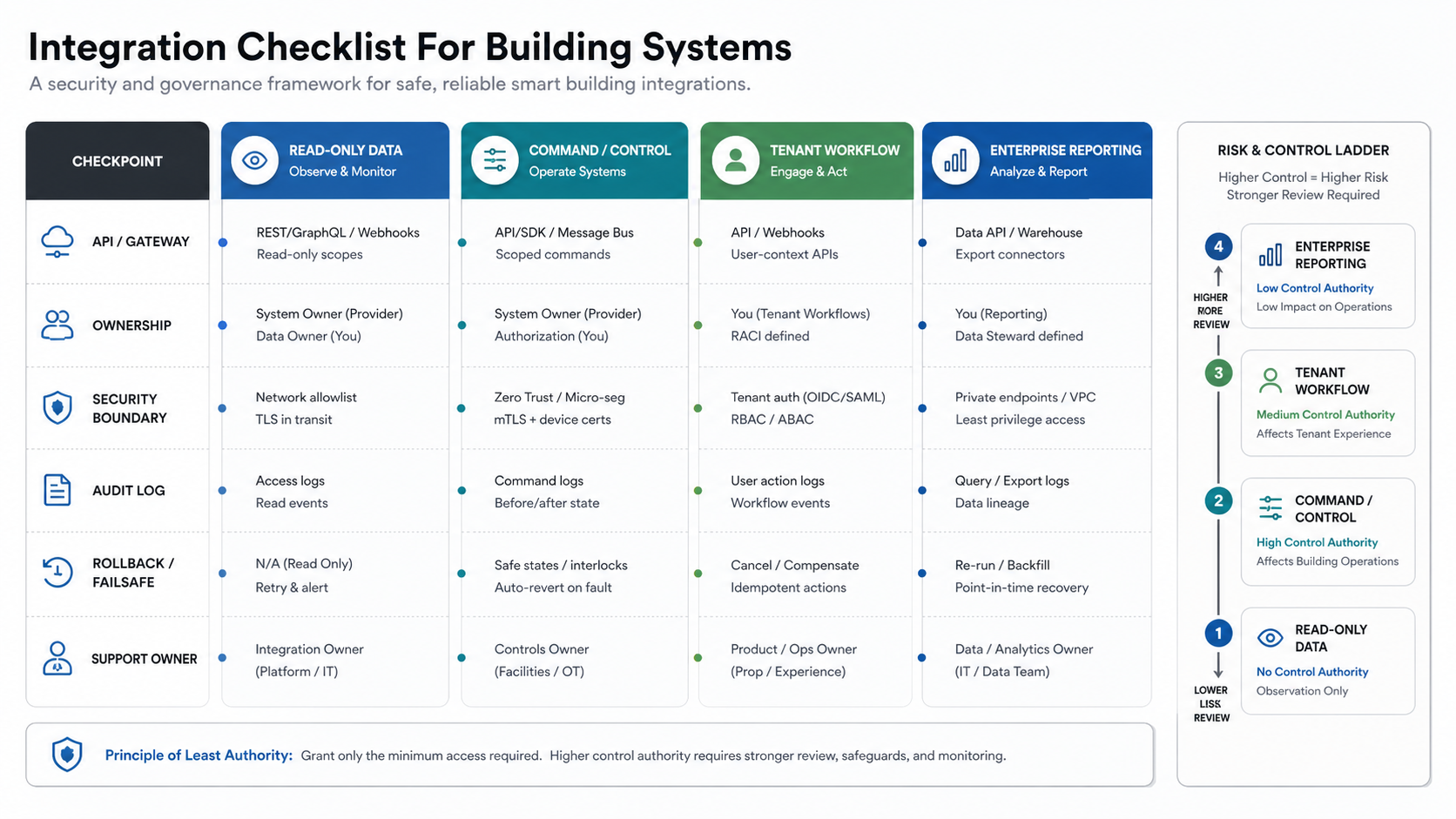
Security must be part of the architecture. Device credentials, building access events, tenant data, and operational controls need role-based access, encryption, logging, vendor boundaries, and incident handling. For broader build estimation, the Custom Software Cost Estimator can help model user roles, integrations, analytics, and complexity.
Security, Governance, And Control Risk
Smart building software sits between IT, operational technology, vendors, tenants, and physical spaces. Treat that boundary carefully. A read-only meter dashboard is a different risk profile from a system that can change HVAC settings, unlock a door, override access, or route emergency communications.
Use a control-authority model during discovery. Each integration should identify who owns the source system, what data is read, whether commands are allowed, what fallback state is safe, where logs are stored, who can approve changes, and how an incident is escalated. NIST's building cybersecurity work points to lifecycle governance and existing frameworks such as the NIST Cybersecurity Framework, Risk Management Framework, DOE C2M2, FEMP Facility Cybersecurity Framework, and ISA/IEC 62443 as relevant references for connected building services.
For production systems, add network segmentation, least-privilege roles, service account review, device identity, encryption in transit, vendor access controls, audit logs, and emergency runbooks. If the platform controls physical operations, make rollback and fail-safe states part of the product backlog rather than a late security checklist.
Tenant App And Facility Dashboard Experience
The facility dashboard should not be a wall of charts. It should answer what needs attention now, which assets are drifting, which alerts are unresolved, and whether the pilot is improving the chosen metric. Facility teams need drill-downs, but the first screen should be operational.
The tenant app should avoid becoming a disconnected amenity app. It is most useful when it ties into real building workflows: service requests, access, visitor management, announcements, comfort feedback, booking shared spaces, package notifications, and emergency communication. If the tenant app is part of the MVP, connect it to the same platform data and support workflows as the facility dashboard.
When the dashboard must support customer-facing access, operational alerts, custom roles, and workflow actions, the Power BI vs custom dashboard app decision matters. Many property teams need BI for executive reporting and a custom app for daily operations.
Data, AI, And Predictive Maintenance
AI is useful when the platform has enough clean data and a clear action path. Predictive maintenance should start with explainable signals: unusual vibration, temperature drift, runtime changes, fault codes, pressure changes, repeated resets, or energy anomalies. The alert should tell the facility team what changed, what asset is affected, how urgent it is, and what action to take.
False positives are a real cost. If the platform sends noisy alerts, teams stop trusting it. Build a review loop where facility teams can mark alerts as useful, false positive, duplicate, or already known. That feedback is what improves future rules and models.
If the roadmap includes AI recommendations, design the data foundation first: consistent asset IDs, timestamps, units, location hierarchy, event history, maintenance records, and outcome labels. NextPage's AI development services and predictive analytics services paths can support analytics and model work once the building data layer is reliable. The supporting guide on predictive maintenance software with IoT and AI is useful when teams need a deeper maintenance workflow model.
Pilot-To-Portfolio Rollout Plan
Do not start with the full portfolio. Pick a pilot building where stakeholders can access systems, baseline data is available, and the operating team is motivated. Define the use case, metric, integration list, and decision criteria before development starts.
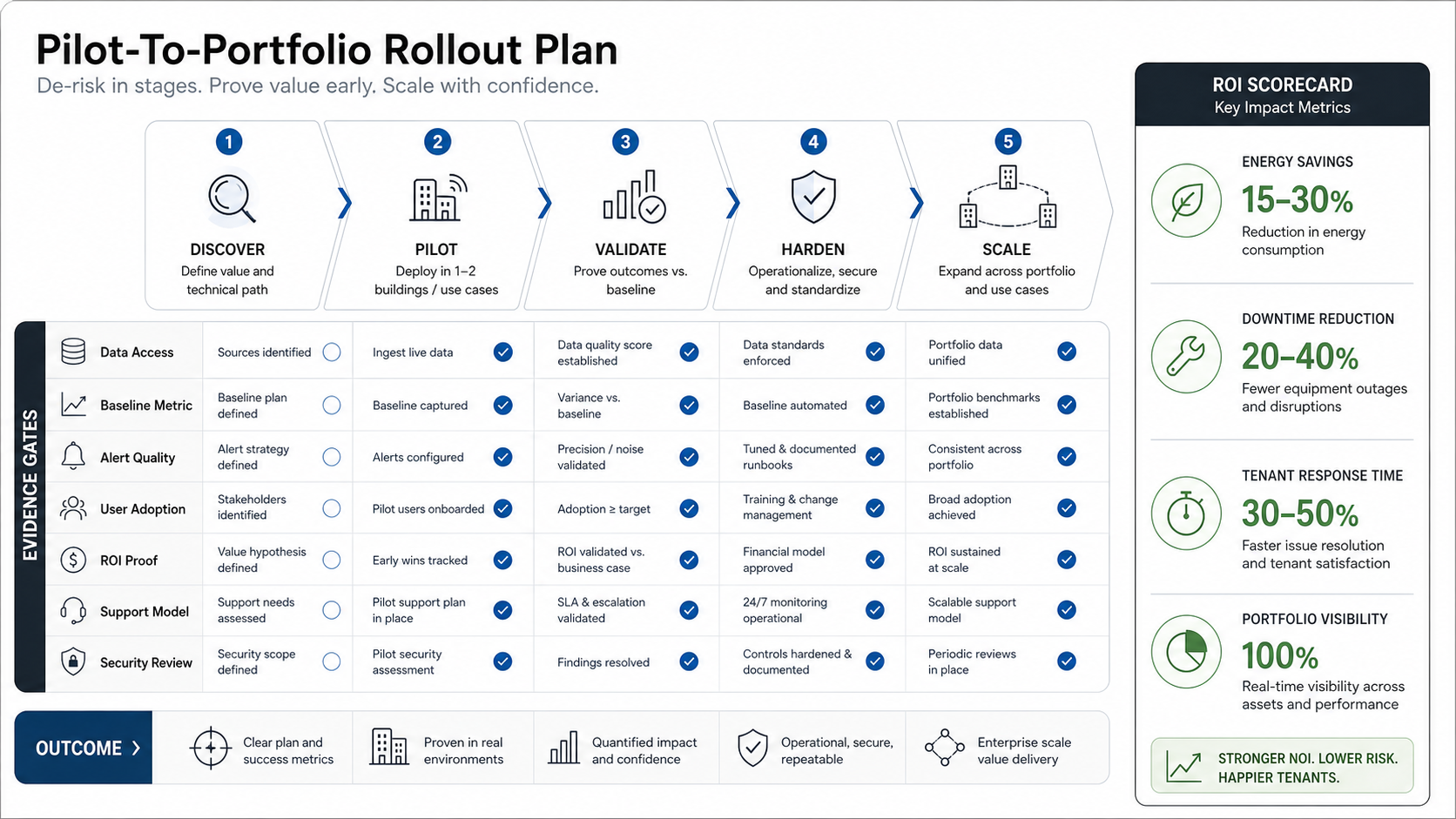
- Discovery: audit devices, systems, vendors, data access, workflows, security, and ROI goals.
- Pilot architecture: choose device categories, ingestion path, data model, dashboard scope, and alert rules.
- MVP build: implement ingestion, dashboards, roles, alerts, reporting, and one tenant or facility workflow if needed.
- Operational pilot: run with real users, track alert quality, data gaps, work order impact, energy baseline, and support issues.
- Portfolio hardening: add permissions, templates, multi-building dashboards, vendor playbooks, observability, and data governance.
- Scale: add more buildings, richer integrations, mobile workflows, analytics, and AI only after the data-to-action loop is trusted.
This rollout keeps the investment tied to evidence. It also prevents a common failure mode: buying more devices before the organization can act on the data from the devices it already owns. If sponsors need delivery proof across dashboards, operations, and workflow software, review the NextPage portfolio before shaping the roadmap.
Next Step: Scope The Building Data Layer Before Buying More Devices
If you are planning a real estate IoT platform, start with the data and workflow map. Which building systems are in scope? What business metric matters first? Who acts on alerts? What tenant experience is worth connecting? Which integrations are read-only and which can control equipment?
NextPage can help plan and build the software layer for connected buildings: telemetry ingestion, dashboards, tenant mobile apps, predictive alerts, AI analytics, and portfolio rollout. Start with IoT app development services, then connect the plan to custom software, AI, dashboards, and mobile delivery once the pilot scope is clear.