
Quick Answer: What Should A Regulated Application Migration Checklist Include?
A regulated application migration checklist should prove that sensitive data, access controls, encryption, logging, audit trails, retention rules, testing evidence, rollback triggers, and hypercare monitoring survive the move. The goal is not just to move code and databases. The goal is to preserve compliance evidence while reducing migration risk.
This matters most for healthcare, BFSI, insurance, public-sector, and enterprise teams where one application can touch personally identifiable information, financial records, protected health data, contracts, payment workflows, or regulated reporting. A standard dependency checklist is useful, but it is not enough when auditors, risk teams, security leaders, and business owners need defensible proof.
Use this guide alongside a broader application migration services plan when you need dependency mapping, wave planning, cutover rehearsal, rollback design, and production support. If the move includes infrastructure and hosting changes, connect it to cloud migration services so platform, security, data, and operations teams work from the same evidence set.
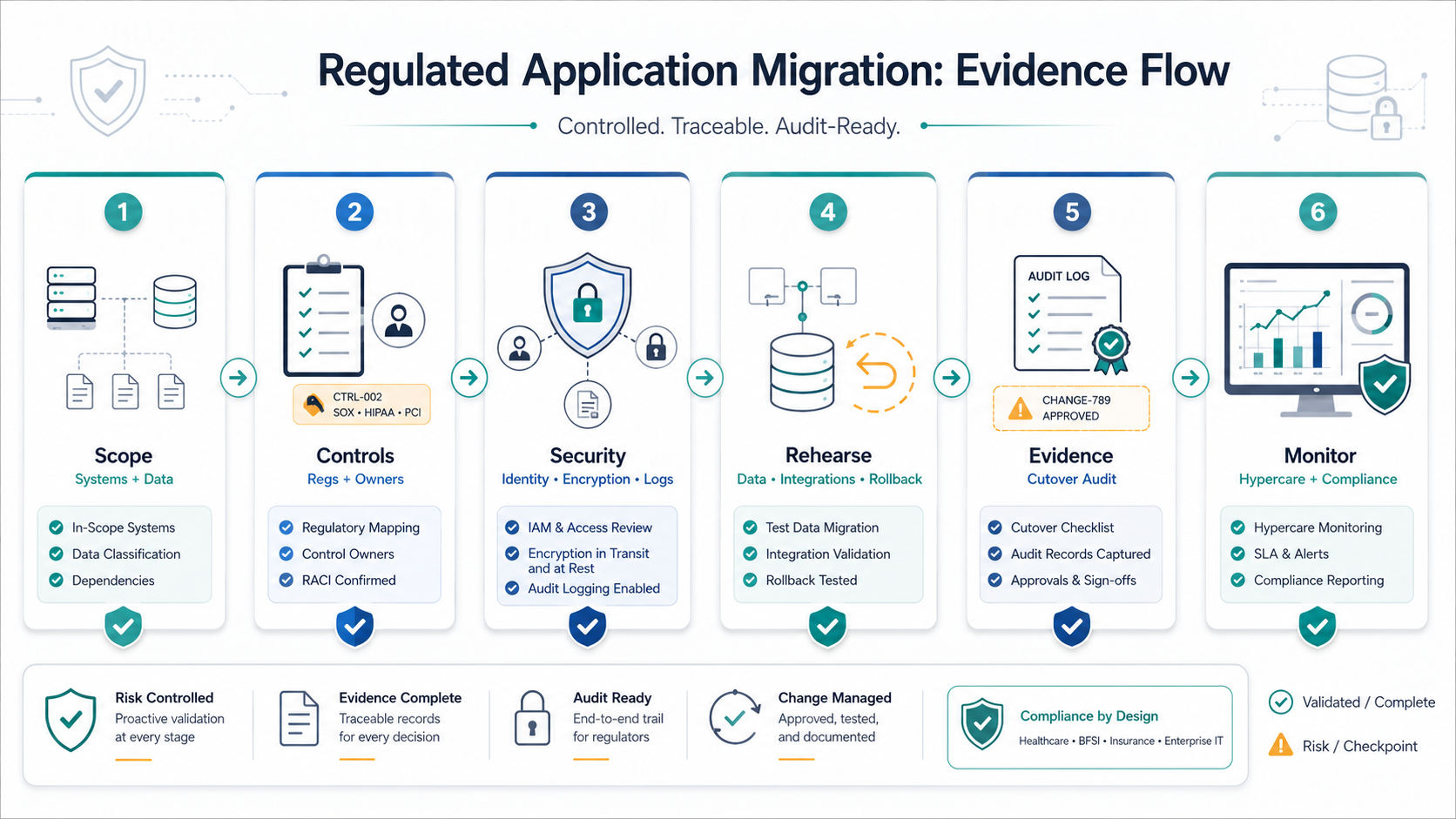
Why Regulated Application Migration Is Different
Generic migration programs usually ask whether the application can run somewhere else. Regulated migration programs ask a harder question: can the organization prove that the new environment still meets the same security, privacy, operational, contractual, and audit expectations as the old one?
The OrangeMantra source validates market demand for application migration, cloud shift, legacy modernization, security, and industry-sensitive use cases. The missing angle for buyers is evidence. A regulated team does not only need a migration partner that can move workloads. It needs a checklist that shows what evidence should exist before, during, and after cutover.
NIST CSF 2.0 frames cybersecurity risk management around governance, identification, protection, detection, response, and recovery. NIST SP 800-53 Rev. 5 adds a richer control catalog with families such as Access Control, Audit and Accountability, Configuration Management, Contingency Planning, Incident Response, Risk Assessment, System and Communications Protection, and Supply Chain Risk Management. You do not need to quote every control in a migration plan, but you do need to map the controls that matter to evidence owners.
Content Brief For Regulated Migration Teams
| Planning item | Decision for this post |
|---|---|
| Primary keyword | Regulated application migration checklist. |
| Related queries and entities | Application migration compliance, audit evidence, data residency, HIPAA migration, BFSI cloud migration, rollback plan, access controls, encryption, logs, retention, DevSecOps gates. |
| Search intent | Decision support for teams preparing a sensitive application move. |
| Expected SERP format | Checklist, risk table, implementation guide, and buyer-readiness framework. |
| Reader job | Understand what must be proven before approving migration of regulated workloads. |
| CTA | Request a regulated app migration risk review. |
The Regulated Application Migration Checklist
Use the checklist as a stage gate. A team can adapt the exact control language to HIPAA, GDPR, PCI DSS, SOC 2, RBI, MAS, FFIEC, ISO 27001, internal policy, or customer contract obligations, but the migration evidence pattern stays similar.
| Stage | What to verify | Evidence to keep |
|---|---|---|
| Scope | Applications, data classes, users, integrations, environments, owners, and business processes. | System inventory, data map, dependency map, RACI, business criticality. |
| Controls | Access, encryption, key ownership, logging, retention, vulnerability management, incident handling. | Control matrix, policy mapping, architecture diagrams, configuration exports. |
| Testing | Functional, integration, security, performance, data reconciliation, backup restore, rollback. | Test plan, defect log, pass/fail record, screenshots, approvals. |
| Cutover | Freeze window, final sync, approvals, smoke tests, communications, rollback deadline. | Runbook, timestamps, owner sign-offs, go/no-go notes. |
| Hypercare | Monitoring, alert routing, incident queue, access review, audit log review, cost and performance baselines. | Dashboards, incident report, access report, audit pack, lessons learned. |
1. Classify Data Before You Design The Target Environment
Start with data, not servers. Identify where regulated data is stored, processed, cached, exported, archived, logged, and transmitted. Include primary databases, file stores, queues, search indexes, analytics extracts, backups, error logs, audit logs, support exports, screenshots, and third-party integrations.
For each data class, record residency requirements, retention rules, encryption requirements, masking needs, consent fields, deletion obligations, archival rules, and reporting dependencies. This is where many migrations fail quietly: the production database moves cleanly, but logs, exports, backups, or reporting stores are left outside the compliance model.
If the application depends on older systems, pair this work with a legacy application modernization roadmap so data risk, code risk, hosting risk, and support risk are separated before the migration wave begins.
2. Build A Control-To-Evidence Matrix
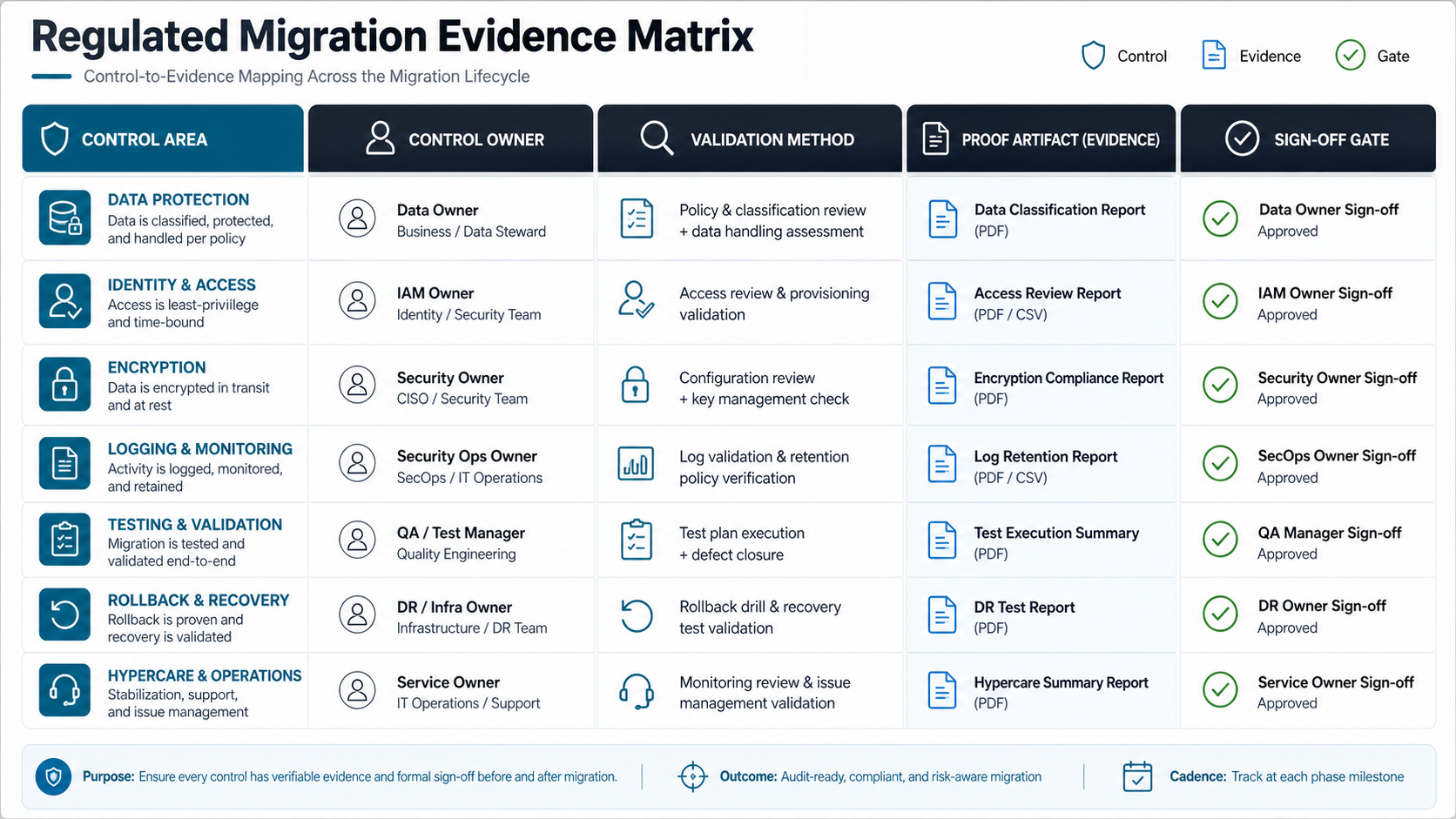
A control matrix turns vague compliance language into migration tasks. It should connect each relevant requirement to an owner, technical control, proof artifact, validation method, and sign-off date. This does not have to be a legal memo. It has to be specific enough that security, compliance, engineering, QA, and operations can agree on what "ready" means.
| Control area | Migration question | Evidence owner |
|---|---|---|
| Identity and access | Are privileged roles, service accounts, break-glass access, MFA, and joiner-mover-leaver flows preserved? | Security and platform lead. |
| Audit logging | Are user actions, admin actions, data exports, configuration changes, and failed access attempts captured? | Security operations. |
| Encryption and keys | Are data-at-rest, data-in-transit, backup, and key-rotation requirements implemented in the target? | Platform and security architecture. |
| Retention and deletion | Do logs, archives, backups, and reporting stores respect retention and deletion obligations? | Data governance. |
| Incident response | Are alerts, escalation paths, evidence capture, and response runbooks updated for the new environment? | SOC and application owner. |
For release pipelines, use a DevSecOps pipeline checklist to connect code scanning, secret detection, artifact provenance, infrastructure review, and release gates to the migration control matrix. When legacy risk is uncertain, run the Legacy Software Modernization Scorecard before setting migration gates so unsupported runtimes, fragile integrations, and manual release steps are visible early.
3. Verify Architecture, Access, And Segmentation
The target architecture should prove least privilege, controlled network paths, environment separation, private connectivity, secure administrative access, and monitored service-to-service communication. Do not approve production cutover with temporary firewall openings, broad admin roles, shared credentials, or undocumented support access.
A regulated migration plan should include diagrams for current state, target state, data flows, trust boundaries, identity paths, integration paths, backup flows, logging flows, and operational access. The diagrams should be versioned and reviewed with the same seriousness as code or infrastructure changes. For broader modernization decisions around risky legacy systems, connect the architecture review to a legacy software modernization roadmap so migration, refactoring, and support risks are not blurred together.
Cloud governance is not a one-time project. Microsoft Cloud Adoption Framework guidance treats governance as an ongoing process that manages policies, risk, compliance, operations, cost, and data. That framing is useful here: the migration design must include who will monitor compliance after go-live, not only who approved the cutover.
4. Rehearse Data, Integrations, Security, And Rollback Together
Regulated applications usually fail at the joins: a partner feed changes IP range, a payment workflow cannot authenticate, a reporting extract misses a consent field, a background job writes to the wrong bucket, or a rollback plan ignores transactions created after cutover. Rehearsal must cover the whole business flow.
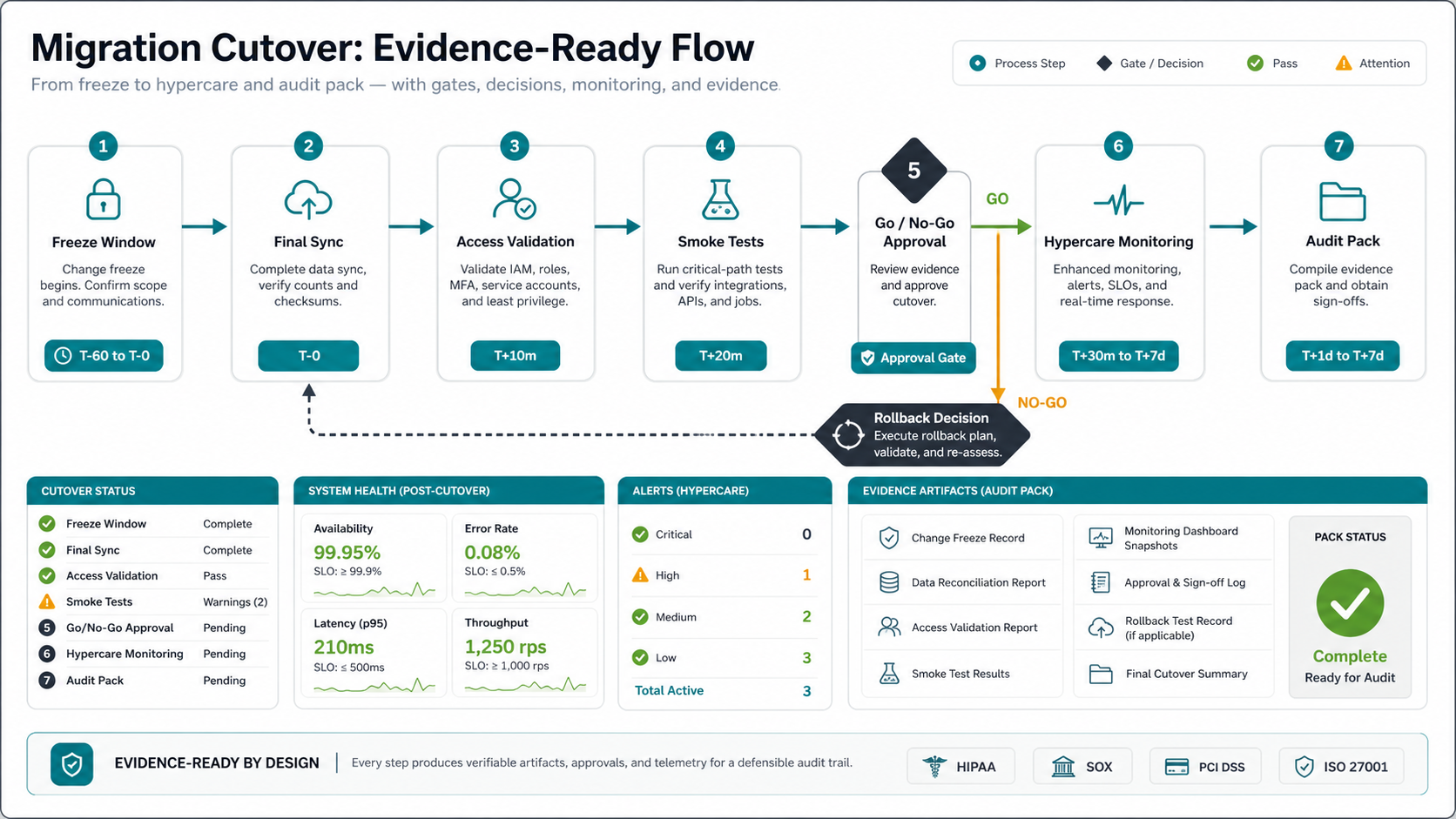
Run at least one end-to-end rehearsal that includes data migration, integration connectivity, user smoke tests, access review, audit log review, backup restore, incident simulation, and rollback decision timing. Record exact timestamps, owners, defects, remediation notes, and sign-offs. If the move includes heavily coupled data stores, compare the rehearsal plan with the data migration checklist so extracts, staging data, reconciliation, and rollback evidence are handled as first-class work.
The broader application migration readiness checklist is useful for dependency, data, cutover, and rollback basics. This regulated checklist adds the evidence layer required for sensitive workloads.
5. Capture Cutover Evidence As The Work Happens
Do not wait until the week after go-live to reconstruct proof. Build evidence capture into the runbook. Each task should have an owner, timestamp, expected result, actual result, link to evidence, and escalation path. The migration lead should be able to hand auditors a coherent pack without asking engineers to search chat history. A portfolio example such as DeviceBridge is a useful reminder that production software handoffs often depend on validation-heavy workflows, controlled access, and operational evidence rather than code movement alone.
| Cutover artifact | Why it matters | Minimum proof |
|---|---|---|
| Go/no-go record | Shows accountable approval. | Decision log, approvers, open risks, rollback deadline. |
| Data reconciliation | Proves records survived the move. | Control totals, sample checks, exception report, business sign-off. |
| Access validation | Prevents privilege drift. | Role export, privileged user review, failed-access monitoring. |
| Security telemetry | Confirms visibility after cutover. | Log ingestion, alert test, dashboard screenshot, incident route. |
| Rollback assessment | Defines when reversal is still possible. | Trigger conditions, data implications, final rollback decision. |
6. Treat Hypercare As Compliance Monitoring
Hypercare is often treated as technical support. For regulated migration, it is also a control validation period. Monitor failed jobs, latency, access anomalies, privileged actions, missing logs, integration retries, data exceptions, backup status, restore readiness, incident volume, and user issues.
Use a daily hypercare review for the first days after go-live, then move to a defined weekly cadence until the risk owner signs off. The managed cloud services checklist can help evaluate whether ongoing operations have the monitoring, patching, backup, incident, and cost controls needed after the migration team leaves.
Ownership Model For A Regulated Migration
| Workstream | Accountable owner | Consulted teams | Evidence output |
|---|---|---|---|
| Compliance mapping | Risk or compliance lead | Security, legal, application owner | Control matrix and sign-off checklist. |
| Target architecture | Solution architect | Platform, security, operations | Architecture diagrams and threat review. |
| Data migration | Data lead | DBA, business process owners, QA | Reconciliation report and exception log. |
| Security validation | Security lead | SOC, DevSecOps, platform | Access, logging, scan, and incident-route proof. |
| Cutover | Migration lead | Business owners, support, vendors | Runbook, timestamps, go/no-go record. |
Common Pitfalls To Avoid
- Approving migration based on application uptime while ignoring logs, backups, reports, and exports.
- Leaving temporary admin access or broad network rules in place after cutover.
- Testing only happy-path user flows instead of integration, exception, and rollback flows.
- Assuming the same compliance evidence applies after moving hosting, identity, storage, or support ownership.
- Letting audit evidence live in chat messages, screenshots, or individual laptops instead of a controlled repository.
- Starting modernization changes during migration without separate risk approval.
NextPage's Regulated Application Migration Checklist
Before approving a regulated application migration wave, confirm that the team can say yes to these questions:
- Have we mapped applications, data classes, integrations, users, environments, and owners?
- Have we translated applicable regulations, customer obligations, and internal policies into migration controls?
- Have access, encryption, key ownership, logging, retention, backup, and incident controls been proven in the target environment?
- Have data migration, reconciliation, reporting, integration, and rollback paths been rehearsed together?
- Does the cutover runbook capture evidence as work happens?
- Are rollback triggers, rollback deadlines, and post-cutover data implications agreed in advance?
- Does hypercare include security and compliance monitoring, not only technical support?
- Is there a named owner for the final audit pack?
NextPage helps teams plan and execute sensitive application moves with dependency mapping, control evidence, migration waves, data validation, integration testing, cutover planning, rollback readiness, and production support. Start with application migration services when the application estate is the main risk, or combine it with cloud migration services when infrastructure and platform governance are changing too.