
Quick Answer: What Makes B2B App Development Secure?
Secure B2B app development means designing the application around controlled access, protected business data, traceable workflows, resilient integrations, and evidence-ready release practices from the start. For partner portals, vendor platforms, internal operations tools, and customer-facing B2B products, security is not one feature. It is the operating model for roles, approvals, records, APIs, environments, monitoring, and support.
The practical checklist starts with the business workflow: who can log in, which organization they belong to, what data they can see, what actions need approval, which integrations can change records, and which events must be logged for audit or incident response. Only after that should the team choose frameworks, cloud services, authentication providers, and UI screens.
If the product will handle customer contracts, invoices, supplier records, employee information, regulated documents, or multi-tenant account data, plan it as custom software development with security requirements, not as a generic app build with security added near launch.
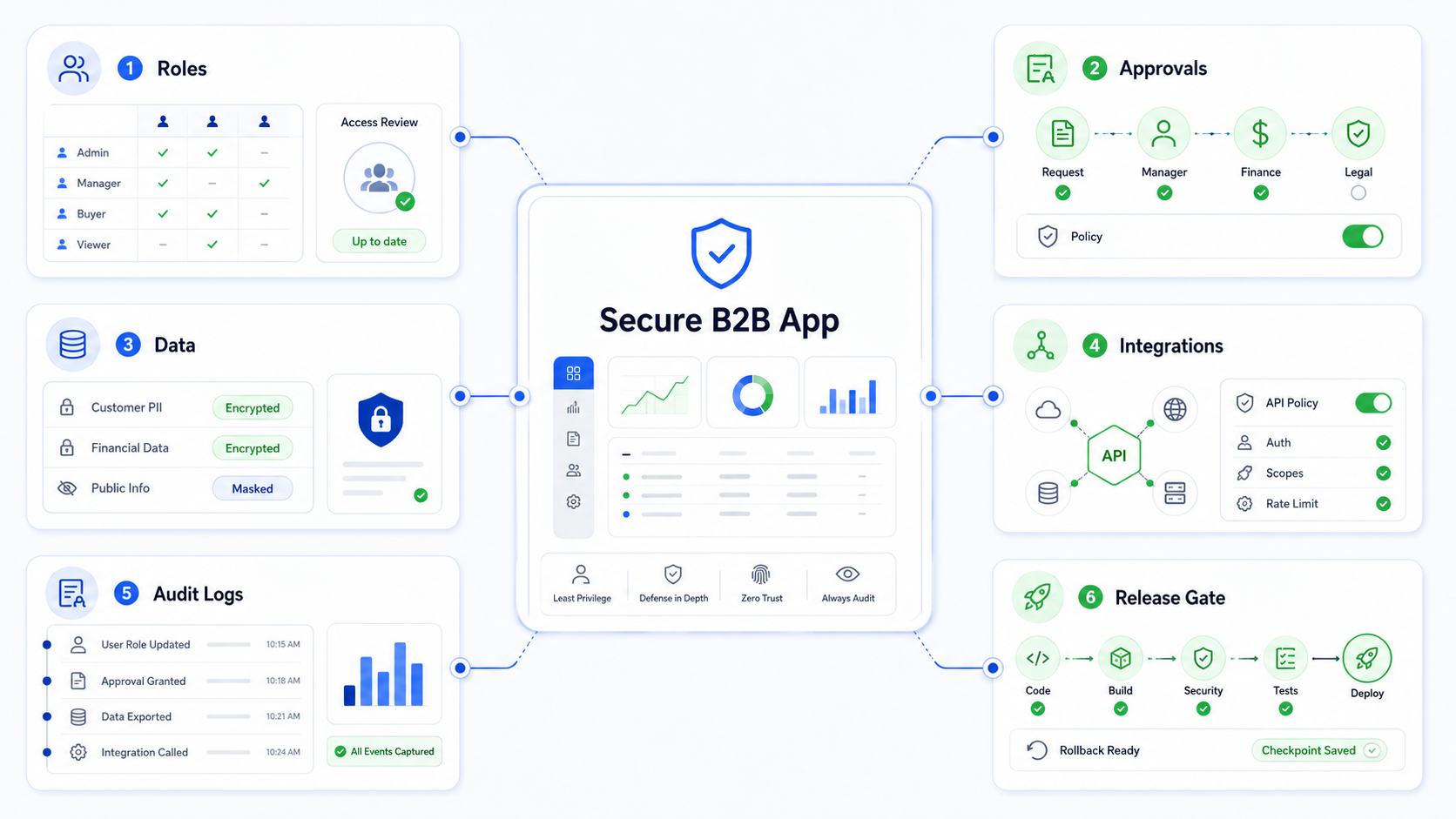
Why B2B App Security Is Different
B2B applications usually have more complicated trust boundaries than consumer apps. A single deployment may serve multiple customer companies, partner teams, vendors, field operators, finance users, admins, support agents, and API clients. Each group may need different permissions, approval steps, data views, export rights, notification rules, and support paths.
The risk is rarely limited to a hacked password. A poorly designed B2B app can expose one customer's data to another customer, let a vendor approve its own invoice, allow a support user to impersonate without oversight, or let an integration overwrite records without a clear audit trail. These are workflow and architecture failures, not only code vulnerabilities.
That is why secure B2B planning should begin in discovery. OWASP ASVS is useful because it gives teams testable application security requirements. OWASP Secure by Design is useful because it pushes security into architecture and design decisions before code is written. NIST CSF 2.0 is useful for aligning the app with broader governance, protection, detection, response, and recovery expectations.
1. Define Security Requirements Before Feature Scope
A secure app brief should include more than a feature list. It should state the assets being protected, the users who can touch them, the misuse scenarios that matter, the compliance expectations, and the release evidence stakeholders will need. This lets product, engineering, security, compliance, and operations teams make the same tradeoffs.
| Requirement Area | Questions To Answer | Evidence To Produce |
|---|---|---|
| Data sensitivity | Which records are confidential, regulated, financial, contractual, or customer-specific? | Data classification, retention rules, masking policy |
| User population | Which companies, roles, departments, vendors, customers, and support users need access? | Role map, account hierarchy, onboarding flow |
| Workflow risk | Which actions can approve spend, change pricing, export data, invite users, or modify legal records? | Approval matrix, segregation-of-duties rules |
| Audit needs | Which events must be attributable, searchable, retained, and protected from tampering? | Audit event catalog and retention plan |
| Operational ownership | Who reviews access, responds to incidents, handles support, and approves releases? | Runbook, escalation map, release checklist |
For budget planning, security requirements should be part of the first estimate. The Custom Software Cost Estimator is a useful starting point because roles, integrations, data sensitivity, and workflow complexity usually move cost more than page count.
2. Design The Role And Account Model
Role-based access control is often described too simply. B2B products need more than admin, manager, and user. They usually need organization-level roles, workspace roles, department roles, external partner roles, support roles, finance roles, API service accounts, and sometimes temporary delegated access.
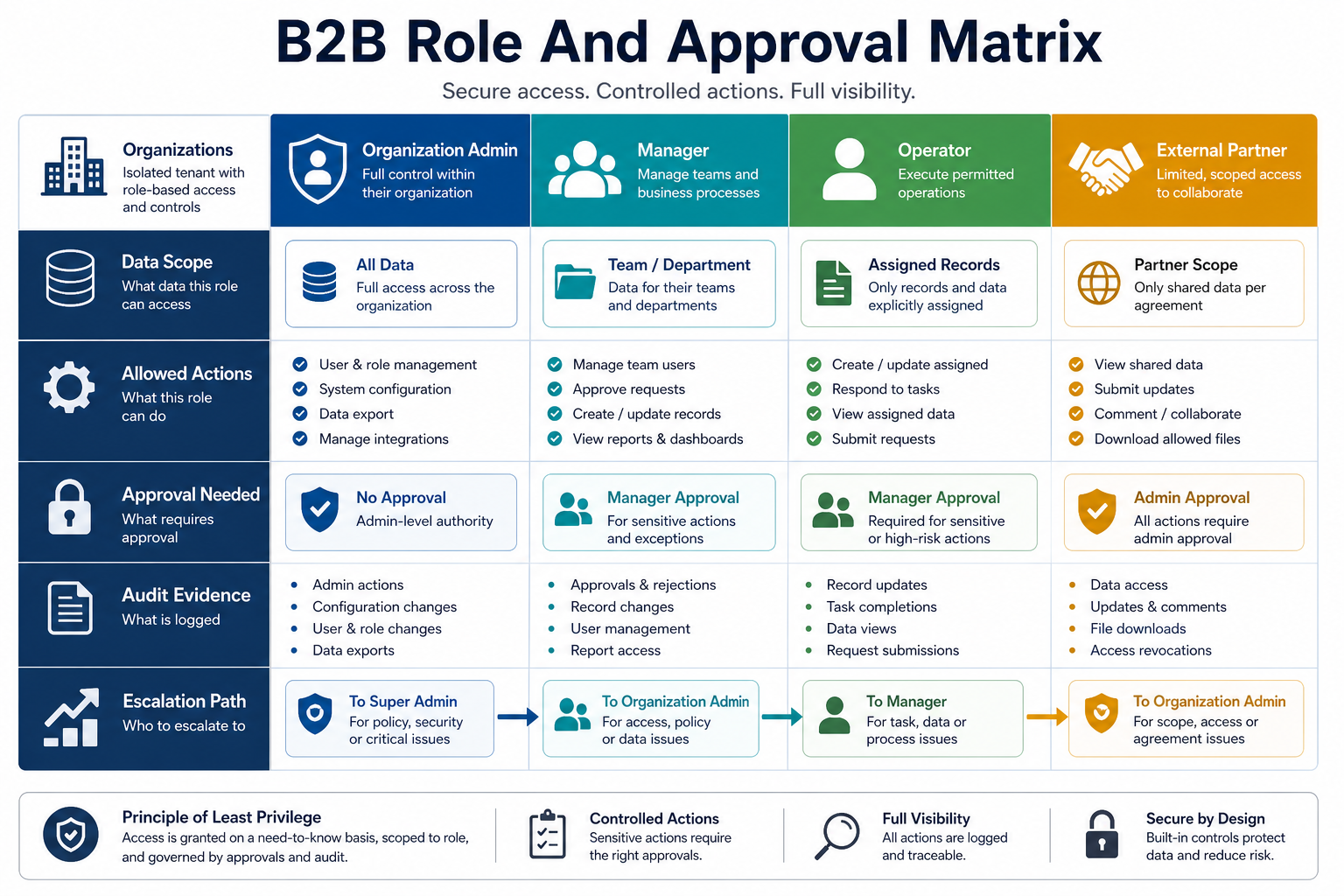
Start with an account hierarchy. Decide whether the primary tenant is a customer company, vendor, branch, location, franchise, project, client account, or legal entity. Then define how users join that tenant, who can invite them, who can suspend them, whether SSO is required, and how access changes when people move roles.
- Least privilege: each user gets only the permissions needed for the current job.
- Separation of duties: sensitive actions require a different reviewer or approver.
- Tenant isolation: one customer or partner cannot see another tenant's records by changing URLs, filters, exports, or API calls.
- Support access controls: internal support users need scoped impersonation, reason capture, session recording or logging, and approval for high-risk access.
- Service accounts: API clients need dedicated identities, scoped tokens, rotation, rate limits, and revocation paths.
If the app is a partner, vendor, customer, or operations portal, pair the role model with a portal scope plan. NextPage's web portal development services cover the workflow and tenant-model decisions that often determine whether B2B access control stays manageable.
3. Map Approval Workflows And Sensitive Actions
Many B2B apps are built to move decisions: quote approvals, vendor onboarding, document review, purchase requests, service tickets, compliance attestations, employee changes, inventory adjustments, and customer account updates. Security must protect those decisions, not only the login screen.
For each sensitive action, define who can request it, who can approve it, what information the approver sees, what happens when it is rejected, what can be edited after approval, and what event is recorded. Avoid broad admin bypasses. If an override is needed, make it explicit, logged, and reviewable.
| Workflow | Control To Design | Common Failure |
|---|---|---|
| Vendor onboarding | KYB fields, document review, bank-detail change approval | One user can both submit and approve risky changes |
| Pricing or quote approval | Thresholds, margin rules, reviewer assignment, history | Final approved values are overwritten without traceability |
| Data export | Export permission, file scope, expiration, watermarking | Users export more tenant data than their role should allow |
| Support impersonation | Reason capture, limited duration, event logging, supervisor review | Support can enter accounts without customer-visible evidence |
| API record updates | Scoped credentials, idempotency, validation, error queues | Integration retries duplicate or corrupt business records |
Approval logic should be tested as business logic. It is not enough to test happy paths. QA should include forbidden transitions, stale approvals, role changes during approval, duplicate submissions, and direct API attempts that bypass the UI.
4. Protect Data Across Storage, Screens, APIs, And Logs
Data protection is broader than encryption. A secure B2B app should minimize what it collects, classify what it stores, control who can view each field, protect data in transit and at rest, and prevent sensitive values from leaking into logs, analytics tools, emails, exports, screenshots, or support systems.
Use encryption in transit for all user and service traffic. Use managed encryption at rest for databases, object storage, backups, and queues. For especially sensitive fields, consider application-level encryption or tokenization. Keep secrets out of source code, logs, tickets, and front-end bundles. Rotate credentials and keep a revocation path for every integration.
Data rules should also shape the UI. If a user only needs the last four digits of an account number, do not display the full value. If a support user needs to verify a record, use masking and step-up approval. If exports are allowed, log the export scope and make the file expire.
For teams modernizing older business systems, data protection often overlaps with replatforming. NextPage's application replatforming services can help move legacy workflows to cleaner cloud, database, deployment, and monitoring foundations without losing control of sensitive records.
5. Secure APIs And Third-Party Integrations
B2B apps rarely stand alone. They connect to CRMs, ERPs, payment processors, logistics systems, identity providers, analytics platforms, document tools, email services, and customer systems. Each integration creates a trust boundary and an operational failure mode.
API security should include authentication, authorization, schema validation, rate limiting, replay protection, idempotency, error handling, webhook verification, and clear ownership of retry queues. Do not let an integration use a human admin account. Give each integration its own scoped service identity and audit trail.
- Inbound APIs: validate scopes, tenant ownership, payload size, field permissions, and rate limits.
- Outbound APIs: store credentials securely, limit data sharing, handle timeouts, and log failures without exposing secrets.
- Webhooks: verify signatures, enforce idempotency, reject stale events, and monitor repeated failures.
- File transfers: scan uploads, restrict file types, encrypt storage, and expire temporary links.
- Admin integrations: require stronger review because they can change billing, users, or account configuration.
Scalability also matters. A B2B app that is secure at small volume can fail when customers add more users, records, integrations, and regions. The scalable software development services path is relevant when performance, multi-tenant data growth, and integration reliability are part of the same risk profile.
6. Build Audit Logs That Are Useful During Real Incidents
Audit logs are often added too late. A useful B2B audit log answers who did what, to which object, for which tenant, from which context, through which interface, and whether the action succeeded. It should also capture approval events, permission changes, exports, support access, integration calls, authentication events, and security-relevant failures.
Do not log sensitive values directly. Log object identifiers, event types, actor identities, tenant IDs, timestamps, source systems, and before/after summaries where appropriate. Protect logs from ordinary user edits. Define retention based on customer contracts, internal policy, regulatory needs, and incident response requirements.
Audit events should be searchable by tenant, user, object, action, time range, and risk category. If customers need audit evidence, design a customer-facing audit view or export instead of forcing support teams to pull logs manually.
7. Put Security Into The Delivery Pipeline
Secure B2B development needs release gates. The goal is not to slow every deployment; it is to make risky changes visible before they affect customer data. Use threat modeling for high-risk workflows, code review for authorization logic, automated tests for permission boundaries, dependency checks, secrets scanning, infrastructure review, and environment separation.
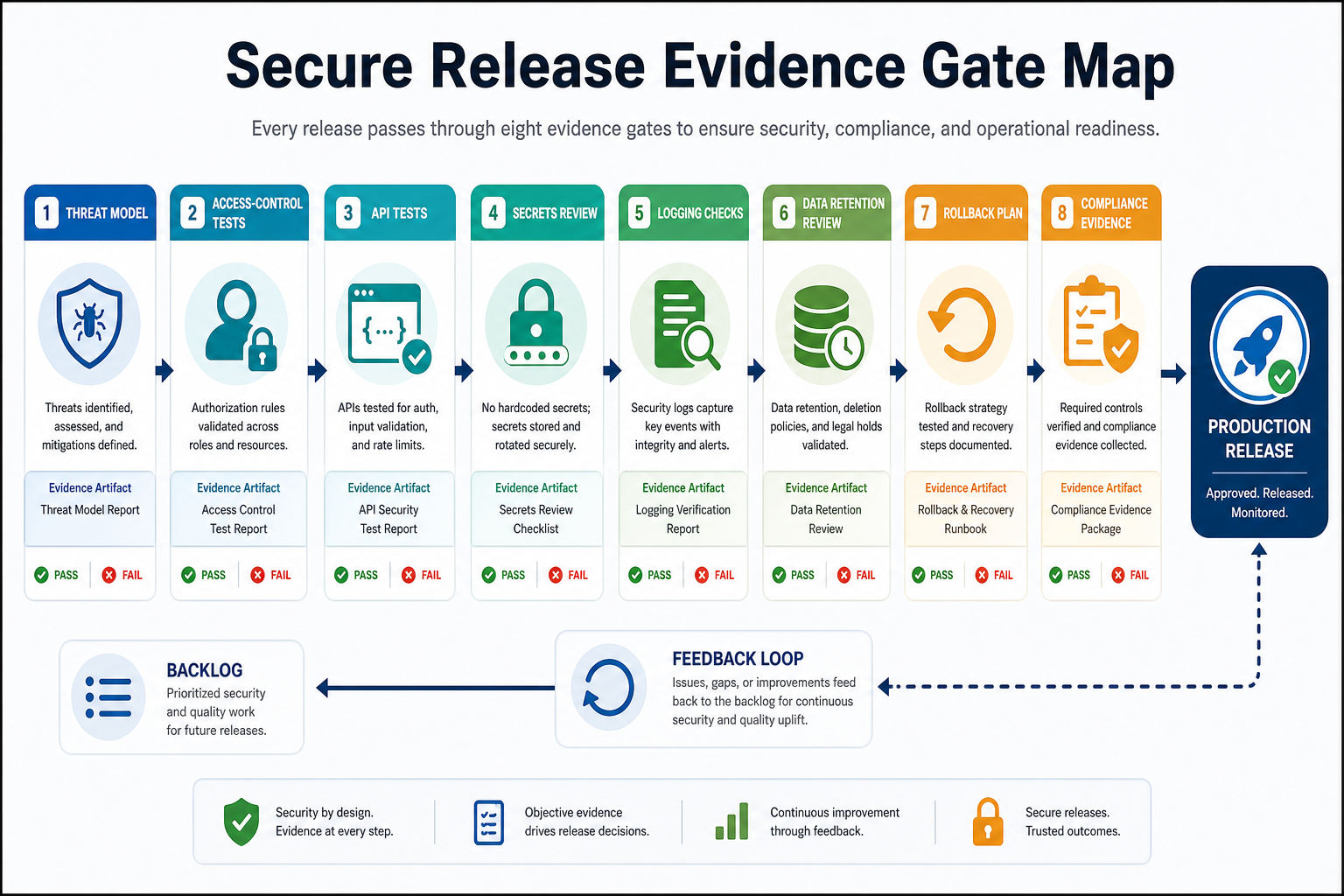
A practical release checklist includes:
- Role and tenant tests for new screens, APIs, exports, and admin actions.
- Negative tests for unauthorized access, object ownership, stale approvals, and direct API calls.
- Dependency and container vulnerability review for exploitable issues.
- Secrets scanning before merge and deployment.
- Database migration rollback plan and backup confirmation.
- Logging and monitoring updates for new high-risk workflows.
- Production access review for engineers, support, and service accounts.
Security testing should be tied to release risk. NextPage's software QA testing services can support practical access, data, API, performance, and release-readiness checks, while recognizing that compliance and security ownership still need clear business stakeholders.
8. Translate Compliance Into Product Controls
Compliance language is often too abstract for product teams. Turn it into product controls. If the requirement is access review, the app needs role reports, inactive-user detection, and revocation workflows. If the requirement is data minimization, the app needs field-level decisions and retention rules. If the requirement is incident response, the app needs logs, alerts, owners, and recovery steps.
NIST CSF 2.0 can help teams connect application decisions to organizational cybersecurity risk management. OWASP ASVS can help define testable application controls. OWASP Secure by Design can help architecture teams document how those controls are built into the system before development starts.
| Governance Need | Product Control | Operational Owner |
|---|---|---|
| Access review | Role reports, approval history, inactive users, revocation workflow | Customer admin, internal support, security owner |
| Data retention | Deletion rules, archive jobs, legal hold handling, backup policy | Product, legal, operations |
| Incident response | Alert routing, audit search, account lock, token revocation | Security, engineering, support |
| Vendor risk | Integration inventory, data shared, credential owner, renewal review | IT, procurement, product |
| Release evidence | Test results, approvals, migration records, deployment notes | Engineering, QA, product owner |
This is also where B2B apps can create sales value. Enterprise buyers often ask for security questionnaires, audit evidence, access controls, uptime practices, and support processes before signing. Building the evidence model early can shorten later procurement cycles.
Implementation Roadmap For A Secure B2B App
Do not try to build every control in the first sprint without sequencing. Use a phased roadmap that matches release risk.
- Discovery and control brief: define data classes, tenants, roles, sensitive actions, integrations, audit needs, compliance expectations, and success metrics.
- Architecture and threat model: map trust boundaries, identity provider, tenant isolation, approval paths, data flows, API surfaces, logging, and deployment environments.
- MVP controls: implement authentication, tenant-aware authorization, core approvals, encrypted storage, basic audit events, and secure admin workflows.
- Integration hardening: add scoped service accounts, webhook verification, idempotency, retry queues, monitoring, and failure playbooks.
- Release governance: add permission tests, security checklists, dependency review, production access review, incident runbooks, and customer-ready evidence exports.
- Scale and continuous review: add role analytics, anomaly detection, stronger customer admin tooling, periodic access reviews, and performance testing.
If the first version is still being shaped, use the custom software development cost guide to understand why security, integrations, role complexity, and QA depth change the budget. A small app with many high-risk roles can be more complex than a larger app with simple public content.
Questions To Ask A B2B App Development Partner
When evaluating a development partner, ask questions that reveal how they think about business risk, not only technology.
- How will you model organizations, users, roles, permissions, service accounts, and support access?
- How will tenant isolation be enforced in the UI, APIs, database queries, exports, and background jobs?
- Which actions require approval, and how will approvals be logged and tested?
- What sensitive data should be masked, encrypted, minimized, or excluded from logs?
- How will integrations authenticate, retry safely, and avoid duplicate or unauthorized updates?
- Which OWASP ASVS areas will guide implementation and verification?
- What release gates apply to role changes, data changes, migrations, and admin workflows?
- What evidence will be available for customer security reviews and internal audits?
The mobile app development RFP checklist covers related vendor-selection questions around data, security, compliance, and release expectations. The same discipline applies to web portals and enterprise workflow apps.
NextPage Point Of View
NextPage's view is that secure B2B app development is mostly a workflow, data, and governance problem before it is a framework choice. The right architecture starts with tenant boundaries, role maps, approval paths, audit evidence, integration ownership, and release controls. Technology choices matter, but they should serve those decisions.
A secure first release does not need every enterprise feature. It does need clear access control, defensible data protection, traceable sensitive actions, safe integrations, tested release gates, and owners who can respond when something goes wrong. Build those controls into the product plan, and the app is much easier to scale, sell, support, and audit.
If you are planning a B2B portal, partner platform, vendor workflow, or internal business app, start with a security and integration review before estimating screens. That review can separate the controls needed for launch from the controls that can mature after adoption is proven.