
Quick Answer: Which Software Development Engagement Model Should You Choose?
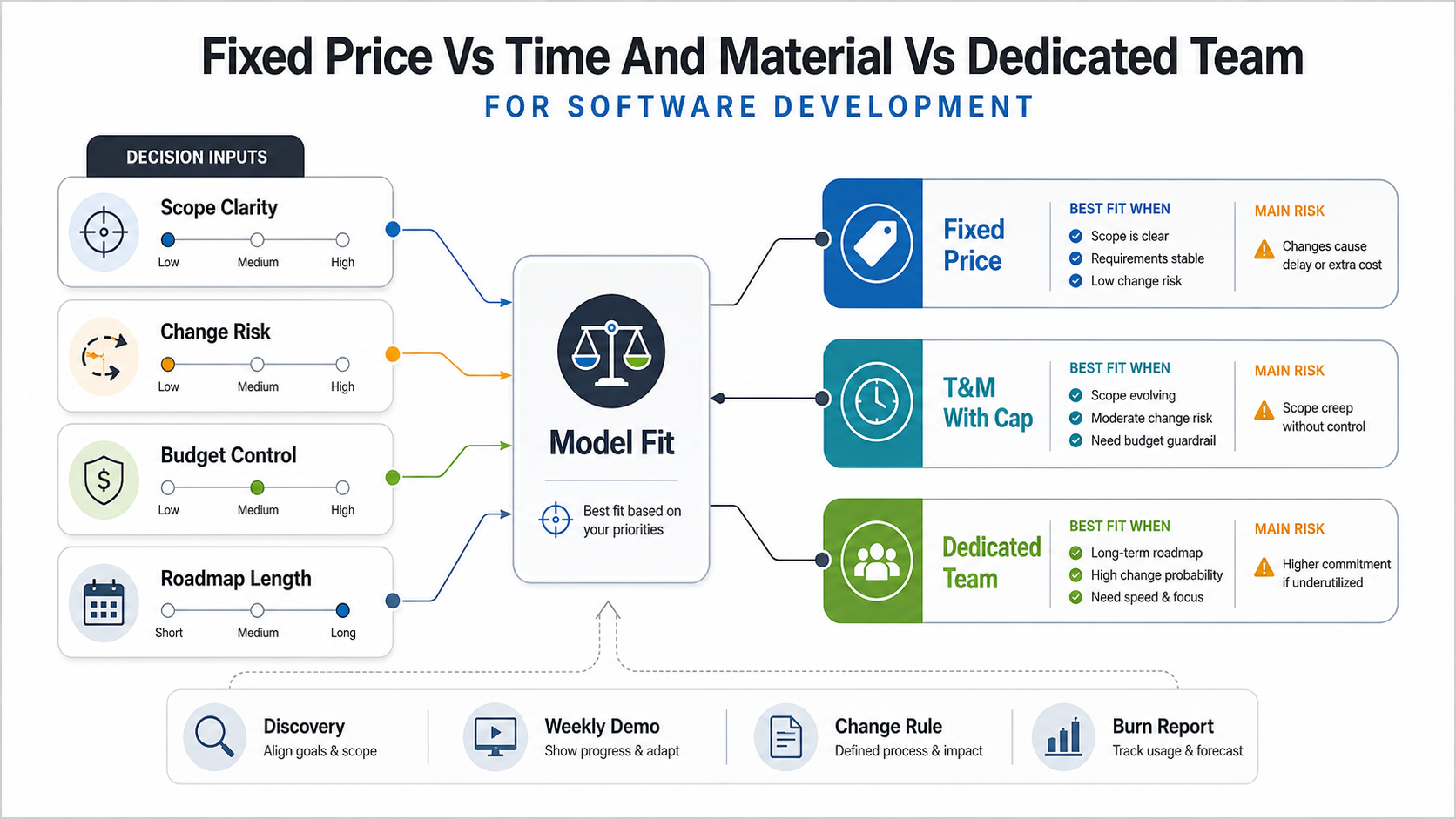
Choose fixed price when the scope is clear, short, documented, and unlikely to change. Choose time and material when requirements will evolve, technical unknowns remain, or you need weekly learning during delivery. Choose a dedicated team when the work is not a one-time project but an ongoing roadmap that needs stable engineering capacity, product context, QA, and delivery rhythm.
The right choice is not the cheapest-looking quote. It is the model that puts risk in the place where it can be managed. Fixed price controls budget by limiting change. Time and material controls learning by keeping the backlog flexible. A dedicated team controls continuity by keeping the same people close to the product over multiple releases.
If you are still comparing proposals, start by estimating your scope with the Custom Software Cost Estimator. Then use the model decision below to decide whether the work needs a fixed quote, a capped T&M phase, or an ongoing team.
Why The Engagement Model Matters
Engagement models decide how software work is estimated, governed, changed, and paid for. Two vendors can quote similar rates but create very different outcomes if one contract freezes every assumption while the other supports weekly reprioritization. The model shapes incentives, transparency, delivery control, and how conflict is handled when the project changes.
This matters because software scope rarely fails in one dramatic moment. It drifts through small decisions: an integration needs extra fields, an admin role needs a new permission, a user flow needs a compliance step, or pilot users ask for a different workflow. A good model makes those tradeoffs visible early. A weak model hides them until budget, trust, or timeline is already under pressure.
The strongest 2026 comparison pages agree on the basic pattern: fixed price fits stable scope, time and material fits evolving work, and dedicated teams fit long-term product development. The gap is that buyers still need a practical way to choose before they sign. That starts with risk ownership.
Fixed Price Vs Time And Material Vs Dedicated Team
| Model | Best Fit | Buyer Gets | Main Risk | Control Needed |
|---|---|---|---|---|
| Fixed price | Clear, limited scope with testable acceptance criteria | Defined deliverables, defined price, milestone control | Change orders, hidden assumptions, reduced flexibility | Discovery, written scope, exclusions, change rules |
| Time and material | Evolving scope, technical discovery, Agile delivery | Flexibility, faster start, transparent work logs | Budget drift if priorities are weak | Budget cap, weekly demos, burn reports, backlog owner |
| Dedicated team | Ongoing roadmap, multiple releases, complex product work | Stable capacity, product context, continuity | Paying for capacity without enough roadmap clarity | Roadmap, sprint governance, role mix, utilization review |
| Hybrid | Mixed certainty across phases or modules | Risk matched by phase | Confusing governance if phase gates are vague | Discovery outputs, decision gates, phase-specific contracts |
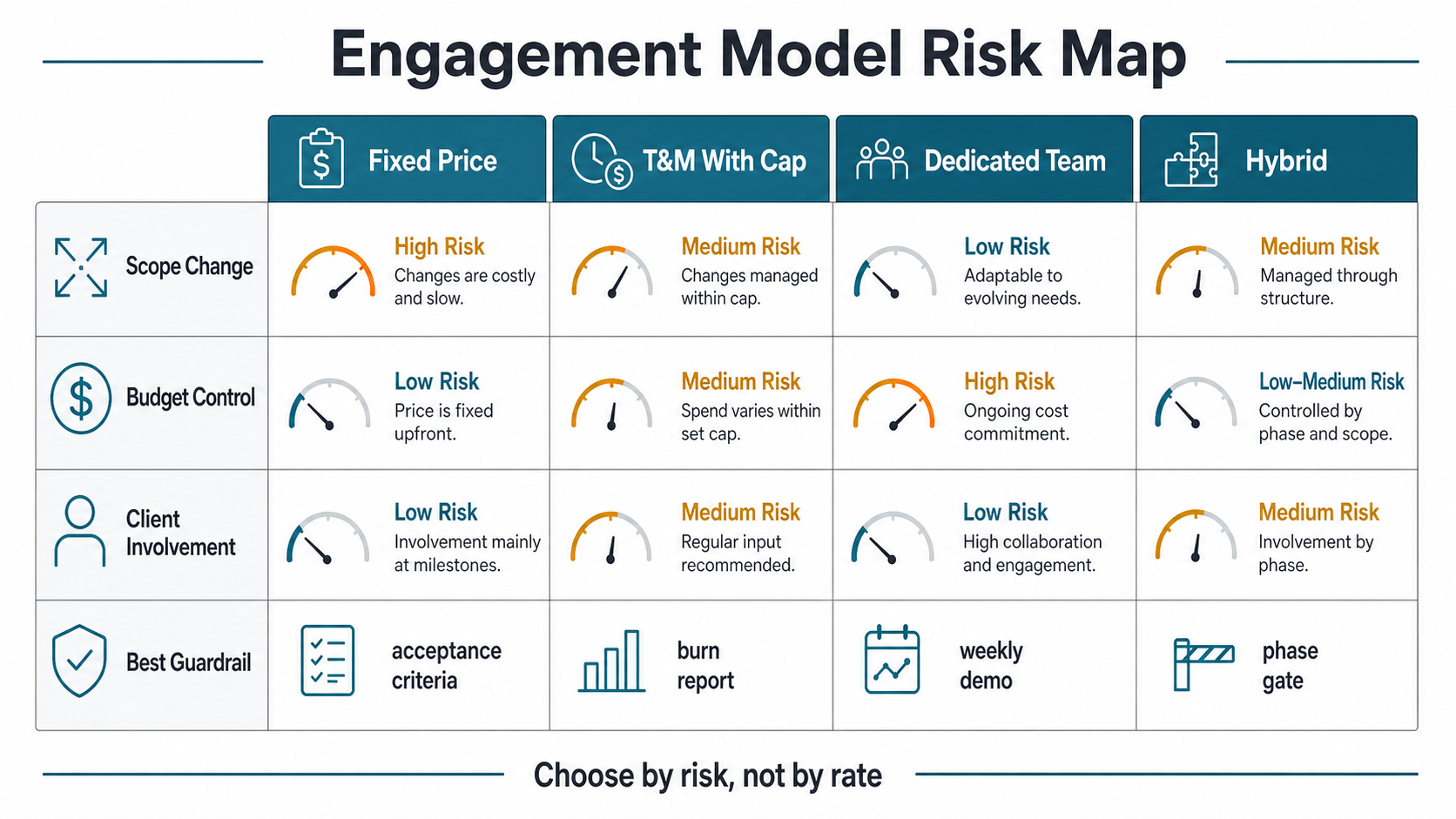
Most serious projects are not purely one model forever. A discovery sprint can be fixed price, core delivery can run as capped T&M, and a validated product can move into a dedicated team. The model should change when risk changes.
When Fixed Price Works
A fixed-price model works when the vendor can define scope, assumptions, deliverables, acceptance criteria, timeline, and price before development begins. It is useful for short projects, known integrations, contained MVPs, website or portal modules, migrations with clear records, and discrete features inside a larger roadmap.
The advantage is predictability. The buyer can plan cash flow and hold the vendor to agreed milestones. The vendor carries more estimation risk, so a serious fixed-price quote should include discovery effort, contingency, assumptions, exclusions, and a formal change-order path.
The weakness is rigidity. If requirements change, fixed price creates negotiation friction. That is not automatically bad. Sometimes change friction protects the budget. But if the product is still searching for user fit, locking scope too early can preserve the wrong plan.
Use fixed price when the workflow is stable, stakeholders agree on must-have scope, dependencies are known, and the buyer values budget certainty over iteration. Avoid it when the product still needs user discovery, technical spikes, or frequent pivots.
When Time And Material Is Safer
Time and material means the buyer pays for actual effort, usually by hourly, daily, weekly, or sprint-based rates. It fits Agile delivery because the team can adjust scope as evidence appears. This is often safer for complex software, early products, AI features, integration-heavy work, modernization, and projects where the final answer cannot be specified up front.
The model should never mean unlimited spending. A professional T&M engagement needs budget guardrails: a not-to-exceed cap, sprint goals, weekly burn reporting, demo evidence, backlog ranking, and a decision owner who can cut or defer scope. Without those controls, flexibility becomes a blank check.
T&M is also useful for discovery, audits, rescue work, and technical spikes. If the team does not know whether a legacy API, data migration, AI workflow, or third-party platform can support the desired flow, a short T&M phase can produce evidence before a larger contract is priced.
Use T&M when change is expected and the buyer can stay engaged. If nobody on the client side can review demos, answer questions, or prioritize tradeoffs weekly, T&M can drift even with a good vendor.
When A Dedicated Team Makes Sense
A dedicated team model gives the buyer stable capacity for an ongoing roadmap. The team may include developers, QA, project management, design, DevOps, data, or AI specialists depending on the work. It is usually billed monthly by role mix or team shape rather than by a single fixed deliverable.
The advantage is continuity. The same team learns the domain, architecture, codebase, users, release process, and business rules. That accumulated context can be more valuable than renegotiating every feature as a separate project. It is especially useful for SaaS products, marketplaces, internal platforms, mobile apps, dashboards, modernization programs, and businesses that expect several releases after launch.
The risk is buying capacity before the roadmap is ready. A dedicated team is expensive if the buyer cannot keep it focused. Before committing, estimate likely monthly cost and role mix with the Dedicated India Team Cost Calculator, then decide who owns backlog priority, sprint acceptance, and roadmap sequencing.
NextPage's hire dedicated developers in India model fits buyers who need ongoing engineering capacity but still want delivery structure, QA, reporting, and product ownership support.
The Scope-Readiness Test
Before choosing a model, score the project against scope readiness. The more "yes" answers you have, the safer fixed price becomes. The more "no" answers you have, the stronger the case for discovery, capped T&M, or a dedicated team after validation.
| Question | If Yes | If No |
|---|---|---|
| Are users, roles, and workflows already clear? | Fixed scope is easier to price | Run discovery or a UX/workflow sprint |
| Are integrations documented and accessible? | Estimate risk is lower | Run a technical spike |
| Are acceptance criteria testable? | Milestones can be objective | Define QA and demo criteria first |
| Will requirements change after user feedback? | Use fixed only for stable parts | Capped T&M may fit better |
| Does the roadmap continue after launch? | Consider dedicated capacity | Keep the first phase smaller |
| Can someone review progress weekly? | T&M or team models can stay controlled | Narrow the scope or add product management support |
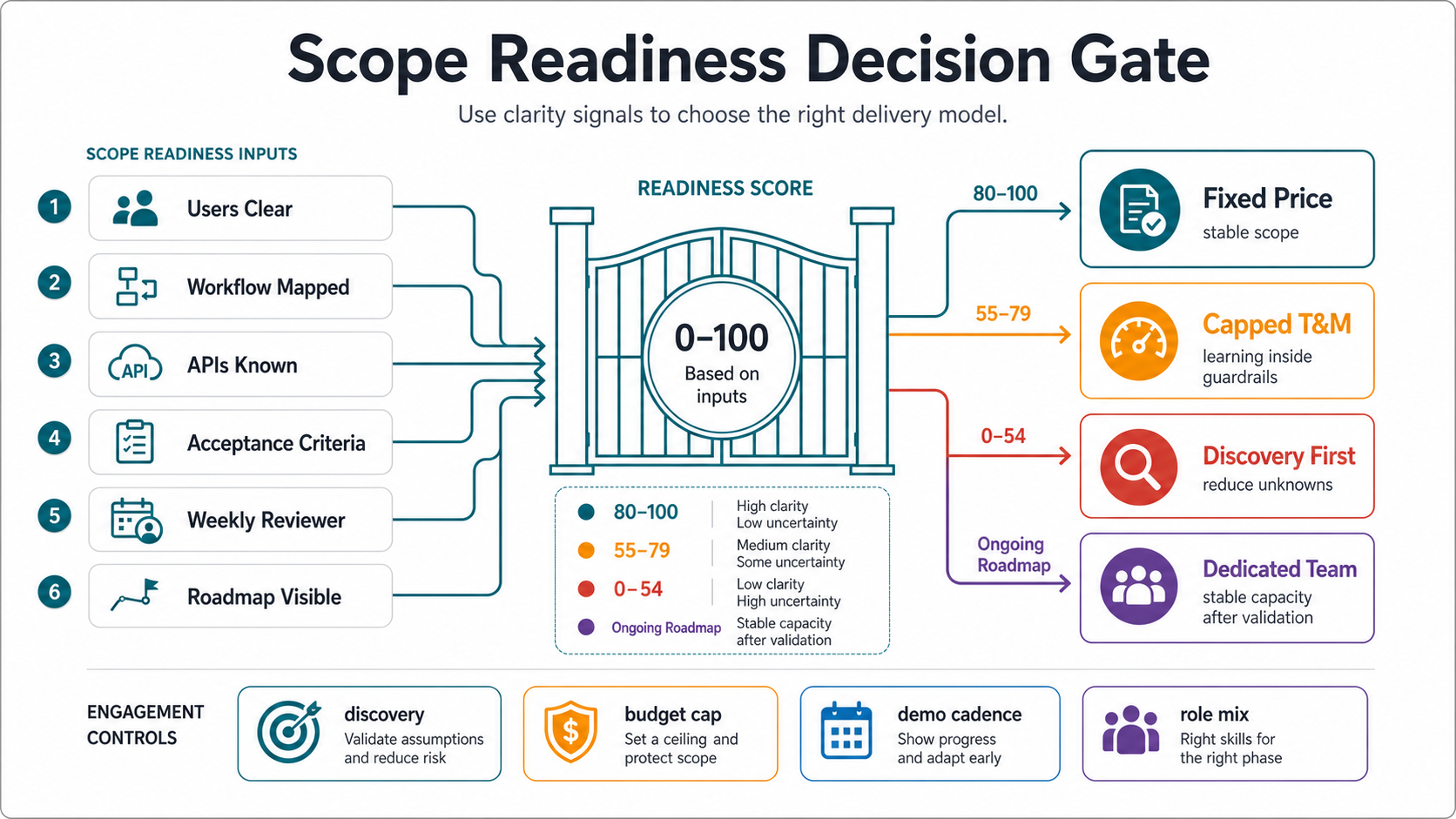
The same questions also affect custom software development cost. Workflow complexity, roles, integrations, data migration, security, QA, and change risk usually matter more than the number of screens.
How Risk Moves Between Models
Fixed price shifts delivery and estimation risk toward the vendor, but it shifts change risk back to the buyer. Time and material shifts budget risk toward the buyer, but it reduces the cost of learning and changing direction. Dedicated teams shift utilization risk toward the buyer, but they reduce context-switching and ramp-up risk over time.
| Risk | Fixed Price | T&M | Dedicated Team |
|---|---|---|---|
| Scope changes | Managed through change orders | Handled through backlog reprioritization | Handled through roadmap and sprint planning |
| Budget control | High upfront control | Needs cap and burn reporting | Monthly capacity is predictable |
| Speed to start | Slower because planning is heavier | Faster for uncertain work | Slower ramp, faster after context builds |
| Client involvement | High before build, lower during delivery | High throughout sprints | High through roadmap ownership |
| Best failure mode | Scope is cut or changed explicitly | Budget and priority are reviewed early | Capacity is adjusted by roadmap evidence |
This is why a model should be chosen from the project's uncertainty profile. A buyer with unclear requirements does not become safer by forcing a fixed quote. A buyer with a small locked feature set does not become more Agile by paying monthly for a full team.
Hybrid Models Often Work Best
Many software projects need different commercial structures at different points. A hybrid model is not indecision; it is often the most honest way to handle mixed certainty.
- Fixed discovery, then fixed delivery: useful when the buyer needs a build-ready scope before committing to the main project.
- T&M discovery, then fixed delivery: useful when technical unknowns must be tested before pricing.
- Fixed core plus T&M backlog: useful when one workflow is non-negotiable but experiments remain flexible.
- Capped T&M: useful when learning is needed but the buyer has a hard budget ceiling.
- Dedicated team plus fixed add-ons: useful when a standing team owns the platform while discrete modules need separate scope control.
For MVPs, this overlaps with the guidance in MVP engagement models for startups: use the smallest commitment that proves the next decision, then scale the model when the roadmap deserves it. The MVP Scope Builder can help separate release-one scope from later-phase ideas.
Proposal Red Flags To Watch
Do not evaluate only the label on the proposal. Look for the mechanics that make the model work.
| Red Flag | Why It Matters | Buyer Control |
|---|---|---|
| Fixed price with vague scope | The quote will become disputes and change orders | Ask for assumptions, exclusions, and acceptance criteria |
| T&M without budget reporting | Flexibility can hide waste | Require weekly burn, demo output, and cap alerts |
| Dedicated team without role clarity | Monthly capacity may not match the roadmap | Define role mix, utilization, sprint goals, and review cadence |
| No discovery for uncertain work | Unknowns move into development | Run a short discovery or technical spike first |
| No QA and release plan | Cheap delivery can become expensive rework | Include environments, testing, regression, analytics, and handover |
| No IP, access, or security terms | Operational risk survives the contract | Confirm repository, credentials, data access, and IP ownership |
For offshore delivery, also check communication overlap, reporting rituals, repository access, IP transfer, escalation process, and QA ownership. NextPage's offshore software development checklist covers these controls before hiring.
How This Applies To Outsourcing
Software outsourcing adds another layer: the engagement model must fit the delivery location, communication rhythm, and team structure. A fixed-price outsourcing project needs very clear specifications and change control. A T&M outsourced project needs frequent demos and transparent time reporting. A dedicated offshore team needs enough overlap, backlog maturity, and delivery leadership to act like a real extension of the product team.
If the goal is cost-efficient capacity, compare the model against broader software development outsourcing to India tradeoffs. India-based teams can be effective across all three models, but the buyer still needs governance. Lower rates do not compensate for unclear scope, slow feedback, weak QA, or missing ownership.
For buyers who want a structured vendor relationship rather than only staff extension, IT outsourcing services can combine development, QA, backend, DevOps, maintenance, and AI work under the right commercial model. For buyers who specifically need ongoing product capacity, software outsourcing India and dedicated team paths may be a better fit than isolated fixed-price tasks.
NextPage's Practical Recommendation
Start with the model that matches the uncertainty you can see today, then add controls for the uncertainty you cannot remove.
- Use discovery first when users, workflows, integrations, data, or acceptance criteria are unclear.
- Use fixed price for short, stable, well-documented work with a clear change process.
- Use capped T&M when you need learning, technical exploration, or flexible prioritization inside a budget guardrail.
- Use a dedicated team when the roadmap is ongoing and stable capacity will compound product context.
- Use hybrid structures when one part of the work is stable and another part needs discovery or iteration.
The model should make the next decision easier. If you need a quote, clarify scope. If you need learning, protect flexibility. If you need velocity, build a team that can keep context. If you need all three, phase the engagement instead of forcing one contract to carry every kind of risk. For complex vendor comparisons, pair this with the custom software development company checklist so pricing, delivery governance, security, and ownership are evaluated together.
Final Takeaway
Fixed price, time and material, and dedicated team are not just billing preferences. They are operating systems for software delivery. Fixed price works when scope is stable. T&M works when learning must stay open. Dedicated teams work when a product roadmap needs continuity.
The safest buyer does not ask which model is universally best. They ask which model matches their current scope clarity, change risk, budget guardrails, and roadmap length. Once those answers are visible, vendor proposals become easier to compare and the engagement is less likely to fail for reasons that were obvious before kickoff.