
Quick Answer: Sports Betting App Development
Sports betting apps give users a mobile way to view events, compare odds, place wagers where legally permitted, manage wallets, receive live updates, and track bet history. A useful product is more than a betting slip. It needs a reliable event feed, odds management, account verification, geolocation or market access controls, responsible-play workflows, secure payments, risk controls, notifications, analytics, and an admin operations layer.
The strongest first release starts with the market, product model, and compliance constraints before screens are designed. Decide whether the app supports sportsbook betting, fantasy contests, free-to-play picks, prediction games, affiliate comparison, or internal trading operations. Then shape the roadmap with an experienced mobile app development team so the user experience, backend, data feeds, security, and operations stack are planned together.
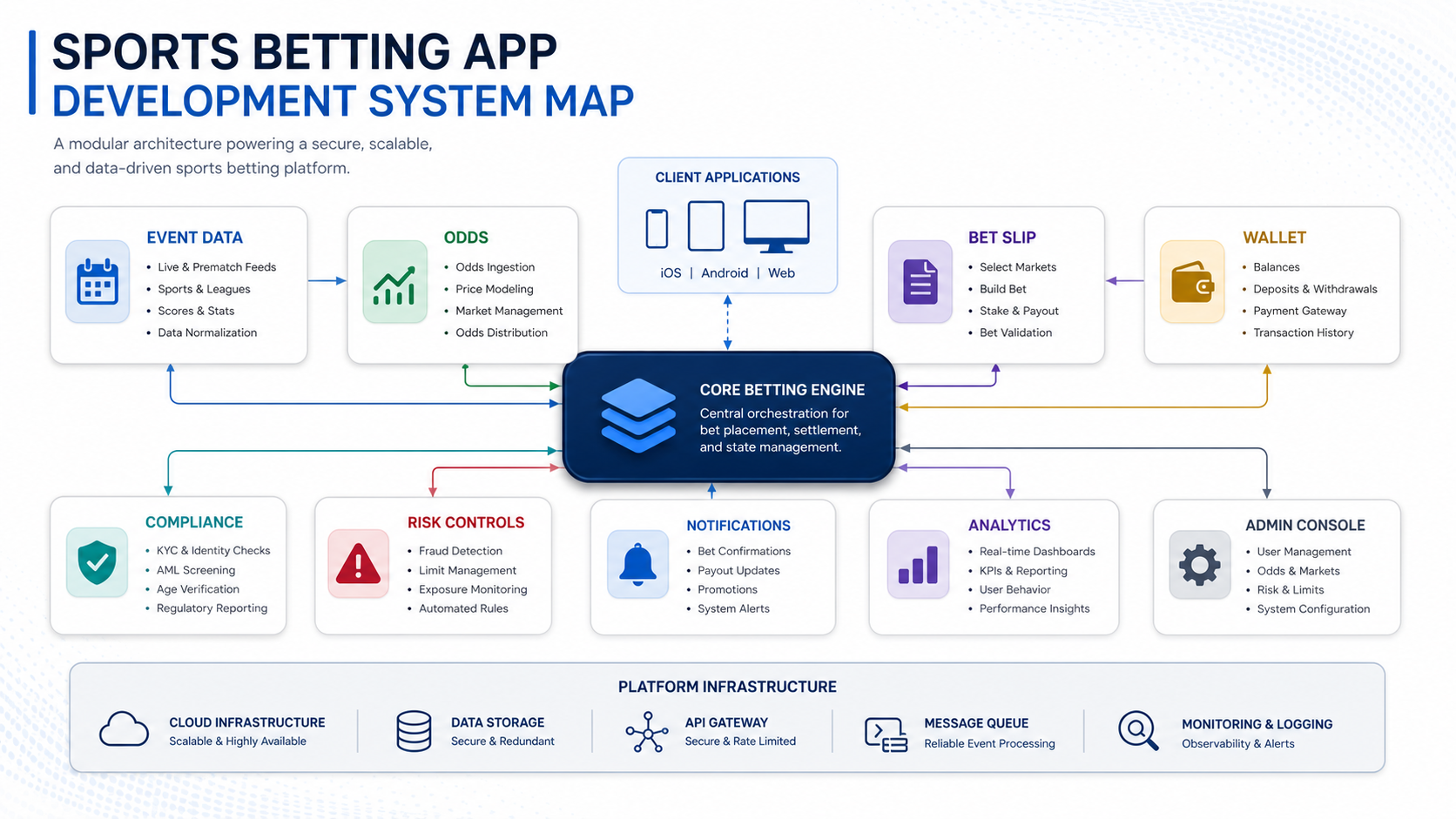
Why Sports Betting Apps Need More Than A Simple Mobile Interface
Sports betting is real-time software. The app must keep event status, odds, markets, wallet balances, bet settlement, notifications, and customer support aligned while users are acting quickly. Small delays or inconsistent states can damage trust, create support load, and expose the operator to operational risk.
That is why sports betting products often overlap with custom software development. The visible mobile app is only one part of the platform. The harder work sits in backend services, third-party data integrations, payment reconciliation, audit trails, fraud checks, content management, reporting, and admin workflows.
Sports Betting App Feature Priority Matrix
Feature planning should separate the launch-critical experience from later growth features. The MVP must support the first compliant user journey end to end: onboarding, event discovery, market selection, bet placement or pick submission, wallet or account state, notifications, help, and admin oversight.
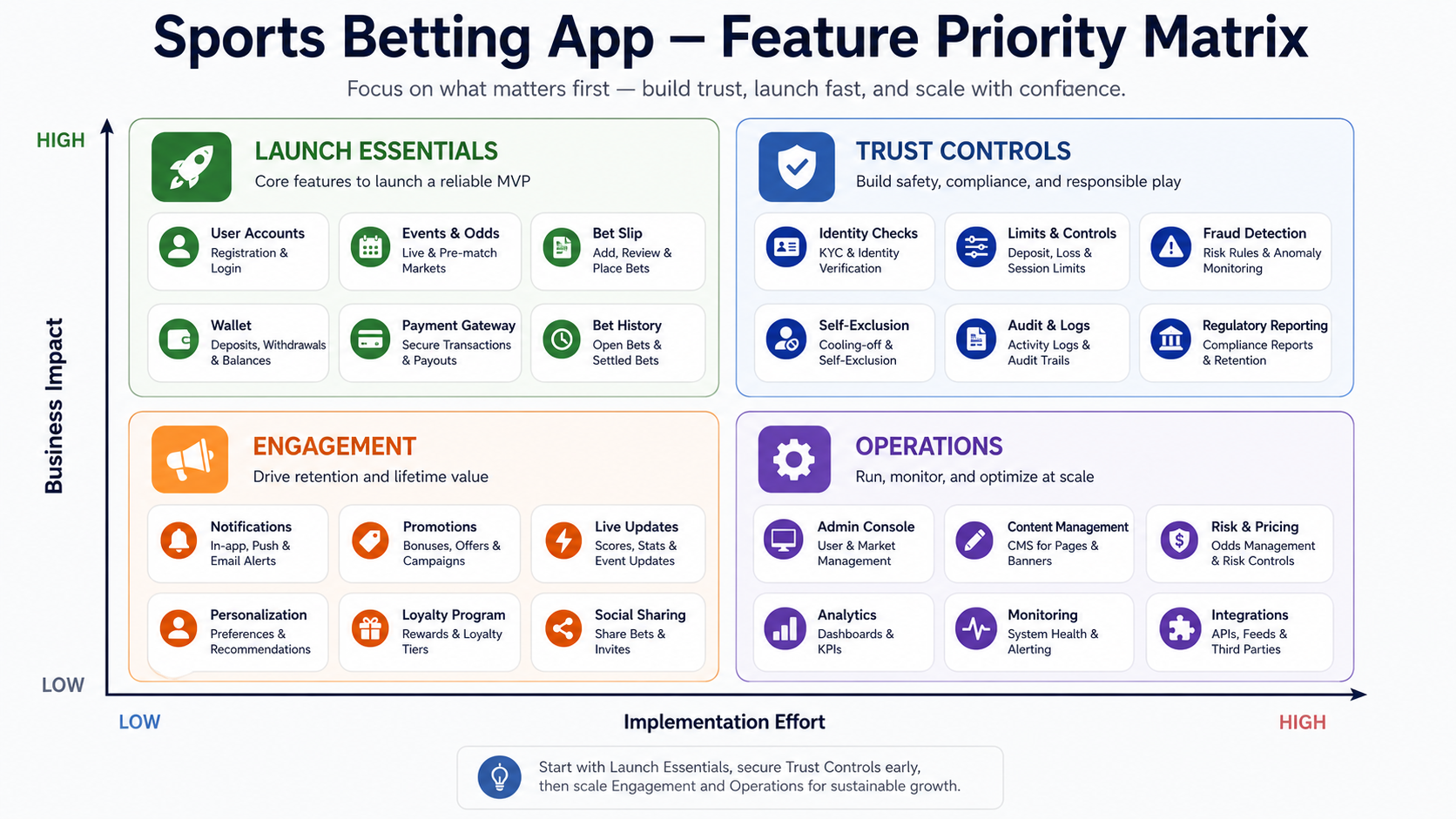
| Feature Area | What To Include | Launch Priority |
|---|---|---|
| Account and access | Signup, login, identity checks, user profile, permissions, session security, and market access rules. | Must have |
| Events and markets | Sports categories, fixtures, live event status, odds display, market filters, favorites, and search. | Must have |
| Bet slip or picks | Single picks, bet slip review, odds refresh, confirmation states, history, void/cancel handling where applicable, and settlement status. | Must have |
| Wallet and payments | Deposits, withdrawals, balances, transaction history, limits, reconciliation, failed payment recovery, and support workflows. | Depends on model |
| Engagement | Personalized alerts, promotions, leaderboards, loyalty, content, referrals, and reactivation campaigns. | Growth stage |
| Operations | Admin console, risk flags, market controls, content management, support tools, analytics, audit logs, and reporting. | Must have |
Real-Time Data, Odds, And Settlement Architecture
The most important technical decision is how the app receives, validates, stores, and displays event and odds data. A product may use a sports data provider, odds provider, internal trading tools, affiliate feeds, or a custom content workflow. Each option affects latency, uptime, cost, data rights, QA, and customer support.
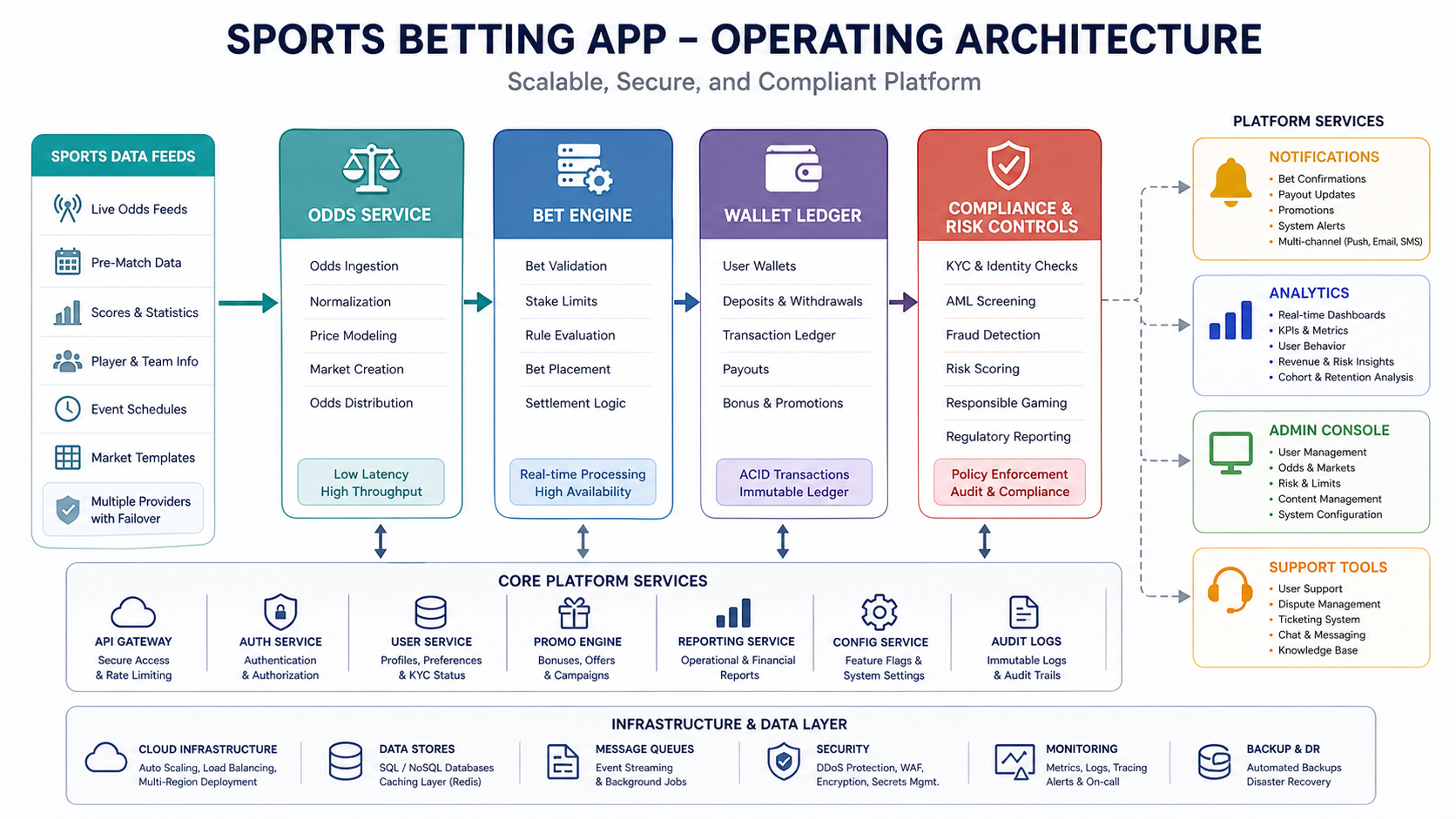
The architecture should avoid making the mobile app responsible for business-critical decisions. The backend should own market status, odds refresh rules, validation, settlement events, wallet updates, limits, audit logs, and event-driven notifications. The app should show clear states when odds change, markets close, payments fail, or results are pending.
Compliance, Responsible Play, And Risk Controls
Compliance requirements vary by market, product type, and operating model, so teams should not copy another app's flow without legal and operational review. Common planning areas include identity checks, age restrictions, location or jurisdiction controls, wallet rules, responsible-play limits, self-exclusion workflows, risk monitoring, fraud checks, anti-abuse controls, audit logs, and clear terms.
Build these workflows into the product from the beginning. Retrofitting compliance later can force changes to onboarding, wallet behavior, market access, notifications, admin tools, data retention, support scripts, and reporting. Treat the compliance layer as product infrastructure, not as a form added at the end.
UX Principles For High-Trust Betting Products
Sports betting UX should make speed and clarity work together. Users need to find events quickly, understand the current market state, review selections, see odds changes, confirm actions, and recover from errors without ambiguity. Confusing labels, stale odds, hidden wallet states, or unclear settlement messages can create avoidable support volume.
Good UX also reduces risky behavior and accidental actions. Use clear confirmations, visible limits, transaction history, reminder states, helpful empty states, and plain-language status messages. For technology choice, compare the tradeoffs in Native Vs Cross Platform Mobile App Development before deciding how much real-time behavior and device-specific polish the first release needs.
Payments, Wallets, And Transaction Reconciliation
Wallet design needs more care than a standard checkout flow. Users expect deposits, withdrawals, balances, pending transactions, bonuses, refunds, failed payment handling, and settlement updates to stay consistent. Operators need reconciliation tools, support visibility, fraud flags, limits, and exports that explain what happened when a payment or settlement is disputed.
The wallet and transaction model has useful parallels with mobile commerce. NextPage's guide to ecommerce mobile app development covers checkout, payments, retention, and operational analytics that also matter when money movement and user trust are central to the product.
Engagement, Personalization, And Retention
Engagement features should be useful, permission-aware, and compliant with the product's market rules. Common options include match reminders, odds movement alerts, bet status updates, personalized sports preferences, saved leagues, promotions, loyalty, content, leaderboards, and reactivation campaigns.
Avoid building engagement mechanics before the core experience is reliable. If event data, odds refresh, wallet state, or settlement status is inconsistent, personalization will not solve the trust problem. Start with clear notifications for important account and event states, then add promotional features after analytics show where users return or drop off.
Sports Betting App Development Cost Drivers
Sports betting app cost depends on product model, data integrations, compliance workflows, payments, real-time architecture, admin operations, and QA depth. A free-to-play prediction app is very different from a real-money sportsbook, and an affiliate odds comparison product is different from an operator-grade trading platform.
Major cost drivers include mobile platform choice, user roles, event and odds provider integration, wallet design, payment gateway work, compliance checks, responsible-play workflows, admin controls, analytics, security, support tooling, monitoring, and launch operations. Use the Custom Software Cost Estimator for early budget framing, then compare backend and admin platform assumptions against the web app development cost guide.
| Product Shape | Typical Scope | Complexity Risk |
|---|---|---|
| Free-to-play picks app | Accounts, fixtures, picks, scoring, leaderboards, notifications, and basic admin. | Lower if no wallet or regulated wagering is involved. |
| Odds comparison or affiliate app | Sports feeds, odds display, filters, content, tracking links, preferences, analytics, and CMS. | Medium because feed reliability and attribution matter. |
| Real-money sportsbook app | Accounts, markets, bet slip, wallet, payments, compliance, risk controls, settlement, support, and reporting. | High because money movement, compliance, and real-time state are central. |
| Operator platform | Mobile app, admin console, market operations, user management, promotions, risk tooling, analytics, and integrations. | Highest because it spans product, operations, and governance. |
Development Roadmap From Discovery To Launch
- Discovery: define markets, product model, users, compliance needs, data feeds, payment assumptions, support workflows, launch risks, and success metrics.
- Prototype: validate event discovery, market browsing, bet slip or pick flow, wallet states, odds refresh behavior, and admin operations.
- MVP build: implement accounts, event data, market display, core transaction or pick flow, notifications, admin controls, analytics, and support visibility.
- Integrations: connect sports data, odds, identity, payment, CRM, messaging, analytics, monitoring, and compliance systems as required by scope.
- Hardening: test race conditions, stale data, failed payments, settlement edge cases, permissions, abuse patterns, uptime, logging, and rollback behavior.
- Growth: add personalization, loyalty, deeper promotions, content, advanced analytics, and automation after the core operating loop is stable.
For another real-time mobile workflow, review How To Develop A Pizza Delivery App Like Domino's. The domain is different, but the operational lesson is similar: customer-facing simplicity depends on a reliable backend, status updates, notifications, and admin controls.
Launch Metrics To Track
Track metrics across product, trust, and operations. Useful product metrics include signup completion, identity-check completion, event views, market views, bet slip starts, confirmed actions, repeat sessions, notification opt-in, and retention. Trust metrics include payment failure rate, withdrawal issues, odds-change errors, settlement delays, support tickets, account-limit actions, and complaint patterns.
Operations teams should also monitor feed latency, provider errors, market suspension events, transaction reconciliation, fraud flags, incident response time, and admin actions. These metrics show whether the app is ready for more markets, more sports, deeper personalization, or heavier promotional activity.
Final Recommendation
Build a sports betting app only after the operating model is clear. The app needs more than polished screens: it needs reliable event data, market rules, account controls, wallet behavior, responsible-play flows, risk operations, analytics, support tooling, and launch monitoring.
Start with the smallest compliant product that proves the core user journey and operating workflow. Once the foundation is stable, expand into more sports, richer markets, personalization, loyalty, and automation with evidence from real usage rather than assumptions.