
Quick Answer: Staff Augmentation Or Managed Dedicated Team?
Choose staff augmentation when you already have strong engineering leadership, a working delivery process, and a specific skill or capacity gap to fill. You keep daily control over architecture, backlog priority, sprint rituals, code review, QA, release decisions, and individual performance. The vendor supplies people; your team owns outcomes.
Choose a managed dedicated team when the work needs a stable pod, not only extra hands. A managed team is better when the roadmap will run for several releases, internal managers are already stretched, QA and delivery coordination need structure, or you want an India-based team that brings a tech lead, PM support, and quality gates with the developers.
The wrong choice usually shows up as hidden management cost. Staff augmentation looks lean because you pay for individual roles, but it consumes internal lead time. A managed dedicated team looks larger because QA, PM, and team leadership may be included, but it can reduce coordination drag when the work needs ownership. If you are comparing both paths, estimate the role mix first with the Dedicated India Team Cost Calculator, compare the operating model against NextPage's software outsourcing in India service path, then use the decision matrix below to pick the delivery structure.
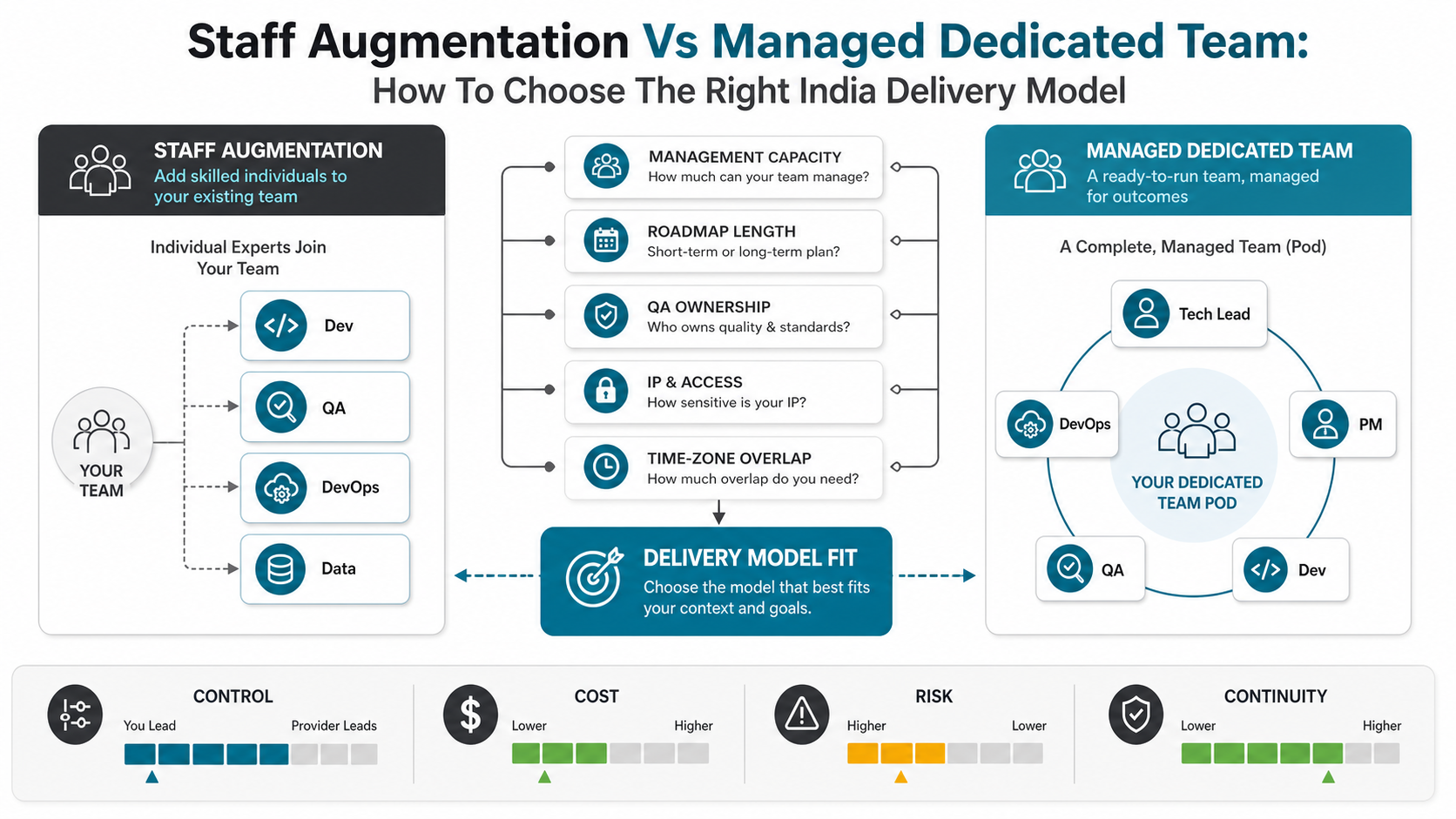
What Is Staff Augmentation?
Staff augmentation means external developers, QA engineers, DevOps specialists, designers, or data engineers join your existing team under your direction. They usually follow your standups, ticketing workflow, branch strategy, review rules, and release process. They are not a separate outsourced project team; they extend the team you already run.
This model is useful when the internal operating system is healthy. If your tech lead can onboard people, split work, answer questions, review pull requests, and protect quality, staff augmentation can add capacity quickly. It is especially practical for short specialist needs: one backend engineer for an API push, a DevOps engineer for infrastructure hardening, two React developers for a quarter, or QA automation support during a release crunch.
The catch is that augmentation does not remove management work. It increases the number of people your leads must coordinate. If architecture is unclear, product requirements are moving, QA is weak, or nobody has time to mentor external developers, staff augmentation can slow delivery while still increasing cost. Teams that need narrow specialist capacity should define role scorecards before hiring; teams that need a product lane should compare the model with Your Team in India before expanding headcount.
What Is A Managed Dedicated Team?
A managed dedicated team is a stable India-based delivery pod assigned to your product or workstream. It can include frontend, backend, mobile, QA, PM, tech lead, DevOps, data, or AI roles depending on the roadmap. The team works exclusively or near-exclusively on your backlog, but the partner helps manage internal coordination, delivery rituals, QA gates, reporting, and team continuity.
The buyer still owns product direction. You decide business goals, roadmap priority, acceptance criteria, compliance constraints, and what success means. The managed team owns more of the "how": sprint planning mechanics, daily coordination, implementation sequencing, defect triage, test discipline, handoffs, and team-level reporting.
This is why NextPage's software team in India model can be either simple team extension or a more managed delivery setup. Some clients only need developers inside their workflow. Others need a pod with QA and coordination because their internal team cannot absorb more day-to-day management.
Staff Augmentation Vs Managed Dedicated Team: Side-By-Side
| Decision Factor | Staff Augmentation | Managed Dedicated Team |
|---|---|---|
| Best fit | Specific skill gaps inside a working team | Sustained product lanes or delivery pods |
| Management owner | Your engineering leads manage daily work | You set direction; partner helps manage delivery rhythm |
| Team shape | Individual contributors or small groups | Cross-functional pod with dev, QA, PM, and tech lead support when needed |
| Control level | High control over tickets and individuals | High product control, less need for daily task assignment |
| Ramp-up | Fast when processes and codebase are documented | Moderate; stronger after the team builds product context |
| Cost visibility | Per-person cost is clear, management cost is hidden | Monthly team cost is larger, but coordination roles are visible |
| Risk | Coordination overload, fragmented ownership, weak QA if not managed | Paying for capacity without enough roadmap clarity |
| Best duration | 1-9 months or specialist bursts | 6-18+ months, ongoing roadmap, or multi-release platform work |
Neither model is universally better. The right choice depends on whether you are buying capacity for a system you already know how to run, or building a delivery lane that needs structure around the people.
The Management Capacity Test
The simplest question is not "Which model is cheaper?" It is "Who will manage the work every day?" If the answer is a named internal engineering manager or tech lead with available time, staff augmentation can work. If the answer is unclear, a managed dedicated team is usually safer.
| Question | If Yes | If No |
|---|---|---|
| Can an internal lead review external developers' work daily? | Staff augmentation remains viable | Use a managed team with tech lead support |
| Are tickets, acceptance criteria, and designs ready before each sprint? | Augmented developers can move quickly | Add PM/product support or run discovery first |
| Is QA already embedded in your release process? | External engineers can follow your gates | Prefer a team that includes QA ownership |
| Can your team onboard people into repo, tools, and domain context within one week? | Staff augmentation ramp-up can be efficient | Managed onboarding and documentation are needed |
| Will this roadmap continue for more than two releases? | Either model can work if leadership is available | A stable dedicated team may compound context better |
Management capacity is often the hidden budget line. A senior internal lead spending ten hours a week unblocking augmented developers is real cost, even when it does not appear on the vendor invoice.
Management Capacity Scorecard
Use the management-capacity test as a scored gate, not a discussion prompt. Staff augmentation is a good fit when internal leadership can own role onboarding, backlog priority, architecture decisions, pull-request review, QA acceptance, and release signoff. A managed dedicated team is safer when those responsibilities are important but no internal owner has enough time to run them every day.
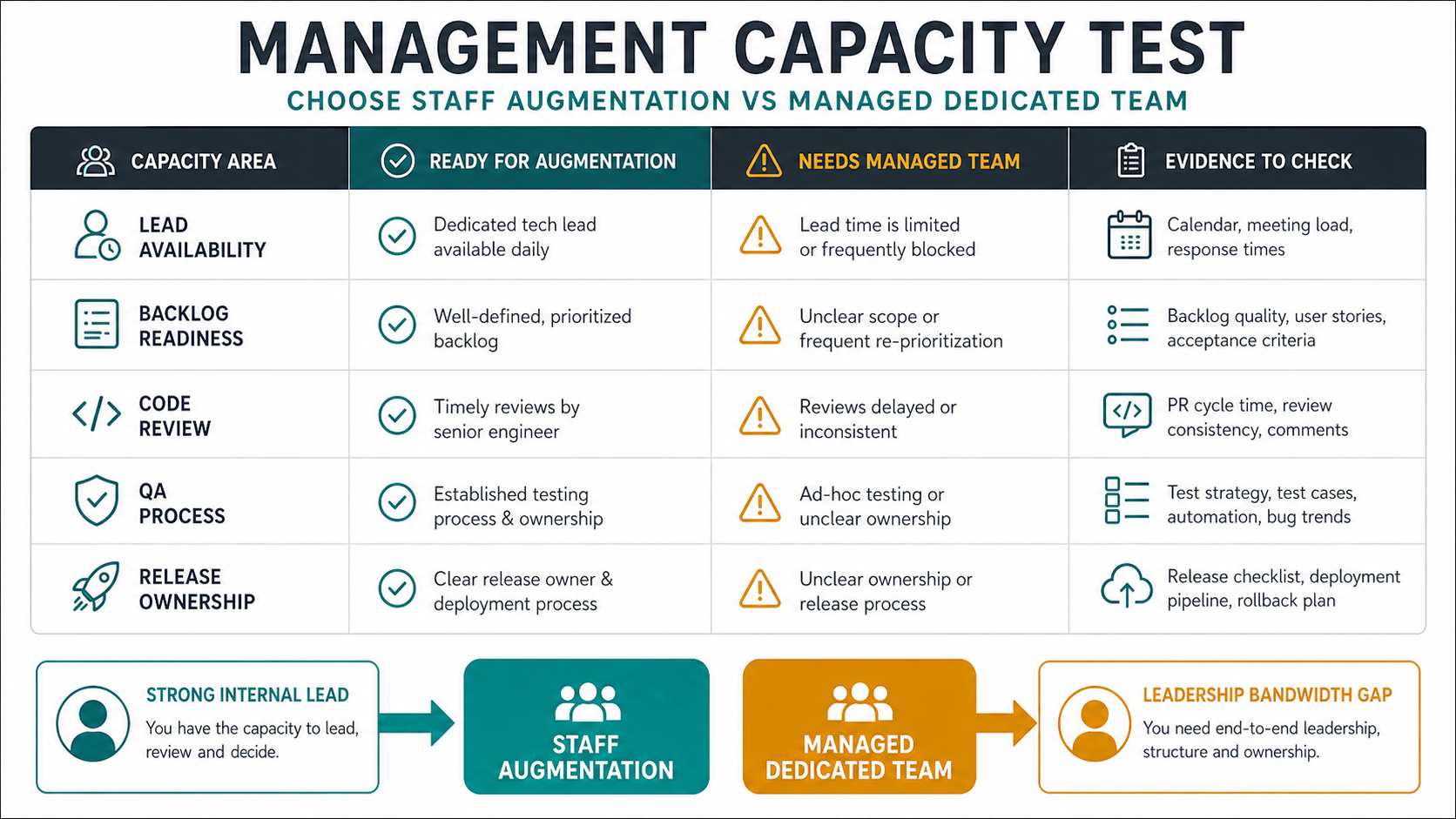
| Capacity Area | Augmentation-Ready Evidence | Managed-Team Signal |
|---|---|---|
| Lead availability | A named lead can spend time daily on direction, reviews, and unblockers. | Leadership is already split across roadmap, incidents, hiring, and stakeholder work. |
| Backlog readiness | Tickets include acceptance criteria, dependencies, owner, and test notes. | Work is still being shaped from vague business requests or shifting priorities. |
| Code review | Branch rules, reviewers, standards, and review SLAs already exist. | PRs wait for days or merge without consistent technical review. |
| QA process | Regression, test cases, defect severity, and release signoff are owned internally. | The roadmap needs QA planning, execution, and reporting from the partner. |
| Release ownership | Internal teams own deployment, rollback, monitoring, and stakeholder communication. | The partner needs to coordinate release evidence, demos, and first-week support. |
If the scorecard exposes a leadership gap, do not treat it as a hiring failure. It means the engagement model should include delivery ownership. NextPage's hire dedicated developers in India model can include QA, senior review, and product leadership support instead of only individual resumes.
Cost Comparison: Look Beyond Hourly Rates
Staff augmentation usually appears cheaper because the buyer sees a rate per person. That can be true when the need is narrow: one backend developer, one QA automation engineer, or one mobile specialist for a defined phase. It becomes misleading when the work also needs PM, QA strategy, release coordination, architecture decisions, and team reporting.
A managed dedicated team often has a higher monthly number because the team shape may include a project coordinator, QA engineer, senior reviewer, or tech lead. That is not overhead by default. Those roles are the delivery system. They reduce missed requirements, uneven code review, slow handoffs, untested releases, and the common offshore problem where "more developers" produce more coordination work instead of more usable software.
For 2026 planning, use the dedicated development team cost in India guide to understand typical role mixes and monthly ranges, then pressure-test broader feature scope with the Custom Software Cost Estimator before locking the team model. If the output shows you need only one or two narrowly scoped specialists, augmentation may be enough. If it shows a PM, QA, lead developer, and multiple engineers, a managed pod is probably the cleaner operating model.
When Staff Augmentation Wins
Staff augmentation is strongest when the work can plug into a mature team without changing the operating model. The internal team owns architecture, standards, backlog grooming, sprint ceremonies, release planning, and quality. The external contributor adds bandwidth or a missing skill.
- You have a strong internal lead. Someone can assign work, review code, explain architecture, and resolve ambiguity quickly.
- The work is well-bounded. Examples include UI implementation, backend endpoints, test automation, migration scripts, API integrations, DevOps support, or short-term mobile delivery.
- You need granular flexibility. You may need two developers this quarter, one QA engineer next quarter, and no external capacity after launch.
- You want direct control. Your team wants to manage tickets, code reviews, pull requests, ceremonies, and release sequencing directly.
- You already have QA and product management. External people can follow existing gates rather than inventing delivery structure.
Staff augmentation fails when it is used to compensate for missing leadership. If nobody can define the work, review it, or protect quality, adding individual contributors creates a larger unmanaged queue.
When A Managed Dedicated Team Wins
A managed dedicated team is strongest when the buyer needs a reliable delivery lane, not only individual contributors. This is common for SaaS products, internal platforms, mobile apps, data products, eCommerce systems, modernization programs, and AI-enabled workflows where product context builds over time.
- The roadmap is sustained. A stable team gets better after every sprint because it learns the domain, codebase, users, and release constraints.
- Internal managers are stretched. You can provide priorities and acceptance criteria, but not daily task management for every external engineer.
- QA ownership matters. The team needs test planning, regression checks, defect triage, and release gates rather than developer-only output.
- The product needs cross-functional delivery. Backend, frontend, mobile, QA, DevOps, analytics, or AI work must move together.
- You need predictable monthly capacity. A stable pod makes roadmap planning easier than repeatedly sourcing individual specialists.
If you want dedicated developers with product leadership and QA support, the hire dedicated developers in India path is more appropriate than a pure staff-extension arrangement.
Governance Checklist Before You Choose
Offshore delivery succeeds when the operating rules are explicit. Before choosing either model, confirm the controls below. They matter more than the label on the proposal.
| Control | What To Confirm | Why It Matters |
|---|---|---|
| Backlog ownership | Who writes acceptance criteria, ranks work, and approves tradeoffs? | Prevents external teams from guessing priorities |
| QA gates | Who owns test cases, regression, defect severity, and release signoff? | Separates working code from releasable software |
| IP and repository access | Code ownership, branch access, credential handling, and offboarding rules | Protects product assets and simplifies audits |
| Time-zone overlap | Daily overlap window, escalation channel, and response expectations | Reduces blocked time and delayed decisions |
| Delivery evidence | Demos, burn reports, sprint notes, release notes, and decision logs | Makes progress visible before invoices arrive |
| Security boundaries | Least-privilege access, environment separation, audit logs, and data masking | Limits blast radius for external contributors |
The offshore software development checklist expands these controls for IP, security, QA, and partner evaluation before hiring.
Offshore Delivery Governance Board
The operating model should be visible in weekly evidence. For staff augmentation, the buyer usually owns the board and the vendor contributes evidence. For a managed dedicated team, the partner should help maintain the board, escalate risks, and keep delivery artifacts current. Either way, the controls below should be reviewed before scaling the team.
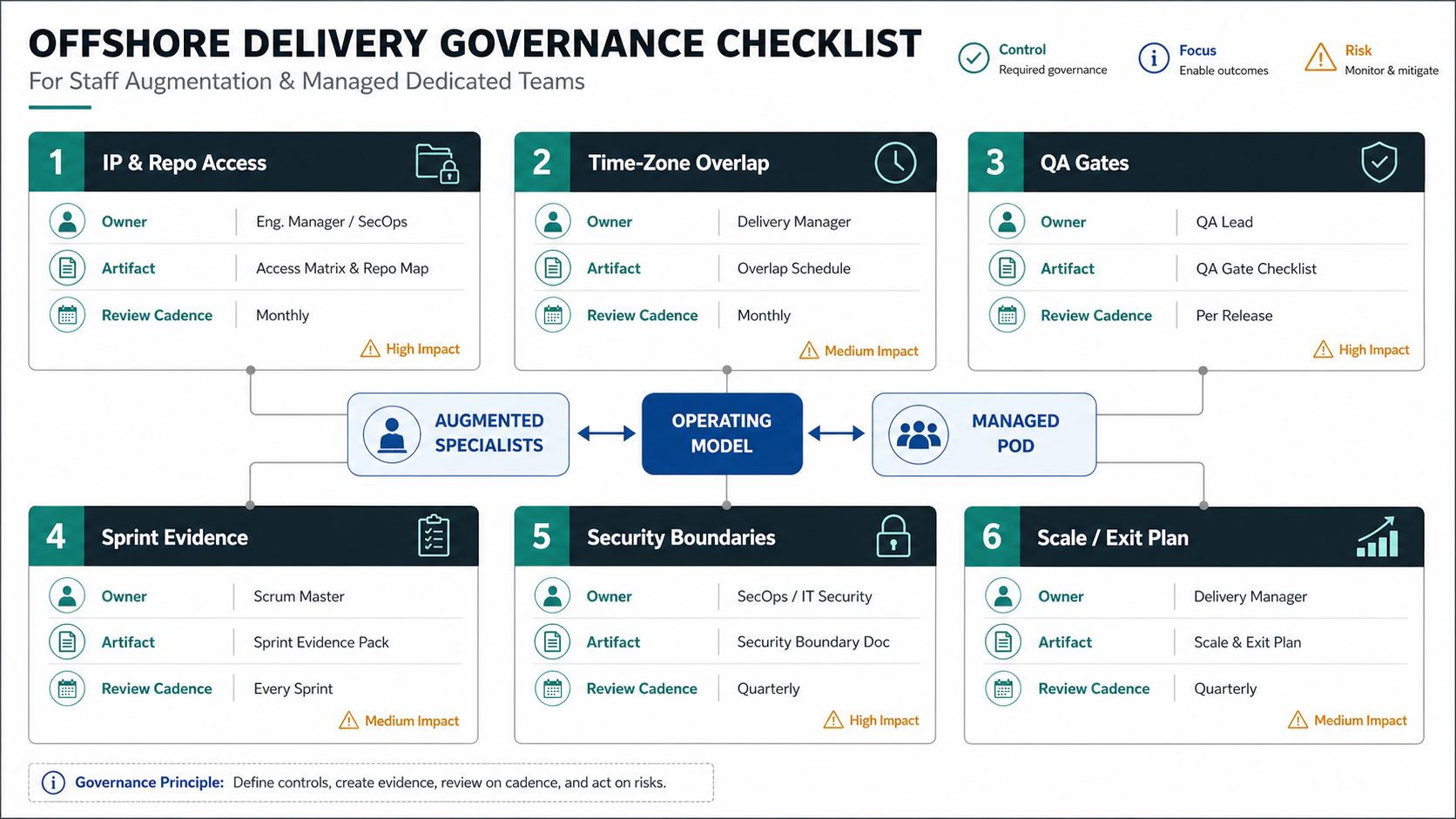
| Control | Evidence Artifact | Review Cadence |
|---|---|---|
| IP and repo access | IP assignment, named accounts, repo permissions, offboarding checklist. | Before kickoff and whenever roles change. |
| Time-zone overlap | Overlap calendar, escalation channel, async handoff format, blocker SLA. | Weekly during the first month, then monthly. |
| QA gates | Definition of done, regression list, defect severity rules, release signoff owner. | Every sprint and before release. |
| Sprint evidence | Demos, sprint goals, accepted tickets, burn notes, risks, and decision requests. | Weekly. |
| Security boundaries | Least-privilege access, masked data, environment rules, audit logs, credential process. | Before access is granted and quarterly after. |
| Scale or exit plan | Role ramp plan, replacement terms, documentation, handover, and continuity notes. | At every capacity change. |
For a deeper checklist, pair this board with the offshore staff augmentation checklist and the loss-of-control outsourcing guide. Those supporting pages help teams turn vendor promises into access, reporting, and ownership controls.
India Delivery Context: What Changes?
India-based software teams can support both staff augmentation and managed dedicated teams. The advantage is not just lower hourly cost. The advantage is access to a large engineering market across backend, frontend, mobile, QA, DevOps, data, cloud, and AI roles. But the model still has to match the buyer's operating capacity.
For staff augmentation, India delivery works best when your internal team can absorb remote contributors into clear ceremonies and documentation. Time-zone overlap should be designed, not assumed. A daily overlap window, written acceptance criteria, and async decision records matter more than generic promises of flexibility.
For managed teams, India delivery works best when the vendor supplies delivery leadership and QA discipline alongside engineers. This is the difference between renting resumes and building a product lane. If you are still comparing price and model options, the broader software development outsourcing to India guide covers cost ranges, engagement models, and partner-selection risks.
A Hybrid Path Often Works Best
The initial model does not have to be permanent. Many buyers use staff augmentation for specialist gaps and a managed dedicated team for sustained product work. Others start with fixed discovery, then choose the model after scope, role mix, system risk, and stakeholder ownership are clearer. This is especially useful when the work could become a product pod but the first decision is still a bounded audit, prototype, or backlog cleanup.
- Discovery first: Use a short fixed-scope discovery phase to define workflows, risks, integrations, and team shape.
- Augmentation for specialists: Add individual DevOps, QA automation, mobile, or AI specialists to an existing team for a clear phase.
- Managed pod for product lanes: Assign a stable pod to own a roadmap area such as a customer portal, mobile app, internal platform, or modernization track.
- Transition after launch: Use a managed team during build, then reduce to staff augmentation for maintenance or specialist support.
This mirrors the model logic in MVP engagement models for startups: use the smallest model that proves the next decision, then scale the team structure only when the roadmap deserves it.
Questions To Ask Vendors Before Signing
Use these questions to separate a real operating model from a sales label.
- Will external developers report to our lead, your lead, or both?
- Who writes sprint goals, acceptance criteria, and release notes?
- Is QA included in the team, optional, or fully owned by us?
- How are IP transfer, repository access, credentials, and offboarding handled?
- What time-zone overlap is guaranteed, and what happens when a blocker appears outside that window?
- How do we scale up, scale down, or swap skills without losing product context?
- What evidence do we receive each week: demos, burn reports, test results, risk logs, or only timesheets?
- Can the model change from staff augmentation to a managed pod after discovery?
If a vendor cannot answer these clearly, the risk is not the model. The risk is weak delivery governance.
NextPage's Practical Recommendation
Start with your internal capacity, not the vendor's rate card. If you have a strong internal team and need targeted help, use staff augmentation. Keep the scope tight, document onboarding, and make sure your lead has time for review and direction.
If you need a cross-functional India team to own a product lane, choose a managed dedicated team. Define roadmap outcomes, acceptance criteria, reporting cadence, QA gates, and monthly role mix before kickoff. Use the dedicated team calculator to pressure-test cost, then talk through the delivery model behind the number.
If the answer is unclear, run discovery first. A short planning phase can expose whether you need one specialist, a capped T&M sprint team, or a managed pod. For MVP or first-release work, the MVP Scope Builder can also separate the first delivery lane from later team expansion. Choosing after discovery is usually cheaper than forcing the wrong model into a vague roadmap.
Final Takeaway
Staff augmentation gives you flexible people inside your process. A managed dedicated team gives you a stable delivery pod with more structure around ownership, QA, and coordination. The better model is the one that matches your management bandwidth, roadmap length, risk profile, and need for delivery ownership.
If you can manage the work directly, augmentation can be efficient. If you need outcomes from a sustained India-based team, a managed dedicated model is safer. The decision should be made before contracts, because the model determines who owns the work when scope changes, defects appear, and deadlines get real.