
A synthetic test data strategy gives regulated software teams realistic QA data without copying sensitive production records into every lower environment. The strategy should define which data must be masked, which data can be generated from rules, which scenarios need AI-assisted generation, and what evidence proves the resulting dataset is private enough, realistic enough, and broad enough for the release risk.
The practical answer is not "replace production data with synthetic data everywhere." Use production data only as a governed source for patterns, constraints, and edge cases; keep direct production records out of development, CI, vendor sandboxes, and demo environments. Then validate synthetic datasets against privacy risk, referential integrity, scenario coverage, and defect-finding value before trusting them in regulated QA.
For teams handling patient records, financial transactions, insurance claims, HR data, student records, or customer support conversations, this is both a quality problem and a governance problem. NextPage treats test data as part of release readiness, alongside software QA testing services, automation coverage, security controls, and audit evidence. If the team needs a broader QA operating model, pair this plan with NextPage's software testing services so synthetic data, manual testing, automation, performance checks, and release reporting use the same risk language.
Quick Answer: What A Synthetic Test Data Strategy Includes
A strong synthetic test data strategy includes five decisions: data-risk classification, generation method, coverage model, validation evidence, and operating controls. Each decision should be explicit before regulated data moves into non-production workflows.
| Strategy Layer | Decision To Make | Evidence To Keep |
|---|---|---|
| Data risk | Which fields, records, logs, files, and conversations contain personal, regulated, contractual, or commercially sensitive data? | Data inventory, owner, retention rule, access boundary, and approved lower-environment use. |
| Generation method | Should this dataset use masking, deterministic rules, model-driven generation, AI-assisted generation, or differential privacy? | Method rationale, source constraints, transformation logic, prompt/model notes, and limitations. |
| Coverage model | Which happy paths, edge cases, negative paths, rare events, integrations, roles, locales, and failure modes must be represented? | Scenario map, boundary-value list, integration matrix, and automated test linkage. |
| Validation | How will the team prove the dataset is realistic enough and private enough? | PII scan, linkage-risk checks, distribution checks, referential-integrity checks, and QA signoff. |
| Operations | Who can generate, refresh, export, approve, and retire synthetic datasets? | Runbook, approvals, version history, access logs, and exception record. |
Why Regulated Teams Need A Strategy, Not Just A Tool
Recent synthetic data guidance points in the same direction: synthetic data can remove dangerous production-data dependencies, but it does not automatically eliminate privacy risk. NIST synthetic-data privacy guidance emphasizes that generated datasets still need disclosure-risk evaluation because some methods preserve too much information about individuals or sensitive groups. Current OWASP AI guidance also pushes teams to treat prompts, model outputs, embeddings, logs, and downstream data flows as security surfaces. Gartner's software-testing research frames synthetic data as a practical choice across AI and non-AI techniques; the implementation lesson is that generator choice, privacy budget, outlier handling, and evidence checks matter more than the label "synthetic."
That distinction matters in real QA programs. A dataset can be synthetic but still unsafe if it was generated from memorized production examples, retains rare combinations that identify a person, leaks real values through free-text fields, or creates plausible but invalid edge cases that hide product defects. It can also be private but useless if it fails to represent transaction limits, claim workflows, medication constraints, payment failures, permission rules, device states, or integration timing.
The strategy has to balance both sides: privacy and utility. If your product includes AI features, connect the test-data plan to an AI assurance testing strategy so synthetic data supports evals, RAG tests, safety cases, and release gates instead of becoming another ungoverned artifact.
Synthetic Test Data Workflow
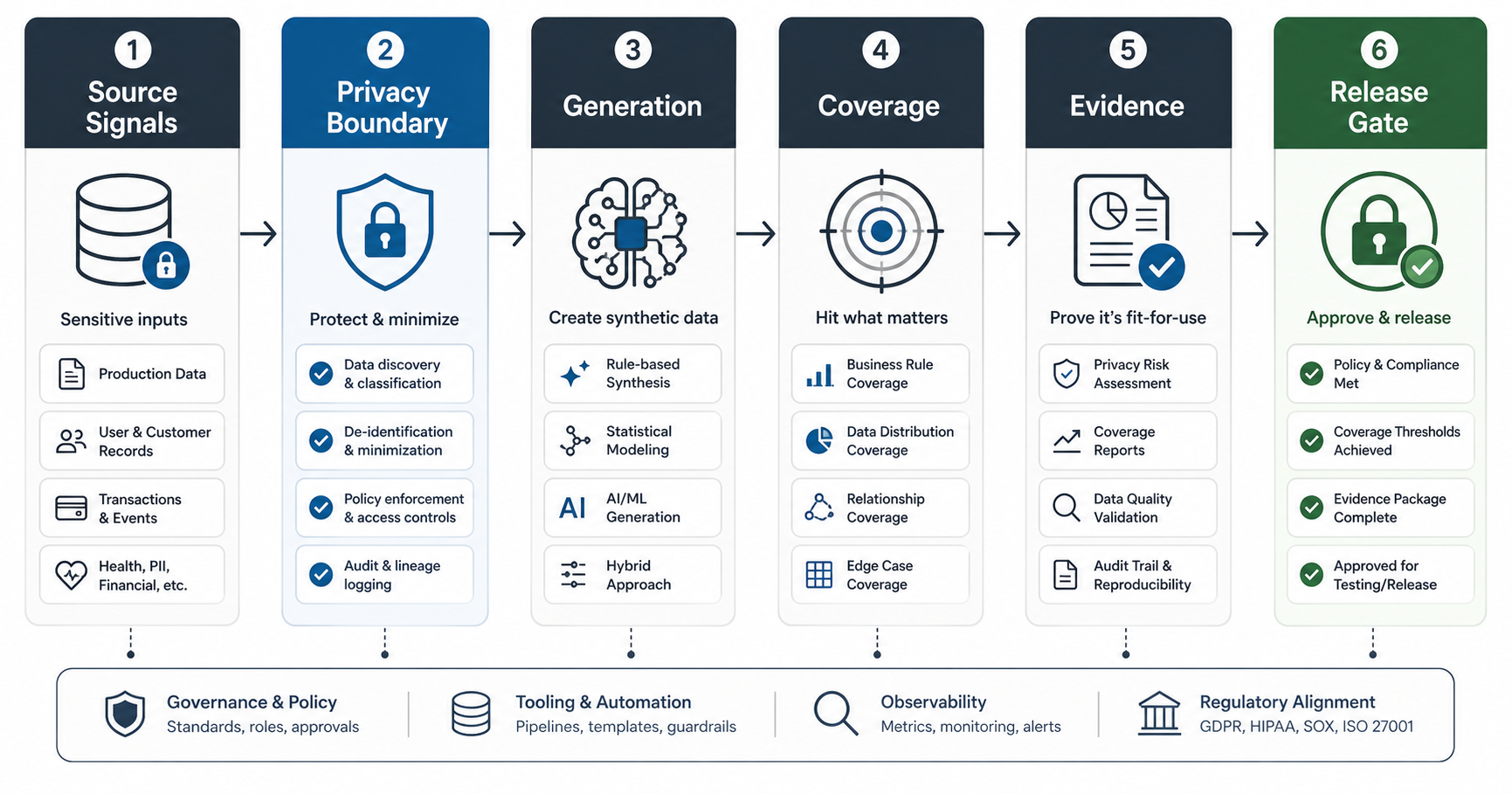
The workflow should start with the product risk, not the generator. A healthcare intake app, lending workflow, insurance claims engine, B2B SaaS billing module, and mobile banking app all need different data realism and different privacy boundaries.
- Classify data by risk and test value. Identify regulated identifiers, quasi-identifiers, sensitive attributes, free text, documents, logs, location data, payment fields, and business-confidential fields. Also identify which fields actually matter for test behavior.
- Choose generation methods by scenario. Use deterministic rules for predictable edge cases, masking or tokenization for stable relationships, model-driven generation for relational datasets, AI-assisted generation for language-heavy workflows, and differential privacy when analytics-style utility and stronger privacy protection are required.
- Build scenario coverage first. Define the release-critical workflows and edge cases before generating data. Synthetic data should serve test design, not the other way around.
- Validate privacy and utility. Run PII scans, re-identification checks where appropriate, distribution checks, referential integrity tests, uniqueness checks, role-permission checks, and application-level QA runs.
- Version and approve datasets. Treat important datasets like release assets. Store generation inputs, method notes, constraints, approval owner, refresh cadence, and known limitations.
Choose The Right Generation Method
Most regulated teams need a mixed approach. One method rarely covers every QA need.
| Method | Best Fit | Risk To Manage |
|---|---|---|
| Static seed fixtures | Unit tests, smoke tests, CI checks, demos, and stable regression cases. | Fixtures drift away from real workflows and miss new edge cases. |
| Rule-based generation | Boundary values, invalid states, permissions, workflow paths, and predictable edge cases. | Rules can be too clean and fail to reproduce messy production patterns. |
| Masked or tokenized data | Systems that need stable relationships, repeatable IDs, and schema realism. | Masking can still leak through rare combinations, free text, or weak transformations. |
| Model-driven synthetic data | Relational databases, multi-table workflows, test environments, and analytics-like distributions. | Generated data must be checked for referential integrity, bias, and memorization risk. |
| AI-assisted generation | Support messages, claims notes, documents, chatbot transcripts, edge-case narratives, and multilingual content. | Prompts, outputs, and provider boundaries need review so sensitive examples are not exposed or reproduced. |
| Differentially private synthetic data | Analytics, research, and data sharing where stronger privacy guarantees matter. | Utility can drop for rare events or complex relationships, so fit-for-purpose validation is essential. |
A simple rule works well: generate exact edge cases with deterministic rules, preserve relational behavior with model-driven techniques, use AI for language variability under strict guardrails, and reserve production-like extracts for tightly controlled pattern analysis rather than routine lower-environment testing.
Privacy Controls Before Generation
Privacy controls should happen before a generator touches sensitive data. Start by deciding whether the generator can access production records at all, whether it runs inside your environment, whether prompts or derived features leave your boundary, and whether generated outputs require human approval before use.
For regulated workflows, free-text fields deserve special attention. Notes, support tickets, claim descriptions, clinical summaries, chat logs, and uploaded documents often contain identifiers that schema-based masking misses. If AI helps create synthetic text, use sanitized templates and domain constraints rather than pasting real user narratives into an external prompt. When this work touches production AI systems, align it with AI development services practices for data boundaries, eval sets, human review, monitoring, and rollback evidence.
Teams building AI-enabled products should also track data lineage. NextPage's EU AI Act readiness checklist for software teams is useful here because the same questions apply to test datasets: where did the data come from, who can use it, what purpose is allowed, how is it retained, and what evidence is available later?
Privacy And Leakage-Control Matrix
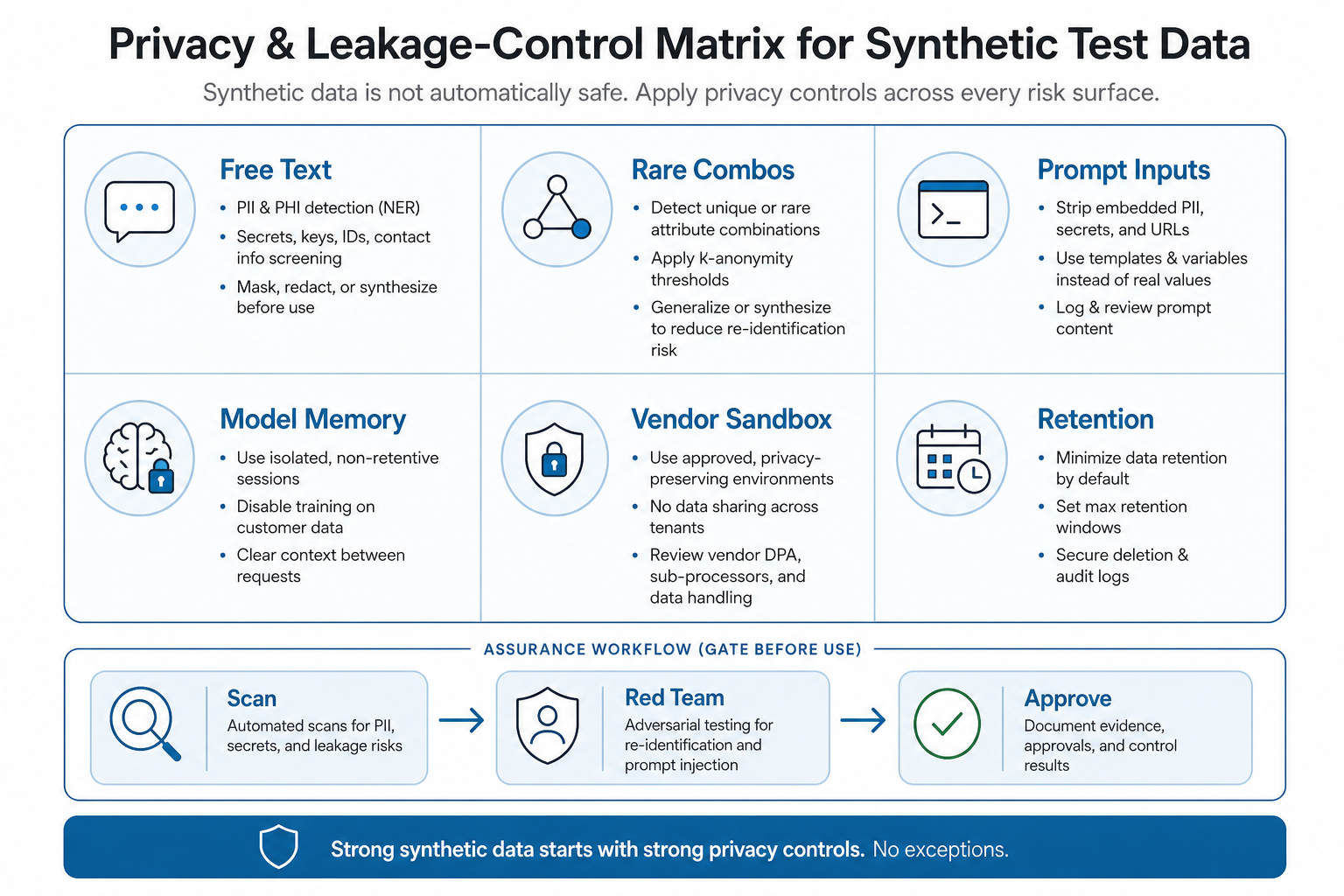
A synthetic dataset can look safe while still carrying leakage risk. The strongest control is to separate source analysis from generator input. Use production records to learn constraints, distributions, and edge cases only inside an approved boundary; then generate lower-environment datasets from sanitized rules, templates, and statistical summaries.
| Risk Surface | Control To Apply | Release Evidence |
|---|---|---|
| Free-text fields | Detect PHI, PII, secrets, URLs, names, contact details, and account references before generation. | Automated scan report, reviewer notes, and rejected examples. |
| Rare combinations | Check quasi-identifiers, outliers, sparse cohorts, and high-uniqueness records. | Uniqueness threshold, generalization rule, and linkage-risk note. |
| Prompt inputs | Use templates, variables, and sanitized examples instead of raw records or screenshots. | Prompt log, input classification, approved provider boundary, and redaction proof. |
| Model memory | Use isolated sessions, disable training on customer data, and clear context between requests. | Vendor setting evidence, DPA review, and environment approval. |
| Vendor sandboxes | Export only purpose-built synthetic slices with expiry, tenant boundaries, and access logs. | Export approval, access log, retention date, and deletion confirmation. |
| Retention | Set default expiry windows for generated datasets, prompts, outputs, and derived features. | Retention policy, owner, cleanup job, and exception record. |
For data-heavy products, the same operating discipline appears in analytics governance. NextPage's big data analytics consulting checklist is a useful companion when synthetic test data shares pipelines, warehouses, governance roles, or metric definitions with reporting teams.
Dataset Governance Operating Model
A regulated synthetic data program needs an operating model, not just a generator. Define who owns each dataset, who approves generation methods, who can export data, who reviews AI-produced text, and when a dataset must be retired. Keep the model lightweight enough for sprint work, but strict enough that lower environments, vendor sandboxes, demos, CI jobs, and support reproductions do not become uncontrolled copies of sensitive workflows.
| Control | Owner | Release Evidence |
|---|---|---|
| Dataset purpose | Product and QA lead | Workflow, risk level, test suites, and allowed environments. |
| Generation method | Engineering and data owner | Rules, model notes, source constraints, prompt boundaries, and rejected methods. |
| Privacy validation | Security, compliance, or data steward | PII scan, quasi-identifier review, linkage-risk notes, and outlier handling. |
| Utility validation | QA and domain reviewer | Scenario coverage, referential integrity, defect yield, and automation mapping. |
| Refresh and retirement | Release owner | Version history, retention date, known limitations, and rollback path. |
This operating model should feed the release checklist. For teams moving from ad hoc test data to controlled releases, the pre-launch QA checklist for custom software is a useful companion because it connects data readiness to roles, integrations, devices, failure paths, and signoff evidence.
Coverage Model For Regulated Software
Synthetic data is valuable when it increases coverage that production data cannot safely or reliably provide. A good coverage model maps data to risks, workflows, and tests. If the product is already hard to regression test, run a legacy software QA audit first so synthetic data fixes real release gaps instead of hiding structural testing debt.
- Workflow coverage: onboarding, eligibility, approvals, exceptions, payments, refunds, cancellations, escalations, notifications, and audit trails.
- Role coverage: admin, staff, customer, auditor, reviewer, manager, external partner, API client, and read-only roles.
- Boundary coverage: age limits, transaction caps, date ranges, currency, locale, duplicate records, missing values, invalid formats, and permission failures.
- Integration coverage: EHR, payment gateway, CRM, identity provider, claims system, ERP, analytics warehouse, email/SMS provider, and third-party API failures.
- Rare-event coverage: fraud signals, contraindications, chargebacks, policy exclusions, consent withdrawal, rate limits, retry storms, and suspicious account behavior.
Connect that model to automation. Synthetic data is most powerful when it feeds stable regression suites, API tests, end-to-end flows, performance tests, and exploratory sessions. It should also feed negative-path tests: expired consent, failed payment authorization, stale eligibility, duplicate identity, denied role access, and third-party timeout states. NextPage's QA automation testing services can help turn the coverage map into repeatable release checks rather than a one-time data exercise. For web-heavy workflows, the test automation strategy for web apps shows how to connect risk, framework choice, CI evidence, and maintenance ownership.
Validation Evidence Matrix
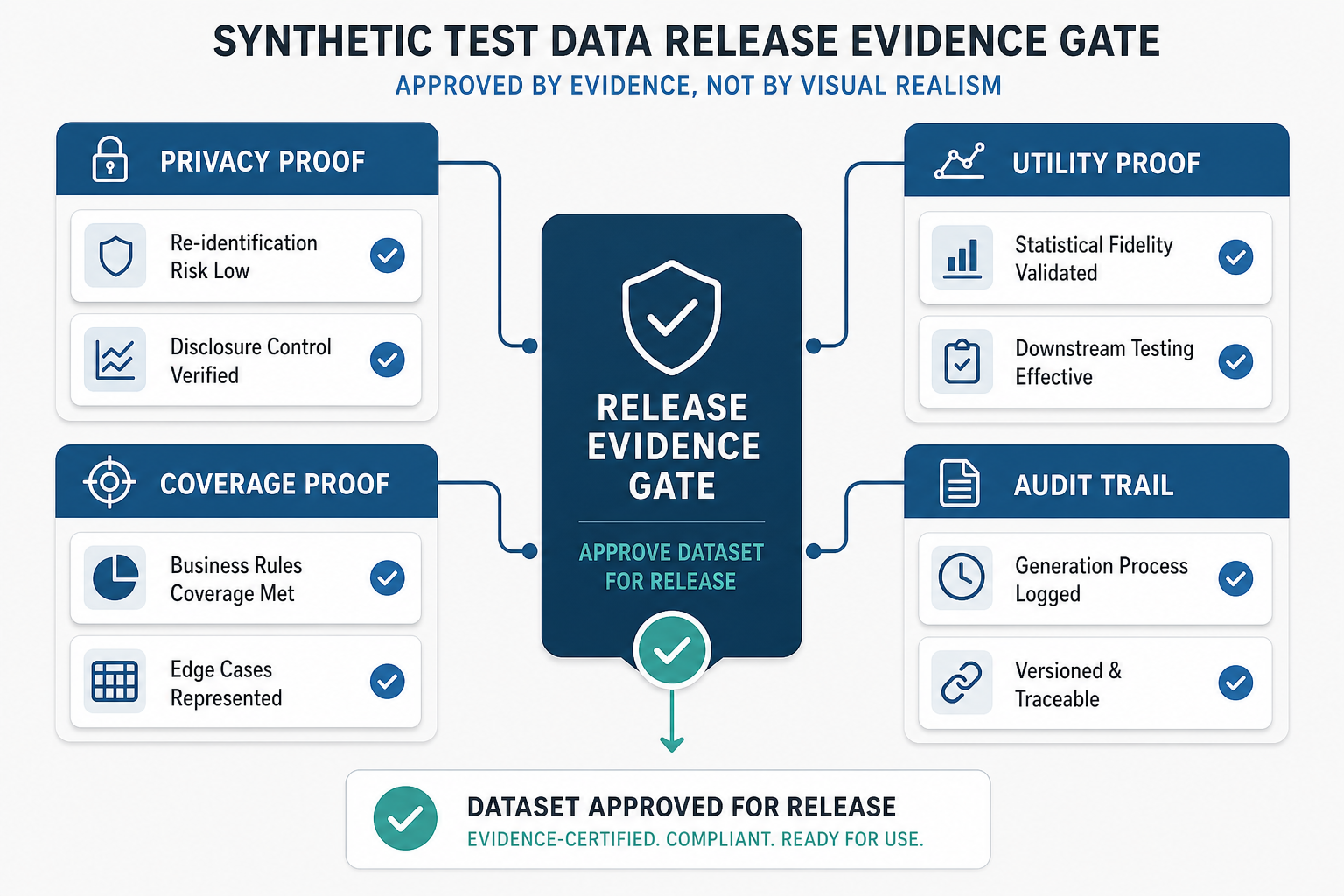
Do not approve a synthetic dataset because it looks realistic in a demo. Approve it because it passes agreed checks.
| Evidence Area | Questions To Answer | Example Checks |
|---|---|---|
| Privacy | Could a person, account, patient, employee, or sensitive cohort be identified? | PII scan, free-text scan, uniqueness check, linkage-risk review, access boundary check. |
| Realism | Does the data behave like the product domain without copying real records? | Schema validation, distribution comparison, relationship checks, domain-rule assertions. |
| Coverage | Does the dataset exercise the workflows and risks the release depends on? | Scenario traceability, test mapping, edge-case counts, integration-state coverage. |
| Audit | Can the team explain how the data was generated, approved, and used? | Dataset version, generator inputs, reviewer, approval date, known limitations, retention rule. |
The evidence should be lightweight enough to repeat. If every dataset requires a large manual review, teams will bypass the process. Automate what can be automated, and reserve human review for high-risk fields, new generators, AI-produced text, and datasets shared outside the core engineering team.
Release Evidence Gate For Synthetic Test Data
Approve important synthetic datasets the same way you approve release-critical code: by evidence. The dataset should not move from a private generation workspace into CI, UAT, vendor QA, demos, or customer-support reproduction until it has privacy proof, utility proof, coverage proof, and an audit trail.
| Evidence Lane | What Good Looks Like | Who Signs Off |
|---|---|---|
| Privacy proof | Re-identification risk is low, free text has been scanned, and disclosure controls are documented. | Security, compliance, or data steward. |
| Utility proof | Distributions, constraints, relationships, and downstream test behavior are fit for the intended workflow. | QA lead and domain reviewer. |
| Coverage proof | Business rules, edge cases, integrations, role boundaries, and failure states map to release-risk tests. | Product owner and test owner. |
| Audit trail | Generation inputs, model/provider settings, version, owner, retention window, and known limitations are stored. | Release owner. |
AI-Generated Test Data Controls
AI can help create realistic conversations, documents, claims notes, support tickets, error narratives, and multilingual content. It can also invent invalid domain details, reproduce sensitive examples from a bad prompt, or create content that passes superficial tests while violating product rules. When the generation workflow depends on model tuning, synthetic labels, or defect patterns, connect it to production-grade machine learning development services controls rather than treating it as a QA-only utility.
Use these controls before relying on AI-generated test data:
- Sanitized prompt inputs: never paste raw regulated records, screenshots, exports, or chat logs into external generators.
- Domain constraints: include allowed states, forbidden values, workflow rules, and validation requirements in the generation spec.
- Output scanning: scan for PII, prohibited terms, real-looking identifiers, and unsupported claims.
- Human review for sensitive scenarios: require review for clinical, financial, legal, insurance, or employment-impact workflows.
- Regression linkage: map each generated scenario to the tests it supports so the data does not become unowned clutter.
If the synthetic data supports AI features, use the AI Agent Readiness Assessment to check whether workflow boundaries, data access, human review, and monitoring are mature enough for broader AI automation.
Vendor And Environment Controls
Regulated teams often lose control when synthetic datasets move outside the core engineering environment. Vendor QA teams, demo tenants, offshore delivery pods, customer-support reproductions, analytics notebooks, and sales sandboxes all need explicit boundaries. The rule should be simple: every environment gets the minimum dataset realism needed for its purpose, and every export has an owner, expiry date, and evidence record.
- Development and CI: use deterministic, versioned datasets that are small enough to reset quickly and broad enough to catch workflow regressions.
- Staging and UAT: add realistic relationships, integration states, roles, and failure paths, but keep raw production records out.
- Vendor sandboxes: provide purpose-built synthetic slices with contractual limits, no real identifiers, no raw free text, and expiry rules.
- Demo environments: optimize for product storytelling without copying customer-like outliers that could be mistaken for real people or accounts.
- AI tooling: treat prompts, generated text, model outputs, and eval datasets as controlled artifacts with review and retention rules.
When synthetic data supports AI agents, RAG workflows, or decision support, keep the controls aligned with the AI assurance plan introduced earlier so data, evals, safety cases, and human review gates tell the same release story.
Regulated Industry Examples
Healthcare teams may need synthetic patients, appointments, insurance details, care-plan states, consent flags, and EHR integration responses. The key is not to mimic a real patient; it is to test intake, triage, scheduling, billing, privacy, and role-based access safely. For product planning, pair the test-data plan with a broader healthcare software development company checklist.
Fintech and insurance teams need transaction histories, KYC states, claims documents, policy rules, fraud signals, refund paths, and exception handling. Synthetic data should include messy but controlled edge cases: duplicate accounts, partial approvals, currency rounding, chargebacks, document mismatch, and timing delays.
SaaS teams often need synthetic tenants, users, roles, subscriptions, invoices, usage events, permissions, integrations, and support conversations. Multi-tenant products need extra checks so generated data does not hide tenant isolation bugs or permission leaks.
Rollout Plan For A Synthetic Data Program
Start small and prove the value in one high-friction workflow.
- Pick one release-critical workflow. Choose an area where production-data dependence slows QA or creates obvious privacy risk.
- Define the risk and coverage target. Write down the fields, roles, edge cases, integrations, and tests the dataset must support.
- Generate a versioned dataset. Use the simplest method that satisfies the scenario. Do not start with AI if deterministic rules are enough.
- Run validation checks. Confirm privacy, realism, coverage, and audit evidence before wider use.
- Wire it into automation. Connect the dataset to CI, API tests, end-to-end tests, or repeatable exploratory charters.
- Review defect yield and maintenance cost. Keep the dataset if it catches issues, speeds releases, or removes privacy risk; retire it if it becomes stale.
For teams modernizing older products, synthetic data is often part of a larger quality reset. Legacy products may need better fixture design, stronger role permissions, cleaner integration mocks, and production-safe observability before synthetic data can be trusted. Use the Legacy Software Modernization Scorecard to separate data-access risk from deeper architecture, integration, and release-process issues.
Common Mistakes
The biggest mistake is treating "synthetic" as a privacy stamp. It is a generation method, not an automatic approval. A dataset still needs privacy checks, utility checks, ownership, and a clear use case.
Other common mistakes include generating too much data without a coverage model, ignoring free-text leakage, using external AI tools with raw examples, failing to preserve referential integrity, skipping rare events, refreshing datasets without version history, and letting vendors use customer-like data without explicit boundaries.
Finally, do not make synthetic data the QA team's private side project. Product, engineering, security, compliance, and data owners should agree on the rules because the dataset affects release confidence, privacy posture, and audit readiness.
How NextPage Can Help
NextPage helps regulated and high-trust software teams design QA programs that balance coverage, privacy, automation, and release evidence. We can map sensitive data flows, define synthetic data methods, build automation-ready fixtures, validate datasets, and connect the work to test automation, AI assurance, and custom software delivery. Teams that want to review comparable delivery patterns can also scan the NextPage portfolio before a QA data readiness call.
If your team is blocked by unsafe production-data copies, thin fixtures, slow QA cycles, or AI workflows that cannot be tested safely, start with a QA data readiness review. We will identify the workflows that need better synthetic data, define the evidence bar, and build a practical path from risky test data to safer releases.