
Quick Answer: Taxi App Development Cost In 2026
Taxi app development cost in 2026 depends on the product model, not just the word "taxi." A focused MVP for a local fleet can be planned around passenger booking, driver job handling, live location, fare estimation, payments, notifications, and a practical admin panel. A ride-hailing marketplace needs deeper dispatch logic, driver onboarding, surge rules, wallets, support tools, analytics, fraud checks, and multi-role operations. A multi-city mobility platform adds scale, localization, compliance, data pipelines, partner integrations, and stricter QA.
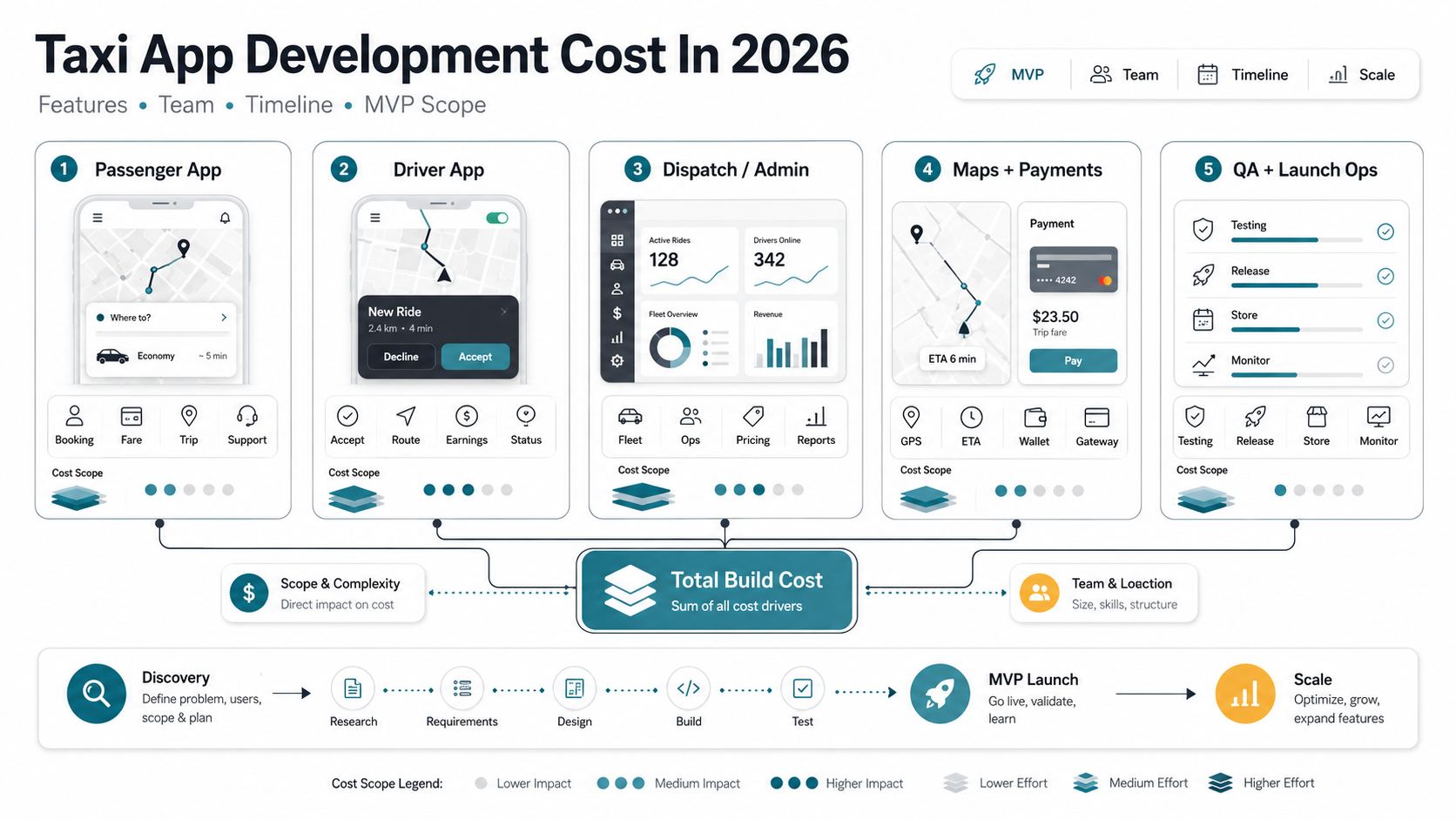
Most public cost guides split the market into MVP, mid-tier, and enterprise builds. That is a useful starting point, but buyers should estimate by scope: passenger app, driver app, admin/dispatch console, backend APIs, maps, payments, notifications, analytics, launch QA, and post-launch operations. NextPage's mobile app development team usually starts by defining those modules before choosing a technology stack or quoting a timeline.
If you already know your release-one features, run them through the Custom Software Cost Estimator. If the feature list is still too broad, use the MVP Scope Builder first so the first release proves demand without trying to copy a mature Uber-scale platform.
Why Taxi App Cost Varies So Much
Two taxi apps can have the same booking button and completely different engineering cost. A small fleet app may only need controlled driver assignment, fixed service zones, a few vehicle types, and manual support. A marketplace ride-hailing app needs driver supply, passenger demand, matching rules, cancellation states, pricing logic, payment disputes, driver earnings, refunds, ratings, and support escalation. A corporate transport app may need employee rosters, approvals, route schedules, invoices, compliance reports, and integration with HR or ERP systems.
Current competitor pages commonly quote broad ranges because taxi products bundle several systems together: mobile apps, backend services, dispatch tooling, map infrastructure, payment flows, admin operations, analytics, and support workflows. That breadth is why a feature checklist is not enough. The expensive parts are often the states users do not notice until they fail: a driver rejects a ride, GPS drops, a payment authorization fails, a passenger cancels after dispatch, a surge rule misfires, or support needs to reverse a wallet transaction.
For buyers, the practical question is not "What does an Uber clone cost?" It is "Which mobility workflow are we launching first, and how safe must it be for paid rides on day one?" That framing produces a better estimate and a cleaner MVP.
Cost Tiers For A Taxi App
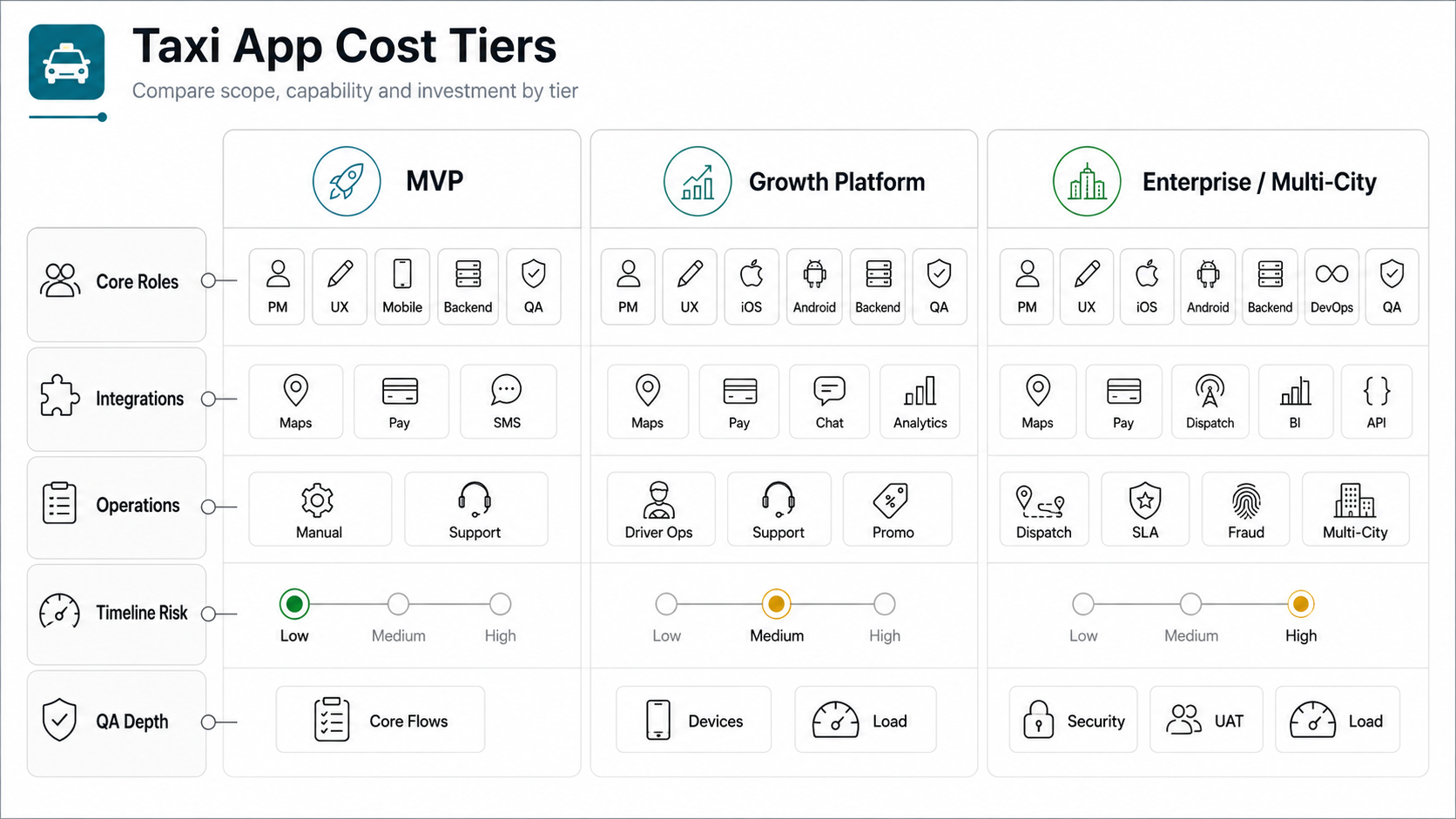
Use these tiers as planning bands, not fixed quotes. Final cost depends on platforms, UI depth, backend complexity, integrations, development location, QA coverage, app-store requirements, and post-launch support. The tiers help you compare scope before a vendor turns the conversation into a single number.
| Scope | Best For | Typical First-Release Features | Cost Pattern |
|---|---|---|---|
| MVP Fleet Or Local Booking App | Testing one city, one fleet, or one focused transport workflow. | Passenger booking, driver app, basic dispatch/admin, fare estimate, live tracking, payment gateway, notifications, trip history. | Lowest custom tier because the product limits roles, service zones, automation, analytics, and edge cases. |
| Growth Ride-Hailing Platform | Launching a serious local or regional marketplace. | Driver onboarding, scheduling, vehicle types, in-app chat, cancellation states, promo codes, wallet or commissions, ratings, support tools, analytics. | Mid to high tier because matching, money flows, operations, and support workflows add complexity. |
| Enterprise Or Multi-City Mobility Platform | Scaling multiple cities, brands, fleets, corporate accounts, or mobility services. | Advanced dispatch, surge/dynamic pricing, multi-language UX, BI dashboards, fraud controls, partner APIs, high-availability infrastructure, data pipelines. | Highest tier because the platform must support scale, governance, compliance, reliability, and ongoing optimization. |
A white-label taxi app can reduce upfront cost when your workflow matches the vendor's default model. It can also create hidden constraints if you need unusual dispatch rules, local compliance, custom pricing, data ownership, deep integrations, or a differentiated customer experience. Treat white-label software as a business fit decision, not only a price shortcut.
Core Modules That Drive The Budget
A realistic estimate should separate the system into modules. Passenger, driver, and admin screens are visible, but backend rules, integrations, and QA usually decide whether the product can operate safely after launch.
| Module | What It Includes | MVP Advice |
|---|---|---|
| Passenger App | Signup, pickup/drop selection, fare estimate, booking, live ride status, payment, trip history, support, ratings. | Start with one booking flow, clear ride states, and reliable notifications before adding loyalty, subscriptions, or complex profiles. |
| Driver App | Driver onboarding, availability, ride offers, navigation handoff, trip status, earnings, documents, support, ratings. | Keep driver workflows simple. Confusing accept/cancel/payment states create support load quickly. |
| Admin And Dispatch | Driver/user management, booking oversight, manual assignment, fare rules, cancellations, refunds, reports, support actions. | Budget for admin tooling. It is how the business operates the app after launch. |
| Maps And Tracking | Geocoding, routing, ETA, live location, zones, distance calculation, route replay, tracking permissions. | Use proven map services, then test location edge cases on real devices and poor networks. |
| Payments And Wallets | Payment gateway, authorization, refunds, commissions, driver payouts, invoices, promo credits, reconciliation. | Define money rules before design. Payments are not just a checkout screen. |
| Analytics And Operations | Funnel events, completed rides, cancellation rates, driver utilization, support issues, revenue reports. | Track launch metrics from day one so product decisions are not based on anecdotes. |
NextPage's existing guide on key taxi booking app features is useful when you need a broader feature inventory. For cost planning, the stronger move is to mark each feature as MVP, phase two, or scale-only.
GPS, Maps, And Real-Time Tracking Cost
Live tracking is the feature most buyers expect and one of the easiest to under-scope. A map pin moving on screen is only the visible layer. The app must handle permissions, stale location, low battery, network loss, route recalculation, pickup accuracy, ETA drift, geofence rules, and driver/passenger privacy. It also has vendor costs because maps, geocoding, directions, and distance calculations usually rely on third-party APIs.
Read NextPage's real-time GPS tracking guide for taxi booking apps before locking the scope. It explains why route planning, driver visibility, accurate ETAs, and live ride monitoring need careful implementation instead of a simple map embed.
For an MVP, keep the location model practical. Use reliable pickup search, driver location updates during active rides, clear ETA messaging, and manual support visibility. Leave route optimization, multi-stop pooling, advanced dispatch scoring, and predictive demand heatmaps for later unless they are core to the launch model.
Payments, Wallets, And Driver Earnings
Taxi app payments can be simple or very complex. A local fleet app may accept card or UPI payments and settle internally. A marketplace may need commissions, driver earnings, payout schedules, promo credits, cancellation fees, refunds, tips, corporate billing, wallet balances, and support adjustments. Each state needs auditability because money disputes damage trust faster than most UI bugs.
Design the payment model before engineering. Decide whether passengers pay per ride, prepay wallet credits, hold authorization, pay with cash, use corporate accounts, or mix methods by market. Decide how drivers see earnings, when payouts are calculated, what happens after cancellation, and who can override transactions. Then build admin tools around those rules.
This is also where integration planning matters. The Mobile App Integrations Checklist can help separate launch-critical integrations such as maps, payments, push notifications, and analytics from nice-to-have CRM, loyalty, or BI integrations.
Team And Timeline For Taxi App Development
A serious taxi app usually needs product discovery, UX/UI design, mobile engineering, backend engineering, QA, project management, and launch support. A lean cross-platform MVP may use a smaller team, but it still needs backend and QA attention because dispatch and payment states are operationally sensitive.
Timeline depends on how many workflows must be production-ready at launch. A focused MVP can often move through discovery, prototype, engineering, QA, and app-store release in phases. A growth platform with driver onboarding, wallet logic, chat, analytics, promos, refunds, and admin operations needs deeper testing. A multi-city platform should be planned as a roadmap, not a single launch sprint.
- Discovery: define service model, markets, roles, pricing, first-release scope, and launch metrics.
- Design: prototype passenger booking, driver ride handling, admin dispatch, payment states, and support workflows.
- Engineering: build apps, backend, admin, integrations, notifications, analytics, and monitoring.
- QA and launch: test real devices, ride states, payments, GPS edge cases, app-store flows, and support actions.
The schedule should leave room for field testing. Taxi apps behave differently in office Wi-Fi, moving vehicles, congested cities, weak networks, and different device permission states. Skipping that testing is a false economy.
MVP Scope That Controls Cost
The best taxi MVP proves one transport workflow. It does not need every feature from a mature ride-hailing platform. For a fleet operator, the MVP might be a passenger booking app, driver app, dispatcher console, basic payments, live tracking, and support actions. For a startup marketplace, the MVP might also need driver onboarding, ratings, cancellation rules, and simple commission reporting. For corporate transport, approvals, rosters, scheduled rides, and invoicing may matter more than consumer-style promos.
Use a strict release-one boundary. Ask which features must exist for a paid ride to be requested, accepted, completed, paid, supported, and measured. Anything that does not support that path can move to phase two unless it is legally or operationally required.
Common features to delay include loyalty programs, complex surge pricing, ride pooling, subscriptions, advanced AI matching, multi-city localization, deep BI dashboards, and elaborate marketing automation. These can be valuable, but they should follow evidence that the first workflow works.
White-Label Vs Custom Taxi Software
White-label taxi software can make sense when speed matters, budget is tight, and your workflow fits the vendor's default assumptions. It may cover common passenger, driver, and admin modules faster than a custom build. The tradeoff is control. You may be limited by the vendor's roadmap, customization options, data model, integrations, security posture, and support quality.
Custom taxi app development is stronger when the business model is differentiated: corporate transport rules, fleet-specific dispatch, local compliance, driver incentives, unusual payment methods, partner integrations, or a customer experience that cannot be expressed through a standard clone script. Custom does not mean building every commodity service from scratch. It means controlling the workflow that matters.
A practical middle path is often best: use proven services for maps, payments, authentication, notifications, analytics, and communication where appropriate, while building custom booking, dispatch, admin, pricing, and operational workflows around your business model.
Launch QA And Operational Risk
Taxi app QA must test the messy states, not only the happy path. Test driver accept and reject flows, passenger cancellation before and after assignment, failed payments, refunds, cash rides, location loss, late driver arrival, duplicate notifications, app backgrounding, permission changes, and admin overrides. Test on real devices, not only simulators.
Operational readiness also affects cost. Someone needs to monitor support tickets, driver onboarding, refunds, payment disputes, map issues, and analytics after launch. If the admin panel does not expose these states, the team will manage them through spreadsheets and chat messages, which defeats the point of building software.
Budget for post-launch iteration. The first few weeks reveal routing assumptions, driver behavior, cancellation patterns, support gaps, and analytics needs. A taxi app is not finished when it reaches the app stores; it starts generating operational evidence.
How NextPage Estimates Taxi App Development Cost
NextPage estimates taxi app development cost by mapping the service model, user roles, release-one workflow, integrations, payment rules, dispatch operations, admin needs, QA depth, and launch metrics. We separate a local fleet MVP from a marketplace ride-hailing app and a multi-city mobility platform because they are different products.
The output is a scope plan, not a generic clone quote: what belongs in the passenger app, driver app, admin console, backend, integrations, analytics, QA plan, and post-launch roadmap. That makes cost tradeoffs visible before development starts.
If you are planning a taxi booking app, start with the MVP path. Define the ride workflow, money flow, support flow, and launch metrics. Then use the cost estimator or talk to NextPage about the smallest release that can prove demand without creating operational debt.