
Hiring a good developer is not only about finding someone who can write code. The real goal is to find a person or team that can understand the product, make sensible technical decisions, communicate tradeoffs clearly, and keep shipping reliable software after the first impressive interview.
For founders, product owners, and business teams, the safest hiring process starts before the job post goes live. You need a clear outcome, a realistic budget, an evidence-based evaluation plan, and a way to test how the developer works with your team. If you are planning a larger build, the same thinking applies whether you hire an employee, freelancer, agency, or custom software development team.
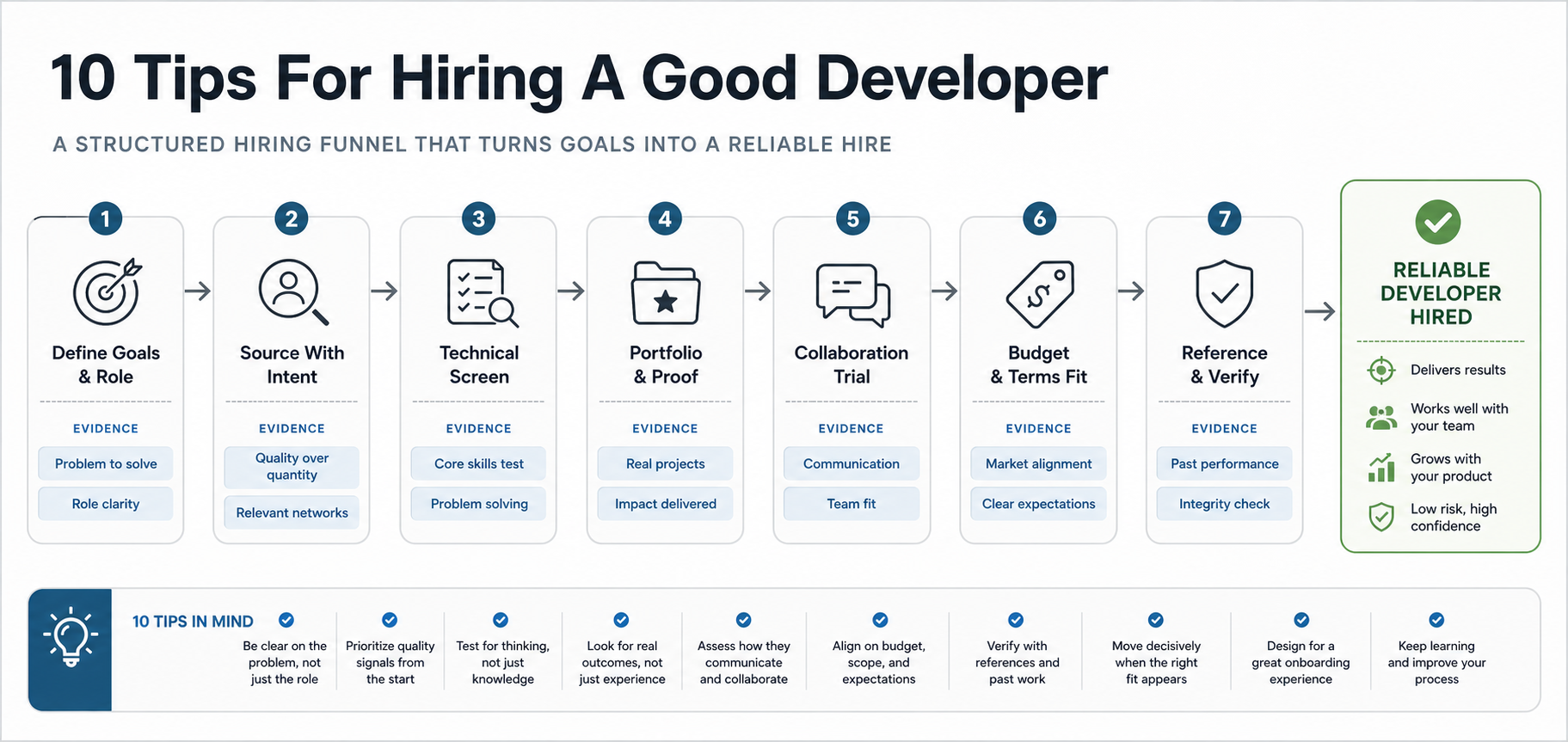
Quick Answer: How Do You Hire A Good Developer?
To hire a good developer, define the product outcome first, choose the right engagement model, source candidates from credible channels, screen for fundamentals, review real work, run a practical technical exercise, evaluate communication, check references, align budget expectations, and start with a short paid trial or milestone-based onboarding plan.
The strongest candidates can explain why they choose one technical path over another. They ask questions about users, constraints, edge cases, maintainability, security, and delivery priorities. They do not only promise speed. They help you reduce build risk.
What Makes A Good Developer?
A good developer combines technical judgment with product awareness and execution discipline. They can write maintainable code, debug calmly, estimate uncertainty honestly, document important decisions, collaborate with designers and stakeholders, and improve the system without making every change fragile.
The original version of this article focused on traits such as passion, future thinking, and culture fit. Those still matter, but they need to be tested through evidence. A developer who sounds confident in an interview may still struggle with messy requirements, production bugs, handoffs, or team communication.
- Technical fundamentals: they understand the language, framework, architecture, testing approach, and deployment environment needed for the work.
- Problem framing: they ask what the software must achieve before jumping into implementation.
- Code quality: they value readability, tests, error handling, security, and maintainability.
- Communication: they explain risks, blockers, tradeoffs, and progress in a way non-engineers can use.
- Ownership: they care about outcomes after the ticket is marked done.
Developer Hiring Scorecard
Use a scorecard so every candidate is evaluated against the same evidence. This avoids hiring the best talker, the cheapest quote, or the person with the most familiar resume instead of the person most likely to deliver the work.
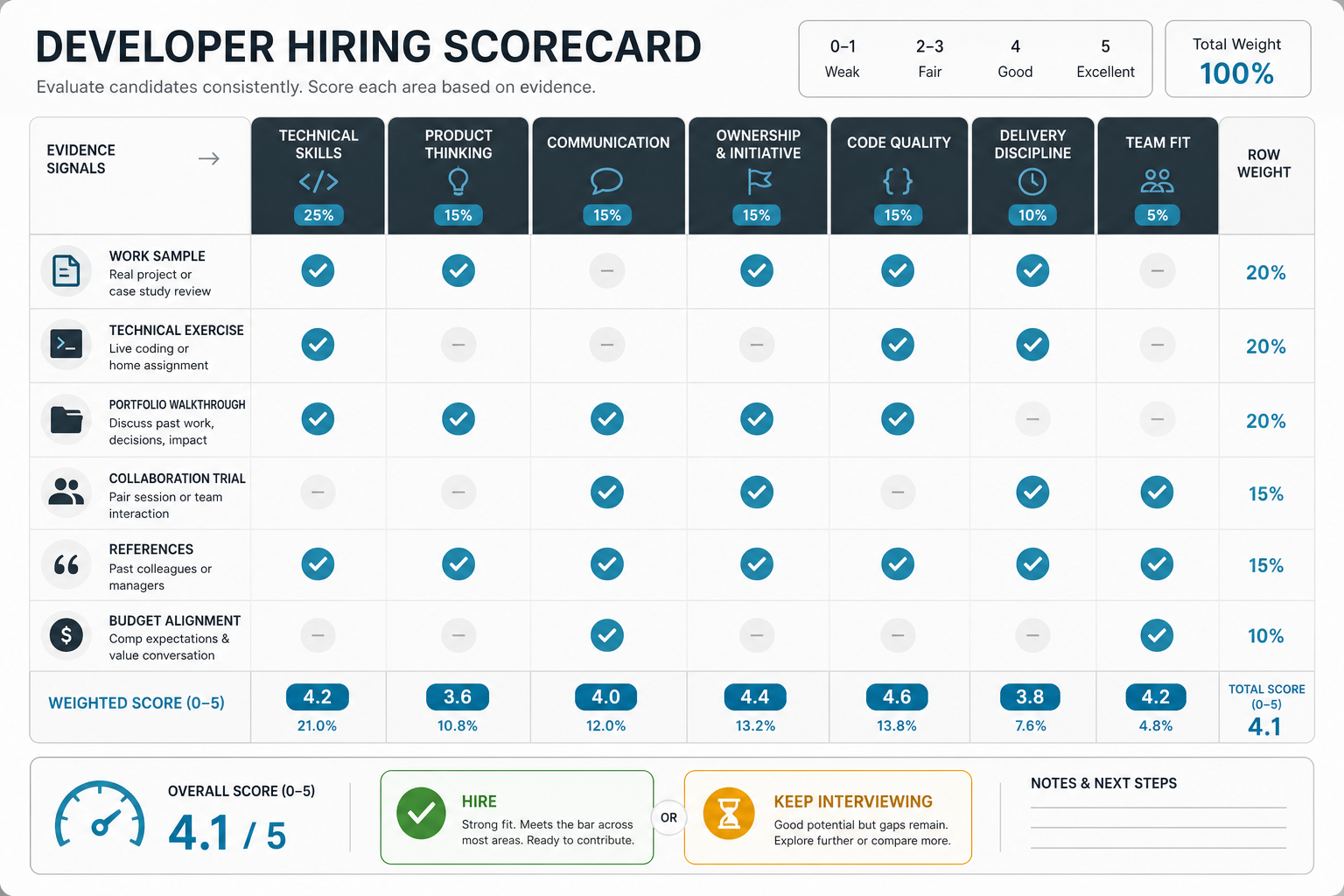
| Evaluation Area | Evidence To Collect | Weak Signal |
|---|---|---|
| Technical fundamentals | Work sample, code review, architecture discussion, testing approach | Only buzzwords or framework names |
| Product thinking | Questions about users, workflows, constraints, and release priorities | Starts estimating before understanding scope |
| Communication | Clear tradeoff notes, async updates, risk explanations | Vague status updates and surprise blockers |
| Ownership | Examples of production support, refactoring, documentation, handoff | Blames tools, teams, or old code without a recovery plan |
| Budget fit | Transparent assumptions, team shape, timeline, and exclusions | Very low quote with no scope boundaries |
10 Tips For Hiring A Good Developer
The tips below are practical checkpoints. Use them together instead of treating any single point as the whole hiring process.
1. Define The Work Before You Source Candidates
Before you post a role or contact vendors, define what the developer must help you ship. Clarify the user problem, business outcome, product type, must-have features, integrations, timeline, security needs, and what existing systems the developer will touch.
If the scope is still rough, model it with the Custom Software Cost Estimator before you compare candidates. A clear scope makes estimates more useful and prevents candidates from filling gaps with assumptions that do not match your business.
2. Choose The Right Engagement Model
A full-time employee is not always the right first step. A freelancer may work for narrow tasks, a managed team may suit a product roadmap, and a specialist agency may be better when discovery, UX, backend, QA, DevOps, and maintenance are all part of the project.
If you are comparing in-house hiring with offshore or managed teams, review the tradeoffs in software development outsourcing to India. The right model depends on control, speed, risk, documentation, and the amount of product leadership you can provide internally.
3. Think Beyond The Current Sprint
Good developers make decisions that survive the next release. They think about maintainability, future integrations, performance, security, observability, and how another engineer will understand the work later. Ask candidates how they handle technical debt, version upgrades, dependency risk, and production incidents.
This matters most when you are building a product that will keep changing. A developer who optimizes only for the fastest first release can leave the business with a fragile codebase that becomes expensive to extend.
4. Outline Culture And Working Specifics
Culture fit should not mean hiring people who sound the same as your current team. It should mean alignment on communication rhythm, ownership, feedback style, documentation, quality bar, and decision-making. Be specific about how your team works.
Define working hours, meeting expectations, pull request standards, issue tracking, design handoff, testing responsibilities, and escalation paths. A strong developer can adapt, but they should know the operating system they are joining.
5. Use Referrals, But Verify Evidence
Employee and founder referrals can reduce sourcing time because they start with trust. Still, every referred candidate should go through the same evaluation process as everyone else. Familiarity is not a substitute for work proof.
Ask what the referrer observed directly. Did the developer own a production system, solve a difficult bug, improve performance, communicate well under pressure, or help a non-technical team understand tradeoffs? The quality of the reference matters more than the warmth of the introduction.
6. Hire For Learning Ability, Not Only Years Of Experience
Experience is useful, but years alone do not prove judgment. A good developer can learn a new library, understand unfamiliar domain rules, and ask sharp questions when requirements are incomplete. Look for curiosity, structured learning, and examples of adapting to new constraints.
That does not mean ignoring seniority. Match seniority to risk. A junior developer may be excellent inside a guided team, while a mission-critical product architecture needs someone who has already handled similar complexity.
7. Know The Market Price
Developer rates vary by skill level, geography, domain complexity, engagement model, and how much delivery support is included. A low hourly rate can become expensive if the work requires rework, missed deadlines, weak testing, or heavy management from your team.
Use the Dedicated India Team Cost Calculator when comparing a managed engineering pod with local hiring, freelancers, or staff augmentation. For a fuller planning view, compare role mix and monthly budget against dedicated development team cost in India and web app development cost.
8. Validate Real Work And Delivery Discipline
Do not rely only on interview questions. Review a portfolio, ask for a walkthrough of a relevant project, discuss architecture decisions, and use a small practical exercise that mirrors the real work. For vendors or agencies, adapt the custom software development company checklist to evaluate process, security, documentation, QA, and maintenance.
The exercise should test thinking, not unpaid production labor. A short debugging task, architecture critique, pull request review, or requirements breakdown can show more than a generic algorithm puzzle.
9. Do Not Choose Cheap Over Quality
Budget discipline is important, but the cheapest developer is rarely the lowest-risk option. A very low quote may hide missing QA, weak documentation, no senior oversight, poor communication, or assumptions that shift cost back to your team later.
Compare total delivery risk, not just hourly rate. If the project has uncertain scope, integrations, compliance needs, or multiple user roles, read the drivers behind custom software development cost before deciding that a low estimate is automatically better.
10. Start With A Paid Trial And Milestone-Based Onboarding
A probation period or paid trial works best when it has clear success criteria. Define the first milestone, expected communication rhythm, review process, code quality expectations, and what must be documented before the engagement expands.
For employees, this may be a structured 30-60-90 day plan. For freelancers or teams, it may be a discovery sprint, prototype, refactor, integration, or first release milestone. The goal is to learn how the developer actually works before the business depends on them deeply.
Hiring Process From Role Clarity To Onboarding
A repeatable process makes developer hiring less emotional. It also gives strong candidates a better experience because they can see what evidence matters and what decision will happen next.
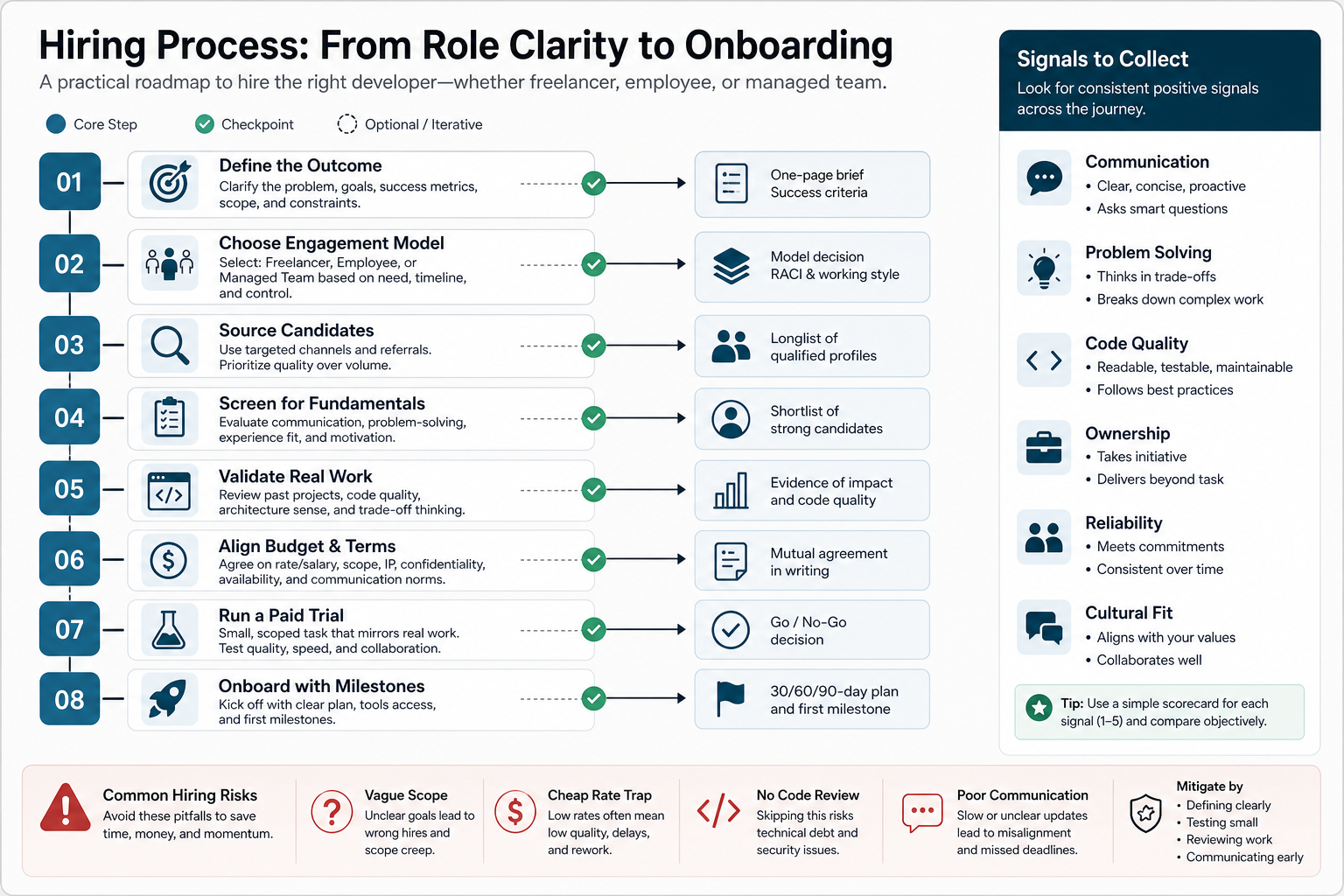
- Define the outcome: document the product result, user workflow, technical constraints, and success metric.
- Choose the model: decide whether you need an employee, freelancer, staff augmentation, agency, or managed pod.
- Source candidates: use referrals, partner networks, communities, job boards, and relevant portfolios.
- Screen fundamentals: check experience fit, communication, availability, and baseline technical judgment.
- Validate real work: review code, architecture, delivery examples, documentation, references, or a practical exercise.
- Align terms: clarify budget, scope, IP ownership, security, communication, maintenance, and exit handoff.
- Start small: use a paid trial or first milestone with explicit review criteria.
- Onboard deliberately: share product context, repos, environments, design assets, decision logs, and release expectations.
Red Flags When Hiring Developers
Red flags do not always mean a candidate is bad. They mean you need more evidence before committing. Be careful when a candidate avoids specifics, dismisses testing, cannot explain past decisions, promises unrealistic timelines, or gives a fixed quote without understanding scope.
- No questions about the product: they jump to implementation before understanding users or constraints.
- No discussion of tradeoffs: every technology choice sounds easy, fast, and risk-free.
- Weak communication trail: updates are vague, delayed, or difficult for non-engineers to act on.
- No testing or review habit: quality depends on manual confidence instead of repeatable checks.
- Portfolio without depth: they can show screens but cannot explain architecture, problems, or outcomes.
- Price without assumptions: the estimate lacks scope boundaries, exclusions, and change-control rules.
Final Recommendation
Hiring a good developer is a structured risk-reduction exercise. Define the work, choose the right engagement model, evaluate evidence, understand the market price, and start with a milestone that proves how the developer communicates and delivers.
The best hiring decision is rarely based on one brilliant interview. It comes from repeated signals: thoughtful questions, clear tradeoffs, relevant work proof, responsible estimates, steady communication, and a quality bar that matches the product you are trying to build.