
Travel budgeting apps are no longer just simple trip calculators. The best tools help travelers plan a trip budget before departure, track spending while they move between cities, split costs with friends, manage currency changes, and understand whether a trip is still on track financially.
This updated guide explains how to compare the best travel budgeting apps for 2026 and what product teams should include when building a travel finance, group trip, or expense-tracking app. Use it to choose an app for your next trip or to plan the feature set for a travel budgeting product.
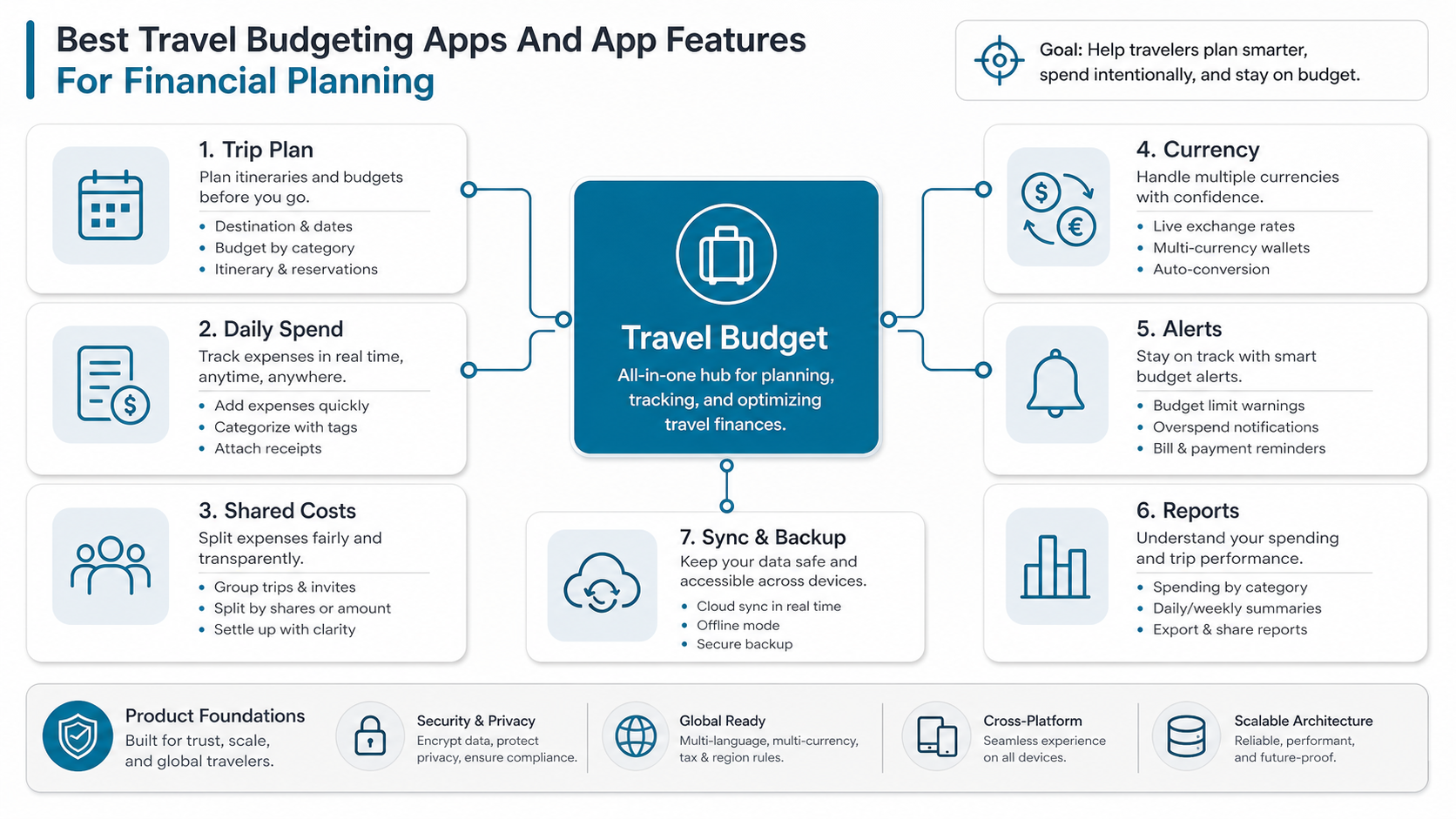
Quick Answer: Best Travel Budgeting Apps For 2026
For most travelers, the practical shortlist includes YNAB for hands-on zero-based budgeting, PocketGuard for a simple spending snapshot, Goodbudget for envelope-style planning, Honeydue for couples, Splitwise for group expense splitting, TravelSpend for trip-specific expense tracking, and general finance tools such as Monarch, Quicken Simplifi, or Wallet by BudgetBakers when broader household finance matters more than travel-only workflows.
There is no single best travel budgeting app for every trip. Solo travelers need fast expense capture, offline access, and category tracking. Couples often need shared visibility and bill reminders. Group trips need balances, repayments, and transparent splits. Frequent international travelers should prioritize multi-currency support, receipt notes, exports, and reliable sync. Product teams building a new app should treat these as separate user journeys, not one generic expense screen.
What Changed Since The 2024 Budget App List
The original article focused on a broad 2024 budget-app list. That is not enough for current search intent. Since Mint shut down in 2024, the budgeting-app market has shifted toward paid personal finance tools, household money dashboards, envelope budgeting, and more specialized travel or group-expense workflows. Readers now need help choosing by use case rather than reading a flat app list.
For travel, the biggest difference is context. A normal monthly budget app may be excellent at household planning but weak during a multi-city trip. A travel-first app may be better for quick expense logging, currency conversion, and group balances but weaker for long-term savings goals. The right answer depends on whether the user is planning a vacation, managing shared travel, running a tour business, or building a travel finance product.
Travel Budgeting App Comparison Table
| App Or Category | Best Fit | What To Check Before Choosing |
|---|---|---|
| YNAB | Travelers who want strict zero-based budgeting and long-term money control. | Subscription cost, learning curve, bank sync availability, and whether multi-currency travel workflows fit your needs. |
| PocketGuard | People who want a quick answer to how much they can safely spend. | Connected-account support, category controls, export needs, and whether the app is too simple for detailed trip planning. |
| Goodbudget | Manual envelope budgeting, families, and users who prefer planning categories before spending. | Manual entry effort, device sharing, envelope limits, and whether bank sync is required. |
| Honeydue | Couples managing shared bills, trip costs, and joint financial visibility. | Privacy settings, bill reminders, shared categories, and whether both partners will maintain the workflow. |
| Splitwise | Group trips where friends need transparent cost splitting and repayment tracking. | Currency handling, settlement workflow, export options, and whether it replaces or only complements budgeting. |
| TravelSpend or trip-first trackers | Travelers who need per-trip budgets, currencies, categories, and quick expense capture. | Offline mode, receipt notes, exchange-rate behavior, group sharing, and export quality. |
| Monarch, Quicken Simplifi, Wallet, and broader finance apps | People who want travel spending to sit inside a full personal finance dashboard. | Pricing, bank coverage, mobile usability, reporting, subscriptions, and data portability. |
For a traveler, this table is a buying guide. For a founder or product team, it is a product-positioning map. A new travel budgeting product should not try to copy every finance app at once. It should decide whether it is best at trip planning, real-time expense capture, group settlement, family budgeting, travel business operations, or analytics.
Travel Budget App Workflow
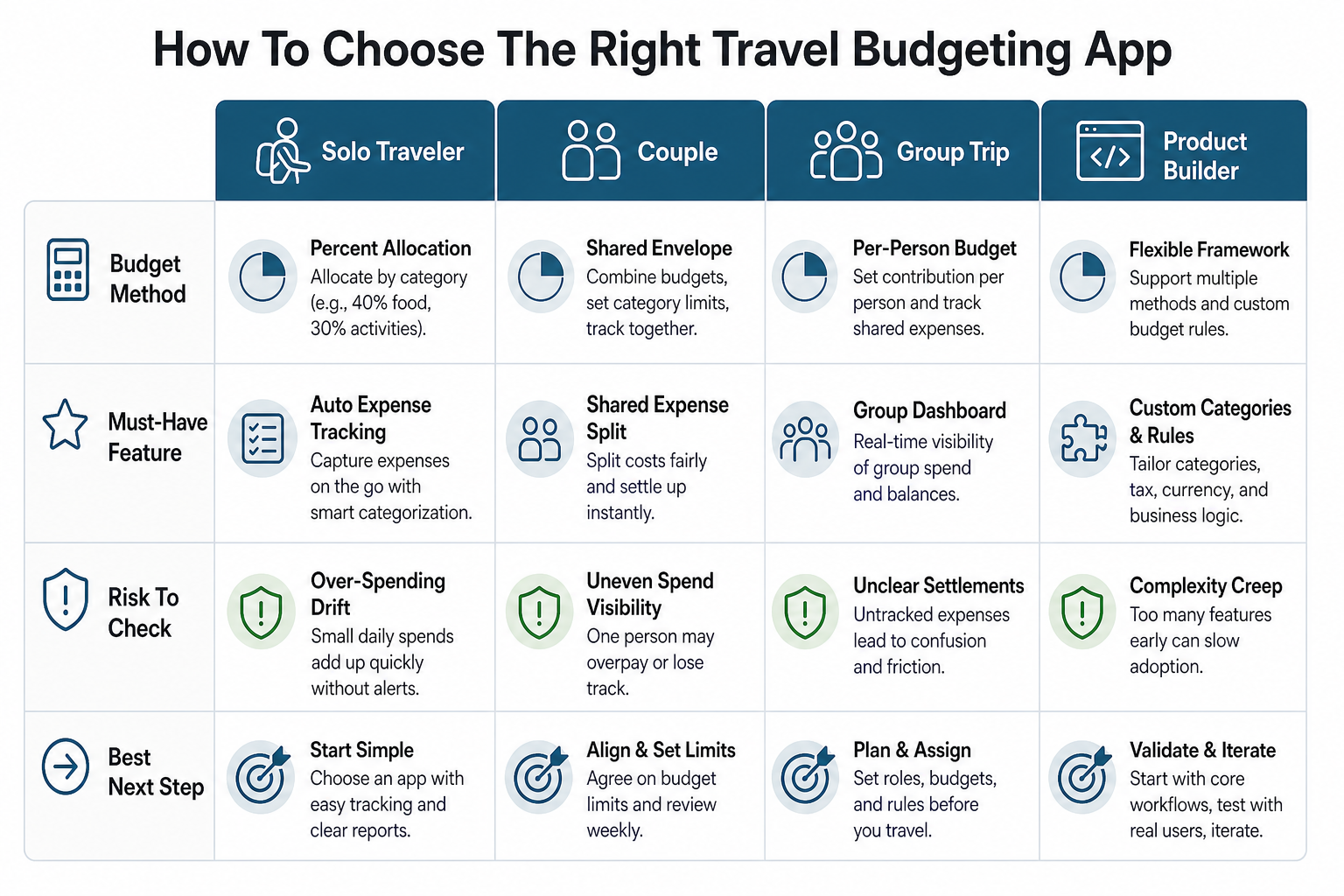
A useful travel budgeting app should start before the trip. Users need to estimate flights, stays, food, local transport, activities, emergency buffer, insurance, and shopping. During the trip, the app should make expense capture fast enough that users actually keep it updated. After the trip, it should explain where money went and what changed against the original plan.
For group travel, budgeting overlaps with collaboration. Shared itineraries, per-person balances, payment status, and reminders can become part of the same product. NextPage's Qdrant index surfaced the supporting guide on collaborative trip planning as the closest topical match, which is useful when travel budgeting sits inside a broader group travel app.
Must-Have Features For A Travel Budgeting App
The core feature set should include trip budgets, expense categories, recurring and one-time costs, quick transaction entry, receipt notes, currency conversion, offline support, shared-trip balances, alerts, exports, and simple reports. If the app connects to bank accounts or cards, it also needs secure account linking, clear permissions, and a reliable way to categorize imported transactions.
For product teams, the launch scope should be intentionally narrow. A travel budgeting MVP can start with trip setup, categories, manual expenses, group splits, currency notes, and summary reports. Bank sync, cards, AI categorization, subscription budgeting, and predictive recommendations can come later if users prove that the manual workflow is valuable. NextPage's MVP development company page explains this staged approach for software products that need to launch without overbuilding.
How To Choose The Right Travel Budgeting App
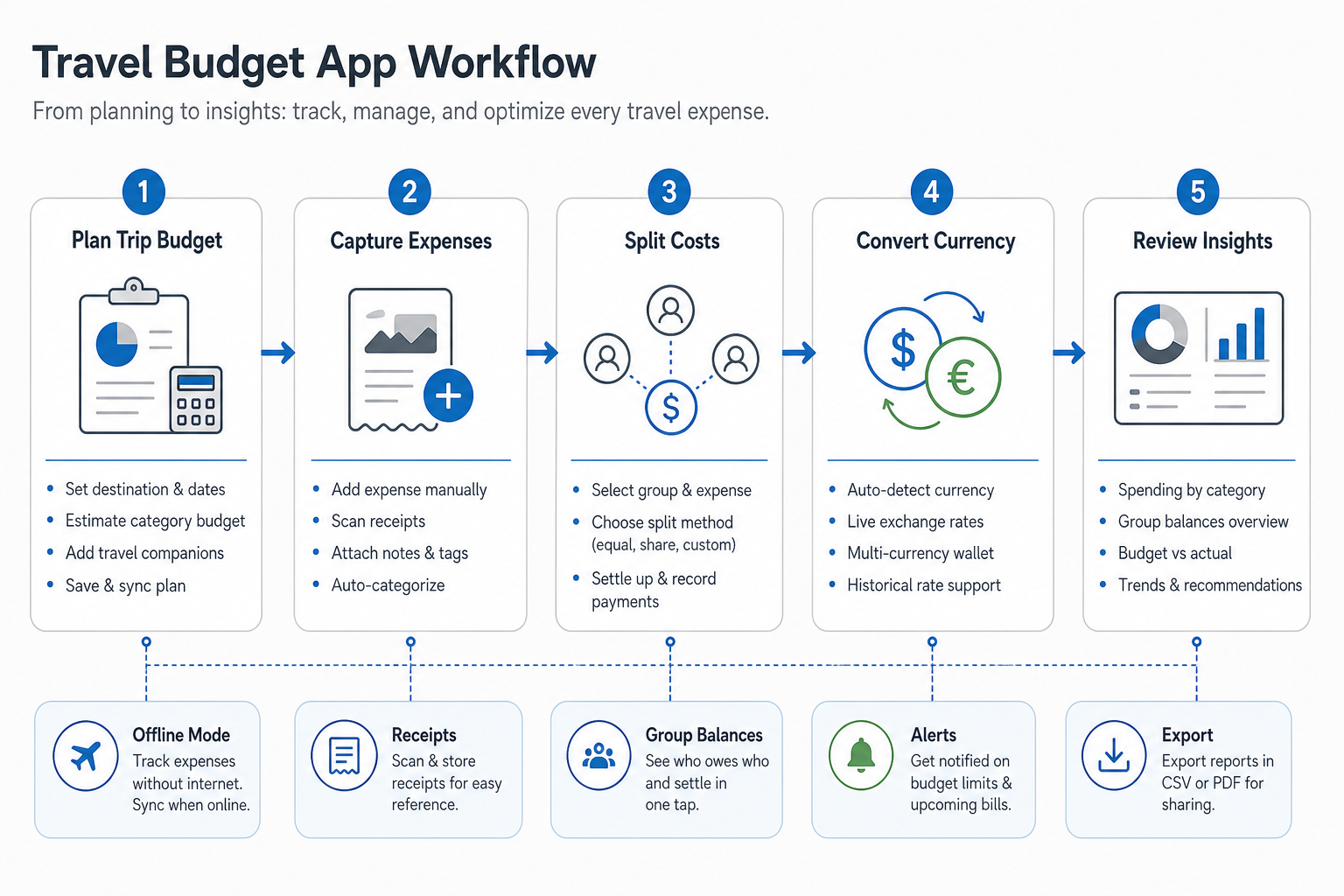
Start with the budgeting method. If you like assigning every dollar before it is spent, YNAB or envelope-based tools may fit. If you only want to avoid overspending, a snapshot-style tool such as PocketGuard may be enough. If you are traveling with friends, group settlement may matter more than long-term finance features. If you are building software, the right decision is the smallest workflow that users will repeat every day of the trip.
Then check the operational details. Does the app work offline? Can it handle multiple currencies without confusing totals? Can users export expenses for reimbursement, tax, or business reporting? Does it show who owes whom? Is it clear enough to use while standing in a train station or market? Those details decide whether a travel budgeting app is actually used after the first day.
Building A Travel Budgeting App
A custom travel budgeting app usually needs mobile-first design, account and trip models, expense categories, shared participants, notifications, export logic, and analytics. If it includes account linking, payments, or stored financial data, the architecture must also address encryption, consent, audit trails, data retention, and support workflows.
This is where travel budgeting becomes a broader mobile app development and custom software development problem. The app needs to be fast in poor connectivity, simple enough for travelers, and robust enough to keep financial records consistent across devices. For a proof point in mobile workflow systems, see the FieldIQ portfolio case study, which shows how field teams can capture operational data through structured mobile workflows.
Security, Privacy, And Data Sync
Budgeting apps often touch sensitive financial behavior, even when they do not store card numbers. Users may enter income, account balances, trip locations, receipts, group payments, and spending patterns. The product should use least-privilege access, secure authentication, encrypted storage, careful logging, role-based sharing, and clear data deletion controls.
For travel apps, privacy also includes location and group visibility. A user may want to share a dinner bill without sharing every transaction. A couple may want joint categories but private personal spending. A business traveler may need exports without exposing personal notes. These permission details should be designed early, not patched after launch.
Cost And Build-Vs-Buy Decision
If you only need personal travel budgeting, buying an existing app is almost always cheaper than building one. If you need a branded travel product, tour-operator workflow, corporate travel expense flow, or a niche community feature, custom software can make sense. The decision depends on differentiation, integration needs, data ownership, user volume, compliance expectations, and whether budgeting is the core product or just one feature.
For early planning, use the Custom Software Cost Estimator to model likely budget and timeline. If you are unsure whether custom development is justified, the Build vs Buy Decision Tool can help compare packaged finance apps, white-label travel software, and a custom product roadmap.
Implementation Roadmap For Product Teams
- Define the primary user: choose solo travelers, couples, group trips, travel businesses, corporate travelers, or finance-conscious frequent travelers.
- Map the first money workflow: decide whether the first loop is trip budget planning, daily expense capture, shared-trip settlement, or reporting.
- Design the data model: define trips, participants, categories, expenses, currencies, receipts, balances, exports, alerts, and permissions.
- Build the MVP: ship the smallest reliable version with trip setup, expense entry, summaries, and sharing before adding automation.
- Test travel conditions: validate offline behavior, low-bandwidth sync, time zones, currency changes, duplicate entries, and device handoffs.
- Scale intelligence carefully: add bank sync, AI categorization, spending predictions, and recommendations only after the manual workflow is stable.
Travel budgeting products should be designed around repeated behavior. A user who records expenses twice and then stops has not received value. The product should make the next action obvious, reduce manual effort, and reward consistency with useful insights.
Common Mistakes To Avoid
The most common mistake is comparing apps only by a generic best-app ranking. A strict household budgeting app may be poor for a two-week international trip. A simple travel tracker may be poor for long-term financial planning. A group expense app may solve settlement but not budgeting. Match the tool to the job.
For builders, the most common mistake is adding advanced finance features before the core travel workflow works. Bank sync, AI categorization, and complex reports are not useful if users cannot quickly add expenses, correct currencies, split bills, and understand balances. Start with trust, speed, and clarity.
Final Recommendation
Choose a travel budgeting app based on the trip, not the trend. YNAB is strong for disciplined budgeting, PocketGuard is useful for quick spending visibility, Goodbudget fits envelope planners, Honeydue fits couples, Splitwise fits group settlement, and trip-first trackers fit travelers who need daily expense control on the road.
If you are building a travel budgeting app, focus on one repeated workflow first. A practical MVP should help users plan a trip budget, capture expenses quickly, split costs clearly, handle currencies honestly, and review spending without confusion. That foundation is more valuable than a long feature list.