
A vibe-coded MVP rescue plan is a structured audit and stabilization workflow for an AI-built prototype that works in demo mode but is not ready for real users, payments, customer data, investor diligence, or enterprise pilots. The plan should identify security gaps, ownership risks, data problems, brittle architecture, missing tests, deployment weaknesses, and the refactor-versus-rebuild decision before more features are added.
This guide is for founders, product managers, and non-technical teams that built fast with AI tools, contractors, plugins, no-code layers, or a mixed prototype stack. The goal is not to shame the prototype. The goal is to keep the speed that got the product started while replacing hidden risk with a production handoff a real engineering team can own.
If the product idea is still moving, start with NextPage's MVP Scope Builder. If the code already exists and needs rescue, use the plan below to decide what to audit, what to stabilize, when to use software project rescue services, and when to stop patching.
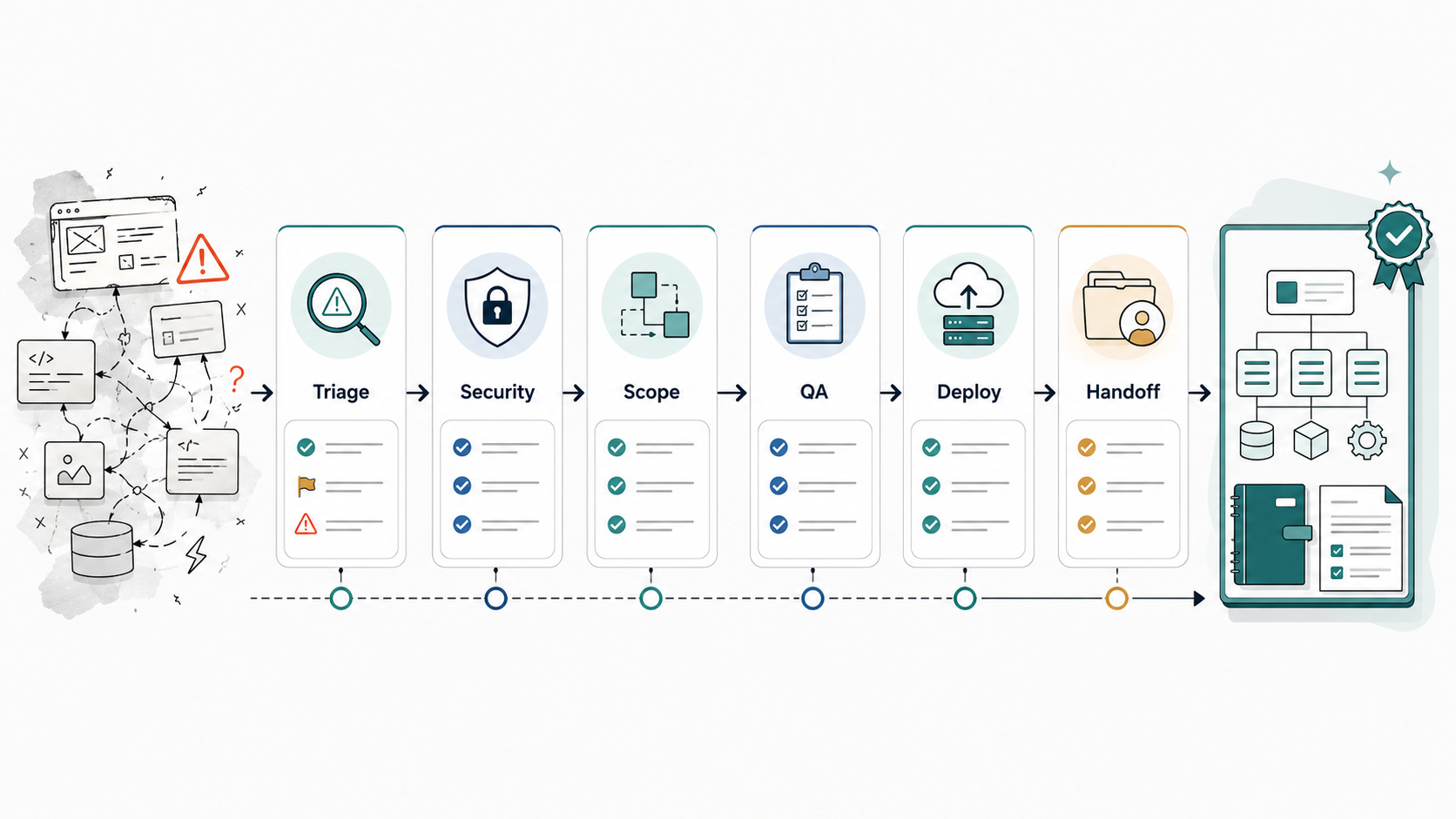
Quick Answer: How To Rescue A Vibe-Coded MVP
Rescue the MVP in five steps: freeze risky feature work, run a technical and security audit, decide whether to patch, refactor, or rebuild, add QA and deployment gates, then create a production handoff with ownership, documentation, monitoring, and rollback. Do not keep asking AI to add features until someone can explain the authentication model, data flow, dependencies, deployment path, and failure modes.
| Rescue Step | What It Checks | Decision It Enables |
|---|---|---|
| Triage | Repo access, stack, product workflow, data touched, current blockers. | Is this a small cleanup or a serious rescue? |
| Security Audit | Auth, roles, secrets, data exposure, dependencies, payments, uploads. | Can real users or real data touch this yet? |
| Refactor Scope | Architecture, state management, database design, API boundaries, maintainability. | Patch, refactor, rebuild, or split the product? |
| QA Gates | Critical paths, edge cases, regression tests, manual checks, launch smoke tests. | What must pass before launch or pilot? |
| Deploy And Handoff | Hosting, environment variables, logs, monitoring, backups, rollback, ownership. | Can a professional team operate this product? |
Why A Working Demo Is Not Production-Ready
AI coding tools can generate polished screens, database calls, API handlers, and deployment scripts quickly. That speed is useful for validation. The problem starts when a working demo creates confidence that the underlying system is safe, maintainable, scalable, and explainable. A founder may see a smooth UI while the code hides hardcoded secrets, missing access checks, weak data validation, untracked dependencies, and no rollback path.
Current security coverage around vibe coding points to the same pattern: generated code often optimizes for visible functionality, not secure defaults or long-term ownership. OWASP's current application and GenAI guidance keeps the same pressure on broken access control, software supply chain risk, sensitive information disclosure, insecure output handling, and monitoring gaps. The adjacent NextPage vibe coding security checklist covers release gates for AI-generated code. This rescue plan applies that thinking to a founder's MVP handoff: what to inspect, what to fix first, and how to make the product ownable.
Red Flags That Your MVP Needs Rescue
Not every AI-built prototype needs a rebuild. Some only need cleanup, tests, and deployment discipline. But several warning signs should stop feature work until the foundation is reviewed.
- No one can explain the codebase: The app works, but the founder, contractor, or AI chat history is the only documentation.
- Authentication is improvised: Login, sessions, roles, password reset, and tenant boundaries are unclear or client-side.
- Secrets are exposed: API keys, database URLs, service tokens, or webhook secrets appear in code, browser bundles, prompts, or logs.
- Data model changed repeatedly: The schema grew through prompts without migrations, constraints, ownership, or backup strategy.
- Every new feature breaks something else: There are no regression tests or stable boundaries.
- Deployment is manual: A single laptop, copied env vars, or unclear hosting account controls production.
- The product needs real users soon: Customer data, payments, investor demos, pilots, or enterprise reviews raise the risk bar.
Triage First: Do Not Start By Refactoring Everything
The first rescue mistake is trying to clean every file. Triage should identify the product's critical workflow, the data it touches, the highest-risk routes, and the launch deadline. A senior engineer should be able to look at the repository, dependencies, database, hosting, and user journey and decide whether the product is salvageable as-is, needs a targeted refactor, or should be rebuilt around a smaller core.
A good triage takes one to three days for a small MVP. It should produce a short evidence pack: stack overview, risk list, working/non-working areas, critical user flows, data sensitivity, deployment state, and recommended rescue path. That evidence gives founders a better choice than "keep prompting" or "throw it away." If scope is still unclear, pair the audit with the Custom Software Cost Estimator so rebuild and refactor options have a budget range instead of a guess.
Security Audit: The Non-Negotiable Checks
Security is usually the first hard gate because prototype shortcuts can become real incidents once customers arrive. Review authentication, authorization, object-level access, payment flows, file uploads, admin routes, logging, third-party APIs, dependency health, and secret handling. For AI-built apps, also inspect generated examples, prompt transcripts, and test data because credentials or customer-like data may have been pasted into tools during development.
| Area | Common Prototype Failure | Rescue Control |
|---|---|---|
| Authentication | Custom auth with weak session handling or untested reset flows. | Use proven auth patterns and test denied access paths. |
| Authorization | UI hides buttons but server routes still expose data. | Add server-side role and object-level permission checks. |
| Secrets | Keys appear in repo history, frontend code, logs, or chat prompts. | Rotate secrets, add scanning, and move config to managed env vars. |
| Dependencies | AI added packages nobody reviewed. | Audit licenses, vulnerabilities, maintenance, and transitive risk. |
| Data Exposure | Debug endpoints or broad queries leak records. | Filter responses, validate ownership, and add logging without sensitive values. |
| Uploads And Files | Unsafe file types, public buckets, or missing size checks. | Validate files, isolate storage, scan where needed, and limit access. |
Refactor, Rebuild, Or Rescue?
The right path depends on product value, code quality, risk, and timing. A rebuild is not automatically better. A focused rescue can preserve validated product learning and get the MVP into a pilot faster. But patching a fragile prototype forever can become more expensive than rebuilding the core around clean boundaries.
| Path | Choose It When | Avoid It When |
|---|---|---|
| Patch | The app is simple, risks are isolated, and launch pressure is high. | Auth, data model, or architecture is fundamentally unsafe. |
| Targeted Refactor | The core workflow is useful but needs cleaner modules, tests, and deployment. | Every major feature depends on brittle generated code. |
| Rebuild Core | The idea is validated but implementation quality blocks production. | The product is still unvalidated and scope is changing daily. |
| Split MVP | One workflow is valuable and the rest is noisy prototype scope. | Customers need the full surface immediately. |
| Retire Prototype | The prototype taught the team what to build but cannot be trusted. | The current system already has real customer data that needs migration care. |
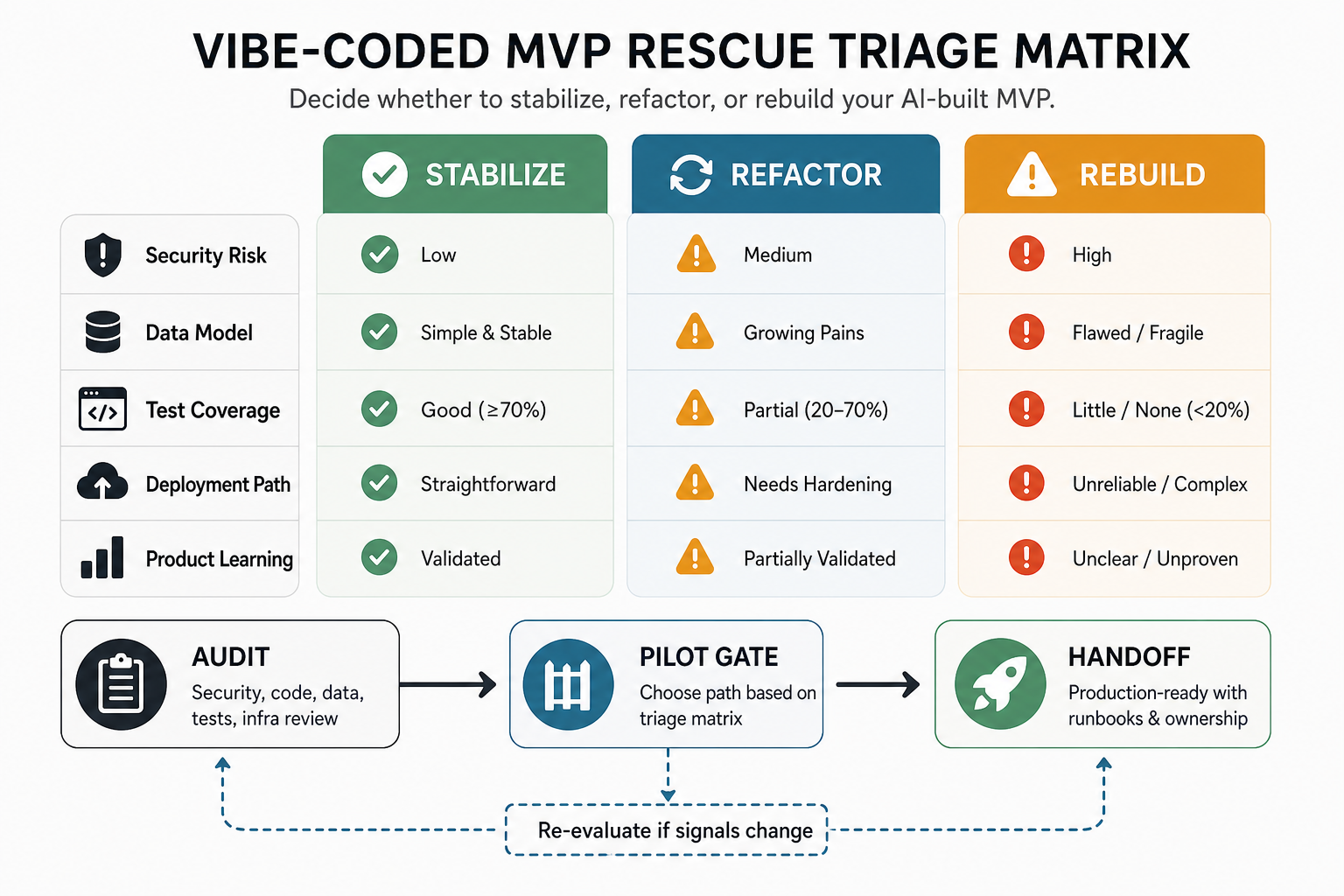
QA Gates Before A Pilot Or Launch
Most vibe-coded MVPs are under-tested because the build loop rewarded visible progress. Rescue work should add enough QA to protect the critical path, not a giant test program on day one. Start with smoke tests for signup, login, primary workflow, payment or submission, admin review, notifications, and data export. Add negative tests for denied access, invalid inputs, duplicate actions, empty states, and failed third-party calls. For teams adding AI-generated tests or regression support, the AI-powered QA automation roadmap is a useful companion for deciding which checks belong in CI and which still need human review.
For founder-led products, QA should also include usability checks. Can a user complete the workflow without the founder explaining it? Are error states understandable? Can support reproduce a user problem? Can product managers see what happened without asking the original builder?
Pilot Evidence Pack: What Must Be Proven Before Real Users
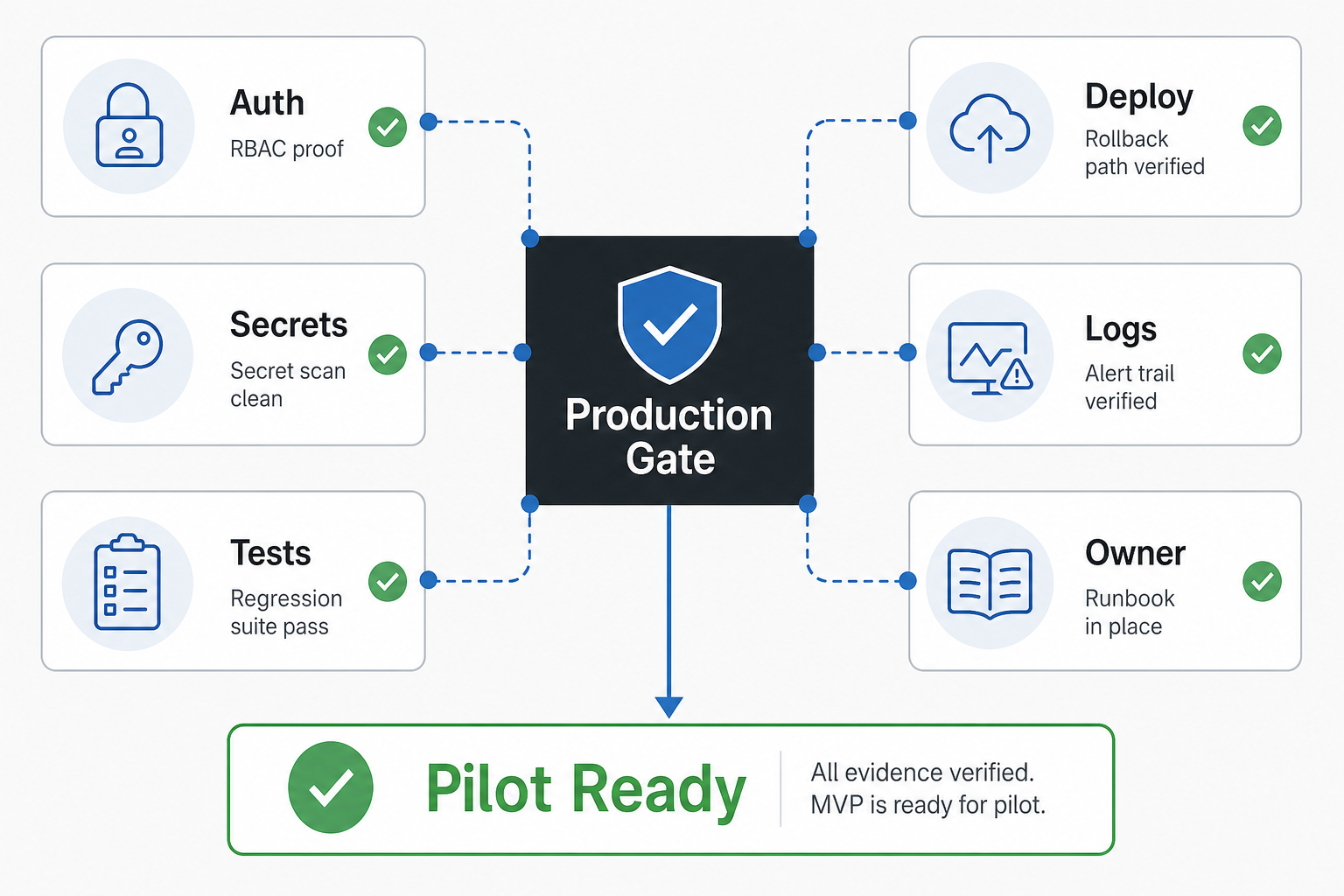
Before inviting customers, investors, or internal operators into a rescued MVP, require evidence instead of confidence. A pilot-ready system should prove server-side authorization, clean secret handling, a regression suite for the main journey, a rollback path, usable logs and alerts, and a named owner with a runbook. If any one of those is missing, the next sprint should close that gap before more product scope is added.
Deployment And Observability
A production handoff must include more than code. It needs hosting ownership, environment management, domain and DNS ownership, database backups, logs, monitoring, alerting, error tracking, analytics, rollback, and incident contacts. If the prototype was deployed through a personal account or a generated script nobody understands, fix that before onboarding real users.
Use a small launch checklist: production and staging environments, protected secrets, database backup/restore test, deployment command, smoke test, error tracking, uptime monitor, log access, admin owner, rollback decision, and support contact. This is where Custom Software Development discipline turns a promising prototype into an operable product.
Production Handoff: What A Team Needs To Own It
The handoff should let a new engineer understand the product without reading every AI chat. Include product goals, architecture diagram, data model, critical workflows, known risks, environment variables, deployment steps, third-party accounts, test commands, monitoring links, backlog, and a decision log. If the MVP will be operated by a dedicated team, connect the handoff to Your Team In India so ownership, delivery cadence, and support expectations are clear.
For products that still need build-out, NextPage's MVP Development Company service is the natural next step. The rescue audit can become a roadmap for a cleaner release one instead of a vague rewrite estimate.
How NextPage Can Help
NextPage helps founders and product teams turn AI-built prototypes into production-ready software. The work can include code audit, security review, architecture cleanup, data model repair, test coverage, deployment setup, monitoring, documentation, and a professional handoff. When AI remains part of the product workflow, AI Development Services can help add guardrails, evaluation, and controlled automation.
The practical first step is a fixed rescue assessment. We review the current MVP, identify launch blockers, separate patchable issues from rebuild risks, and produce a prioritized production-readiness plan.
Vibe-Coded MVP Rescue Checklist
- Freeze risky feature work until the audit is complete.
- Map the primary user workflow and data touched.
- Review authentication, authorization, secrets, dependencies, and uploads.
- Inspect database schema, migrations, backups, and ownership rules.
- Check deployment, environment variables, logs, monitoring, and rollback.
- Decide patch, refactor, rebuild core, split MVP, or retire prototype.
- Add smoke tests and negative tests for the critical path.
- Create a handoff pack with architecture, setup, deploy, tests, risks, and backlog.
Next Step
If your AI-built MVP is moving from demo to real users, do not wait for the first security issue or customer-facing outage. Start with the MVP Scope Builder, then ask NextPage for a focused MVP code audit and production handoff plan.