
A vibe coding security checklist is the release gate that treats AI-generated code as untrusted until humans and automation prove it is safe enough to ship. The checklist should review the prompt context, generated diff, authentication and authorization logic, secret handling, dependency changes, tests, infrastructure permissions, logging, rollback, and ownership before the code reaches production.
This guide is for CTOs, engineering leaders, founders, and product teams that already use AI coding assistants or agentic development tools. The goal is not to ban AI-generated code. The goal is to keep speed without letting an assistant quietly introduce insecure defaults, over-broad permissions, hidden dependencies, data exposure, or release paths nobody can explain later.
Before an AI coding workflow touches production, score the workflow with the AI Agent Readiness Assessment. If the tool can read private repositories, open pull requests, call APIs, update infrastructure, or deploy changes, it needs the same governance mindset you would apply to any production-facing automation.
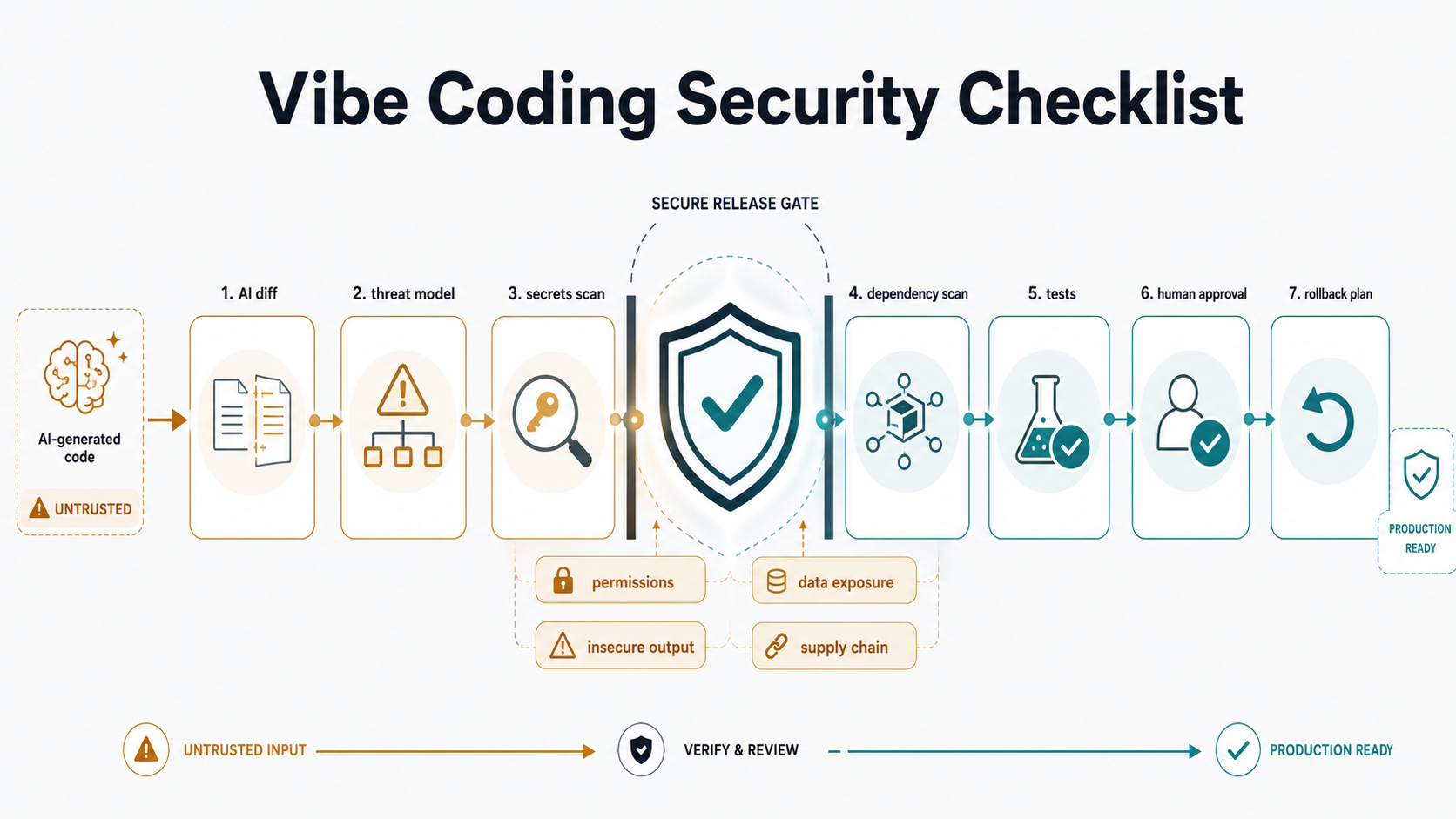
Quick Answer: What Should A Vibe Coding Security Checklist Include?
A practical checklist should cover seven gates: define what the AI was allowed to change, review the diff like untrusted third-party code, threat-model security-sensitive flows, scan for secrets and vulnerable dependencies, run tests and static analysis, require human approval for risky paths, and confirm rollback before deployment. For agentic coding tools, also review tool permissions, memory/context retention, repository access, and whether the agent can take actions beyond drafting code.
The highest-risk areas are authentication, authorization, payments, file uploads, data export, admin workflows, personally identifiable information, infrastructure scripts, encryption, dependency upgrades, and generated tests that only prove the AI's own assumptions. These areas need deeper review than UI copy or a small internal dashboard tweak.
Why Vibe-Coded Apps Need A Security Gate
Vibe coding compresses product intent, code generation, testing, and iteration into a conversational loop. That speed is useful, but it also removes some friction that normally catches risky work: requirements review, architecture discussion, secure coding habits, and a second engineer asking why the code is doing something unusual.
Current security guidance points to the same pattern from different angles. OWASP's LLM guidance highlights risks such as prompt injection and insecure output handling. OWASP's agentic application work adds concerns around autonomy, tool use, memory, and excessive agency. NIST's AI risk guidance frames this as a governance, measurement, mapping, and management problem, not just a prompt-writing problem. GitHub's code security guidance still points teams back to concrete controls such as code scanning, secret scanning, and pull-request triage.
The takeaway is simple: AI code is software supply chain input. It may be useful, fast, and mostly correct, but it still enters your system from a probabilistic tool with limited understanding of your business rules, data sensitivity, and threat model.
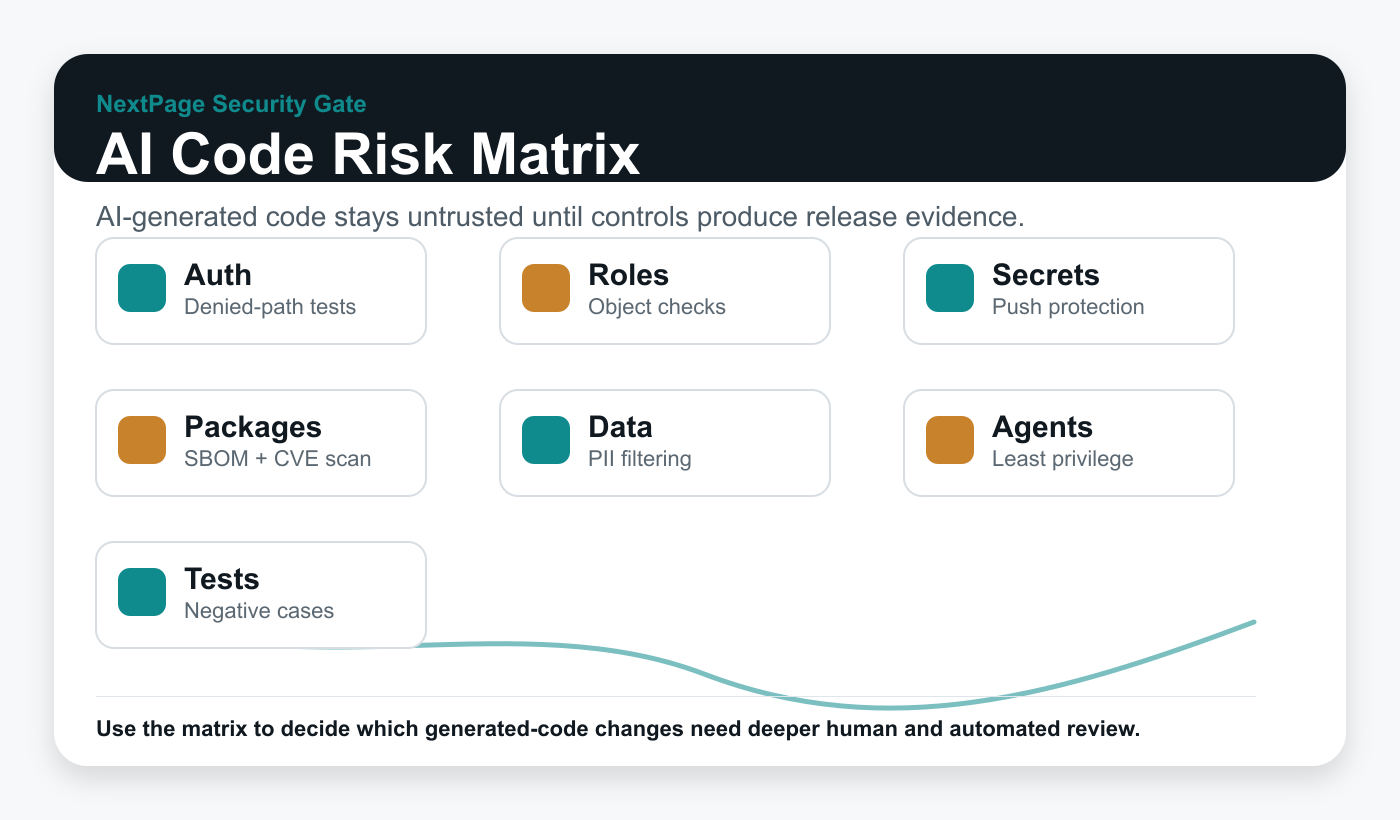
Risk Matrix For AI-Generated Code
| Risk Area | What Can Go Wrong | Required Control |
|---|---|---|
| Authentication | Generated code bypasses login checks, trusts client state, or creates weak session handling. | Manual review by an engineer familiar with the auth model plus security tests for denied paths. |
| Authorization | Role checks are missing on API routes, admin actions, tenant data, or object-level access. | Object-level permission tests and review of every new data query. |
| Secrets | Keys, tokens, connection strings, or test credentials appear in code, logs, prompts, or examples. | Secret scanning with push protection and review of prompt/context sharing settings. |
| Dependencies | The assistant adds unmaintained packages, typosquatted packages, or vulnerable transitive dependencies. | Dependency review, SBOM update, license check, and vulnerability scan. |
| Data Exposure | Generated endpoints expose internal records, PII, logs, embeddings, or chat history. | Data classification, response filtering, access tests, and logging review. |
| Agent Permissions | An autonomous tool can edit files, call APIs, open PRs, or deploy with broader access than needed. | Least-privilege tool scopes, human approval, audit logs, and kill switch. |
| Generated Tests | Tests validate the happy path but miss abuse cases, tenant isolation, and failure behavior. | Human-written negative tests and security regression cases. |
The Pre-Merge Checklist For Vibe Coding Security
Use this checklist before merging AI-generated code into a protected branch. It works whether the code came from an IDE assistant, a coding agent, a chat transcript, or a pull request opened by automation.
- Record the intent: What problem was the AI asked to solve, what files did it touch, and what was explicitly out of scope?
- Review the generated diff: Do not review only the final UI. Read changed routes, database queries, middleware, configuration, package files, and infrastructure scripts.
- Identify sensitive paths: Flag changes touching auth, roles, payments, uploads, data exports, admin features, webhooks, background jobs, AI prompts, and third-party APIs.
- Check permissions: Confirm the code enforces server-side authorization and does not rely on hidden UI controls, client flags, or route naming.
- Scan secrets: Run secret scanning and check whether any prompt, fixture, test, or log includes credentials or customer data.
- Review dependencies: Ask why every new package is needed, whether it is maintained, and whether it changes the deployment or license profile.
- Run security automation: Use static analysis, dependency scanning, linting, type checks, and test suites before approval.
- Add negative tests: Test denied access, invalid input, empty states, rate limits, malformed files, duplicate requests, and cross-tenant access.
- Confirm observability: Make sure errors, denied actions, queue failures, and third-party API failures are logged without leaking sensitive data.
- Prepare rollback: Know how to disable the feature, revoke credentials, roll back schema changes, and restore data if the release behaves badly.
Audit Agent Permissions Before You Audit Code
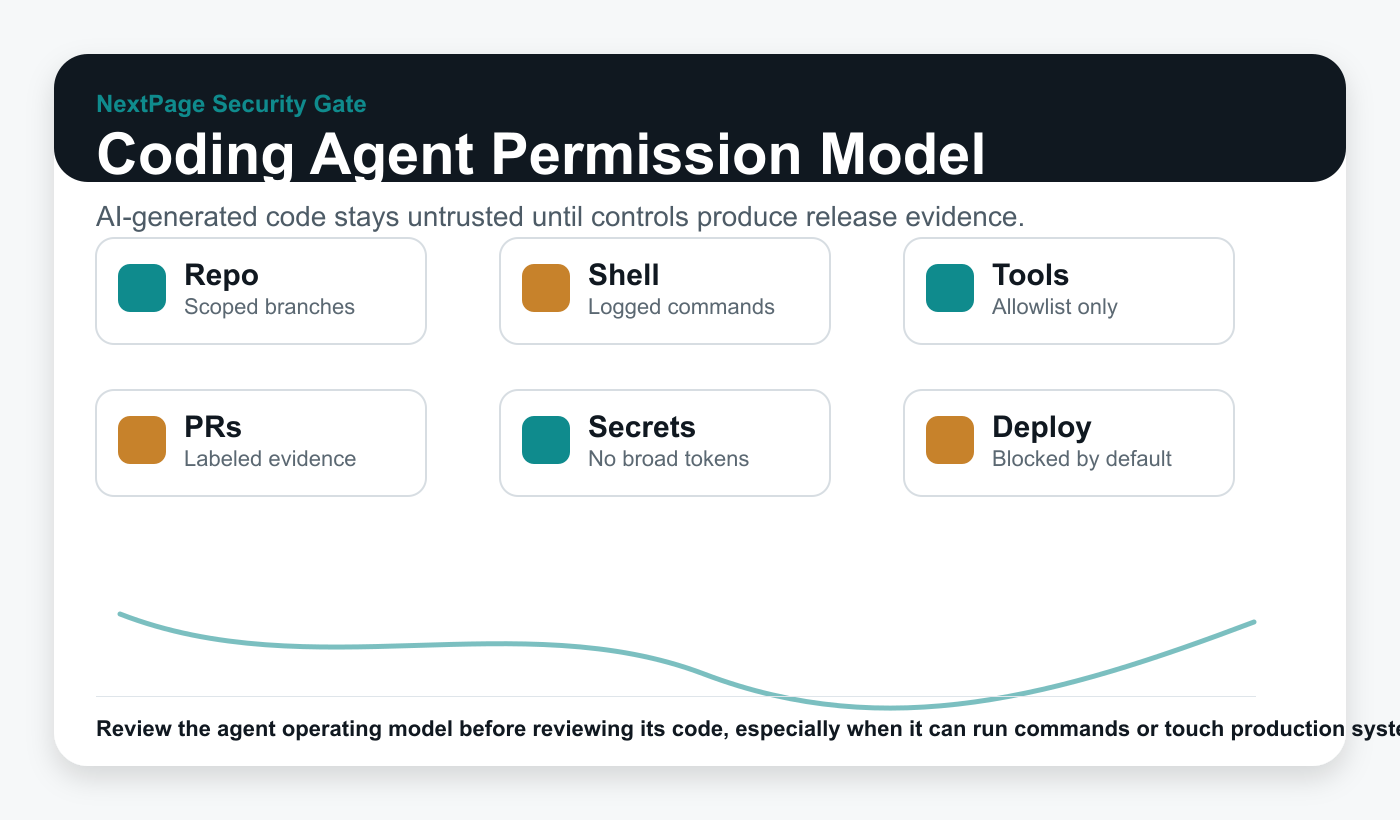
When a coding tool can only suggest code, the security review centers on the diff. When it can read repositories, run commands, create branches, call tools, or deploy, the review must start earlier. The agent itself becomes part of the development environment.
Use the operating model from enterprise AI agent governance: define what the agent may access, what actions require approval, what gets logged, how risky actions are blocked, and how the team rolls back unsafe behavior. A coding agent should not receive broad repository, cloud, ticketing, database, or production credentials just because it saves time during prototyping.
| Permission | Default Stance | Escalate Only When |
|---|---|---|
| Read repository | Allow only required repos and branches. | The task needs cross-repo context. |
| Write files | Allow in a sandbox branch or worktree. | Human review and branch protection are active. |
| Run commands | Restrict destructive commands and production credentials. | The command is reproducible and logged. |
| Open pull requests | Allowed with labels and generated summary. | Reviewers can trace source prompts and test output. |
| Deploy | Do not allow by default. | A mature release gate, approvals, and rollback path exist. |
CI And Secure SDLC Controls That Should Block The Merge
AI-generated code should not get a lighter pipeline than human-written code. In most teams it needs a stricter one because the reviewer may not know why the model chose a pattern. At minimum, protect the branch with type checks, tests, linting, dependency scanning, secret scanning, and code scanning.
For teams with compliance, customer data, or complex dependencies, connect this checklist to a broader software supply chain security checklist. The AI assistant can add packages, build scripts, container images, test fixtures, and generated files that become part of your supply chain. Treat those changes as release artifacts, not harmless scaffolding.
Useful blocking controls include:
- CodeQL or equivalent static analysis for injection, unsafe deserialization, path traversal, and access-control smells.
- Secret scanning with push protection for tokens, keys, webhook secrets, and connection strings.
- Dependency review for new packages, license changes, known CVEs, and suspicious maintainer patterns.
- Test coverage for server-side authorization, validation, rate limiting, and failure paths.
- Infrastructure policy checks for IAM, storage buckets, public network access, environment variables, and database migrations.
If the review needs an independent release-readiness pass, connect the workflow to Software QA Testing Services so test design, browser checks, security-sensitive paths, and regression coverage are planned before the AI-written feature reaches customers.
Human Review Workflow For AI-Generated Pull Requests
The reviewer should know which parts were generated, which parts were edited by a human, and which assumptions still need validation. A good pull-request template asks for the original request, tool used, files changed, tests run, security-sensitive areas touched, and any model uncertainty. If nobody can explain why the generated code is safe, the PR is not ready.
Use a two-reviewer rule for high-risk changes. One reviewer checks product behavior and maintainability. The second checks security assumptions: data access, trust boundaries, dependency choices, error handling, and abuse cases. The review should look for subtle problems, not just whether the page loads.
This is where the AI agent development lifecycle becomes useful even for internal engineering tools. Lifecycle thinking forces the team to define roles, metrics, release gates, monitoring, and iteration paths before an agent becomes part of day-to-day delivery.
Prompt And Context Hygiene
Security review should include what the model was allowed to see. Prompts can contain customer data, internal architecture details, API responses, stack traces, tokens, and private business rules. If the coding tool stores chat history or uses prompts for training depending on account settings, the exposure risk changes.
Set rules for what developers may paste into coding tools. Avoid raw production data, real credentials, private customer records, unreleased security reports, and proprietary algorithms unless the tool, account, and contract are approved for that class of data. Prefer synthetic examples, local fixtures, redacted logs, and short architecture summaries.
For agent workflows, also review memory. If an agent remembers credentials, internal URLs, private repository structure, or customer-specific logic across tasks, that memory needs retention, deletion, and access rules.
Review Evidence To Keep With Every AI-Generated PR
Keep evidence with the pull request instead of relying on a generated summary after the fact. Store the original task, tool or agent used, files changed, security-sensitive paths touched, scan output, test output, reviewer notes, deployment flag, and rollback owner. For higher-risk agent workflows, compare the controls against the AI agent skill security checklist and the secure AI agent development checklist.
For budget and roadmap planning, the Custom Software Cost Estimator can frame the engineering effort behind safer AI-assisted delivery, especially when the work includes tests, refactoring, integrations, monitoring, and release support.
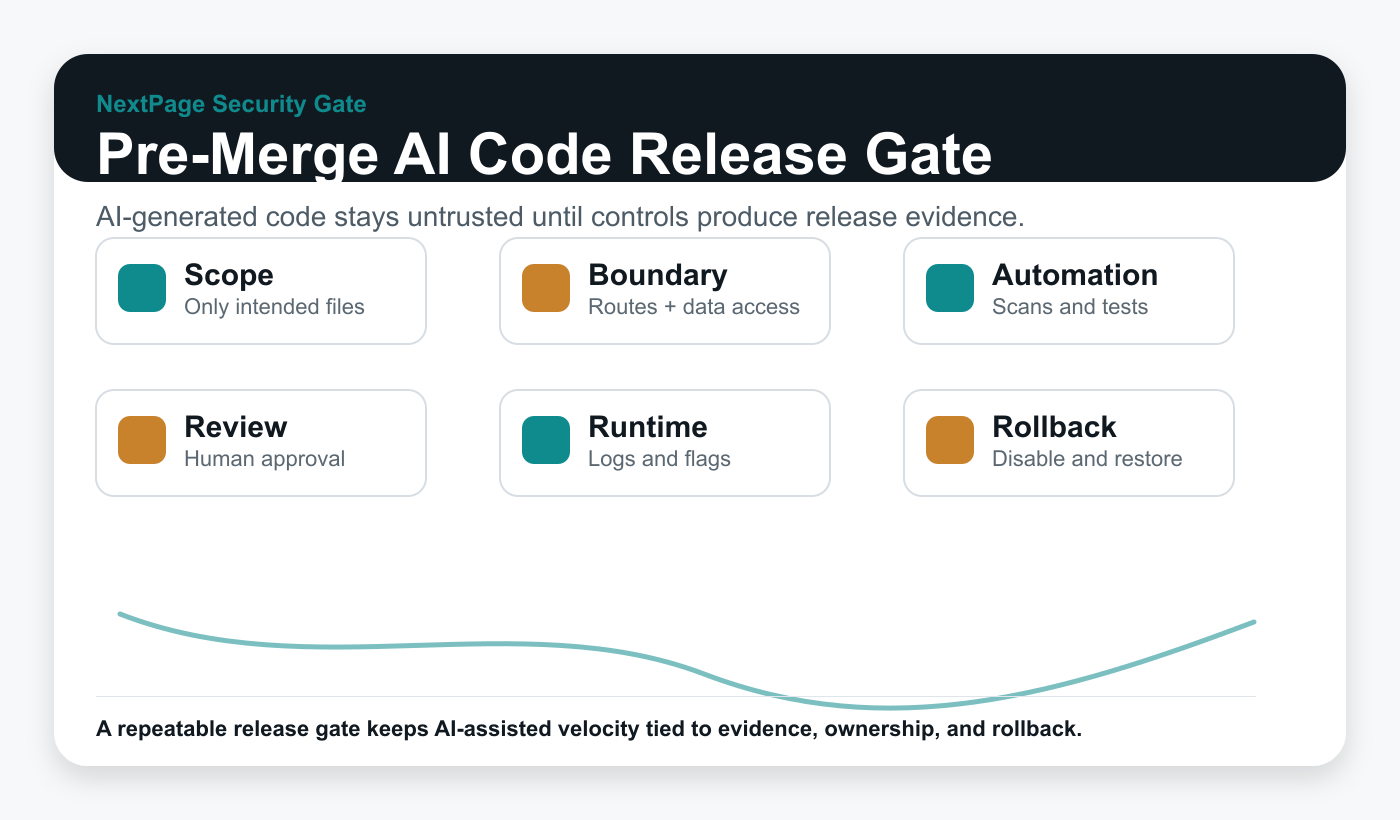
A Practical Release Gate For AI-Written Features
A release gate should be small enough to run every time and strict enough to block risky changes. Use this order:
- Scope gate: Confirm the AI changed only the intended area.
- Trust-boundary gate: Review server routes, database queries, permissions, and third-party calls.
- Automation gate: Run scans, tests, dependency checks, and type checks.
- Human gate: Require approval from an accountable engineer for sensitive paths.
- Runtime gate: Confirm logging, monitoring, alerts, and feature flags.
- Rollback gate: Confirm disablement, migration rollback, and credential revocation steps.
Do not let the AI write its own release evidence without verification. Generated summaries are useful as a starting point, but the final evidence should come from actual command output, CI status, screenshots, logs, and reviewer notes.
What Not To Delegate To AI Coding Tools Without Expert Review
Some work is too sensitive for low-friction generation without expert review. Authentication flows, encryption design, payment handling, medical or financial decision logic, tenant isolation, infrastructure permissions, and incident response scripts should involve experienced engineers. AI can assist with explanation, boilerplate, tests, and review prompts, but it should not be the authority.
The same rule applies to compliance-sensitive software. If your product handles regulated data, safety-critical workflows, or contractual security commitments, connect AI coding adoption to your secure SDLC and risk register. AI speed is valuable only when the organization can still prove control.
How NextPage Can Help
NextPage helps teams adopt AI coding and AI agents without weakening their delivery process. We can assess readiness, define agent permissions, add security gates, improve test coverage, review architecture, and build production software with secure SDLC controls.
If your team is experimenting with AI-generated code, start with the AI Agent Readiness Assessment. For implementation support, review AI Development Services and Custom Software Development.