
Quick Answer: Choose The Model That Matches Your Scope Risk
The best web app development engagement model is not the cheapest label on a proposal. It is the commercial structure that matches how clear your scope is, how often the product is likely to change, how much delivery control you want, and who will own day-to-day decisions.
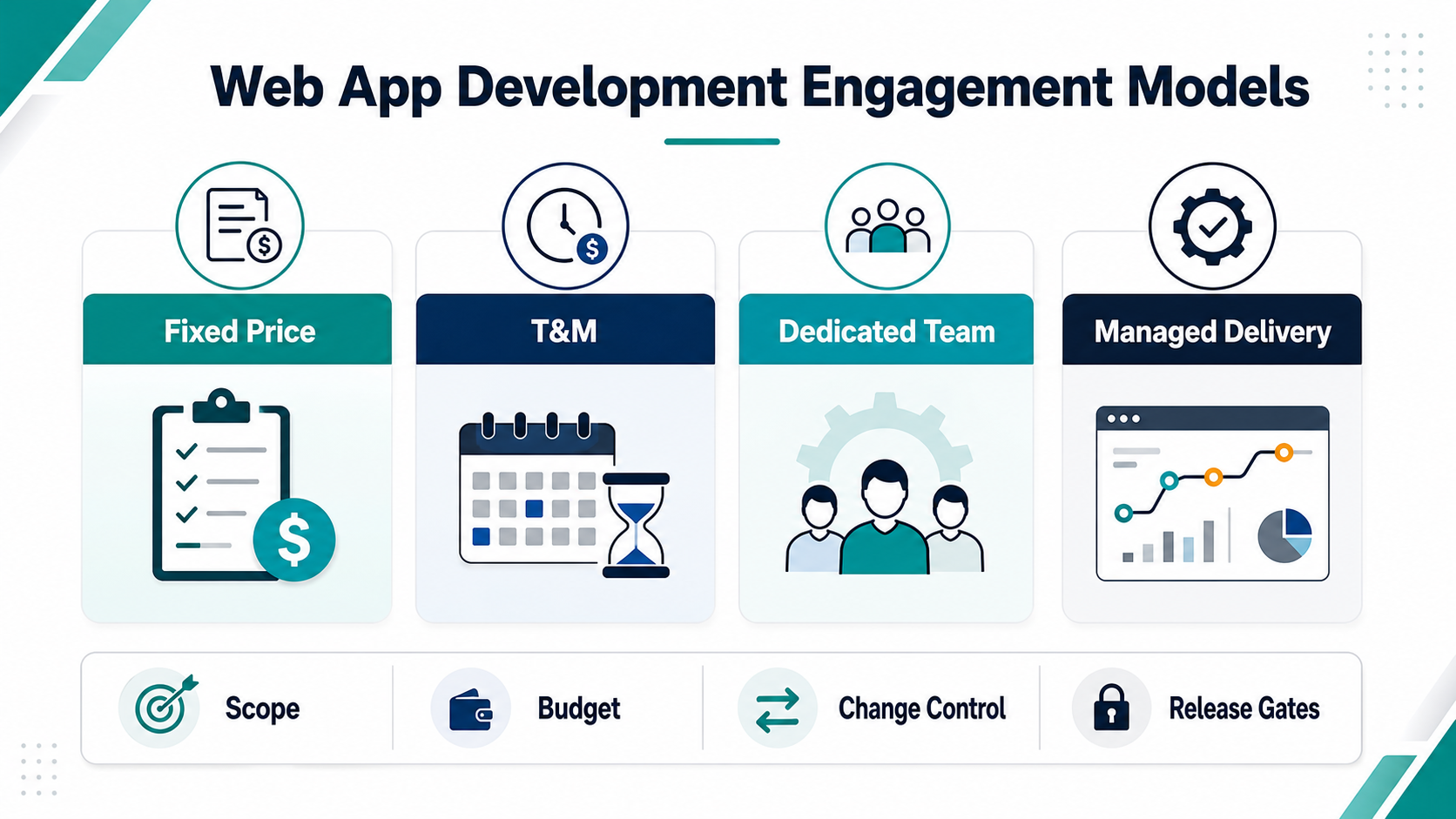
Use a fixed-price model when the web app scope is stable, the acceptance criteria are specific, integrations are known, and procurement needs a defined milestone budget. Use time and material when the product needs discovery, iteration, changing priorities, or technical investigation, but add budget guardrails so flexibility does not become drift. Use a dedicated team when you need long-running product capacity, direct collaboration, and steady roadmap execution. Use a managed-delivery hybrid when you want flexible scope but still need one accountable partner to own delivery outcomes.
If you already know the product type, user roles, workflows, integrations, and release goals, the Custom Software Cost Estimator can turn that scope into a directional budget before you ask for a formal quote.
Web App Engagement Model Decision Matrix
Most web app proposals mention fixed price, time and material, or dedicated team. The important question is what each model does to risk. Fixed price moves estimation risk to the vendor, but only works when scope is tightly described. Time and material keeps scope flexible, but moves budget discipline to the buyer and delivery team. Dedicated teams create continuity, but require strong product ownership, sprint hygiene, and backlog decisions.
A useful selection process starts with five questions: how clear is the first-release scope, how many unknowns sit inside the workflow, how often will priorities change, how closely does your team want to manage delivery, and how important is monthly budget predictability?
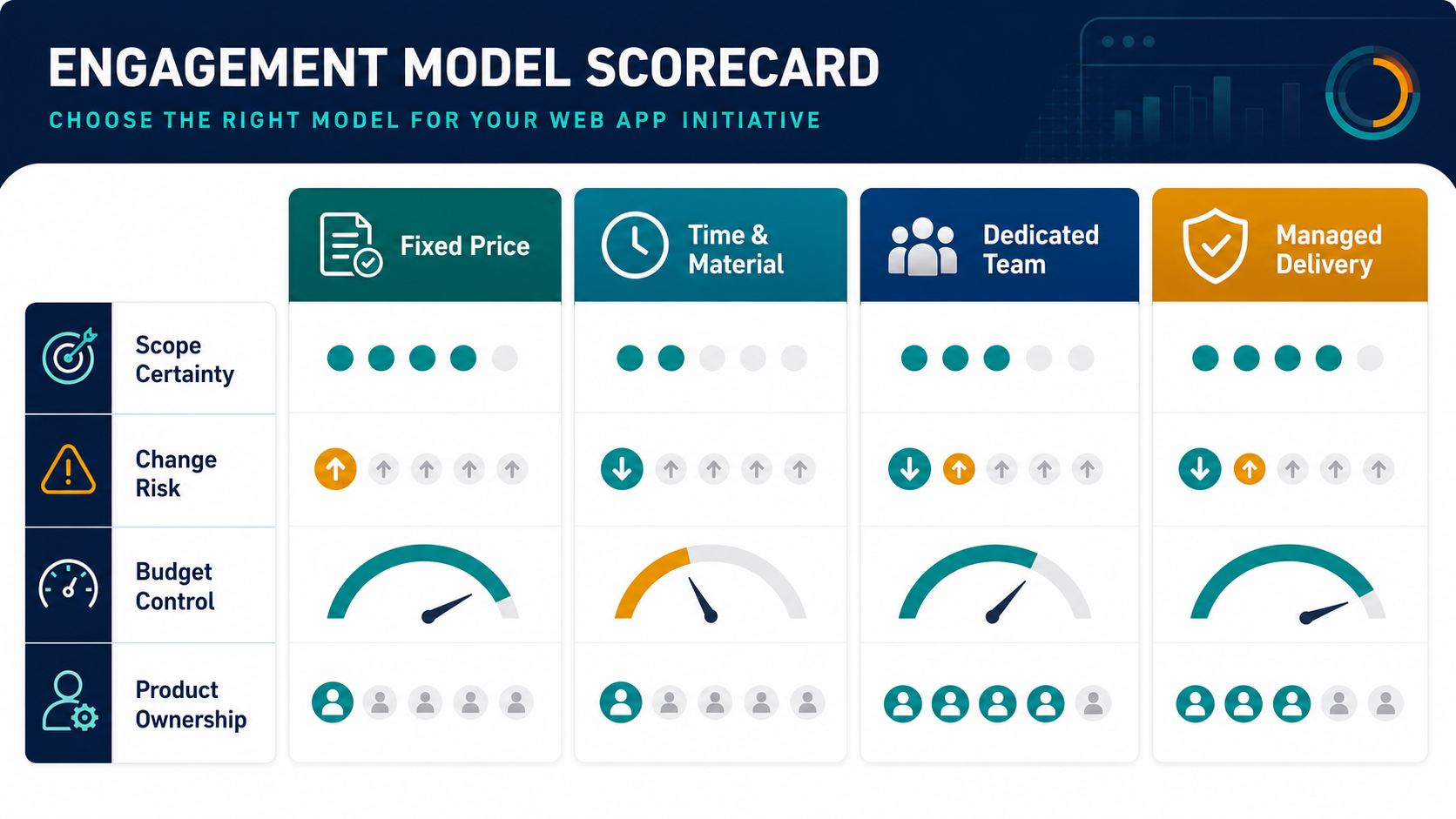
| Model | Best Fit | Budget Behavior | Main Risk | Governance Needed |
|---|---|---|---|---|
| Fixed price | Clear, bounded web app builds | Milestone-based and predictable | Change requests and assumptions | Detailed scope, acceptance criteria, change-control process |
| Time and material | Iterative builds with discovery or changing backlog | Flexible, usually weekly or monthly burn | Open-ended spend | Sprint goals, budget caps, burn reports, decision logs |
| Dedicated team | Longer roadmap, product evolution, team extension | Monthly capacity cost | Weak product ownership or idle capacity | Roadmap, team rituals, role clarity, delivery metrics |
| Managed delivery | Complex web app where buyer wants outcome ownership | Can be phased, capped, or retainer-based | Ambiguous success definition | Release outcomes, decision owners, technical leadership, QA gates |
Fixed Price Works When The Web App Is Already Well Defined
A fixed-price web app project works best when the buyer and delivery team can agree on what will be built before development starts. That means more than a feature list. It means user roles, workflows, permissions, data objects, integrations, admin screens, acceptance criteria, reporting needs, and launch constraints are known enough to estimate.
For example, a fixed-price model can work for a customer portal with known login roles, document upload, status tracking, notifications, and a small admin console. It can also work for a marketing-backed MVP when the goal is to test one workflow and defer nonessential automation. It is weaker for SaaS products that are still finding the right onboarding flow, pricing rules, analytics events, or workflow depth.
The biggest misconception is that fixed price removes risk. It only changes where risk shows up. If requirements are unclear, the vendor protects margin through assumptions, exclusions, narrower acceptance criteria, or change orders. The buyer may still pay later through rework, slow approvals, or a product that technically meets the contract but misses the operating need.
- Use it when: scope is stable, stakeholders are aligned, and the release can be described as a concrete set of deliverables.
- Avoid it when: integrations, user behavior, architecture, or market requirements are still uncertain.
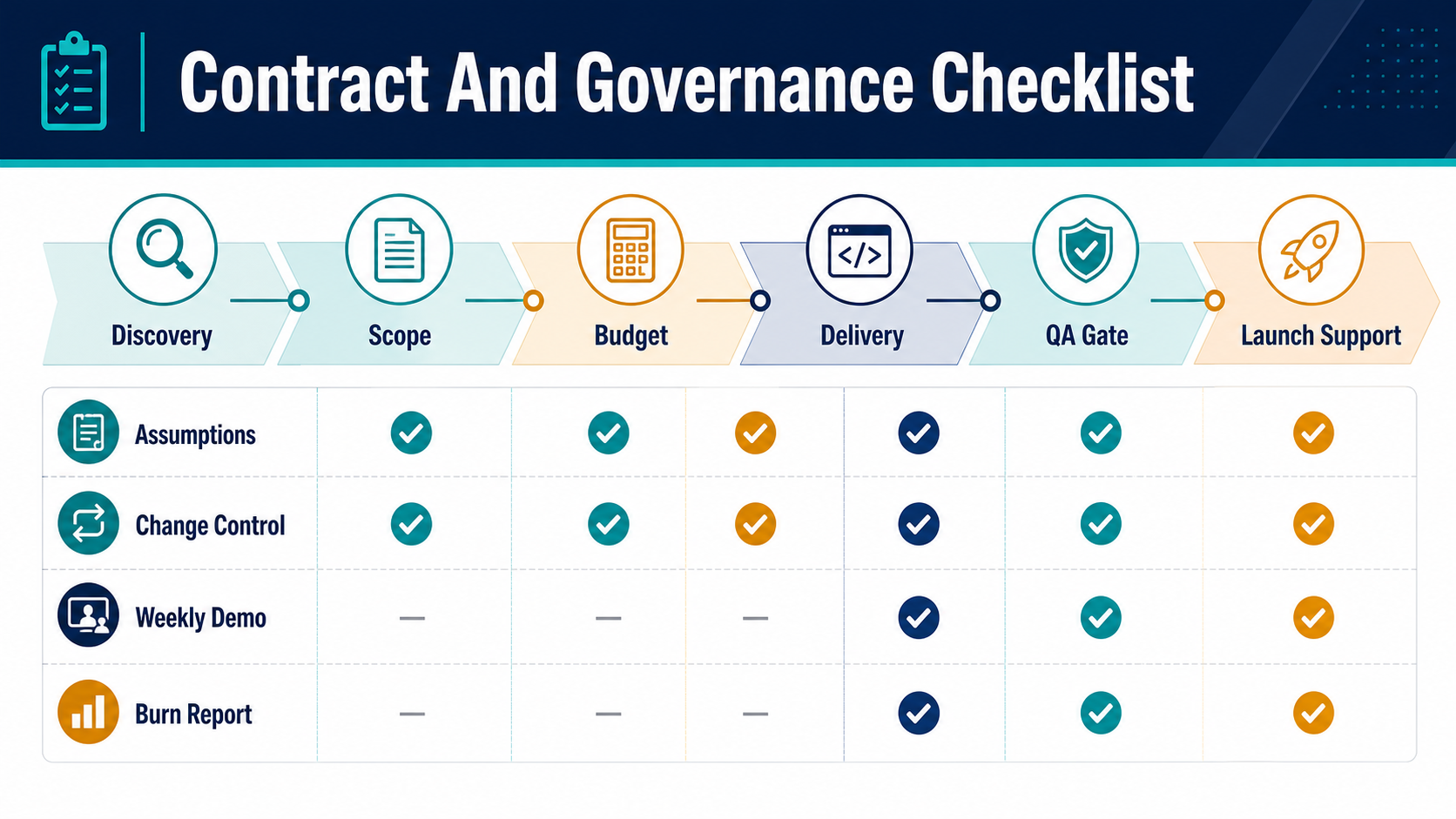
- Require: a discovery phase, assumptions log, milestone acceptance criteria, change request rules, and launch-support scope.
Before choosing a fixed-price contract, compare the quoted scope against realistic web app development cost drivers such as roles, workflows, integrations, security, data migration, QA, and support. A low fixed bid often means some of that work is outside the proposal.
Time And Material Gives Flexibility, But Needs Budget Controls
Time and material is useful when the team cannot responsibly lock the whole project on day one. In contract terms, this model charges for the effort spent rather than one lump-sum outcome, and it is commonly used when the project size is hard to estimate or requirements may change. For web apps, that situation is common: user workflows evolve, API behavior is discovered late, admin requirements grow, and analytics needs become clearer only after the first usable build exists.
The model fits product discovery, SaaS iteration, complex integrations, AI-assisted workflows, internal tools, modernization work, and projects where business stakeholders need to see working software before final decisions. It also works when the buyer wants to prioritize speed and learning over a long specification phase.
Flexibility is not the same as weak control. A serious time-and-material project should still have a budget range, sprint goals, release milestones, weekly burn visibility, backlog triage, and a clear process for pausing or narrowing scope. Without those controls, the buyer may feel informed but not protected.
| Control | Why It Matters | How To Run It |
|---|---|---|
| Budget cap | Prevents unlimited spend | Set a monthly or release-level ceiling with escalation triggers |
| Sprint outcome | Keeps work tied to business value | Define what should be demo-ready at the end of each sprint |
| Decision log | Stops invisible scope growth | Record product, technical, and tradeoff decisions weekly |
| Backlog grooming | Controls priority churn | Separate must-have release work from later-phase ideas |
| QA gate | Protects velocity from becoming rework | Track acceptance, regression, integration, and release evidence |
If you are still deciding release-one scope, the MVP Scope Builder can help separate core workflow from later-phase features before a T&M build starts.
Dedicated Teams Are Best For Ongoing Product Capacity
A dedicated team model gives you consistent capacity rather than a single bounded project. It is useful when your web app will evolve through multiple releases, needs ongoing feature development, or must sit close to your internal product, design, QA, DevOps, or operations teams.
This model can be a strong fit for SaaS platforms, marketplace back offices, customer portals, internal operations platforms, modernization programs, and roadmap-heavy products. When the roadmap is a subscription product rather than a one-off portal, compare the team shape against SaaS development services expectations for roadmap ownership, platform scalability, analytics, onboarding, and support. The value is continuity: the team understands the codebase, business rules, user feedback, deployment patterns, and long-term quality tradeoffs.
The risk is that buyers sometimes treat a dedicated team as a staffing shortcut without the operating system needed to make it productive. A team still needs product leadership, sprint planning, backlog quality, architecture direction, QA ownership, release discipline, and feedback loops. Without that, monthly capacity turns into fragmented tickets.
NextPage's hire dedicated developers in India model is strongest when the buyer wants vetted engineering capacity with product leadership and QA support, not anonymous resumes. For budget planning, the Dedicated India Team Cost Calculator can model roles, seniority, QA, PM support, and ramp-up assumptions.
Managed Delivery Is The Useful Hybrid Many Web Apps Need
Some web app projects do not fit neatly into one classic model. The buyer wants flexibility because the scope will evolve, but also wants someone accountable for delivery outcomes, technical decisions, QA gates, and release planning. That is where a managed-delivery hybrid can be better than arguing over fixed price versus T&M.
In a managed model, the work may still be phased, capped, or billed by capacity, but the vendor owns more of the delivery system. This can include solution architecture, sprint planning, backlog shaping, quality strategy, security review, DevOps, release readiness, and stakeholder reporting. The buyer still owns business priorities, but the delivery partner owns execution coherence.
This model is especially useful for multi-role web apps, ERP/CRM integrations, workflow automation, SaaS rebuilds, AI-enabled admin tools, and modernization projects where the first release must be practical but the product roadmap is not frozen.
If you are comparing partners, use a broader custom software development cost lens: delivery management, discovery, architecture, QA, security, integrations, and support are not overhead when they reduce rework and launch risk.
Examples By Web App Project Type
The same engagement model can be right or wrong depending on the web app. Use the model as a fit decision, not a default preference.
| Project Type | Likely Best Model | Reason |
|---|---|---|
| Simple MVP with one workflow | Fixed price or capped T&M | Scope can be controlled if release-one is narrow |
| New SaaS product | T&M moving into dedicated team | Onboarding, pricing, analytics, roles, and product-market feedback will change the build |
| Customer or partner portal | Fixed price after discovery, or managed delivery | Works when roles, workflows, integrations, and acceptance criteria are clear |
| Internal operations platform | T&M or managed delivery | Workflow details emerge as operations users test real screens |
| Legacy web app modernization | Managed delivery or dedicated team | Unknown dependencies, data migration, regression risk, and staged rollout need sustained ownership |
| Roadmap-heavy product team extension | Dedicated team | Continuity and capacity matter more than a single project estimate |
For early-stage products, also read the related guide on MVP engagement models for startups. MVP work has its own constraints around validation speed, investor timing, and first-release scope.
Red Flags In Engagement Model Proposals
Weak proposals often hide risk behind model language. A fixed-price proposal with vague acceptance criteria is not truly predictable. A T&M proposal without a budget range is not truly transparent. A dedicated-team proposal without delivery ownership is not truly managed. If the choice is really between staff augmentation and managed ownership, pressure-test the proposal against a staff augmentation vs managed dedicated team comparison before you sign.
- The vendor recommends a model before understanding user roles, workflows, integrations, data, and release goals.
- The fixed-price scope has broad words like dashboard, automation, integration, or admin panel without acceptance criteria.
- The T&M plan has no sprint outcomes, burn reporting, backlog rules, or pause points.
- The dedicated-team offer lists roles but not onboarding, code ownership, QA process, sprint rituals, or reporting.
- The proposal excludes QA, DevOps, data migration, security, documentation, or post-launch support without making that risk explicit.
- The model pushes all product decisions to you but still promises a guaranteed outcome.
For buyers evaluating offshore or distributed teams, software outsourcing in India should be assessed on delivery ownership, communication rhythm, seniority, QA, security, and escalation paths, not just hourly rate. For a broader pricing-model view beyond web apps, use the companion guide to fixed price vs time and material vs dedicated team for software development.
Questions To Ask Before You Sign
Ask model-specific questions before comparing final numbers. The right answers will reveal whether the vendor understands the commercial structure they are proposing. If the project also needs distributed delivery, QA, DevOps, or support coverage, compare the proposed model against broader IT outsourcing services expectations before signing.
| Question | What A Good Answer Shows |
|---|---|
| What assumptions drive the estimate? | The vendor can name workflow, integration, data, role, QA, and launch assumptions. |
| What happens when scope changes? | There is a practical process for change requests, backlog tradeoffs, or budget reallocation. |
| How will we know weekly progress? | Demos, burndown, risks, blockers, QA status, and budget burn are visible. |
| Who owns product decisions? | Business, product, and technical decision owners are explicit. |
| What is included after launch? | Bug fixes, warranty, monitoring, support, enhancements, and handover are separated clearly. |
| How is quality proven? | Acceptance tests, regression checks, security review, performance testing, and release evidence are planned. |
How NextPage Helps Choose The Right Web App Model
NextPage helps buyers choose the delivery model after we understand the product, not before. In web app development work, we look at release goals, user roles, workflow complexity, integration risk, compliance needs, roadmap uncertainty, internal team capacity, and budget constraints. Then we recommend a structure that makes delivery risk visible.
For a tightly scoped release, that may be fixed-price after discovery. For a product with unknowns, it may be a capped T&M phase that proves the workflow and architecture. For a long-running roadmap, it may be a dedicated team with product leadership and QA support. For complex web apps, it may be managed delivery with clear release outcomes and flexible backlog control.
Talk to NextPage about the right engagement model for your web app.