
Quick Answer: White-Label Vs Custom NFT Marketplace
A white-label NFT marketplace can be enough when your goal is a short validation sprint, the asset model is simple, trading volume is low, compliance exposure is limited, and you can accept the vendor's wallet, contract, auction, royalty, and admin assumptions. Custom NFT marketplace development is safer when ownership, smart contract behavior, wallet UX, metadata durability, compliance controls, analytics, roadmap flexibility, or marketplace trust are part of the business model.
The risky option is not always white label. The risky option is launching a marketplace without knowing which parts you own, which parts the vendor controls, which contracts are upgradeable, what happens to NFT metadata, how approvals are scoped, and how the platform handles disputes, fraud, royalties, custody, and regulatory review. If the platform will carry meaningful brand, revenue, community, or investor risk, run a structured Build vs Buy Decision Tool exercise before buying a clone script.
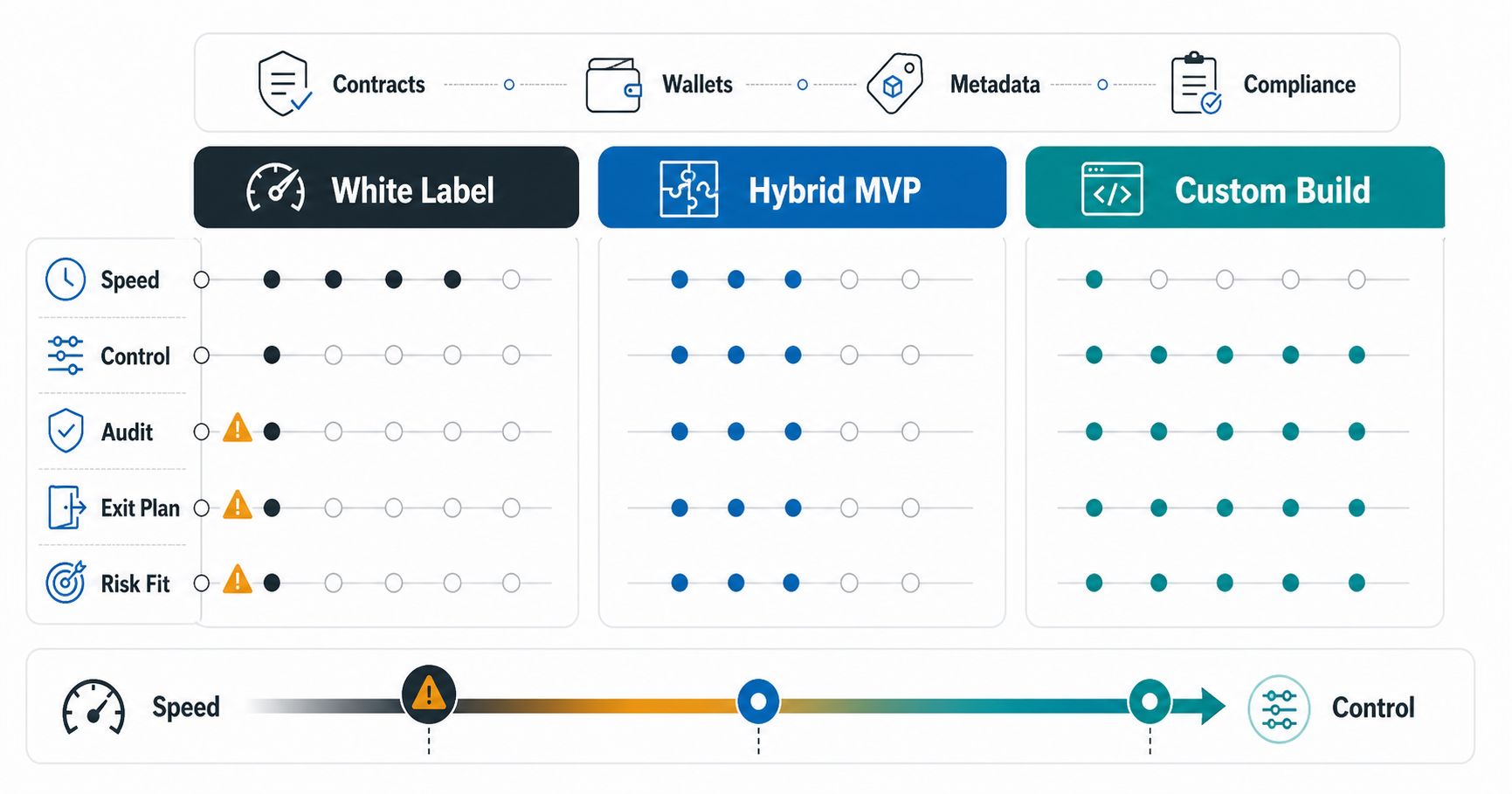
Use a white-label base when speed matters more than differentiation. Use a hybrid MVP when you need fast validation but must customize wallet onboarding, admin review, or collection rules. Use custom development when the marketplace workflow itself creates advantage or liability.
What A White-Label NFT Marketplace Usually Includes
White-label NFT marketplace software usually bundles the common product surface: collection pages, minting, listings, offers, auctions, wallet connection, token standards such as ERC-721 or ERC-1155, admin panels, creator profiles, transaction history, and basic CMS controls. Clone-script pages often position this as a faster way to launch a Rarible-like or OpenSea-like marketplace without starting from a blank codebase.
That can be useful. A founder can validate whether a niche collection, gaming asset marketplace, membership model, creator community, or loyalty-token concept has demand before funding a larger product. A white-label base may also reduce early discovery cost because standard screens, admin flows, and marketplace states already exist.
But the buyer should separate visible features from operating control. A marketplace is not just a UI for collectible cards. It is a trust system with smart contracts, wallet approvals, metadata storage, moderation, royalties, disputes, indexing, custody assumptions, analytics, and support operations. NextPage's NFT marketplace development services work starts by mapping those trust boundaries before choosing whether a prebuilt base is acceptable.
Where Clone Scripts Become Risky
Clone scripts become risky when the business depends on assumptions that the template cannot prove. A generic marketplace may support auctions, bids, and wallet connection, but that does not answer whether your team owns the contracts, can audit upgrade permissions, can change royalty logic, can preserve metadata, can screen collections, can handle refunds, or can explain every wallet prompt to users.
The biggest risk categories are technical, operational, and regulatory. Technical risk includes smart contract bugs, broad wallet approvals, weak signature handling, upgradeable contract control, metadata stored on brittle centralized paths, and vendor-specific integrations that are hard to replace. Operational risk includes poor admin tooling, weak moderation, no dispute workflow, missing creator verification, limited analytics, and unclear support ownership. Regulatory risk appears when NFTs behave less like collectibles and more like financial products, fractional ownership, investment contracts, loyalty instruments, or tokenized real-world assets.
In 2026, the royalty and marketplace-policy layer also deserves review. Creator earnings can be optional or enforceable depending on contract compatibility and marketplace support, so a clone script that advertises royalties may still leave the business dependent on chain, contract, and marketplace-specific rules. Ask the vendor to prove how royalties, payment processors, signatures, and transfer restrictions work in the actual deployed contracts, not only in a sales deck.
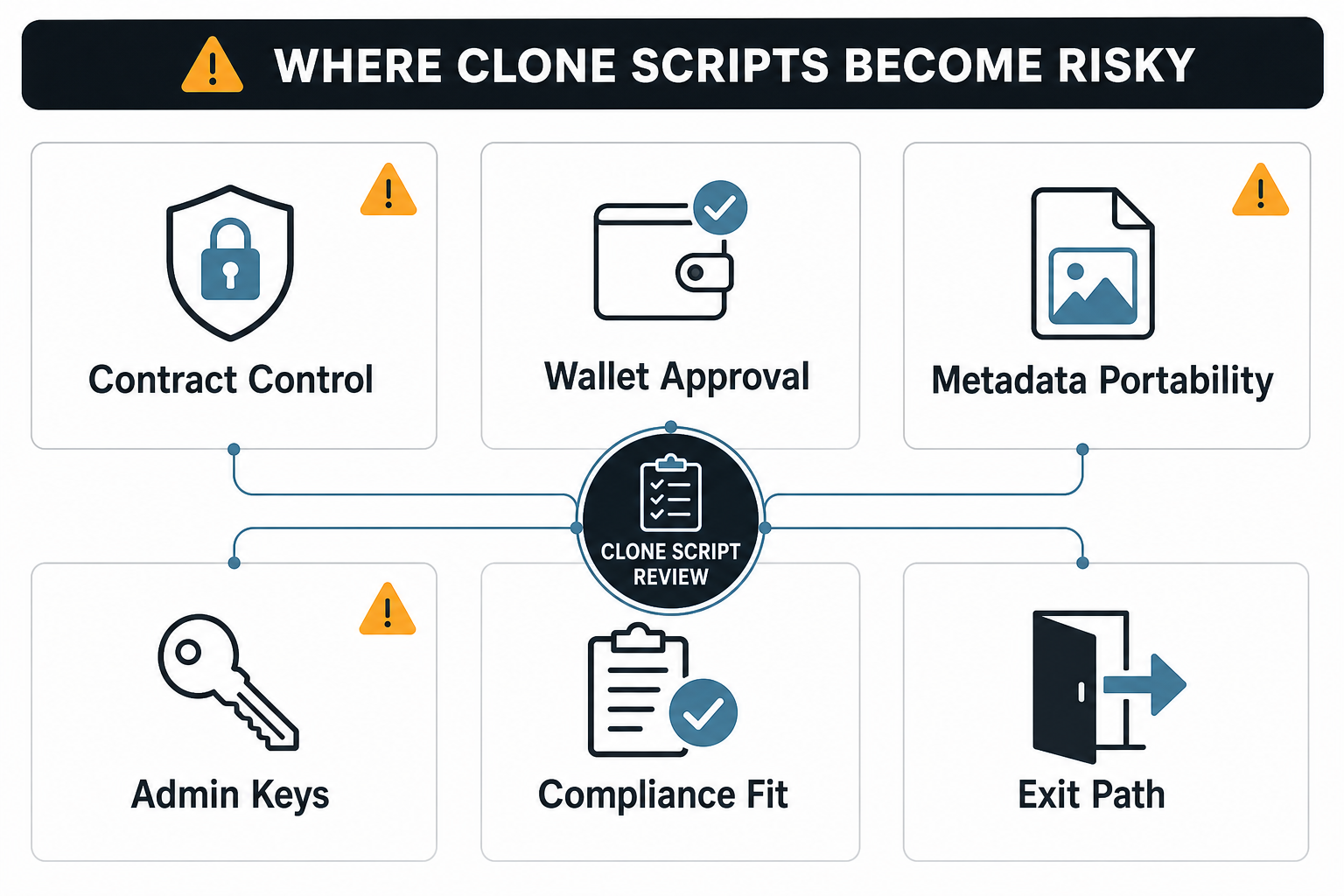
None of this means every NFT marketplace must be custom from day one. It means the clone-script decision should be based on risk fit, not launch-speed marketing. If the first release only tests collection discovery and non-custodial wallet purchase flow, a constrained white-label pilot may be reasonable. If the platform controls funds, promises returns, fractionalizes assets, or needs enterprise audit trails, a generic clone can create more hidden risk than it removes.
When Custom Development Is Worth It
Custom NFT marketplace development is worth considering when the marketplace model is differentiated enough that the software must express your rules. Examples include gaming asset economies, membership marketplaces, token-gated communities, real-world asset marketplaces, brand loyalty platforms, creator revenue splits, enterprise digital collectibles, or marketplaces where buyer trust depends on verification and governance.
Custom does not always mean building every component from scratch. A pragmatic custom build can still use established wallet libraries, chain infrastructure, indexers, payment processors, identity providers, storage networks, and marketplace protocols where they fit. The difference is that the architecture is designed around your operating model instead of forcing your business into a clone script's assumptions. If the marketplace also needs internal dashboards, reviewer workbenches, payment operations, or enterprise reporting, treat it as custom software development with a Web3 trust layer rather than a theme installation.
The NFT marketplace development cost drivers usually sit in workflow complexity, smart contracts, wallet/payment layer, security, and operations. Custom work becomes easier to justify when those areas affect revenue, legal exposure, user trust, or future roadmap control.
Decision Matrix: White Label, Hybrid MVP, Or Custom Build
| Decision Signal | White Label Fits | Hybrid MVP Fits | Custom Build Fits |
|---|---|---|---|
| Launch goal | Validate demand quickly with standard marketplace behavior. | Validate demand while customizing one or two critical flows. | Build a defensible marketplace where workflow and trust are strategic. |
| Asset model | Simple collectibles or community drops. | Niche assets with custom metadata, review, or pricing rules. | Gaming, memberships, RWA, enterprise, or regulated asset workflows. |
| Smart contracts | Vendor contracts are acceptable after review. | Template contracts need limited customization and audit. | Contract ownership, upgrade policy, royalties, and auditability are core. |
| Wallet UX | Standard connect, sign, buy, sell, and bid flows are enough. | Onboarding needs clearer prompts, fiat bridge, or guided custody choices. | Wallet experience, permissions, recovery, and user education are differentiators. |
| Compliance | Low-risk collectible use case with legal review. | Some KYC, moderation, terms, or jurisdiction logic is needed. | Financial, fractionalized, custody, enterprise, or cross-border risk exists. |
| Roadmap | You can live with the vendor's feature pace. | You need a short-term launch plus planned replacement paths. | Your roadmap requires deep integrations, analytics, roles, and governance. |
Smart Contracts, Wallets, Metadata, And Royalties
Smart contract review is where many white-label evaluations become concrete. Ask whether contracts are verified, who can upgrade them, what admin keys can do, which standards are implemented, whether royalties are advisory or enforced, whether marketplace signatures can be replayed, and whether the audit covers the actual deployed code. Token-contract audit guidance consistently separates contract scope from off-chain metadata and marketplace behavior, so a clean token audit does not automatically prove the whole marketplace is safe.
Wallet UX deserves the same attention. Users may approve marketplace operators, sign typed data, switch networks, pay gas, bridge assets, or connect through WalletConnect-style flows. A rushed UI can make users approve more access than they understand. If your audience is not crypto-native, custom onboarding, warnings, test transactions, support content, and failure states may matter more than another marketplace filter.
Metadata and media durability are business questions, not only engineering details. If image files and JSON metadata sit on a vendor server with unclear backup and portability, buyers may not trust the assets long term. IPFS pinning, Arweave, decentralized storage, and clear metadata update policies all change the trust model. Royalties also require sober planning because enforcement varies across marketplaces and chains. Treat royalty logic as an operating policy, not just a checkbox in a clone script.
Compliance And Operating Model Questions
NFT regulation is not one-size-fits-all. A unique digital collectible is different from a fractionalized asset, a revenue-share token, a loyalty instrument, a tokenized financial claim, or a marketplace that takes custody. Recent U.S. regulatory guidance continues to distinguish different crypto asset categories, but that does not remove the need for legal review when a marketplace resembles brokerage, exchange, custody, investment, or financial promotion activity.
Before selecting white label or custom, define the operating model. Will the marketplace be non-custodial? Who can create collections? How are creators verified? Are sanctions, KYC, or AML checks required? Can admins freeze listings? What happens when a stolen asset is reported? How are chargebacks handled if fiat payments are allowed? What data is logged for disputes? Who owns support when a wallet transaction fails?
A white-label vendor may have answers for common flows, but the buyer remains accountable for the business model. Custom development is often justified when those answers need to be designed into permissions, data models, dashboards, terms, reporting, and operational workflows.
A Safer NFT Marketplace MVP Roadmap
A safer roadmap starts with scope discipline. Use the MVP Scope Builder to separate launch proof from later marketplace complexity. For many founders, the first release should prove one asset category, one chain, one purchase flow, one creator onboarding path, and one admin moderation workflow. Multi-chain trading, governance tokens, liquidity programs, lending, fractionalization, advanced auctions, and complex royalties can wait until the core trust loop works.
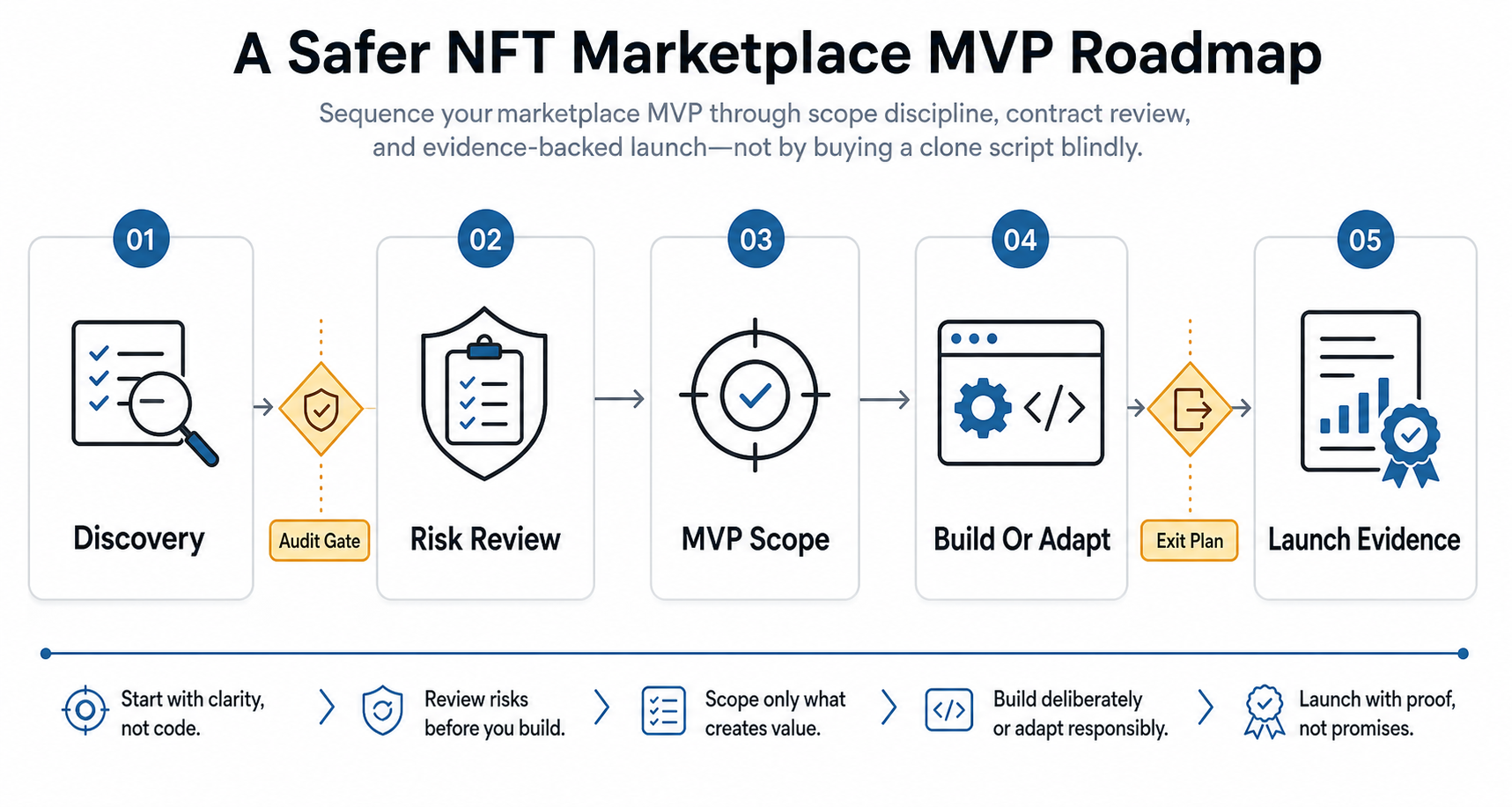
- Discovery: define asset type, audience, legal assumptions, wallet model, primary transaction, and launch success metric.
- Risk review: inspect contracts, vendor ownership, admin permissions, metadata storage, wallet approvals, and audit evidence.
- MVP scope: choose one chain, one asset workflow, essential marketplace screens, admin review, analytics, and support flows.
- Build or adapt: configure a white-label base, customize a hybrid MVP, or build the critical contract and marketplace layers.
- Security validation: run contract review, wallet-flow QA, abuse testing, role-permission checks, and production monitoring.
- Launch evidence: verify transactions, metadata availability, support paths, SEO pages, analytics, error tracking, and rollback procedures.
If budget is uncertain, the Custom Software Cost Estimator can help turn feature depth, roles, integrations, and security needs into a directional planning range before vendor conversations become too vague. For broader marketplace planning beyond NFTs, compare the trust, payment, seller, and admin patterns in the marketplace app development cost guide.
Buyer Checklist Before Buying A Clone Script
- Can the vendor show the exact smart contracts that will be deployed for your marketplace?
- Who controls admin keys, upgrade rights, royalty settings, and emergency pause functions?
- Does the audit cover the deployed contracts, marketplace signatures, wallet flows, and admin permissions?
- Where are media and metadata stored, and what happens if you leave the vendor?
- Can the platform support your creator verification, collection review, dispute, and takedown workflows?
- Can you customize wallet onboarding, fiat payment flow, error states, email notifications, and analytics?
- Does the marketplace support your target chain, token standards, indexing needs, and gas-fee expectations?
- How are compliance, KYC, sanctions screening, tax, and jurisdiction requirements handled when needed?
- What is the exit plan if the white-label base validates demand but becomes a growth constraint?
How NextPage Helps
NextPage helps founders and product teams choose the right NFT marketplace path before they overcommit to a clone script or overspend on unnecessary custom development. We map the marketplace workflow, user roles, smart contract assumptions, wallet experience, metadata strategy, admin operations, security review, integrations, and launch roadmap.
For early ideas, we can help shape a lean MVP and validate whether a white-label base is enough. For higher-risk marketplaces, we can design and build custom marketplace software with owned workflows, clearer audit trails, stronger admin controls, and a roadmap that does not depend entirely on a vendor template. If you already have a team, a managed delivery pod through Your Team In India can support product, Web3, backend, QA, and integration work without forcing a full internal hiring cycle.
The best choice is the one that matches the risk. If the marketplace is only a validation surface, keep it lean. If it is the business, design the trust layer deliberately.