Portfolio case study

CareStay: Lodging marketplace web platform

A Next.js lodging marketplace and booking operations platform that connects guest search, property discovery, host listings, booking review, chat, verification, and Stripe payment workflows in one web product.

Name changed to respect NDA.

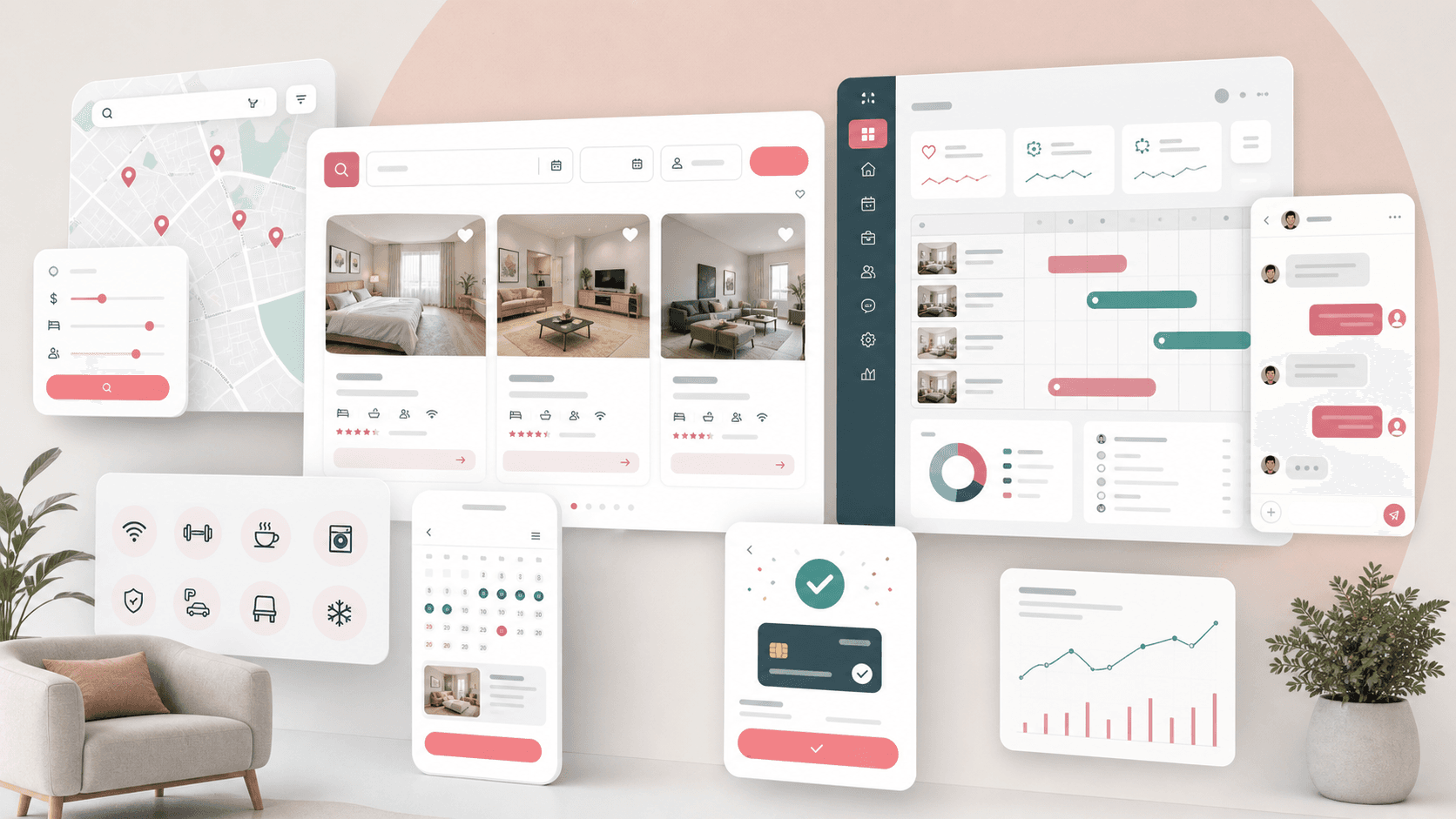
Lodging marketplace platform visual with property cards, booking operations dashboard, map pins, chat, payment confirmation, and amenity icons
Project scope

Frontend product engineering for marketplace, host operations, booking, payments, and communication workflows

Next.js
web marketplace foundation
Stripe
card and payment workflow
Maps
location-led property discovery
Chat
booking conversation support

Timeline

Multi-surface lodging marketplace web build

Lodging operations needed one connected web journey

The product had to support guests looking for short-term stays while also giving property owners and operators the controls to manage listings, bookings, verification, and customer communication.

  • Guest discovery needed search, date, guest count, location, price, review, and amenity filters
  • Hosts needed listing management for descriptions, photos, features, pricing, location, rules, policies, and availability context
  • Booking operations needed accept, reject, cancel, verification, and customer detail workflows
  • Payment and chat experiences had to sit inside the same booking journey instead of feeling like disconnected add-ons

A web marketplace that joins booking demand with host operations

CareStay brings guest-facing property search together with owner dashboards, booking review, profile management, chat rooms, notification access, and payment screens in a single Next.js application.

  • Homepage search flow for destination, dates, guests, children, infants, pets, and amenities
  • Property listing and detail surfaces with filters, reviews, image galleries, rules, policies, and booking entry points
  • Owner dashboard tabs for bookings and properties, including search, filters, pagination, and booking action states
  • Stripe card capture, saved-card selection, payment intent handling, and success routing for checkout

Product surfaces

What the platform brought together

The work spanned core product operations, daily user workflows, data-heavy coordination, and resilient platform management.

Guest search and property discovery

The guest journey starts with location, date, and guest inputs and continues into filterable property results.

  • Search panel with location selection, date range picker, guest counters, and featured property data
  • Property result filters for price range, reviews, amenities, location, dates, and guest count
  • Property detail flows for images, rates, beds, guests, amenities, reviews, rules, instructions, and refund policy context

Host property operations

Property owners can maintain marketplace-ready listings through structured forms and media workflows.

  • Property create and edit forms for name, description, address, details, rules, beds, guests, pricing, and policies
  • Country, state, city, map coordinate, amenity, and image upload controls
  • Dashboard property list with owner-specific filtering, pagination, search, and delete/edit actions

Booking management

Operational booking screens help hosts and staff review customer context and move reservations through clear states.

  • Booking dashboard with status, date, property, price, location, owner, and search filters
  • Booking detail view with customer contact, property address, stay dates, pricing, rejection reasons, verification, cancellation, and accept or reject actions
  • Check-in and payment success paths that keep booking state visible after checkout

Communication and payments

Chat and payment modules support the moments where guests and hosts need confidence before a stay is confirmed.

  • Chat room list and booking-linked conversation view with property summary context
  • Stripe Elements checkout with new-card tokenization, saved-card retrieval, and payment intent confirmation
  • Notification, profile, password reset, OTP, help, contact, terms, and privacy surfaces around the core booking journey

Buyer priorities

What mattered most to the people evaluating the platform

Prospective buyers want to know whether the work solved real workflow, adoption, reliability, data, and operations problems. These priorities shaped the product decisions.

Marketplace conversion

The product needed to reduce friction between browsing a stay and starting a booking.

  • Destination, date, guest, amenity, price, and rating filters made discovery easier
  • Property cards and detail pages kept stay information scannable
  • Checkout and payment confirmation stayed inside the web journey

Owner control

Owners needed enough operational control to maintain listings and respond to booking activity without a separate admin product.

  • Dashboard tabs separated booking and property work without splitting the product
  • Listing forms captured policies, media, location, capacity, and amenity data
  • Booking actions gave staff clear accept, reject, cancel, and verify flows

Trust and support

Bookings depend on confidence, so the product included communication, profile, notification, and payment-support surfaces.

  • Booking-linked chat connected guest questions to property context
  • Customer verification and booking status handling supported operational trust
  • Profile, support, FAQ, contact, terms, privacy, and notification pages rounded out the customer journey

System model

How the platform connects roles, workflows, and product surfaces

The product architecture brings every role into the same operating model, with shared data moving cleanly between web, mobile, media, and notification layers.

Guest to booking workflow

A marketplace flow connects search, filtered results, property details, checkout, and booking confirmation.

Host operations surface

Owner dashboards connect properties, bookings, customer verification, and booking action states.

Stay support loop

Chat, notifications, profile management, help content, and payment status support the booking relationship.

Technology

The Stack We Used And Why

The stack section is written for buyers who need to understand the product architecture, operational trade-offs, and long-term maintainability of the system.

Frontend platform

Used to build a route-rich lodging marketplace with guest pages, owner dashboards, account flows, and booking operations.

Next.js 14React 18TypeScriptSassBootstrapReact Bootstrap

Forms and interaction

Used for high-volume listing, search, profile, checkout, and dashboard inputs that needed validation and reusable controls.

React Hook FormReact SelectReact Date RangeNotistackCustom form controllers

Location and discovery

Used for destination search, region selection, property mapping, and location-aware listing flows.

Google Maps APIsPlaces autocompleteCountry/state/city servicesAmenity filters

Payments and booking APIs

Used to connect checkout, saved cards, booking state, user profiles, files, reviews, notifications, and settings to backend services.

AxiosStripe ElementsStripe.jsPayment intentsToken-based API client

Communication

Used to support booking-linked conversations and live customer communication around stays.

WebSocket chat clientBooking-linked channelsChat room UIMessage history streams

Why Next.js For The Web Product

The product needed many user-facing and operational routes while keeping the implementation approachable for fast marketplace iteration.

  • App Router pages mapped cleanly to guest, owner, booking, account, and support workflows
  • Client components supported rich search, filters, maps, dashboards, chat, and payment interactions
  • TypeScript kept shared controls and API service calls easier to evolve

Why Stripe And Saved Cards

Booking products need payment confidence at the moment of confirmation.

  • Stripe Elements handled card entry without building sensitive card UI from scratch
  • Saved-card retrieval gave returning users a faster checkout path
  • Payment intent handling connected booking completion to payment status

Why Maps And Structured Location Data

Location quality is central to lodging discovery, host listing management, and guest confidence.

  • Places and map controls supported address capture and location selection
  • Region services kept country, state, and city inputs structured
  • Map pins and location filters helped browsing feel tied to real stay context

Delivery

How the product came together

The work moved from domain modeling to core platform delivery, mobile adoption, and operational hardening.

1

Model The Marketplace Journeys

The build separated guest discovery, owner listing management, booking operations, account flows, and support pages into clear route groups.

2

Build The High-Friction Workflows

The heaviest implementation work centered on search filters, property forms, booking actions, chat, and payment handling.

3

Round Out Trust Surfaces

Supporting pages and controls helped the product behave like a complete lodging platform rather than a thin listing catalog.

Operational depth

What made the platform usable after launch

The strongest case studies are not only feature lists. They show how the system is operated, monitored, governed, and improved when real users depend on it.

Route coverage

The web app includes guest, host, booking, account, informational, and support routes in one cohesive frontend.

  • Homepage, property search, property detail, checkout, payment success, bookings, dashboard, chat, and notifications
  • Sign in, sign up, OTP, forgot password, reset password, profile, contact, FAQ, terms, and privacy pages
  • Mission, story, values, events, blogs, check-in, property rules, and technical assistance content surfaces

Listing data depth

Property forms captured more than a title and image, giving the marketplace useful operational context.

  • Descriptions, details, rules, instructions, refund policy, beds, guests, pricing, amenities, images, and coordinates
  • Country, state, city, address, map, and place-driven location data
  • Feature, file, review, and property services behind the listing UI

Booking state handling

Booking screens gave operators room to make decisions instead of only viewing reservations.

  • Accept, reject, cancellation, verification, rejection reason, and status filter actions
  • Customer contact and property context in the booking detail surface
  • Payment success and check-in flows connected back to reservation state

Results

The measurable and observable lift from the work

The strongest improvements are the ones a buyer can connect to daily work: fewer disconnected tools, safer operations, clearer workflows, and more reliable product behavior.

Full journey

Marketplace Coverage

Guests can move from search to filtered listings, property detail, checkout, payment, and booking communication.

Owner tools

Host Operations

Owners can manage properties and bookings through dashboard views with search, filters, pagination, and action states.

Payment-ready

Checkout Foundation

Stripe card capture, saved-card selection, payment intents, and success routing make the product ready for booking monetization.

Location-led

Discovery Quality

Map, places, region, amenities, dates, ratings, price, and guest filters help users narrow lodging options by real stay criteria.

Outcome

A stronger operating system for lodging marketplace and booking platform

The platform reduced tool fragmentation and gave each role a clearer path from live activity to day-to-day action.

A Next.js lodging marketplace frontend with guest search, property listings, property details, checkout, bookings, dashboard, chat, and account flows

A structured host operations experience for property creation, editing, images, amenities, location data, policies, and booking review

Integrated payment and communication surfaces through Stripe Elements, saved-card retrieval, payment intents, booking-linked chat, and notification routes

A route-rich web product foundation covering marketplace discovery, operational workflows, support pages, legal pages, and user account recovery

FAQ

Frequently Asked Questions About CareStay

Answers about the lodging marketplace and booking platform scope, platform model, technology choices, operational workflows, and related build patterns.

What Kind Of Platform Does CareStay Represent?

CareStay represents a lodging marketplace and booking operations platform with guest property discovery, host listing management, booking review, chat, customer verification, notifications, and Stripe checkout workflows.

Why Was A Custom Web Platform Useful For Lodging Bookings?

A custom web platform was useful because lodging bookings need a tailored mix of destination search, date and guest filters, property details, host controls, booking status handling, chat, payments, and support pages.

How Does The Stack Support Marketplace Operations?

Next.js and React support the route-rich web product, while Axios-backed services connect properties, bookings, payments, places, users, files, reviews, snippets, notifications, and settings to backend APIs.

Can This Pattern Work For Other Booking Or Rental Products?

Yes. The same pattern can support serviced apartments, medical housing, staff accommodation, vacation rentals, co-living, equipment rental, venue booking, and other marketplace products that need search, inventory, booking, payment, and communication workflows.

Related services

Build a similarly ambitious product without starting from a blank page.

We can help scope the web, mobile, AI, media, and operating layers needed for your own platform.

Start a project inquiry