Portfolio case study

DermiVista: Skincare intelligence and product discovery platform

A consumer skincare intelligence platform that helps users build a skin profile, discover products, manage ingredient preferences, read care content, submit reviews, and gives operators an admin console for user, review, and content workflows.

Name changed to respect NDA.

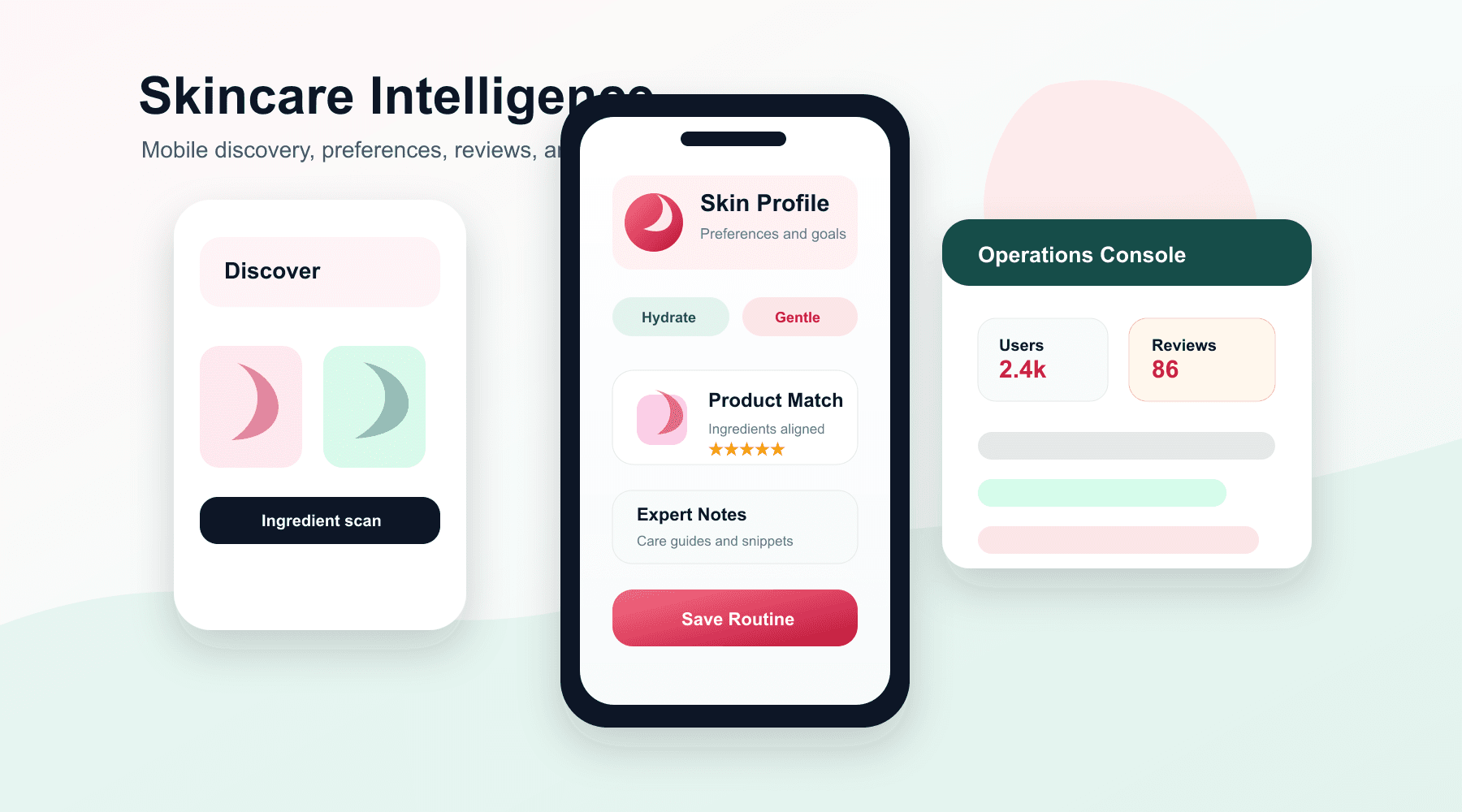
Skincare product intelligence mobile app visual with profile, product match, ingredient preference, review, and admin moderation surfaces
Project scope

Mobile app, admin console, API integration, content workflows, moderation operations, and release support

2
connected product surfaces
5
consumer discovery workflows
3
admin operating modules
Profile-led
recommendation journey

Timeline

Consumer mobile product and operations console delivery

Skincare discovery needed more context than a product list

The product had to help users move from broad beauty browsing into a guided skincare journey shaped by profile details, ingredient preferences, product search, reviews, and educational content.

  • Users needed onboarding that captured skin preferences before product discovery
  • Product search and recommendations had to connect with ingredients, reviews, favorites, and profile state
  • Content snippets and care articles needed a lightweight operating path outside the mobile release cycle
  • Operators needed moderation and account visibility without exposing internal tools to consumers

A profile-led skincare app with an operations layer behind it

DermiVista combines a Flutter mobile experience for discovery and daily use with a React admin console for user oversight, content snippets, and review moderation.

  • Profile setup captures user details and preferred or reactive ingredients before guiding product discovery
  • Mobile product flows cover search, product detail, recommended products, favorites, reviews, and manual additions
  • Blog and snippet content gives operators a way to publish skincare guidance and in-app messaging
  • Admin routes support user lookup, account status, snippet management, and review approval workflows

Product surfaces

What the platform brought together

The work spanned core product operations, daily user workflows, data-heavy coordination, and resilient platform management.

Skin Profile And Preference Setup

The onboarding flow turns skincare context into structured preferences that can shape product discovery.

  • Profile screens collect demographics, contact details, skin-related preference inputs, and ingredient choices
  • Ingredient search and selection flows help users identify ingredients they prefer or want to avoid
  • Saved profile state carries into product discovery, recommendations, and account settings

Product Discovery And Recommendations

The mobile app gives users multiple ways to find relevant skincare products and evaluate fit.

  • Search, product list, product detail, recommended products, and top product sections support browsing intent
  • Product models connect titles, brands, images, descriptions, ingredients, ratings, and preference state
  • Manual product and ingredient-backed discovery paths cover products that are not already in the catalog

Reviews And Trust Signals

Reviews turn product browsing into a feedback loop while giving operators a moderation path.

  • Mobile review submission captures rating, title, and user review context for products
  • Approved review fetching keeps public product pages focused on moderated feedback
  • Admin review queues support pending, approved, and blocked states with search and detail screens

Content And Snippet Operations

Educational content and reusable snippets help the app stay useful beyond pure catalog browsing.

  • Blog feeds and detail views bring skincare education into the mobile app
  • Snippet keys and content records can be searched, edited, and added through the admin console
  • Rich text and reusable content controls keep operational updates separate from app-store releases

Module depth

Dedicated product blocks for the highest-value workflows

For large platforms, the conversion story depends on showing how each major module solves a specific operating problem, not only listing features.

Consumer experience

From Profile To Product Match

The mobile app guides users through profile setup, ingredient selection, product search, recommendations, details, and reviews so skincare discovery feels personal instead of generic.

Supported by Flutter screens for setup profile, ingredient selection, product search, all products, product detail, recommended products, reviews, and profile settings.

  • Profile and preference screens define the user context
  • Search and recommendations turn that context into product discovery
  • Reviews, favorites, and product detail screens help users compare options

Operator experience

Moderation, Users, And Content In One Console

The admin console gives the operations team a practical way to review users, moderate feedback, and maintain app content without entering the mobile codebase.

Supported by React admin routes and services for users, snippets, reviews, pagination, search, role-gated navigation, and API calls.

  • User tables and detail pages support account lookup and status review
  • Review lists include status filters, search, detail views, and moderation actions
  • Snippet lists and forms support reusable in-app content updates

Platform layer

API-backed Mobile Workflows

The product uses service classes, providers, and structured models so authentication, product data, ingredients, reviews, files, and content can evolve without hardcoding every screen.

Supported by mobile providers, API service classes, JSON models, file upload handling, and authenticated request clients.

  • Provider state keeps product, user, blog, preference, and review flows coordinated
  • Dio services wrap authentication, profile, product, ingredient, review, upload, and content endpoints
  • Generated models give the mobile app predictable data contracts for catalog and profile workflows

Buyer priorities

What mattered most to the people evaluating the platform

Prospective buyers want to know whether the work solved real workflow, adoption, reliability, data, and operations problems. These priorities shaped the product decisions.

Personalized discovery

Beauty and skincare products are personal, so the app needed to collect enough user context before recommending or saving products.

  • Profile, ingredient, and preference flows reduce generic browsing
  • Product detail and review surfaces give users comparison signals
  • Search and manual add paths cover both catalog and long-tail product needs

Operational control

Consumer feedback and content both need controls so the product can stay fresh without sacrificing trust.

  • Review moderation separates pending, approved, and blocked content
  • Snippet management supports reusable copy and care guidance
  • User tables give the team account visibility and support context

Mobile retention

The product needed daily-use reasons beyond initial onboarding, including content, recommendations, favorites, profile updates, and notifications.

  • Blog content and snippets create repeat education moments
  • Favorites and saved preferences give users a reason to return
  • Mobile analytics, ads, and issue reporting support iteration after launch

System model

How the platform connects roles, workflows, and product surfaces

The product architecture brings every role into the same operating model, with shared data moving cleanly between web, mobile, media, and notification layers.

Profile to recommendation workflow

A user creates a profile, selects ingredient preferences, searches products, reviews product detail, and saves or rates a match.

Consumer and operator surfaces

The mobile app handles discovery while the admin console manages users, snippets, and review moderation.

Three trust loops

Recommendations, educational content, and moderated reviews each reinforce product confidence.

Technology

The Stack We Used And Why

The stack section is written for buyers who need to understand the product architecture, operational trade-offs, and long-term maintainability of the system.

Mobile app

Used for the consumer skincare experience where cross-platform delivery, product discovery, profile setup, media, and app-store distribution matter.

FlutterDartProviderDioFirebase AuthSharedPreferences

Admin console

Used for the protected operating layer where teams manage users, snippets, reviews, search, pagination, and account support workflows.

ReactTypeScriptMaterial UIReact RouterReact Hook FormAxios

Consumer growth and trust

Used to support login options, product media, app diagnostics, monetization tests, and content-rich skincare education.

Google sign-inApple sign-inFacebook loginImage uploadBug reportingAdMob

Backend and content operations

Used to connect product catalog, ingredients, preferences, reviews, users, snippets, files, and content publishing workflows.

REST APIsJSON modelsMultipart uploadsReview moderationCMS-style snippets

Why Flutter For The Consumer App

The app needed a polished mobile experience across iOS and Android while keeping product discovery logic consistent.

  • Flutter let one codebase handle onboarding, product browsing, reviews, content, and profile flows
  • Provider kept user, product, preference, blog, and review state accessible across screens
  • Native integrations covered sign-in, file/image selection, diagnostics, ads, and mobile packaging

Why A Separate Admin Console

Operations teams needed high-control workflows that would be awkward and risky inside a consumer mobile app.

  • React tables, filters, and detail screens made review and user operations faster
  • Role-gated routes kept admin navigation separate from consumer functionality
  • Snippet forms let the team update reusable content without waiting for mobile releases

Why Content And Moderation Matter

Skincare products need trust signals and educational context, not only catalog records.

  • Blog and snippet flows support guidance around ingredients and routines
  • Review status controls prevent unmoderated feedback from shaping product trust
  • Product and ingredient models make discovery more structured as the catalog grows

Delivery

How the product came together

The work moved from domain modeling to core platform delivery, mobile adoption, and operational hardening.

1

Map The Skincare Journey

Translate a broad beauty app idea into concrete mobile journeys for onboarding, ingredient preferences, product search, recommendations, reviews, and profile updates.

2

Build The Mobile Experience

Implement Flutter screens, providers, models, API services, authentication, upload handling, content feeds, and reusable UI components.

3

Create The Operations Console

Add a React admin panel for users, snippets, and reviews with protected routes, pagination, filters, search, detail views, and API services.

4

Prepare For Release And Iteration

Connect mobile packaging, social sign-in, diagnostics, ads, and content workflows so the product could be maintained after launch.

Operational depth

What made the platform usable after launch

The strongest case studies are not only feature lists. They show how the system is operated, monitored, governed, and improved when real users depend on it.

Review moderation flow

The admin console turns customer feedback into a controlled queue before it influences public product trust.

  • Review list filters by status and supports text search
  • Detail views give operators context before approving or blocking feedback
  • Mobile review endpoints keep product ratings tied to authenticated users

Profile-aware discovery

The mobile app treats user context, ingredients, and preferences as part of discovery rather than optional settings.

  • Ingredient selection is built into profile setup
  • Preference APIs support saved product and ingredient relationships
  • Product detail, search, and recommendation screens share common product models

Content without release bottlenecks

Reusable snippets and blog content give the product team a way to keep education and messaging current.

  • Snippet keys can be managed from the admin console
  • Blog feeds are rendered inside the mobile app
  • Rich content rendering supports more than plain catalog copy

Results

The measurable and observable lift from the work

The strongest improvements are the ones a buyer can connect to daily work: fewer disconnected tools, safer operations, clearer workflows, and more reliable product behavior.

2 surfaces

Product Coverage

A Flutter consumer app and React admin console cover both discovery and operations workflows.

4 data loops

Personalization Inputs

Profile details, ingredient preferences, product actions, and reviews feed the user journey.

3 queues

Admin Modules

Users, snippets, and reviews give operators the core controls needed to maintain trust and content.

Cross-platform

Mobile Delivery

Flutter supported iOS and Android release paths from a shared consumer app codebase.

Outcome

A stronger operating system for skincare discovery and product intelligence mobile app

The platform reduced tool fragmentation and gave each role a clearer path from live activity to day-to-day action.

A cross-platform skincare mobile app for profile setup, ingredient preferences, product search, recommendations, product detail, reviews, blogs, and profile management

A protected admin console for users, snippets, review queues, search, pagination, and detail workflows

API-backed models and provider state for products, ingredients, preferences, reviews, files, content, and authentication

NDA-safe public positioning that describes the finished skincare platform without exposing private repository names, hosts, tokens, source assets, or client identifiers

FAQ

Frequently Asked Questions About DermiVista

Answers about the skincare discovery and product intelligence mobile app scope, platform model, technology choices, operational workflows, and related build patterns.

What Kind Of Skincare App Does This Case Study Represent?

It represents a skincare discovery and product intelligence app with profile setup, ingredient preferences, product search, recommendations, reviews, educational content, and an admin moderation console.

Why Does A Skincare App Need An Admin Console?

A skincare app usually needs operational controls for user support, review moderation, reusable content, snippets, and product trust signals. A separate admin console keeps those workflows away from the consumer app while making them easier for the team to manage.

Can This Pattern Support Beauty Commerce Or Routine Tracking?

Yes. The same foundation can extend into product routines, affiliate commerce, marketplace catalogs, skin goals, reminders, expert content, or brand-managed product data.

What Should A Buyer Prepare Before Building A Similar App?

The most useful inputs are product catalog fields, ingredient taxonomy, preference rules, moderation policy, content model, login requirements, image/upload needs, and the operating workflows the admin team needs after launch.

Related services

Build a similarly ambitious product without starting from a blank page.

We can help scope the web, mobile, AI, media, and operating layers needed for your own platform.

Start a project inquiry